
Palun kasuta seda identifikaatorit viitamiseks ja linkimiseks:
http://elartu.tntu.edu.ua/handle/lib/51485
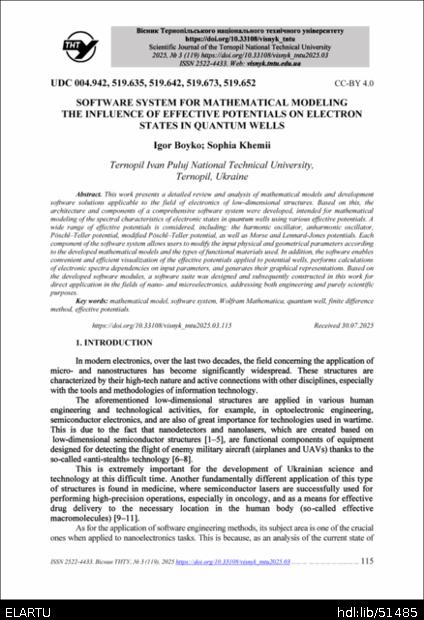
| Pealkiri: | Software system for mathematical modeling the influence of effective potentials on electron states in quantum wells |
| Teised pealkirjad: | Програмна система для математичного моделювання впливу ефективних потенціалів на електронні стани у квантових ямах |
| Autor: | Бойко, Ігор Хемій, Софія Boyko, Igor Khemii, Sophia |
| Affiliation: | Тернопільський національний технічний університет імені Івана Пулюя, Тернопіль, Україна Ternopil Ivan Puluj National Technical University, Ternopil, Ukraine |
| Bibliographic description (Ukraine): | Boyko I. Software system for mathematical modeling the influence of effective potentials on electron states in quantum wells / Igor Boyko, Sophia Khemii // Scientific Journal of TNTU. — Tern. : TNTU, 2025. — Vol 119. — No 3. — P. 115–126. |
| Bibliographic reference (2015): | Boyko I., Khemii S. Software system for mathematical modeling the influence of effective potentials on electron states in quantum wells // Scientific Journal of TNTU, Ternopil. 2025. Vol 119. No 3. P. 115–126. |
| Bibliographic citation (APA): | Boyko, I., & Khemii, S. (2025). Software system for mathematical modeling the influence of effective potentials on electron states in quantum wells. Scientific Journal of the Ternopil National Technical University, 119(3), 115-126. TNTU.. |
| Bibliographic citation (CHICAGO): | Boyko I., Khemii S. (2025) Software system for mathematical modeling the influence of effective potentials on electron states in quantum wells. Scientific Journal of the Ternopil National Technical University (Tern.), vol. 119, no 3, pp. 115-126. |
| Is part of: | Вісник Тернопільського національного технічного університету, 3 (119), 2025 Scientific Journal of the Ternopil National Technical University, 3 (119), 2025 |
| Journal/Collection: | Вісник Тернопільського національного технічного університету |
| Issue: | 3 |
| Volume: | 119 |
| Ilmumisaasta: | 29-aug-2025 |
| Submitted date: | 30-juu-2025 |
| Date of entry: | 9-vee-2026 |
| Kirjastaja: | ТНТУ TNTU |
| Place of the edition/event: | Тернопіль Ternopil |
| DOI: | https://doi.org/10.33108/visnyk_tntu2025.03.115 |
| UDC: | 004.942 519.635 519.642 519.673 519.652 |
| Märksõnad: | математична модель програмна система Wolfram Mathematica квантова яма метод скінченних різниць ефективні потенціали mathematical model software system Wolfram Mathematica quantum well finite difference method effective potentials |
| Number of pages: | 12 |
| Page range: | 115-126 |
| Start page: | 115 |
| End page: | 126 |
| Kokkuvõte: | Представлено розгорнутий огляд сучасного стану досліджень та аналіз математичних моделей, які використовуються для описування електронних процесів у низьковимірних структурах,
зокрема у квантових ямах. Особливу увагу приділено розробленню програмних рішень, що забезпечують точне та ефективне математичне моделювання спектральних характеристик електронних станів із
застосуванням широкого спектру ефективних потенціалів. У межах дослідження розроблено архітектуру програмного комплексу, який поєднує в собі функціональність для виконання обчислювальних
експериментів, зміни параметрів моделей та візуалізації результатів. Розглянуто такі типи ефективних потенціалів, як гармонійний осцилятор, ангармонійний осцилятор, потенціал Пешля–Теллера,
модифікований потенціал Пешля–Теллера, потенціал Морзе, потенціал Леннарда-Джонса. Ці потенціали широко застосовуються в квантовій механіці для описування взаємодії частинок у системах з
обмеженнями розмірності. Реалізовані в програмному середовищі алгоритми дозволяють користувачам змінювати фізичні параметри (наприклад, масу частинок, глибину потенціальної ями, її ширину), а
також геометричні характеристики системи, що моделюється, відповідно до конкретного типу наноструктури чи матеріалу. Однією з ключових особливостей програмного комплексу є зручний
інтерфейс для інтерактивної побудови графіків ефективних потенціалів та спектральних ліній електронних станів. Система також забезпечує чисельне розв’язання відповідних рівнянь Шредінгера з
урахуванням вхідних параметрів і генерацію результатів у вигляді графіків, таблиць та інших форматів, придатних для подальшого аналізу. Важливим етапом стало тестування працездатності комплексу на
основі прикладів реальних фізичних систем і порівняння отриманих результатів із теоретичними прогнозами та літературними даними. Завдяки модульній структурі, програмний комплекс може бути
розширений новими моделями або адаптований до інших типів потенціалів та умов. У підсумку, створена програмна система є універсальним інструментом для дослідників і розробників, які працюють у галузі
мікро- та наноелектроніки, оскільки дозволяє не лише проводити точні розрахунки спектральних характеристик електронних станів у квантових ямах, але й служити освітнім та науковим засобом для
вивчення поведінки електронів у різних потенціальних конфігураціях This work presents a detailed review and analysis of mathematical models and development software solutions applicable to the field of electronics of low-dimensional structures. Based on this, the architecture and components of a comprehensive software system were developed, intended for mathematical modeling of the spectral characteristics of electronic states in quantum wells using various effective potentials. A wide range of effective potentials is considered, including: the harmonic oscillator, anharmonic oscillator, Pöschl–Teller potential, modified Pöschl–Teller potential, as well as Morse and Lennard-Jones potentials. Each component of the software system allows users to modify the input physical and geometrical parameters according to the developed mathematical models and the types of functional materials used. In addition, the software enables convenient and efficient visualization of the effective potentials applied to potential wells, performs calculations of electronic spectra dependencies on input parameters, and generates their graphical representations. Based on the developed software modules, a software suite was designed and subsequently constructed in this work for direct application in the fields of nano- and microelectronics, addressing both engineering and purely scientific purposes |
| URI: | http://elartu.tntu.edu.ua/handle/lib/51485 |
| ISSN: | 2522-4433 |
| Copyright owner: | © Ternopil Ivan Puluj National Technical University, 2025 |
| URL for reference material: | https://doi.org/10.1016/j.apsusc.2024.161153 https://doi.org/10.1016/j.applthermaleng.2024.123659 https://doi.org/10.1016/j.jscs.2024.101941 https://doi.org/10.1016/j.optlastec.2024.111189 https://doi.org/10.1016/j.optlastec.2024.111360 https://doi.org/10.1016/j.cej.2024.152275 https://doi.org/10.1016/j.cej.2024.150094 https://doi.org/10.1016/j.ceramint.2024.03.226 https://doi.org/10.1016/j.ijbiomac.2024.130634 https://doi.org/10.1016/j.theriogenology.2022.08.032 https://doi.org/10.1016/j.nano.2018.10.004 https://doi.org/10.1016/S0022-0248(97)00313-8 https://doi.org/10.1016/j.ijrefrig.2024.09.005 https://www.nextnano.de/products/overview.php https://engineering.purdue.edu/gekcogrp/software-projects/nemo3D/ https://doi.org/10.1063/1.3512981 https://doi.org/10.1016/S0021-9991(03)00268-7 https://doi.org/10.1007/s40820-023-01017-5 https://doi.org/10.33108/visnyk_tntu2017.03.134 |
| References (International): | 1. Wang S., Zhou X., Zheng J. (2025) Optimization of GeSn nanostructures via tuning of femtosecond laser parameters. Appl. Surf. Sci, vol. 679, pp. 161153. https://doi.org/10.1016/j.apsusc.2024.161153 2. Li K., Wang C., Sun L. (2024) Laser-assisted electrohydrodynamic jet printing of hierarchical nanostructure. Appl. Therm. Eng, vol. 253, pp. 123659. https://doi.org/10.1016/j.applthermaleng.2024.123659 3. Labis J. P., Albrithen H. A., Shar M. A. 2024() Synthesis of Sn-ZnO nanostructures on MgO<0001> by hybrid pulsed laser ablation and RF magnetron sputtering tandem system for CO gas-sensing application. J. Saudi Chem. Soc, vol. 28, pp. 101941. https://doi.org/10.1016/j.jscs.2024.101941 4 Liu J., Jiang Q., Yan J., Geng J., Shi L. (2024) Femtosecond pulse train-facilitated periodic nanostructuring on TiN films via laser-oxidation. Opt. Laser Technol, vol. 177, pp. 111189. https://doi.org/10.1016/j.optlastec.2024.111189 5. Solana I., Chacon-Sanchez F., Garcia-Lechuga M., Siegel J. (2024) Versatile femtosecond laser interference patterning applied to high-precision nanostructuring of silicon. Opt. Laser Technol, vol. 179, pp. 111360. https://doi.org/10.1016/j.optlastec.2024.111360 6. Cao K., Ye W., Zhang Y. (2024) Fabrication of multifunctional Co,N co-doped UIO-rGO aerogel with properties of hydrophobic, anti-corrosion, heat insulation, infrared stealth and electromagnetic wave absorption, Chem. Eng. J, vol. 492, pp. 152275. https://doi.org/10.1016/j.cej.2024.152275 7. Ling Z., Chen J., Li S. (2024) A multi-band stealth and anti-interference superspeed light-guided swimming robot based on multiscale bicontinuous three-dimensional network. Chem. Eng. J, vol. 485, pp. 150094. https://doi.org/10.1016/j.cej.2024.150094 8. Zhang Y., Zhang G., Wang C. (2024) The construction of structural defects in MoAlB thin films by leveraging the enhanced Kirkendall effect for improved infrared stealth performance. Ceram. Int, vol. 50, pp. 21175–21183. https://doi.org/10.1016/j.ceramint.2024.03.226 9. Zanata S. M., El-Shafai N. M., Beltagi A. M. (2024) Bio-study: Modeling of natural nanomolecules as a nanocarrier surface for antioxidant and glucose biosensor. Int. J. Biol. Macromol, vol. 264, pp. 130634. https://doi.org/10.1016/j.ijbiomac.2024.130634 10. Feugang J. M., Ishak G. M., Eggert M. W. (2022) Intrafollicular injection of nanomolecules for advancing knowledge on folliculogenesis in livestock. Theriogenology, vol. 192, pp. 132–140. https://doi.org/10.1016/j.theriogenology.2022.08.032 11. Li X., Wu M., Wang J. (2019) Ultrasmall bimodal nanomolecules enhanced tumor angiogenesis contrast with endothelial cell targeting and molecular pharmacokinetics. Nanomedicin, vol. 15, pp. 252–263. https://doi.org/10.1016/j.nano.2018.10.004 12. Santailler J. L., Duffar T., Théodore F. (1997) Some features of two commercial softwares for the modeling of bulk crystal growth processes. J. Cryst. Growth, vol. 180, pp. 698–710. https://doi.org/10.1016/S0022-0248(97)00313-8 13. Leng D., Li P., Kong F. (2024) Experimental and numerical study on single ice crystal growth of deionized water and 0.9% NaCl solution under static magnetic field. Int. J. Refrig, vol. 168, pp. 297–306. https://doi.org/10.1016/j.ijrefrig.2024.09.005 14. NextNano Software. URL: https://www.nextnano.de/products/overview.php 15. NEMO–3D. URL: https://engineering.purdue.edu/gekcogrp/software-projects/nemo3D/ 16. Cooper J. D., Valavanis A., Ikonić Z., Harrison P., Cunningham J. E. (2010) Finite difference method for solving the Schrödinger equation with band nonparabolicity in mid-infrared quantum cascade lasers. J. Appl. Phys, vol. 168, pp. 297–306. https://doi.org/10.1063/1.3512981 17. Wang W., Hwang T.-M., Lin W.-W., Liu J.-L. (2003) Numerical methods for semiconductor heterostructures with band nonparabolicity. J. Comput. Phys, vol. 108, pp. 113109. https://doi.org/10.1016/S0021-9991(03)00268-7 18. Xue T., Yang Y., Yu D., Wali Q. (2023) 3D Printed Integrated Gradient-Conductive MXene/CNT/Polyimide Aerogel Frames for Electromagnetic Interference Shielding with Ultra-Low Reflection. Nano-Micro Lett, vol. 15, p. 45. https://doi.org/10.1007/s40820-023-01017-5 19. Boiko I., Petryk M., Mykhalyk D. (2017) Model of nanoporous medium with charged impurities // Sci. J. TNTU, vol. 87, no. 3, pp. 134–138. https://doi.org/10.33108/visnyk_tntu2017.03.134 |
| Content type: | Article |
| Asub kollektsiooni(de)s: | Вісник ТНТУ, 2025, № 3 (119) |
Failid selles objektis:
| Fail | Kirjeldus | Suurus | Formaat | |
|---|---|---|---|---|
| TNTUSJ_2025v119n3_Boyko_I-Software_system_for_mathematical_115-126.pdf | 4,1 MB | Adobe PDF | Vaata/Ava | |
| TNTUSJ_2025v119n3_Boyko_I-Software_system_for_mathematical_115-126__COVER.png | 1,24 MB | image/png | Vaata/Ava |
Kõik teosed on Dspaces autoriõiguste kaitse all.