
Utilizza questo identificativo per citare o creare un link a questo documento:
http://elartu.tntu.edu.ua/handle/lib/52424
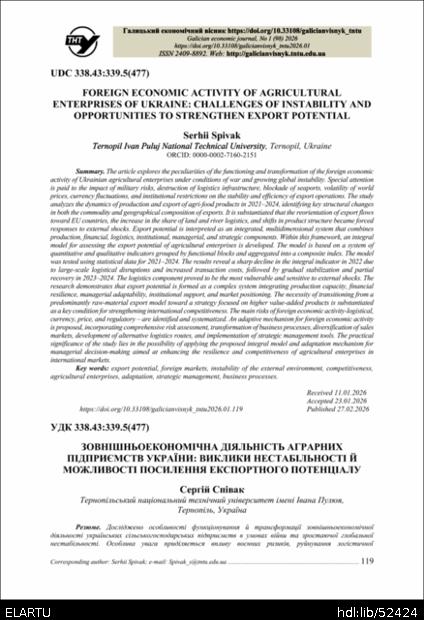
| Titolo: | Зовнішньоекономічна діяльність аграрних підприємств України: виклики нестабільності й можливості посилення експортного потенціалу |
| Titoli alternativi: | Foreign economic activity of agricultural enterprises of Ukraine: challenges of instability and opportunities to strengthen export potential |
| Autori: | Співак, Сергій Михайлович Spivak, Serhii |
| Affiliation: | Тернопільський національний технічний університет імені Івана Пулюя, Тернопіль, Україна Ternopil Ivan Puluj National Technical University, Ternopil, Ukraine |
| Bibliographic description (Ukraine): | Співак С. М. Зовнішньоекономічна діяльність аграрних підприємств України: виклики нестабільності й можливості посилення експортного потенціалу / Співак Сергій Михайлович // ГЕВ. — Т. : ТНТУ, 2026. — Том 98. — № 1. — С. 119–127. — (Менеджмент). |
| Bibliographic reference (2015): | Співак С. М. Зовнішньоекономічна діяльність аграрних підприємств України: виклики нестабільності й можливості посилення експортного потенціалу // ГЕВ, Тернопіль. 2026. Том 98. № 1. С. 119–127. |
| Bibliographic citation (APA): | Spivak, S. (2026). Zovnishnoekonomichna diialnist ahrarnykh pidpryiemstv Ukrainy: vyklyky nestabilnosti y mozhlyvosti posylennia eksportnoho potentsialu [Foreign economic activity of agricultural enterprises of Ukraine: challenges of instability and opportunities to strengthen export potential]. Galician economic journal, 98(1), 119-127. TNTU. [in Ukrainian]. |
| Bibliographic citation (CHICAGO): | Spivak S. (2026) Zovnishnoekonomichna diialnist ahrarnykh pidpryiemstv Ukrainy: vyklyky nestabilnosti y mozhlyvosti posylennia eksportnoho potentsialu [Foreign economic activity of agricultural enterprises of Ukraine: challenges of instability and opportunities to strengthen export potential]. Galician economic journal (Tern.), vol. 98, no 1, pp. 119-127 [in Ukrainian]. |
| Is part of: | Галицький економічний вісник, 1 (98), 2026 Galician economic journal, 1 (98), 2026 |
| Journal/Collection: | Галицький економічний вісник |
| Issue: | 1 |
| Volume: | 98 |
| Data: | 29-gen-2026 |
| Submitted date: | 27-feb-2026 |
| Date of entry: | 15-giu-2026 |
| Editore: | ТНТУ TNTU |
| Place of the edition/event: | Тернопіль Ternopil |
| DOI: | https://doi.org/10.33108/galicianvisnyk_tntu2026.01.119 |
| UDC: | 338.43 339.5(477) |
| Parole chiave: | експортний потенціал зовнішні ринки нестабільність зовнішнього середовища конкурентоспроможність агропідприємства адаптація стратегічне управління бізнес-процеси export potential foreign markets instability of the external environment competitiveness agricultural enterprises adaptation strategic management business processes |
| Number of pages: | 9 |
| Page range: | 119-127 |
| Start page: | 119 |
| End page: | 127 |
| Abstract: | Досліджено особливості функціонування й трансформації зовнішньоекономічної
діяльності українських сільськогосподарських підприємств в умовах війни та зростаючої глобальної
нестабільності. Особлива увага приділяється впливу воєнних ризиків, руйнування логістичної
інфраструктури, блокади морських портів, волатильності світових цін, коливань валютних курсів та
інституційних обмежень на стабільність та ефективність експортних операцій. Проаналізовано
динаміку виробництва та експорту агропродовольчої продукції у 2021–2024 роках, визначено ключові
структурні зміни як у товарному, так і в географічному складі експорту. Обґрунтовано, що
переорієнтація експортних потоків у бік країн ЄС, збільшення частки сухопутної та річкової логістики,
а також зрушення в структурі продукції стали вимушеними відповідями на зовнішні шоки. Експортний
потенціал трактується як інтегрована, багатовимірна система, що поєднує виробничу, фінансову,
логістичну, інституційну, управлінську та стратегічну складові. У цих рамках розроблено інтегральну
модель оцінювання експортного потенціалу сільськогосподарських підприємств. Модель базується на
системі кількісних та якісних показників, згрупованих за функціональними блоками та агрегованих у
композитний індекс. Модель була протестована з використанням статистичних даних за 2021–2024
роки. Результати дослідження демонструють різке зниження інтегрального показника у 2022 році через
масштабні логістичні збої та зростання трансакційних витрат, а потім поступову стабілізацію та
часткове відновлення у 2023–2024 роках. Логістична складова виявилася найбільш вразливою та
чутливою до зовнішніх шоків. Дослідження демонструє, що експортний потенціал формується як складна
система, що інтегрує виробничі потужності, фінансову стійкість, управлінську адаптивність, інституційну
підтримку та позиціонування на ринку. Обґрунтовано необхідність переходу від переважно сировинної
експортної моделі до стратегії, орієнтованої на продукцію з вищою доданою вартістю, як ключову умову
посилення міжнародної конкурентоспроможності. Визначено та систематизовано основні ризики
зовнішньоекономічної діяльності – логістичний, валютний, ціновий та регуляторний. Запропоновано
адаптивний механізм зовнішньоекономічної діяльності, що включає комплексне оцінювання ризиків,
трансформацію бізнес-процесів, диверсифікацію ринків збуту, розвиток альтернативних логістичних
маршрутів та впровадження інструментів стратегічного управління. Практичне значення дослідження
полягає в можливості застосування запропонованої інтегральної моделі та механізму адаптації для
прийняття управлінських рішень, спрямованих на підвищення стійкості й конкурентоспроможності
сільськогосподарських підприємств на міжнародних ринках. The article explores the peculiarities of the functioning and transformation of the foreign economic activity of Ukrainian agricultural enterprises under conditions of war and growing global instability. Special attention is paid to the impact of military risks, destruction of logistics infrastructure, blockade of seaports, volatility of world prices, currency fluctuations, and institutional restrictions on the stability and efficiency of export operations. The study analyzes the dynamics of production and export of agri-food products in 2021–2024, identifying key structural changes in both the commodity and geographical composition of exports. It is substantiated that the reorientation of export flows toward EU countries, the increase in the share of land and river logistics, and shifts in product structure became forced responses to external shocks. Export potential is interpreted as an integrated, multidimensional system that combines production, financial, logistics, institutional, managerial, and strategic components. Within this framework, an integral model for assessing the export potential of agricultural enterprises is developed. The model is based on a system of quantitative and qualitative indicators grouped by functional blocks and aggregated into a composite index. The model was tested using statistical data for 2021–2024. The results reveal a sharp decline in the integral indicator in 2022 due to large-scale logistical disruptions and increased transaction costs, followed by gradual stabilization and partial recovery in 2023–2024. The logistics component proved to be the most vulnerable and sensitive to external shocks. The research demonstrates that export potential is formed as a complex system integrating production capacity, financial resilience, managerial adaptability, institutional support, and market positioning. The necessity of transitioning from a predominantly raw-material export model toward a strategy focused on higher value-added products is substantiated as a key condition for strengthening international competitiveness. The main risks of foreign economic activity-logistical, currency, price, and regulatory – are identified and systematized. An adaptive mechanism for foreign economic activity is proposed, incorporating comprehensive risk assessment, transformation of business processes, diversification of sales markets, development of alternative logistics routes, and implementation of strategic management tools. The practical significance of the study lies in the possibility of applying the proposed integral model and adaptation mechanism for managerial decision-making aimed at enhancing the resilience and competitiveness of agricultural enterprises in international markets. |
| URI: | http://elartu.tntu.edu.ua/handle/lib/52424 |
| ISSN: | 2409-8892 |
| Copyright owner: | © Тернопільський національний технічний університет імені Івана Пулюя, 2026 |
| URL for reference material: | https://kse.ua/wp-content/uploads/2025/06/Petrenko-Oleksandr-BE25-THE-IMPACT-OF-THE-FULL-SCALE-WAR-ON-AGRICULTURAL-PERFORMANCE-IN-UKRAINE https://ukraineworld.org/en/articles/analysis/geopolitics-grain-ukraines-role https://doi.org/10.4060/cd2144en https://doi.org/10.1002/aepp.13468 https://doi.org/10.15407/economyukr.2021.04.051 https://doi.org/10.32782/2524-0072/2025-77-37 http://documents.worldbank.org/curated/en/099062524074539069 https://stat.gov.ua/uk https://doi.org/10.32317/ekon.apk/2.2025.50 https://kse.ua/wp-content/uploads/2025/06/Petrenko-Oleksandr-BE25-THE-IMPACT-OF-THE-FULL-SCALE-WAR-ON-AGRICULTURAL-PERFORMANCE-IN-UKRAINE.pdf |
| References (Ukraine): | 1. Petrenko O. The impact of the full-scale war on agricultural performance in Ukraine. Social Sciences Department Kyiv School of Economics. 2025. URL: https://kse.ua/wp-content/uploads/2025/06/Petrenko-Oleksandr-BE25-THE-IMPACT-OF-THE-FULL-SCALE-WAR-ON-AGRICULTURAL-PERFORMANCE-IN-UKRAINE. pdf (дата звернення: 05.02.2026). 2. Synhaievska D. The Geopolitics of Grain: Ukraine’s Role in Global Food Security and the Costs of War. UkraineWorld. June 27, 2025. URL: https://ukraineworld.org/en/articles/analysis/geopolitics-grain-ukraines-role (дата звернення: 05.02.2026). 3. FAO. 2024. The State of Agricultural Commodity Markets 2024 – Trade and nutrition: Policy coherence for healthy diets. Rome. DOI: https://doi.org/10.4060/cd2144en 4. Countryman A. M., Litvinov V., Kolodiazhnyi I., Bogonos M., Nivievskyi O. Global economic effects of war-induced agricultural export declines from Ukraine. Applied Economic Perspectives and Policy. 2025. Vol. 47. No. 2. P. 624–665. DOI: https://doi.org/10.1002/aepp.13468 5. Шубравська O. Спеціалізація агропродовольчого експорту україни: тенденції, драйвери, перспективи. Економіка України. 2021. 64 (4 (713). C. 51–67. DOI: https://doi.org/10.15407/economyukr.2021.04.051 6. Файчук О., Коноплястий А. Формування стратегічних напрямів розвитку зовнішньоекономічної діяльності сільськогосподарського підприємства в умовах євроінтеграції (на прикладі агрохолдингу «Астарта»). Економіка та суспільство. 2025. № 77. DOI: https://doi.org/10.32782/2524-0072/2025-77-37 7. World Bank. Україна: Вплив війни на рентабельність сільського господарства – Проблема номер один (Ukrainian). Washington, D.C. : World Bank Group. URL: http://documents.worldbank.org/curated/en/099062524074539069 (дата звернення: 05.02.2026). 8. Porter M. E. Competitive Advantage: Creating and Sustaining Superior Performance. New York: Free Press, 2008. 9. Державна служба статистики України. 2025. URL: https://stat.gov.ua/uk (дата звернення: 05.02.2026). 10. Cheremisina S., Rossokha V., Selinnyi M., Balan O., Nahornyi V. Assessment of structural changes in exports and price situation on the Ukrainian grain market during the war. Ekonomika APK. 2025. Vol. 32. No. 2. P. 50–62. DOI: https://doi.org/10.32317/ekon.apk/2.2025.50 |
| References (International): | 1. Petrenko O. (2025) The impact of the full-scale war on agricultural performance in Ukraine. Social Sciences Department Kyiv School of Economics. Available at: https://kse.ua/wp-content/uploads/2025/06/Petrenko-Oleksandr-BE25-THE-IMPACT-OF-THE-FULL-SCALE-WAR-ON-AGRICULTURAL-PERFORMANCE-IN-UKRAINE.pdf (accessed: 5 February 2026). 2. Synhaievska D. (2025)The Geopolitics of Grain: Ukraine’s Role in Global Food Security and the Costs of War. UkraineWorld. June 27. Available at: https://ukraineworld.org/en/articles/analysis/geopolitics-grain-ukraines-role (accessed: 5 February 2026). 3. FAO. 2024. The State of Agricultural Commodity Markets 2024 – Trade and nutrition: Policy coherence for healthy diets. Rome. DOI: https://doi.org/10.4060/cd2144en 4. Countryman A. M., Litvinov V., Kolodiazhnyi I., Bogonos M., Nivievskyi O. (2025) Global economic effects of war-induced agricultural export declines from Ukraine. Applied Economic Perspectives and Policy, vol. 47, no. 2. pp. 624–665. DOI: https://doi.org/10.1002/aepp.13468 5. Shubravska O. (2021) Specialization of agri-food exports of Ukraine: trends, drivers, prospects. Economy of Ukraine, 64 (4 (713), pp. 51–67. DOI: https://doi.org/10.15407/economyukr.2021.04.051 6. Faychuk O., Konoplyastyi A. (2025) Formation of strategic directions for the development of foreign economic activity of an agricultural enterprise in the conditions of European integration (on the example of the agricultural holding “Astarta”). Economy and society, no. 77. DOI: https://doi.org/10.32782/2524-0072/2025-77-37 7. World Bank. Ukraine: The impact of the war on agricultural profitability – Problem number one (Ukrainian). Washington, D.C. World Bank Group. Available at: http://documents.worldbank.org/curated/en/099062524074539069 (accessed: 5 February 2026). 8. Porter M. E. (2008) Competitive Advantage: Creating and Sustaining Superior Performance. New York: Free Press. 9. State Statistics Service of Ukraine. 2025. Available at: https://stat.gov.ua/uk (accessed: 5 February 2026). 10. Cheremisina S., Rossokha V., Selinnyi M., Balan O., Nahornyi V. (2025) Assessment of structural changes in exports and price situation on the Ukrainian grain market during the war. Ekonomika APK, vol. 32, no. 2, pp. 50–62. DOI: https://doi.org/10.32317/ekon.apk/2.2025.50 |
| Content type: | Article |
| È visualizzato nelle collezioni: | Галицький економічний вісник, 2026, № 1 (98) |
File in questo documento:
| File | Descrizione | Dimensioni | Formato | |
|---|---|---|---|---|
| GEJ_2026v98n1_Spivak_S-Foreign_economic_activity_119-127.pdf | 3 MB | Adobe PDF | Visualizza/apri | |
| GEJ_2026v98n1_Spivak_S-Foreign_economic_activity_119-127__COVER.png | 1,31 MB | image/png | Visualizza/apri |
Tutti i documenti archiviati in DSpace sono protetti da copyright. Tutti i diritti riservati.