
Bitte benutzen Sie diese Kennung, um auf die Ressource zu verweisen:
http://elartu.tntu.edu.ua/handle/lib/51941
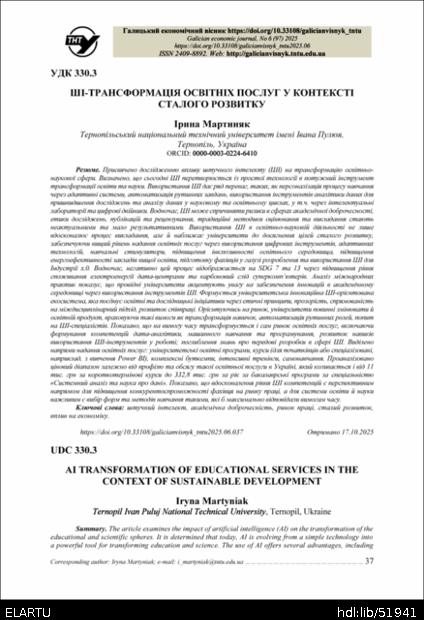
| Titel: | Ші-трансформація освітніх послуг у контексті сталого розвитку |
| Sonstige Titel: | Ai transformation of educational services in the context of sustainable development |
| Autor(en): | Мартиняк, Ірина Олександрівна Martyniak, Iryna |
| Affiliation: | Тернопільський національний технічний університет імені Івана Пулюя, Тернопіль, Україна Ternopil Ivan Puluj National Technical University, Ternopil, Ukraine |
| Bibliographic description (Ukraine): | Мартиняк І. О. Ші-трансформація освітніх послуг у контексті сталого розвитку / Мартиняк Ірина Олександрівна // ГЕВ. — Т. : ТНТУ, 2025. — Том 97. — № 6. — С. 37–45. — (Економіка та міжнародні економічні відносини). |
| Bibliographic reference (2015): | Мартиняк І. О. Ші-трансформація освітніх послуг у контексті сталого розвитку // ГЕВ, Тернопіль. 2025. Том 97. № 6. С. 37–45. |
| Bibliographic citation (APA): | Martyniak, I. (2025). Shi-transformatsiia osvitnikh posluh u konteksti staloho rozvytku [Ai transformation of educational services in the context of sustainable development]. Galician economic journal, 97(6), 37-45. TNTU. [in Ukrainian]. |
| Bibliographic citation (CHICAGO): | Martyniak I. (2025) Shi-transformatsiia osvitnikh posluh u konteksti staloho rozvytku [Ai transformation of educational services in the context of sustainable development]. Galician economic journal (Tern.), vol. 97, no 6, pp. 37-45 [in Ukrainian]. |
| Is part of: | Галицький економічний вісник, 6 (97), 2025 Galician economic journal, 6 (97), 2025 |
| Journal/Collection: | Галицький економічний вісник |
| Issue: | 6 |
| Volume: | 97 |
| Erscheinungsdatum: | 18-Nov-2025 |
| Submitted date: | 17-Okt-2025 |
| Date of entry: | 9-Mär-2026 |
| Herausgeber: | ТНТУ TNTU |
| Place of the edition/event: | Тернопіль Ternopil |
| DOI: | https://doi.org/10.33108/galicianvisnyk_tntu2025.06.037 |
| UDC: | 330.3 |
| Stichwörter: | штучний інтелект академічна доброчесність ринок праці сталий розвиток вплив на економіку artificial intelligence academic integrity labour market sustainable development economic impact |
| Number of pages: | 9 |
| Page range: | 37-45 |
| Start page: | 37 |
| End page: | 45 |
| Zusammenfassung: | Присвячено дослідженню впливу штучного інтелекту (ШІ) на трансформацію освітньо-
наукової сфери. Визначено, що сьогодні ШІ перетворюється із простої технології в потужний інструмент
трансформації освіти та науки. Використання ШІ дає ряд переваг, таких, як персоналізація процесу навчання
через адаптивні системи, автоматизація рутинних завдань, використання інструментів аналітики даних для
пришвидшення досліджень та аналізу даних у науковому та освітньому циклах, у т.ч. через інтелектуальні
лабораторії та цифрові двійники. Водночас, ШІ може спричиняти ризики в сферах академічної доброчесності,
етики досліджень, публікацій та рецензування, традиційні методики оцінювання та викладання стають
неактуальними та мало результативними. Використання ШІ в освітньо-науковій діяльності не лише
вдосконалює процес викладання, але й наближає університети до досягнення цілей сталого розвитку,
забезпечуючи вищий рівень надання освітніх послуг через використання цифрових інструментів, адаптивних
технологій, навчальні стимулятори, підвищення інклюзивності освітнього середовища, підвищення
енергоефективності закладів вищої освіти, підготовку фахівців у галузі розроблення та використання ШІ для
Індустрії х.0. Водночас, негативно цей процес відображається на SDG 7 та 13 через підвищення рівня
споживання електроенергії дата-центрами та карбоновий слід суперкомп’ютерів. Аналіз міжнародних
практик показує, що провідні університети акцентують увагу на забезпечення інновацій в академічному
середовищі через використання інструментів ШІ. Формується університетська інноваційна ШІ-орієнтована
екосистема, яка поєднує освітні та дослідницькі ініціативи через етичні принципи, прозорість, спрямованість
на міждисциплінарний підхід, розвиток співпраці. Орієнтуючись на ринок, університети повинні змінювати й
освітній продукт, враховуючи такі вимоги як трансформація навичок, автоматизація рутинних ролей, попит
на ШІ-спеціалістів. Показано, що на вимогу часу трансформується і сам ринок освітніх послуг, включаючи
формування компетенцій дата-аналітики, машинного навчання та програмування, розвиток навиків
використання ШІ-інструментів у роботі; поглиблення знань про передові розробки в сфері ШІ. Виділено
напрями надання освітніх послуг: університетські освітні програми, курси (для початківців або спеціалізовані,
наприклад, з вивчення Power BI), комплексні буткемпи, інтенсивні тренінги, самонавчання. Проаналізовано
ціновий діапазон залежно від профілю та обсягу такої освітньої послуги в Україні, який коливається і від 11
тис. грн за короткотермінові курси до 332,8 тис. грн за рік за бакалаврські програми за спеціальністю
«Системний аналіз та наука про дані». Показано, що вдосконалення рівня ШІ компетенцій є перспективним
напрямом для підвищення конкурентоспроможності фахівця на ринку праці, а для системи освіти й науки
важливим є вибір форм та методів навчання такими, які б максимально відповідали вимогам часу. The article examines the impact of artificial intelligence (AI) on the transformation of the educational and scientific spheres. It is determined that today, AI is evolving from a simple technology into a powerful tool for transforming education and science. The use of AI offers several advantages, including personalization of the learning process through adaptive systems, automation of routine tasks, and the utilisation of data analytics tools to integrate research and data analysis into scientific and educational cycles, such as those facilitated by intelligent laboratories and digital twins. At the same time, AI can pose risks in areas such as academic integrity, research ethics, publications, and peer review; traditional assessment and teaching methods become irrelevant and ineffective. The use of AI in educational and scientific activities not only improves the teaching process, but also brings universities closer to achieving sustainable development goals, ensuring a higher level of educational services through the use of digital tools, adaptive technologies, learning stimulators, increasing the inclusiveness of the educational environment, increasing the energy efficiency of higher education institutions, training specialists in the development and use of AI for Industry x.0. At the same time, this process negatively affects SDG 7 and 13 due to the increase in electricity consumption by data centres and the carbon footprint of supercomputers. Analysis of international practices reveals that leading universities prioritise innovation in the academic environment by leveraging AI tools. A universityʼs innovative AI-oriented ecosystem is being formed, which combines educational and research initiatives through ethical principles, transparency, a focus on interdisciplinary approaches, and the development of cooperation. Focusing on the market, universities must also adapt their educational products, taking into account requirements such as skill transformation, automation of routine roles, and the demand for AI specialists. It is shown that the educational services market itself is transforming in response to the demands of the time, including the formation of data analytics, machine learning, and programming competencies, the development of skills in using AI tools in the workplace, and a deepening of knowledge about advanced developments in the field of AI. The following areas of educational services are highlighted: university educational programs, courses (for beginners or specialised, such as those on studying Power BI), comprehensive boot camps, intensive training, and self-study. The price range, depending on the profile and volume of such educational services in Ukraine, was analysed, which ranges from 11,000 UAH for short-term courses to 332,800 UAH per year for bachelorʼs programs in the speciality «Systems Analysis and Data Science». It is demonstrated that enhancing the level of AI competencies is a promising approach to increasing a specialistʼs competitiveness in the labour market. For the education and science system, it is crucial to select training forms and methods that most effectively meet the current requirements. |
| URI: | http://elartu.tntu.edu.ua/handle/lib/51941 |
| ISSN: | 2409-8892 |
| Copyright owner: | © Тернопільський національний технічний університет імені Івана Пулюя, 2025 |
| URL for reference material: | https://artificialintelligenceact.eu/ https://www.coe.int/en/web/artificial-intelligence/the-framework-convention-on-artificial-intelligence https://ease.org.uk/2024/09/recommendations-on-the-use-of-ai-in-scholarly-communication/ https://uit.stanford.edu/security/responsibleai https://www.csis.org/analysis/sen-chuck-schumer-launches-safe-innovation-ai-age-csis https://www.innopharmaeducation.com/blog/the-impact-of-ai-on-job-roles-workforce-and-employment-what-you-need-to-know https://civilrights.org/wp-content/uploads/2025/05/The-Innovation-Framework.pdf https://www.researchgate.net/publication/382921122_VPLIV_SI-TEHNOLOGIJ_NA_STALIJ_ROZVITOK_FIRM https://backend.hromada.gov.ua/storage/uploads/files/research/bila-kniga-z-regulyuvannya-si-v-ukrayini-bacennya-mincifri/%D0%A0%D0%B5%D0%B3%D1%83%D0%BB%D1%8E%D0%B2%D0%B0%D0%BD%D0%BD%D1%8F%20%D0%A8%D0%86.pdf?time=1744806741842 https://doi.org/10.28925/2312-5829.2024.15 https://www.pwc.com/ua/uk/survey/2025/vykorystannya-shtuchnoho-intelektu-vplyv-na-rynok-pratsi.html https://mon.gov.ua/news/shtuchnyi-intelekt-u-zakladakh-vyshchoi-osvity-rekomendatsii-dlia-vykladachiv-studentiv-i-pratsivnykiv-zvo https://osvita.ua/consultations/vartist-navchannya/90509/ https://osvita.ua/master/vartist-navchannya/90857/ |
| References (Ukraine): | 1. Artificial Intelligence Act. URL: https://artificialintelligenceact.eu/ (дата звернення: 15.10.2025). 2. Framework Convention on Artificial Intelligence and human rights, democracy and the rule of law. URL: https://www.coe.int/en/web/artificial-intelligence/the-framework-convention-on-artificial-intelligence (дата звернення: 15.10.2025). 3. Recommendations on the Use of AI in Scholarly Communication. URL: https://ease.org.uk/2024/09/recommendations-on-the-use-of-ai-in-scholarly-communication/ (дата звернення: 15.10.2025). 4. Responsible AI at Stanford. URL: https://uit.stanford.edu/security/responsibleai (дата звернення: 15.10.2025). 5. Schumer, Sen. Chuck Launches SAFE Innovation in the AI Age at CSIS. URL: https://www.csis.org/analysis/sen-chuck-schumer-launches-safe-innovation-ai-age-csis (дата звернення: 15.10.2025). 6. The Impact of AI on Job Roles, Workforce, and Employment: What You Need to Know. URL: https://www.innopharmaeducation.com/blog/the-impact-of-ai-on-job-roles-workforce-and-employment-what-you-need-to-know (дата звернення: 15.10.2025). 7. The Innovation Framework: A Civil Rights Approach to AI. URL: https://civilrights.org/wp-content/uploads/2025/05/The-Innovation-Framework.pdf (дата звернення: 15.10.2025). 8. Бакушевич І. В., Мартиняк І. О. Вплив ШІ-технологій на сталий розвиток фірм. Інклюзивна економіка. 2024. № 2 (04). URL: https://www.researchgate.net/publication/382921122_VPLIV_SI-TEHNOLOGIJ_NA_STALIJ_ROZVITOK_FIRM. 9. Біла книга з регулювання ШІ в Україні: бачення Мінцифри. URL: https://backend.hromada.gov.ua/storage/uploads/files/research/bila-kniga-z-regulyuvannya-si-v-ukrayini-bacennya-mincifri/%D0%A0%D0%B5%D0%B3%D1%83%D0%BB%D1%8E%D0%B2%D0%B0%D0%BD%D0%BD%D1%8F%20%D0%A8%D0%86.pdf?time=1744806741842 (дата звернення: 15.10.2025). 10. Паламар С., Науменко М. Штучний інтелект в освіті: використання без порушення принципів академічної чесності. Освітологічний дискурс. 2024. № 1 (44). DOI: https://doi.org/10.28925/2312-5829.2024.15 11. Погляд на використання штучного інтелекту без страху: Глобальний барометр зайнятості у сфері ШІ, 2025. URL: https://www.pwc.com/ua/uk/survey/2025/vykorystannya-shtuchnoho-intelektu-vplyv-na-rynok-pratsi.html (дата звернення: 15.10.2025). 12. Рекомендації щодо відповідального впровадження та використання технологій штучного інтелекту в закладах вищої освіти. URL: https://mon.gov.ua/news/shtuchnyi-intelekt-u-zakladakh-vyshchoi-osvity-rekomendatsii-dlia-vykladachiv-studentiv-i-pratsivnykiv-zvo (дата звернення: 15.10.2025). 13. Системний аналіз та наука про дані – вартість навчання на бакалавра. URL: https://osvita.ua/consultations/vartist-navchannya/90509/ (дата звернення: 15.10.2025). 14. Системний аналіз та наука про дані – вартість навчання на магістра. URL: https://osvita.ua/master/vartist-navchannya/90857/ (дата звернення: 15.11.2025). |
| References (International): | 1. Artificial Intelligence Act. Available at: https://artificialintelligenceact.eu/ (accessed: 15 October 2025). 2. Framework Convention on Artificial Intelligence and human rights, democracy and the rule of law. Available at: https://www.coe.int/en/web/artificial-intelligence/the-framework-convention-on-artificial-intelligence (accessed: 15 October 2025). 3. Recommendations on the Use of AI in Scholarly Communication. Available at: https://ease.org.uk/2024/09/recommendations-on-the-use-of-ai-in-scholarly-communication/ (accessed: 15 October 2025). 4. Responsible AI at Stanford. URL: https://uit.stanford.edu/security/responsibleai (accessed: 15.10 2025). 5. Schumer, Sen. Chuck Launches SAFE Innovation in the AI Age at CSIS. Available at: https://www.csis.org/analysis/sen-chuck-schumer-launches-safe-innovation-ai-age-csis (accessed: 15 October 2025). 6. The Impact of AI on Job Roles, Workforce, and Employment: What You Need to Know. Available at: https://www.innopharmaeducation.com/blog/the-impact-of-ai-on-job-roles-workforce-and-employment-what-you-need-to-know (accessed: 15 October 2025). 7. The Innovation Framework: A Civil Rights Approach to AI. Available at: https://civilrights.org/wp-content/uploads/2025/05/The-Innovation-Framework.pdf (accessed: 15 October 2025). 8. Bakushevych I. V., Martyniak I. O. (2024) Vplyv ShI-tekhnolohii na stalyi rozvytok firm. [The impact of AI technologies on the sustainable development of firms]. Inkliuzyvna ekonomika [Inclusive Economy], no. 2 (04). Available at: https://www.researchgate.net/publication/382921122_VPLIV_SI-TEHNOLOGIJ_NA_STALIJ_ROZVITOK_FIRM (accessed: 15 October 2025). 9. Bila knyha z rehuliuvannia ShI v Ukraini: bachennia Mintsyfry. [White Paper on AI Regulation in Ukraine: Vision of the Ministry of Digital Transformation]. Available at: https://backend.hromada.gov.ua/storage/uploads/files/research/bila-kniga-z-regulyuvannya-si-v-ukrayini-bacennya-mincifri/%D0%A0%D0%B5%D0%B3%D1%83%D0%BB%D1%8E%D0%B2%D0%B0%D0%BD%D0%BD%D1%8F%20%D0%A8%D0%86.pdf?time=1744806741842 (accessed: (accessed: 15 October 2025). 10. Palamar S., Naumenko M. (2024) Shtuchnyi intelekt v osviti: vykorystannia bez porushennia pryntsypiv akademichnoi chesnosti. [Artificial Intelligence in Education: Use without Violating the Principles of Academic Honesty.] Osvitolohichnyi dyskurs. [Educational Discourse], no. 1 (44). DOI: https://doi.org/10.28925/2312-5829.2024.15 11. Pohliad na vykorystannia shtuchnoho intelektu bez strakhu: Hlobalnyi barometr zainiatosti u sferi ShI, 2025. [A Look at Using Artificial Intelligence Without Fear: The Global AI Employment Barometer, 2025.] Available at: https://www.pwc.com/ua/uk/survey/2025/vykorystannya-shtuchnoho-intelektu-vplyv-na-rynok-pratsi.html (accessed: 15 October 2025). 12. Rekomendatsii shchodo vidpovidalnoho vprovadzhennia ta vykorystannia tekhnolohii shtuchnoho intelektu v zakladakh vyshchoi osvity. [Recommendations for Responsible Implementation and Use of Artificial Intelligence Technologies in Higher Education Institutions]. Available at: https://mon.gov.ua/news/shtuchnyi-intelekt-u-zakladakh-vyshchoi-osvity-rekomendatsii-dlia-vykladachiv-studentiv-i-pratsivnykiv-zvo (accessed: 15 October 2025). 13. Systemnyi analiz ta nauka pro dani – vartist navchannia na bakalavra. [Systems Analysis and Data Science – Bachelor’s Degree Cost]. Available at: https://osvita.ua/consultations/vartist-navchannya/90509/ (accessed: 15 October 2025). 14. Systemnyi analiz ta nauka pro dani – vartist navchannia na mahistra. [Systems Analysis and Data Science – Master’s Degree Cost]. Available at: https://osvita.ua/master/vartist-navchannya/90857/ (accessed: 15 October 2025). |
| Content type: | Article |
| Enthalten in den Sammlungen: | Галицький економічний вісник, 2025, № 6 (97) |
Dateien zu dieser Ressource:
| Datei | Beschreibung | Größe | Format | |
|---|---|---|---|---|
| GEJ_2025v97n6_Martyniak_I-Ai_transformation_of_educational_37-45.pdf | 3,2 MB | Adobe PDF | Öffnen/Anzeigen | |
| GEJ_2025v97n6_Martyniak_I-Ai_transformation_of_educational_37-45__COVER.png | 1,32 MB | image/png | Öffnen/Anzeigen |
Alle Ressourcen in diesem Repository sind urheberrechtlich geschützt, soweit nicht anderweitig angezeigt.