
Denne identifikatoren kan du bruke til å sitere eller lenke til denne innførselen:
http://elartu.tntu.edu.ua/handle/lib/54164
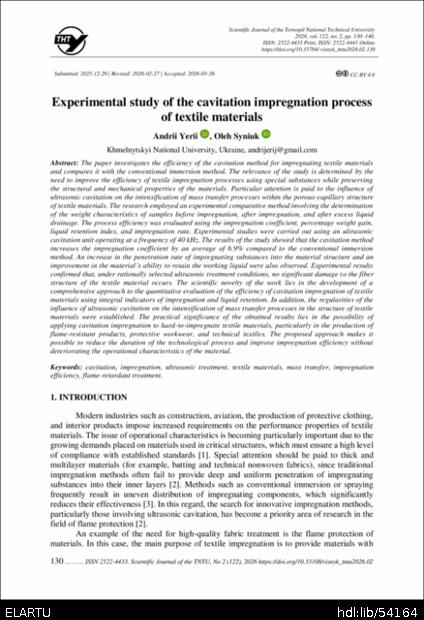
| Tittel: | Experimental study of the cavitation impregnation process of textile materials |
| Authors: | Yerii, Andrii Syniuk, Oleh |
| Affiliation: | Khmelnytskyi National University, Ukraine |
| Bibliographic description (Ukraine): | Yerii A. Experimental study of the cavitation impregnation process of textile materials / Andrii Yerii, Oleh Syniuk // Scientific Journal of TNTU. — Tern. : TNTU, 2026. — Vol 122. — No 2. — P. 130–140. |
| Bibliographic reference (2015): | Yerii A., Syniuk O. Experimental study of the cavitation impregnation process of textile materials // Scientific Journal of TNTU, Ternopil. 2026. Vol 122. No 2. P. 130–140. |
| Bibliographic citation (APA): | Yerii, A., & Syniuk, O. (2026). Experimental study of the cavitation impregnation process of textile materials. Scientific Journal of the Ternopil National Technical University, 122(2), 130-140. TNTU.. |
| Bibliographic citation (CHICAGO): | Yerii A., Syniuk O. (2026) Experimental study of the cavitation impregnation process of textile materials. Scientific Journal of the Ternopil National Technical University (Tern.), vol. 122, no 2, pp. 130-140. |
| Is part of: | Вісник Тернопільського національного технічного університету, 2 (122), 2026 Scientific Journal of the Ternopil National Technical University, 2 (122), 2026 |
| Journal/Collection: | Вісник Тернопільського національного технічного університету |
| Issue: | 2 |
| Volume: | 122 |
| Utgivelsesdato: | 26-mai-2026 |
| Submitted date: | 29-des-2025 |
| Date of entry: | 13-okt-2026 |
| Forlag: | ТНТУ TNTU |
| Place of the edition/event: | Тернопіль Ternopil |
| DOI: | https://doi.org/10.35784/ visnyk_tntu2026.02.130 |
| Emneord: | cavitation impregnation ultrasonic treatment textile materials mass transfer impregnation efficiency flame-retardant treatment |
| Number of pages: | 11 |
| Page range: | 130-140 |
| Start page: | 130 |
| End page: | 140 |
| Abstrakt: | The paper investigates the efficiency of the cavitation method for impregnating textile materials and compares it with the conventional immersion method. The relevance of the study is determined by the need to improve the efficiency of textile impregnation processes using special substances while preserving the structural and mechanical properties of the materials. Particular attention is paid to the influence of ultrasonic cavitation on the intensification of mass transfer processes within the porous-capillary structure of textile materials. The research employed an experimental comparative method involving the determination of the weight characteristics of samples before impregnation, after impregnation, and after excess liquid drainage. The process efficiency was evaluated using the impregnation coefficient, percentage weight gain, liquid retention index, and impregnation rate. Experimental studies were carried out using an ultrasonic cavitation unit operating at a frequency of 40 kHz. The results of the study showed that the cavitation method increases the impregnation coefficient by an average of 6.9% compared to the conventional immersion method. An increase in the penetration rate of impregnating substances into the material structure and an improvement in the material’s ability to retain the working liquid were also observed. Experimental results confirmed that, under rationally selected ultrasonic treatment conditions, no significant damage to the fiber structure of the textile material occurs. The scientific novelty of the work lies in the development of a comprehensive approach to the quantitative evaluation of the efficiency of cavitation impregnation of textile materials using integral indicators of impregnation and liquid retention. In addition, the regularities of the influence of ultrasonic cavitation on the intensification of mass transfer processes in the structure of textile materials were established. The practical significance of the obtained results lies in the possibility of applying cavitation impregnation to hard-to-impregnate textile materials, particularly in the production of flame-resistant products, protective workwear, and technical textiles. The proposed approach makes it possible to reduce the duration of the technological process and improve impregnation efficiency without deteriorating the operational characteristics of the material. |
| URI: | http://elartu.tntu.edu.ua/handle/lib/54164 |
| ISSN: | 2522-4433 |
| Copyright owner: | © Тернопільський національний технічний університет імені Івана Пулюя, 2026 |
| URL for reference material: | https://doi.org/10.3390/coatings11111413 https://patentimages.storage.googleapis.com/d3/d9/7f/82b379127ef871/US2177323.pdf https://doi.org/10.3390/coatings10040333 https://doi.org/10.1016/j.surfin.2025.106833 https://patents.google.com/patent/US3909196A/en |
| References (International): | 1. Repon M. R., Islam T., Sadia H. T., Mikučionienė D., Hossain S., Kibria G., Kaseem M. (2021) Development of antimicrobial cotton fabric impregnating AgNPs utilizing contemporary practice. Coatings, vol. 11, no. 11, article no. 1413. Available at: https://doi.org/10.3390/coatings11111413 (accessed: 25.01.2026). 2. Syniuk O. M., Yerii A. V. (2025) Study of Modern Methods and Technological Equipment for the Impregnation of Textile Materials. Bulletin of Khmelnytskyi National University. Technical Sciences, no. 5.1. 3. Method and apparatus for controlling the impregnation of textiles : U.S. Patent No. 2,177,323. – Patented Oct. 24, 1939. Washington, DC: U.S. Patent and Trademark Office, 6 p. Available at: https://patentimages.storage.googleapis.com/d3/d9/7f/82b379127ef871/US2177323.pdf (accessed: 01.06.2025). 4. Malucelli Giulio (2020) Sol-Gel and Layer-by-Layer Coatings for Flame-Retardant Cotton Fabrics: Recent Advances. Coatings, vol. 10, no. 4, pp. 333. Available at: https://doi.org/10.3390/coatings10040333 (accessed: 08.05.2025). 5. Shikder A. A. R., Mamun M. A. A., Islam T., Khan M. H. K. (2023) Uddin M. Z. Fire retardant properties enhancement of cotton twill fabric using pumpkin (Cucurbita maxima) extract. Heliyon, vol. 9, no. 4, p. e14806. DOI: 10.1016/j.heliyon.2023.e14806. 6. Qingting Ni, ZhuanMing Liu, JingYi Chen, LiPing Xu, Dan Liu, Junfei Ou, Synergistic flame retardant effect of phosphorus-nitrogen system for the preparation of high-performance flame- retardant cotton fabrics, Surfaces and Interfaces, Volume 69, 2025, 106833, ISSN 2468-0230. https://doi.org/10.1016/j.surfin.2025.106833. 7. Silin R. I., Hordieiev A. I. )2007). Vibratsiine obladnannia na osnovi hidropulsatora: monohrafiia Khmelnytskyi, KhNU, 386 p. 8. Process and device for the impregnation and drying of textile material [Elektronnyi resurs]: pat. US 3909196 A / vynakhidnyky Walter BirkeDer Eltz, Hans-Ulrich VonFranz, Schon; zaiavnyk BRUCKNER TROCKENTECHNIK & Co KG. SShA. Opubl. 30.09.1975. № US 3909196 A. Available at: https://patents.google.com/patent/US3909196A/en (accessed: 08.05.2025). 9. Montgomery, Douglas C. Design and analysis of experiments. Eighth edition. ISBN 978-1-118-14692-7. |
| Content type: | Article |
| Vises i samlingene: | Вісник ТНТУ, 2026, № 2 (122) |
Tilhørende filer:
| Fil | Beskrivelse | Størrelse | Format | |
|---|---|---|---|---|
| TNTUSJ_2026v122n2_Yerii_A-Experimental_study_of_the_130-140.pdf | 4,01 MB | Adobe PDF | Vis/Åpne | |
| TNTUSJ_2026v122n2_Yerii_A-Experimental_study_of_the_130-140__COVER.png | 1,31 MB | image/png | Vis/Åpne |
Alle innførsler i DSpace er beskyttet av copyright