
Veuillez utiliser cette adresse pour citer ce document :
http://elartu.tntu.edu.ua/handle/lib/54163
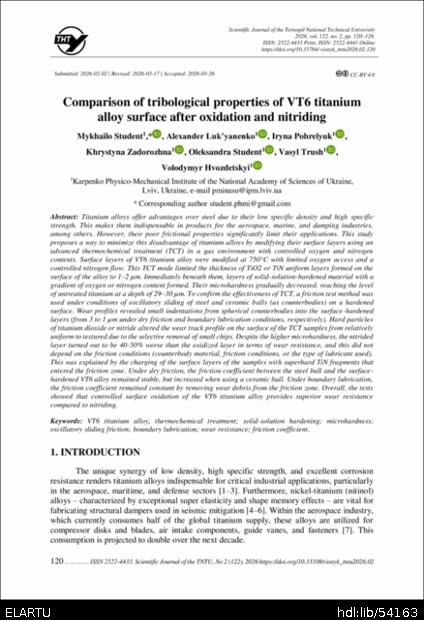
| Titre: | Comparison of tribological properties of VT6 titanium alloy surface after oxidation and nitriding |
| Auteur(s): | Student, Mykhailo Luk’yanenko, Alexander Pohrelyuk, Iryna Zadorozhna, Khrystyna Student, Oleksandra Trush, Vasyl Hvozdetskyi, Volodymyr |
| Affiliation: | Karpenko Physico-Mechanical Institute of the National Academy of Sciences of Ukraine, Lviv, Ukraine |
| Bibliographic description (Ukraine): | Comparison of tribological properties of VT6 titanium alloy surface after oxidation and nitriding / Mykhailo Student, Alexander Luk’yanenko, Iryna Pohrelyuk, Khrystyna Zadorozhna, Oleksandra Student, Vasyl Trush, Volodymyr Hvozdetskyi // Scientific Journal of TNTU. — Tern. : TNTU, 2026. — Vol 122. — No 2. — P. 120–129. |
| Bibliographic reference (2015): | Comparison of tribological properties of VT6 titanium alloy surface after oxidation and nitriding / Student M. та ін. // Scientific Journal of TNTU, Ternopil. 2026. Vol 122. No 2. P. 120–129. |
| Bibliographic citation (APA): | Student, M., Luk’yanenko, A., Pohrelyuk, I., Zadorozhna, K., Student, O., & Trush, V. (2026). Comparison of tribological properties of VT6 titanium alloy surface after oxidation and nitriding. Scientific Journal of the Ternopil National Technical University, 122(2), 120-129. TNTU.. |
| Bibliographic citation (CHICAGO): | Student M., Luk’yanenko A., Pohrelyuk I., Zadorozhna K., Student O., Trush V., Hvozdetskyi V. (2026) Comparison of tribological properties of VT6 titanium alloy surface after oxidation and nitriding. Scientific Journal of the Ternopil National Technical University (Tern.), vol. 122, no 2, pp. 120-129. |
| Is part of: | Вісник Тернопільського національного технічного університету, 2 (122), 2026 Scientific Journal of the Ternopil National Technical University, 2 (122), 2026 |
| Journal/Collection: | Вісник Тернопільського національного технічного університету |
| Issue: | 2 |
| Volume: | 122 |
| Date de publication: | 26-mai-2026 |
| Submitted date: | 2-fév-2026 |
| Date of entry: | 13-oct-2026 |
| Editeur: | ТНТУ TNTU |
| Place of the edition/event: | Тернопіль Ternopil |
| DOI: | https://doi.org/10.35784/ visnyk_tntu2026.02.120 |
| Mots-clés: | VT6 titanium alloy thermochemical treatment solid-solution hardening microhardness oscillatory sliding friction boundary lubrication wear resistance friction coefficient |
| Number of pages: | 10 |
| Page range: | 120-129 |
| Start page: | 120 |
| End page: | 129 |
| Résumé: | Titanium alloys offer advantages over steel due to their low specific density and high specific strength. This makes them indispensable in products for the aerospace, marine, and damping industries, among others. However, their poor frictional properties significantly limit their applications. This study proposes a way to minimize this disadvantage of titanium alloys by modifying their surface layers using an advanced thermochemical treatment (TCT) in a gas environment with controlled oxygen and nitrogen contents. Surface layers of VT6 titanium alloy were modified at 750°C with limited oxygen access and a controlled nitrogen flow. This TCT mode limited the thickness of TiO2 or TiN uniform layers formed on the surface of the alloy to 1–2 µm. Immediately beneath them, layers of solid-solution-hardened material with a gradient of oxygen or nitrogen content formed. Their microhardness gradually decreased, reaching the level of untreated titanium at a depth of 29–30 µm. To confirm the effectiveness of TCT, a friction test method was used under conditions of oscillatory sliding of steel and ceramic balls (as counterbodies) on a hardened surface. Wear profiles revealed small indentations from spherical counterbodies into the surface-hardened layers (from 3 to 1 µm under dry friction and boundary lubrication conditions, respectively). Hard particles of titanium dioxide or nitride altered the wear track profile on the surface of the TCT samples from relatively uniform to textured due to the selective removal of small chips. Despite the higher microhardness, the nitrided layer turned out to be 40-50% worse than the oxidized layer in terms of wear resistance, and this did not depend on the friction conditions (counterbody material, friction conditions, or the type of lubricant used). This was explained by the charging of the surface layers of the samples with superhard TiN fragments that entered the friction zone. Under dry friction, the friction coefficient between the steel ball and the surface- hardened VT6 alloy remained stable, but increased when using a ceramic ball. Under boundary lubrication, the friction coefficient remained constant by removing wear debris from the friction zone. Overall, the tests showed that controlled surface oxidation of the VT6 titanium alloy provides superior wear resistance compared to nitriding. |
| URI/URL: | http://elartu.tntu.edu.ua/handle/lib/54163 |
| ISSN: | 2522-4433 |
| Copyright owner: | © Тернопільський національний технічний університет імені Івана Пулюя, 2026 |
| URL for reference material: | https://doi.org/10.15802/tpm.4.2025.05 http://dx.doi.org/10.5772/intechopen.1001617 http://dx.doi.org/10.1016/j.engstruct.2022.115556 http://dx.doi.org/10.33108/visnyk_tntu2022.03.045 https://www.doi.org/10.31891/2307-5732-2020-289-5-131-135 https://www.doi.org/10.3390/met10060705 https://doi.org/10.3390/coatings14070786 https://doi.org/10.1080/10402004.2024.2357288 https://doi.org/10.3390/lubricants13100449 https://doi.org/10.1016/j.surfcoat.2021.127505 https://doi.org/10.1016/j.matdes.2025.114801 https://doi.org/10.1016/j.jmrt.2025.04.071 https://doi.org/10.1007/s11003-024-00836-0 https://doi.org/10.3390/met15020192 https://doi.org/10.1007/s11003-025-00905-y https://doi.org/10.33894/mtk-2024.21.08 https://doi.org/10.15407/pcmm2025.06.057 |
| References (International): | 1. Leokha F. L., Khrychikov V. E. (2025) Current trends in the production and application of titanium alloys. Theory and Practice of Metallurgy, 4, pp. 30 36. https://doi.org/10.15802/tpm.4.2025.05. 2.Titanium and Titanium Alloys. Fundamentals and Applications. Edited by Christoph Leyens, Manfred Peters. WILEY-VCH Verlag GmbH & Co. KGaA, Weinheim. 2003. 514 p. ISBN: 3-527-30534-3. 3. Titanium-Based Alloys – Characteristics and Applications. Edited by Petrica Vizureanu and Madalina Simona Baltatu. London, IntechOpen, United Kingdom. 2024. 190 p. http://dx.doi.org/10.5772/intechopen.1001617. 4. Iasnii V., Yasniy O., Homon S., Budz V., Yasniy P. (2023) Capabilities of self-centering damping device based on pseudoelastic NiTi wires. Engineering Structures, 278, 115556. http://dx.doi.org/10.1016/j.engstruct.2022.115556. 5. Iasnii V., Bykiv N., O. Yasniy, V. Budz (2022) Methodology and some results of studying the influence of frequency on functional properties of pseudoelastic SMA. Scientific journal of the Ternopil national technical university, 107, pp. 45–50. http://dx.doi.org/10.33108/visnyk_tntu2022.03.045. 6. Iasnii V. (2020) Main regularities of influence of cyclic loading parameters on the module of elasticity austenite of shape memory alloys. Herald of Khmelnytskyi national university, 289, pp. 131–135. https://www.doi.org/10.31891/2307-5732-2020-289-5-131-135. 7. Williams J. C., Boyer R. R. (2020) Opportunities and Issues in the Application of Titanium Alloys for Aerospace Components. Metals, 10 705. https://www.doi.org/10.3390/met10060705. 8. Chen Y., Zhang H., Wang B., Huang J., Zhou M., Wang L., Xi Y., Jia H., Xu S., Liu H., Wen L., X. Xiao, Liu R., Ji J. (2024) A Review of Research on Improving Wear Resistance of Titanium Alloys. Coatings, 14, 786. https://doi.org/10.3390/coatings14070786. 9. Kandrotaitė J. R., Blažys G., Mažeika D., Syzonenko O. D. (2024) Tribological investigation of titanium composite materials used in aviation. International Scientific Journal “Machines. Technologies. Materials”, XVIII, 5, pp. 171–175. 10. Rundora N. R., Klenam D. E. P., Polat S., Mathabathe N. M., J.s van der Merwe, Bodunrin M. O. (2024) Dry Sliding Wear Behavior of Experimental Low-Cost Titanium Alloys. Tribology Transactions, 67, pp. 560–572. https://doi.org/10.1080/10402004.2024.2357288. 11. Yang C.-H., Li C.-Y., Chan C.-C., Chi P.-C., Shih J.-H., Liao F.-Y., Chang S.-H. (2025) Effect of Low-Pressure Gas Oxynitriding on the Microstructural Evolution andWear Resistance of Ti-6Al-4V Alloy. Lubricants, 13, 449. https://doi.org/10.3390/lubricants13100449. 12. Meng Y., Villa M., Dahl K. V., Wang B., Drouet M., Dubois J.-B., Somers M. A. J., Christiansen T. L., (2021) Thermochemical surface hardening of Ti-6Al-4V: On the role of temperature and treatment media. Surface and Coatings Technology, 422, 127505. https://doi.org/10.1016/j.surfcoat.2021.127505. 13. Dziri A., Ammar K., Forest S., Proudhon H., Sirvin Q., T. Richeton D. Texier, Effect of oxygen content on elastic properties of an oxygen-graded titanium: Experimental and computational analyses, Materials & Design. 259 (2025) 114801. https://doi.org/10.1016/j.matdes.2025.114801. 14. Li W., Ma Z., Yang Z., Wang S. (2025) Effect of high-temperature oxidation on mechanical properties of TC11 titanium alloy. Journal of Materials Research and Technology, 36, ppю 3634–3646. https://doi.org/10.1016/j.jmrt.2025.04.071. 15. Pohrelyuk I. M., Student M. M., Zadorozhna Kh. R., Lavrys S. M., Kravchyshyn T. M., Kovalchuk I. V. (2024) Tribological Characteristics of Titanium after Combined Treatment. Materials Science, 59, pp. 746–753. https://doi.org/10.1007/s11003-024-00836-0. 16. Li W., Wang S., Yang X., Duan H., Wang Y., Yang Z., (2025) Research Progress on Fatigue Damage and Surface Strengthening Technology of Titanium Alloys for Aerospace Applications, Metals, 15, 192. https://doi.org/10.3390/met15020192. 17. Tkachuk O. V., Hvozdetskyi V. M., Student M. M., Zadorozhna Kh. R., Kovalchuk I. V., Pohrelyuk I. M. (2025) Structural features and wear resistance of the TiAlN coating formed on the Ti–6Al–4V alloy by combining electric arc spraying and gas nitriding methods. Materials Science, 60, pp. 577–583. https://doi.org/10.1007/s11003-025-00905-y. 18. Binti A. B. M., Pinke P., Tóth L., Kovács T. A. (2024) Heat-treating processes of the titanium alloys. Műszaki Tudományos Közlemények, 21, pp. 56–60. https://doi.org/10.33894/mtk-2024.21.08. 19. Student M. M., Pohrelyuk I. M., Luk’yanenko A. G., Student O. Z., Zadorozhna Kh. R., Hvozdetsky V. M. (2025) Improving the tribological characteristics of the surface layers of titanium alloy VT6 by diffusion saturation with interstitial elements, Phys.-Chem. Mechanics of Materials, 61, pp. 57–64. https://doi.org/10.15407/pcmm2025.06.057 (In Ukrainian). |
| Content type: | Article |
| Collection(s) : | Вісник ТНТУ, 2026, № 2 (122) |
Fichier(s) constituant ce document :
| Fichier | Description | Taille | Format | |
|---|---|---|---|---|
| TNTUSJ_2026v122n2_Student_M-Comparison_of_tribological_120-129.pdf | 3,92 MB | Adobe PDF | Voir/Ouvrir | |
| TNTUSJ_2026v122n2_Student_M-Comparison_of_tribological_120-129__COVER.png | 1,25 MB | image/png | Voir/Ouvrir |
Tous les documents dans DSpace sont protégés par copyright, avec tous droits réservés.