
このアイテムの引用には次の識別子を使用してください:
http://elartu.tntu.edu.ua/handle/lib/52483
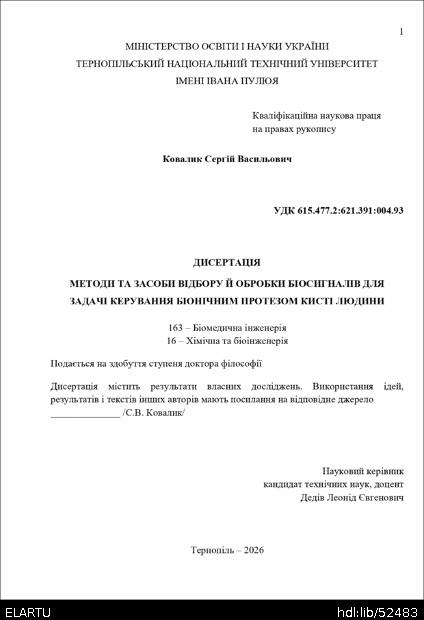
| タイトル: | Методи та засоби відбору й обробки біосигналів для задачі керування біонічним протезом кисті людини |
| その他のタイトル: | Methods and tools for the selection and processing of biosignals for the control of a human bionic hand prosthesis |
| 著者: | Ковалик, Сергій Васильович |
| Affiliation: | Тернопільський національний технічний університет імені І. Пулюя |
| Bibliographic reference (2015): | Ковалик С.В. Методи та засоби відбору й обробки біосигналів для задачі керування біонічним протезом кисті людини : дис. ... доктора філософії : 131. Тернопіль, 2026.189 с. |
| 発行日: | 2026 |
| Date of entry: | 18-6月-2026 |
| 出版者: | Тернопільський національний технічний університет ім. І. Пулюя |
| Country (code): | UA |
| Place of the edition/event: | Тернопіль |
| Science degree: | доктор філософії |
| Level thesis: | докторська дисертація |
| Code and name of the specialty: | 163 - біомедична інженерія |
| Institution defense: | Тернопільський національний технічний університет ім. Івана Пулюя |
| Supervisor: | Дедів, Леонід Євгенович |
| UDC: | 615.477.2 621.391 004.93 |
| キーワード: | сенсор біосигнал завада обробка реабілітація кінцівка протез імплант ампутація система керування модель метод алгоритм програмне забезпечення sensor biosignal noise processing rehabilitation limb prosthesis implant amputation system control model method algorithm software |
| Number of pages: | 189 |
| 抄録: | Ковалик С.В. Методи та засоби відбору й обробки біосигналів для задачі
керування біонічним протезом кисті людини. - Кваліфікаційна наукова праця на
правах рукопису.
Дисертація на здобуття ступеня доктора філософії за спеціальністю 163
«Біомедична інженерія» – Тернопільський національний технічний університет
імені Івана Пулюя, Тернопіль, 2026.
Підготовка здійснювалась на кафедрі біотехнічних систем Тернопільського
національного технічного університету імені Івана Пулюя Міністерства освіти і
науки України.
У дисертаційній роботі вирішено актуальне наукове завдання – розроблення
методів та засобів відбору й обробки біосигналів, якими є сигнали поверхневої
електроміографії та п’єзосигнали системи сенсорного зворотного зв’язку, для
задачі керування біонічним протезом кисті людини.
У вступі розкрито актуальність теми дослідження. Показано зв'язок роботи з
науковими програмами, планами, темами. Сформовано мету та основні завдання
дослідження, виокремлено об’єкт та предмет дослідження. Охарактеризовано
використані методи дослідження. Сформовано наукову новизну отриманих
результатів та їх практичне значення. Наведено особистий внесок здобувача в
працях, які опубліковані за результатами виконання дисертаційного дослідження
та результати апробації матеріалів дисертації. Описано структуру та обсяг
дисертації.
У першому розділі проведено комплексний аналіз теоретичних основ
побудови систем керування біонічними протезами кисті та визначено ключові
напрямки їх розвитку. Показано, що ефективне керування біонічним протезом
можливе лише за умови реалізації замкненого контуру керування, який поєднує
моторні сигнали та сенсорний зворотний зв’язок. Проаналізовано сучасні концепції
реалізації сенсорного зворотного зв’язку та показано їхні недоліки чи обмеження в
плані застосування в системах керування біонічними протезами. Встановлено, що
основним неінвазивним джерелом інформації для керування біонічними протезами
є сигнали поверхневої електроміографії, а існуючі методи реєстрації таких сигналів
мають обмеження, пов’язані з якістю контакту електродів, впливом артефактів та
індивідуальними особливостями користувача, що обумовлює доцільність
застосування багатоканальних систем та адаптивних методів обробки сигналів.
Проведено аналіз основних поширених методів обробки сигналів поверхневої
електроміографії для керування біонічними протезами кисті людини, визначено їх
недоліки та встановлено, що необхідним є розроблення методів обробки таких
сигналів на основі методу прямого керування, із можливістю використання
мультиелектодної системи реєстрації, а також введення контура сенсорного
зворотного зв'язку на основі реалізації функції тактильних відчуттів із наступною
інтеграцією цих двох груп методів обробки в єдину структуру керування біонічним
протезом.
У другому розділі було обґрунтовано структурну інтегрованої адаптивної
системи керування біонічним протезом кисті, а також розроблено засоби та
проведено експериментальну реєстрацію біосигналів. Запропоновано адаптивну
структуру системи, в якій сигнали тактильних сенсорів використовуються не лише
для формування зворотного зв’язку, але й для корекції керуючих впливів системи
керування протезом. Обґрунтовано вибір та виготовлено прототип біонічного
протеза, який забезпечує функціональну відповідність біомеханіці кисті людини
при відносній простоті та низькій вартості. Проведено його конструктивну
оптимізацію. Розроблено конструкцію мультиелектродної системи реєстрації
електроміографічних сигналів та виконано інтеграцію п’єзоелектричних сенсорів у
конструкцію прототипа протеза. Розроблено методику синхронної реєстрації
електроміографічних та п’єзосигналів, яка базується на використанні здорової
кінцівки для формування еталонних сигналів і реалізації принципу «дзеркальних
рухів». Проведено експериментальну реєстрацію цих сигналів.
У третьому розділі розроблено метод обробки біосигналів та побудовано
інтегровану математичну модель системи керування біонічним протезом кисті, яка
поєднує канал моторного наміру користувача та канал сенсорного зворотного
зв’язку. Виконано аналіз властивостей електроміографічного сигналу та
встановлено його нестаціонарний, стохастичний характер, широкий частотний
спектр та наявність значної шумової складової. Обґрунтовано використання
огинаючої сигналу як основного інформативного параметра, що відображає рівень
м’язової активності та може бути безпосередньо використаний у системі
керування. Аналогічно досліджено властивості п’єзосигналу, який має імпульсний
характер, широкий спектр та коротку кореляційну залежність. Показано, що його
огинаюча адекватно відображає силу контактної взаємодії та є ефективною для
реалізації сенсорного зворотного зв’язку. Запропоновано інтегровану математичну
модель системи керування. Розроблено метод віконної обробки біосигналів, який
враховує нестаціонарність сигналів та особливості функціонування систем у
режимі реального часу. Обгрунтовано використання каузального підходу до
формування огинаючої сигналів на основі рекурсивного згладжування.
Сформовано двоканальну структуру обробки біосигналів, у якій окремо
формуються огинаючі електроміографічних та п’єзосигналів.
У четвертому розділі проведено комплексне експериментальне дослідження
розробленої системи керування біонічним протезом кисті в середовищі MATLAB,
а також виконано кількісне оцінювання її основних характеристик. У процесі
моделювання підтверджено працездатність інтегрованої системи біокерування, яка
поєднує канал моторного наміру на основі електроміографічного сигналу та канал
сенсорного зворотного зв’язку на основі п’єзосигналу. Встановлено, що система
коректно відтворює процес формування керуючої напруги та сили захвату в режимі
реального часу з урахуванням динаміки електромеханічного приводу.
Проведено оцінювання точності формування сили, плавності керування,
стабільності та сенсорної реакції системи, за результатами чого було підтверджено,
що запропонована система біокерування забезпечує достатню точність формування
сили захвату, формує плавні керуючі впливи без імпульсних збурень, гарантує
стабільний режим утримання об’єкта та реалізує ефективний сенсорний зворотний
зв’язок. Результати експериментальних досліджень підтверддили адекватність
розробленої математичної моделі та ефективність запропонованих методів і
алгоритмів обробки біосигналів, а запропонований підхід здатний забезпечити
фізично узгоджений, стабільний і безпечний характер формування сили захвату,
що відповідає вимогам до систем керування біонічними протезами кисті та
підтверджує можливість його практичного застосування Kovalyk S.V. Methods and tools for the selection and processing of biosignals for the control of a human bionic hand prosthesis. – Manuscript. Dissertation for the degree of Doctor of Philosophy in specialty 163 «Biomedical Engineering». – Ternopil Ivan Puluj National Technical University, Ternopil, 2026. The research was conducted at the Department of Biotechnical Systems of Ternopil Ivan Puluj National Technical University of the Ministry of Education and Science of Ukraine. In the dissertation, an important scientific problem has been solved – the development of methods and means for the selection and processing of biosignals, namely surface electromyography signals and piezo signals from a sensory feedback system, for the task of controlling a bionic hand prosthesis. In the introduction, the relevance of the research topic was substantiated. The connection of the work with scientific programs, plans, and themes was demonstrated. The aim and main objectives of the research are formulated, and the object and subject of the research were identified. The used research methods were characterized. The scientific novelty of the obtained results and their practical significance were presented. The author’s personal contribution to the papers published based on the dissertation research, as well as the results of the approbation of the dissertation materials, were provided. The structure and scope of the dissertation were described. In the first chapter, a comprehensive analysis of the theoretical foundations for the construction of control systems for bionic hand prostheses was carried out, and the key directions of their development were identified. It was shown that effective control of a bionic prosthesis is possible only under the condition of implementing a closed-loop control system that integrates motor signals and sensory feedback. Modern concepts for implementing sensory feedback were analyzed, and their shortcomings or limitations in terms of application in control systems for bionic prostheses were demonstrated. It was established that the primary non-invasive source of information for controlling bionic prostheses is surface electromyography signals, and existing methods for recording such signals have limitations related to electrode contact quality, the influence of artifacts, and individual user characteristics, which substantiates the feasibility of using multichannel systems and adaptive signal processing methods. An analysis of the main commonly used methods for processing surface electromyography signals for controlling bionic hand prostheses was conducted, their drawbacks were identified, and it was established that there is a need to develop methods for processing such signals based on direct control methods, with the possibility of using a multi-electrode recording system, as well as incorporating a sensory feedback loop based on the implementation of tactile sensation functions, followed by the integration of these two groups of processing methods into a unified control structure for a bionic prosthesis. In the second chapter, the structure of an integrated adaptive control system for a bionic hand prosthesis was substantiated, and the means for biosignal selection were developed along with their experimental recording. An adaptive system structure was proposed in which signals from tactile sensors are used not only to provide feedback but also to adjust the control actions of the prosthesis control system. The selection was justified and a prototype of a bionic prosthesis was developed, ensuring functional correspondence to the biomechanics of the human hand while maintaining relative simplicity and low cost. Its design optimization was carried out. A multi-electrode system for recording electromyographic signals was designed, and piezoelectric sensors were integrated into the prosthesis prototype. A methodology for the synchronous recording of electromyographic and piezo signals was developed, based on the use of a healthy limb to generate reference signals and implement the principle of “mirror movements.” Experimental recording of these signals was conducted. In the third chapter, a method for biosignal processing was developed and an integrated mathematical model of the control system for a bionic hand prosthesis was constructed, combining the user’s motor intention channel and the sensory feedback channel. The properties of the electromyographic signal were analyzed, and its non- stationary, stochastic nature, wide frequency spectrum, and significant noise component were established. The use of the signal envelope as the main informative parameter was substantiated, as it reflects the level of muscle activity and can be directly used in the control system. Similarly, the properties of the piezo signal were studied; it is characterized by an impulsive nature, a wide spectrum, and short correlation dependence. It was shown that its envelope adequately reflects the force of contact interaction and is effective for implementing sensory feedback. An integrated mathematical model of the control system was proposed. A method of window-based biosignal processing was developed, taking into account signal non-stationarity and the specifics of real-time system operation. The use of a causal approach to envelope formation based on recursive smoothing was substantiated. A two-channel structure for biosignal processing was formed, in which the envelopes of electromyographic and piezo signals are generated separately. In the fourth chapter, a comprehensive experimental research of the developed control system for a bionic hand prosthesis was carried out in the MATLAB environment, and a quantitative evaluation of its main characteristics was performed. During the simulation, the operability of the integrated biocontrol system was confirmed, combining the motor intention channel based on the electromyographic signal and the sensory feedback channel based on the piezo signal. It was established that the system correctly reproduces the process of forming the control voltage and grip force in real time, taking into account the dynamics of the electromechanical drive. An evaluation of the accuracy of force generation, smoothness of control, stability, and sensory response of the system was conducted. The results confirmed that the proposed biocontrol system provides sufficient accuracy in grip force generation, produces smooth control actions without impulsive disturbances, ensures a stable object holding mode, and implements effective sensory feedback. Thus, the results of the experimental research confirmed the adequacy of the developed mathematical model and the effectiveness of the proposed methods and algorithms for biosignal processing. The proposed approach is capable of ensuring a physically consistent, stable, and safe formation of grip force, which meets the requirements for control systems of bionic hand prostheses and confirms the possibility of its practical application |
| 記述: | Подається на здобуття ступеня доктора філософії Дисертація містить результати власних досліджень. Використання ідей, результатів і текстів інших авторів мають посилання на відповідне джерело |
| Content: | ПЕРЕЛІК УМОВНИХ ПОЗНАЧЕНЬ ТА СКОРОЧЕНЬ... 16 ВСТУП... 18 РОЗДІЛ 1. ТЕОРЕТИЧНІ ОСНОВИ ТА АНАЛІЗ ПРИНЦИПІВ КЕРУВАННЯ БІОНІЧНИМИ ПРОТЕЗАМИ КИСТІ... 26 1.1. Потреба створення високофункціональних біонічних протезів кисті руки... 26 1.2. Біомеханічні особливості кисті людини як об’єкта технічного відтворення в біонічних протезах ...28 1.3. Аналіз поширених концепцій реалізації сенсорного зворотного зв'язку в сучасних біонічних протезах кисті людини... 32 1.4. Керування біонічним протезом на основі сигналів поверхневої електроміографії... 39 1.5. Методи та засоби реєстрації сигналів поверхневої електроміографії для задачі керування біонічним протезом... 41 1.6. Сенсомоторна інтеграція при виконанні рухів захвату... 45 1.7. Методи обробки сигналів поверхневої електроміографії... 47 1.7.1. Класичне амплітудне керування.. 47 1.7.2. Керування на основі кінцевих автоматів... 48 1.7.3. Методи розпізнавання образів...48 1.7.4. Регресійні методи... 49 1.7.5. Узагальнення сучасних підходів... 49 1.8. Постановка задач дослідження... 56 1.9. Висновки до розділу 1... 57 РОЗДІЛ 2. ЗАСОБИ РЕЄСТРАЦІЇ БІОСИГНАЛІВ ТА СТРУКТУРНА ПОБУДОВА ІНТЕГРОВАНОЇ СИСТЕМИ КЕРУВАННЯ... 59 2.1. Узагальнена структура системи керування біонічним протезом... 59 2.2. Прототип біонічного протеза... 62 2.3. Реалізація удосконаленого прототипу біонічного протеза... 65 2.4. Засоби реєстрації електроміографічних сигналів... 70 2.4.1. Мультиелектродна система... 70 2.4.2. Електронний тракт підсилення та фільтрації... 73 2.5. Засоби реєстрації п’єзосигналів... 76 2.5.1. Інтеграція сенсорів у конструкцію протеза... 76 2.5.2. Попередня реєстрація п'єзосигналу... 77 2.5.3. Вибір типу стимуляції при реалізації тактильного зворотного зв'язку... 78 2.6. Методика експериментальної реєстрації біосигналів... 79 2.7. Висновки до розділу 2... 83 РОЗДІЛ 3. МЕТОДИ ТА АЛГОРИТМ ОБРОБКИ БІОСИГНАЛІВ І ІНТЕГРОВАНОЇ МАТЕМАТИЧНОЇ МОДЕЛІ СИСТЕМИ КЕРУВАННЯ БІОНІЧНИМ ПРОТЕЗОМ КИСТІ... 85 3.1. Структура системи керування біонічним протезом на основі електроміографічних сигналів та п’єзосигналів... 85 3.2. Властивості та математична модель електроміографічного сигналу як каналу наміру користувача... 88 3.3. Властивості та математична модель п’єзосигналу як каналу сенсорного зворотного зв’язку... 98 3.4. Інтегрована модель системи керування біонічним протезом... 107 3.5 Метод обробки біосигналів і формування керуючої напруги в системі керування біонічним протезом руки... 110 3.5.1. Обґрунтування необхідності віконної обробки біосигналів у системі реального часу... 110 3.5.2. Сегментація сигналів у ковзних часових вікнах... 111 3.5.3. Випрямлення сигналу як етап виділення амплітудної інформації... 119 3.5.4. Формування огинаючої сигналу як каузального функціонала... 120 3.5.5. Окремі канали обробки біосигналів... 123 3.5.6. Формування керуючої напруги... 125 3.5.7. Каузальне згладжування керуючої напруги... 126 3.5.8. Обмеження керуючої напруги... 126 3.6 Модель електромеханічної частини біонічного протеза... 128 3.6.1. Електрична частина виконавчого механізму... 128 3.6.2. Механічна частина виконавчого механізму...128 3.6.3. Перетворення моменту у силу та швидкість руху... 129 3.7. Алгоритм обробки біосигналів у режимі реального часу в замкненому контурі системи керування біонічним протезом... 131 3.8. Висновки до розділу 3... 134 РОЗДІЛ 4. ЕКСПЕРИМЕНТАЛЬНІ ДОСЛІДЖЕННЯ ТА АНАЛІЗ РОБОТИ СИСТЕМИ КЕРУВАННЯ БІОНІЧНИМ ПРОТЕЗОМ КИСТІ В СЕРЕДОВИЩІ MATLAB... 137 4.1. Результат роботи системи керування в середовищі Matlab... 137 4.2. Кількісне оцінювання характеристик системи керування... 145 4.2.1. Мета та загальна постановка оцінювання... 145 4.2.2. Оцінювання точності формування вихідної сили... 147 4.2.2.1. Інтегральні показники точності... 147 4.2.2.2. Ковзні (локальні) показники точності... 151 4.2.2.3. Алгоритм обчислення показників точності формування сили... 152 4.2.2.4. Аналіз показників точності... 154 4.2.3. Оцінювання плавності керування... 156 4.2.3.1. Мета та загальна постановка оцінювання... 156 4.2.3.2. Інтегральні показники плавності... 157 4.2.3.3. Ковзні (локальні) показники плавності 159 4.2.3.4. Алгоритм оцінювання плавності керування... 160 4.2.3.5. Аналіз результатів оцінювання плавності... 161 4.2.4. Оцінювання стабільності режиму утримання... 164 4.2.4.1. Формалізація режиму утримання... 164 4.2.4.2. Інтегральні показники стабільності... 165 4.2.4.3. Ковзна оцінка стабільності... 166 4.2.4.4. Аналіз показників стабільності... 167 4.2.5. Оцінювання сенсорної реакції системи... 170 4.2.5.1. Математичне формулювання показника сенсорної реакції та ковзні показники... 170 4.2.5.2. Інтегральний показник сенсорної реакції... 171 4.2.5.3. Аналіз результатів оцінювання сенсорної реакції... 172 4.3. Перспективи практичного використання результатів досліджень... 173 4.4. Висновки до розділу 4... 175 ВИСНОВКИ... 177 СПИСОК ВИКОРИСТАНИХ ДЖЕРЕЛ... 179 ДОДАТКИ... 191 |
| URI: | http://elartu.tntu.edu.ua/handle/lib/52483 |
| Copyright owner: | © Ковалик Сергій Васильович, 2026 |
| References (Ukraine): | 1. Міністерство соціальної політики України. Інформація щодо забезпечення осіб допоміжними засобами реабілітації у 2024 році. URL: https://www.msp.gov.ua/ (дата звернення: 02.02.2026). 2. Щодо забезпечення осіб допоміжними засобами реабілітації. URL: https://miskrada-radekhiv.gov.ua/news/214625-shhodo-zabezpecennia-osib- dopomiznimi-zasobami-reabilitaciyi (дата звернення: 02.02.2026). 3. Беспалова О., Білошицька О., Мельник Г. Особливості надання медичних послуг у поліфункціональних протезно-реабілітаційних центрах для військовослужбовців з ампутацією кінцівок. Біомедична інженерія і технологія. 2024. № 15. С. 63-72. DOI: 10.20535/.2024.15.314809. 4. Biloshytska O. K., Bespalova O. Y., Seminska N. V., Galkin O. Y. Concept of a multifunctional prosthetic and rehabilitation center with an innovative educational component for patients with limb amputation in the context of war in Ukraine. Wiadomości Lekarskie. 2025. Vol. 78, № 6. P. 1160-1167. DOI: 10.36740/wlek/207373. 5. Деякі питання протезування та ортезування виробами підвищеної функціональності: постанова Кабінету Міністрів України від 01.10.2014 № 518. URL: https://surl.li/csotrx (дата звернення: 02.02.2026). 6. Про внесення змін до деяких постанов Кабінету Міністрів України: постанова Кабінету Міністрів України від 12.04.2022 № 454. URL: https://surl.li/xybfin (дата звернення: 02.02.2026). 7. Allbionics, Speka. Біонічні руки в Україні: потреби та розвиток технологій. URL: https://speka.ua/ (дата звернення: 02.02.2026). 8. Amirouche F., Mejia A., Wongworawat M. D., Elhassan B. Biomechanics of the Hand: Orthopedic and Clinical Perspectives. Cham: Springer Nature, 2025. 363 p. 9. Routledge Handbook of Biomechanics and Human Movement Science / ed. by Y. Hong, R. Bartlett. London; New York: Routledge, 2008. 624 p. 10. Tian L., Magnenat-Thalmann N., Thalmann D., Zheng J. A methodology to model and simulate customized realistic anthropomorphic robotic hands. Computer Graphics International (CGI 2018). 2018. P. 153-162. 11. Yuan Z. et al. A two degrees of freedom robotic hand for grasping and intra- palmar fine manipulation. Mechanism and Machine Theory. 2025. Vol. 218. Art. 106291. DOI: 10.1016/j.mechmachtheory.2025.106291. 62. Sensinger J. W., Dosen S. A review of sensory feedback in upper-limb prostheses. Frontiers in Neuroscience. 2020. Vol. 14. Art. 345. DOI: 10.3389/fnins.2020.00345. 63. Nacci L. et al. Neuro-computational modelling of closed-loop prostheses control. Proceedings of the IEEE EMBS Annual International Conference. 2025. P. 1-5. DOI: 10.1109/EMBC58623.2025.11254755. 64. Zollo L. et al. Restoring tactile sensations via neural interfaces. Science Robotics. 2019. Vol. 4, No. 27. Art. eaau9924. DOI: 10.1126/scirobotics.aau9924. 65. Guo D. et al. Robotic grasping using visual and tactile sensing. Information Sciences. 2017. Vol. 417. P. 274–286. DOI: 10.1016/j.ins.2017.07.017. 66. Massari L. et al. Tactile sensing and control of robotic manipulator. Frontiers in Neurorobotics. 2019. Vol. 13. Art. 8. DOI: 10.3389/fnbot.2019.00008. 67. Simão M., Mendes N., Gibaru O., Neto P. A Review on Electromyography Decoding and Pattern Recognition for Human-Machine Interaction. IEEE Access. 2019. Vol. 7. Pp. 39564-39582. DOI: 10.1109/ACCESS.2019.2906584. 68. Geethanjali P. Myoelectric control of prosthetic hands: state-of-the-art. Medical Devices: Evidence and Research. 2016. Vol. 9. P. 247–255. DOI: 10.2147/MDER.S91102. 69. Barzilay O., Wolf A. A fast implementation for EMG signal linear envelope computation. Journal of Electromyography and Kinesiology. 2011. P. 678-82. DOI: 10.1016/j.jelekin.2011.04.004. PMID: 21689608. 70. Mereu F. et al. Control strategies and performance assessment of upper-limb TMR prostheses. Sensors. 2021. Vol. 21. Art. 1953. DOI: 10.3390/s21061953. 71. Roche A. D. et al. Prosthetic myoelectric control strategies: a clinical perspective. Current Surgery Reports. 2014. Vol. 2. Art. 44. DOI: 10.1007/s40137-013- 0044-8. 75. Li G., Kuiken T. A. EMG pattern recognition control of multifunctional prostheses by transradial amputees. Proceedings of the IEEE EMBS Annual International Conference. 2009. P. 6914-6917. DOI: 10.1109/IEMBS.2009.5333628. 72. Dellacasa Bellingegni A., Gruppioni E., Colazzo G. et al. NLR, MLP, SVM, and LDA: a comparative analysis on EMG data from people with trans-radial amputation. Journal of NeuroEngineering and Rehabilitation. 2017. Vol. 14. Art. 82. DOI: 10.1186/s12984-017-0290-6. 73. Wang X., Ao D., Li L. Robust myoelectric pattern recognition methods for reducing users’ calibration burden: challenges and future. Frontiers in Bioengineering and Biotechnology. 2024. Vol. 12. Art. 1329209. DOI: 10.3389/fbioe.2024.1329209. 74. Asghar A. et al. Review on electromyography based intention for upper limb control using pattern recognition for human-machine interaction. Proceedings of the Institution of Mechanical Engineers, Part H. 2022. DOI: 10.1177/09544119221074770. 76. Espinoza D., Velasco L. Comparison of EMG signal classification algorithms for the control of an upper limb prosthesis prototype. Proceedings of the IEEE Conference on Electrical Engineering (CCE). 2020. P. 1-4. DOI: 10.1109/CCE50788.2020.9299208. 77. Pieprzycki A. et al. Analysis of surface EMG signals to control of a bionic hand prototype. Sensors. 2025. Vol. 25. Art. 5335. DOI: 10.3390/s25175335. 78. Igual C. et al. An interactive training model for myoelectric regression control. Computers. 2024. Vol. 13. Art. 29. DOI: 10.3390/computers13010029. 79. Farag H. O. et al. Myoelectric prosthetic hands: a review of muscle synergy, machine learning and edge computing. ACM Computing Surveys. 2025. Vol. 57, No. 12. Art. 311. DOI: 10.1145/3742471. 80. Randriamanalina R. N. et al. Algorithmic approach to an embedded electronic medical device for EMG-to-joint angle regression. Journal of Electrical and Electronic Engineering. 2026. Vol. 14, No. 1. P. 34-45. DOI: 10.11648/j.jeee.20261401.14. 81. Englehart K., Hudgins B. A robust, real-time control scheme for multifunction myoelectric control. IEEE Transactions on Biomedical Engineering. 2003. Vol. 50, No. 7. P. 848-854. DOI: 10.1109/TBME.2003.813539. 82. Scheme E., Englehart K. Electromyogram pattern recognition for control of powered upper-limb prostheses: state of the art and challenges for clinical use. Journal of Rehabilitation Research and Development. 2011. Vol. 48, No. 6. P. 643-660. DOI: 10.1682/JRRD.2010.09.0177. 83. Phinyomark A. et al. Feature Extraction and Selection for Myoelectric Control Based on Wearable EMG Sensors. Sensors, 2018, 18, 1615. https://doi.org/10.3390/s18051615. 84. Hargrove L. J. et al. A comparison of surface and intramuscular myoelectric signal classification. IEEE Transactions on Biomedical Engineering. 2007. Vol. 54, No. 5. P. 847–853. DOI: 10.1109/TBME.2006.889192. 88. Dozorskyi V. et al. The concept of developing the structure of a highly functional bionic hand prosthesis based on IoT technologies. CEUR Workshop Proceedings. 2024. Vol. 3842. P. 268-280. 85. Oskoei M. A., Hu H. Myoelectric control systems – a survey. Biomedical Signal Processing and Control. 2007. Vol. 2, No. 4. P. 275-294. DOI: 10.1016/j.bspc.2007.07.009. 86. Farina D. et al. The extraction of neural information from the surface EMG for the control of upper-limb prostheses. IEEE Transactions on Neural Systems and Rehabilitation Engineering. 2014. Vol. 22, No. 4. P. 797-809. DOI: 10.1109/TNSRE.2014.2305111. 87 Parker P. A. et al. Myoelectric signal processing for control of powered limb prostheses. Journal of Electromyography and Kinesiology. 2006. Vol. 16, No. 6. P. 541- 548. DOI: 10.1016/j.jelekin.2006.08.006. 89. Dediv L., Kovalyk S. Structure of the bionic hand prosthesis control system with sensor feedback. Scientific Journal of TNTU. 2025. Vol. 119, No. 3. P. 45-55. DOI: https://doi.org/10.33108/visnyk_tntu2025.03.045. 90. Dediv L. Ye., Dozorskyi V. H., Kovalyk S. V., Kubashok A. V. Design of a biocontrolled hand prosthesis. Scientific Achievements and Innovations as a Way to Success: Proceedings of the XXI International Scientific and Practical Conference. Vilnius, Lithuania, 2024. P. 226-227. 91. Dozorskyi V., Dediv L., Kovalyk S., Dozorska O., Dediv I. Design of the endoskeleton of a biocontrolled hand prosthesis. Scientific Journal of TNTU. 2024. Vol. 115, No. 3. P. 100-111. DOI: https://doi.org/10.33108/visnyk_tntu2024.03.100. 92. Колнаузов І., Білошицька О. Використання нітинолових штучних м’язів у протезуванні. Біомедична інженерія і технологія. 2025. Т. 4, № 19. С. 13- 22. DOI: 10.20535/.2025.19.344105. 93. Free 3D Hands. URL: https://free3dhands.org (дата звернення: 05.03.2026). 94. Скубко В., Білошицька О. Біобезпека виробництва біоімплантів стегнових кісток методом 3D-біодруку. Біомедична інженерія і технологія. 2025. Т. 2, № 17. С. 37-49. DOI: 10.20535/.2025.17.331612. 95. Dediv L. Ye., Dozorskyi V. H., Kovalyk S. V., Kukurudza V. A. Robot- manipulator hand for robotic surgery. Modern Scientific Challenges are the Driving Force of the Development of Scientific Research: Proceedings of the XXIV International Scientific and Practical Conference. Bruges, Belgium, 2024. P. 213-214. 96. Tymkiv P., Kłos-Witkowska A., Bahrii-Zaiats O., Kovalyk S. Smart prosthetics in surgery: AI-driven tactile feedback using piezoelectric sensors. Proceedings of the 1st International Workshop on Bioinformatics and Applied Information Technologies (BAIT 2024). 2024. Vol. 3842. P. 208-217. ISSN 1613-0073. 97. Dozorska O. et al. The method of selection and pre-processing of electromyographic signals. Proceedings of the IEEE 15th International Conference on Computer Sciences and Information Technologies (CSIT). 2020. P. 188–192. 101. Myers H., Lu D., Gray S. J., Bruscino-Raiola F. Targeted muscle reinnervation to improve electromyography signals for advanced myoelectric prosthetic limbs: a series of seven patients. ANZ Journal of Surgery. 2020. Vol. 90. P. 591-596. DOI: 10.1111/ans.15664. 98. Дозорська О. Ф. Математична модель та методи опрацювання біосигналів: дис. … канд. техн. наук: 01.05.02. Тернопіль: ТНТУ, 2020. 170 с. 99. Дедів Л. Є., Кубашок А. В., Ковалик С. В. Спосіб реалізації тактильних відчуттів для біокерованого протеза кисті руки. Актуальні проблеми науки, освіти і суспільства: досвід та перспективи: матеріали Міжнародної науково-практичної конференції. Дрогобич: ЦФЕНД, 2023. Ч. 3. С. 46-47. 100. Dosen S. et al. EMG biofeedback for online predictive control of grasping force in a myoelectric prosthesis. Journal of NeuroEngineering and Rehabilitation. 2015. Vol. 12. Art. 55. DOI: 10.1186/s12984-015-0047-z. 102. Vasan G., Pilarski P. M. Learning from demonstration: teaching a myoelectric prosthesis with an intact limb via reinforcement learning. IEEE International Conference on Rehabilitation Robotics. 2017. P. 1457-1464. DOI: 10.1109/ICORR.2017.8009453. 103. Khvostivskyi M., Kovalyk S. Integrated mathematical model of the control system for upper-limb bioprosthesis based on EMG and piezoelectric signals. Herald of Khmelnytskyi National University. Technical Sciences. 2025. No. 359. P. 31-37. DOI: 10.31891/2307-5732-2025-359-74. 104. Сверстюк А.С., Мосій Л.Є. Математичне моделювання амплітудної варіабельності електрокардіосигналів для інформаційної технології аналізу їх морфологічних та ритмічних ознак. Комп’ютерно-інтегровані технології: освіта, наука, виробництво. 2025. № 59. С. 228-240. DOI: https://doi.org/10.36910/6775- 2524-0560-2025-59-29. 105. Kovalyk S., Khvostivskyi M. Method and algorithm of windowed processing of EMG and piezoelectric signals for the formation of control actions in bioprostheses. Perspective Technologies and Devices. 2025. Vol. 27, No. 1. P. 21-28. DOI: https://doi.org/10.36910/10.36910/6775-2313-5352-2025-27-1. 106. Dediv L., Dozorska O., Kukuruza V., Nykytyuk V., Kovalyk S. Computer simulation modeling of voice signals in the MATLAB environment for the task of computerized diagnostic systems testing. Proceedings of the 1st International Workshop on Computer Information Technologies in Industry 4.0 (CITI 2023). 2023. Vol. 3468. P. 257-262. ISSN 1613-0073. 107. Willmott C. J., Matsuura K. Advantages of the mean absolute error (MAE) over the root mean square error (RMSE) in assessing average model performance. Climate Research. 2005. Vol. 30. P. 79-82. DOI: 10.3354/cr030079. 108. Chai T., Draxler R. R. Root mean square error (RMSE) or mean absolute error (MAE)? – Arguments against avoiding RMSE in the literature. Geoscientific Model Development. 2014. Vol. 7, No. 3. P. 1247–1250. DOI: 10.5194/gmd-7-1247-2014. 109. Hogan N., Sternad D. Sensitivity of smoothness measures to movement duration, amplitude, and arrests. Journal of Motor Behavior. 2009. Vol. 41, No. 6. P. 529– 534. DOI: 10.3200/35-09-004-RC. 110. Oppenheim A.V., Schafer R.W. Discrete-Time Signal Processing. 3rd ed. Harlow : Pearson Education Limited, 2014. 1120 p. ISBN 978-1-292-03815-5. 12. Zhang N. et al. Biomimetic rigid-soft finger design for highly dexterous and adaptive robotic hands. Science Advances. 2025. Vol. 11, No.17. 13 p. DOI: 10.1126/sciadv.adu2018. 111. Montgomery D.C., Runger G.C. Applied Statistics and Probability for Engineers. 7th ed. Hoboken: John Wiley & Sons, 2018. 710 p. ISBN 978-1-119-40036- 3. 112. Марценюк В., Андрущак І., Кіт Н., Кравчик Ю., Сверстюк А., Паляниця Ю. Порівняння результатів чисельного аналізу моделювання кіберфізичних біосенсорних систем. Вісник Хмельницького національного університету. 2023. Т. 1, №2, 2023 (319). С. 102–108. DOI: https://doi.org/10.31891/2307-5732-2023-319-1- 202-212. 113. George J. A. et al. Biomimetic sensory feedback through peripheral nerve stimulation improves dexterity in a bionic hand. Science Robotics. 2019. Vol. 4, No. 32. Art. eaax2352. DOI: 10.1126/scirobotics.aax2352. 13. Salvietti G. Replicating human hand synergies onto robotic hands: a review on software and hardware strategies. Frontiers in Neurorobotics. 2018. Vol. 12. Art. 27. DOI: 10.3389/fnbot.2018.00027. 14. Alicea R. et al. A soft, synergy-based robotic glove for grasping assistance.. Wearable Technologies. 2021. Vol. 2. DOI: 10.1017/wtc.2021.3. 15. Gao G. et al. On differential mechanisms for underactuated, lightweight, adaptive prosthetic hands. Frontiers in Neurorobotics. 2021. Vol. 15. Art. 702031. DOI: 10.3389/fnbot.2021.702031. 16. Courchesne J., Cardou P., Onadja P. A. R. A compact underactuated gripper. Frontiers in Robotics and AI. 2023. Vol. 10. Art. 1066516. DOI: 10.3389/frobt.2023.1066516. 17. Naceri A. et al. Role of tactile noise in the control of digit normal force. Frontiers in Psychology. 2021. Vol. 12. Art. 612558. DOI: 10.3389/fpsyg.2021.612558. 18. Hu X. et al. Research on the development and application of force tactile interaction technology in China. Intelligent Robotics. 2025. Vol. 5, No. 3. P. 505–519. DOI: 10.20517/ir.2025.26. 19. Panarese A. et al. Humans can integrate force feedback. IEEE Transactions on Neural Systems and Rehabilitation Engineering. 2009. Vol. 17. P. 560–567. DOI: 10.1109/TNSRE.2009.2021689. 20. Bandes Rodriguez S. I., Koike Y. Hybrid EEG-EMG control scheme. Actuators. 2025. DOI: 10.3390/act14080397. 21. Yang H. et al. A lightweight prosthetic hand with 19-DOF dexterity. Nature Communications. 2025. DOI: 10.1038/s41467-025-56352-5. 22. Tang S. et al. Design and experimental evaluation of a new modular. 2020. URL: [https://ro.uow.edu.au/eispapers1/3998] (дата звернення: 02.05.2026). 23. Zhuwawu S. S., El-Hussieny H. Leveraging LSTM, tactile sensors. Scientific Reports. 2025. Vol. 15. Art. 29781. DOI: 10.1038/s41598-025-92651-z. 24. Dong J. et al. Online closed-loop control using tactile feedback. Frontiers in Neuroscience. 2021. Vol. 15. Art. 580385. DOI: 10.3389/fnins.2021.580385. 25. Tuthill J. C., Azim E. Proprioception. Current Biology. 2018. Vol. 28, No. 5. P. 194–203. DOI: 10.1016/j.cub.2018.01.064. 26. Li K. et al. Non-invasive stimulation-based tactile sensation. IEEE Sensors Journal. 2017. DOI: 10.1109/JSEN.2017.2674965. 27. Thomas N. et al. Comparison of vibrotactile and joint-torque feedback. Journal of NeuroEngineering and Rehabilitation. 2019. Vol. 16, No. 1. DOI: 10.1186/s12984-019-0545-5. 28. Mayer R. M. et al. Tactile feedback in closed-loop control. Frontiers in Neuroscience. 2020. Vol. 14. Art. 348. DOI: 10.3389/fnins.2020.00348. 29. Raveh E. et al. Adding vibrotactile feedback. Human Movement Science. 2018. Vol. 58. P. 32–40. DOI: 10.1016/j.humov.2018.01.008. 30. Abd M. et al. Multichannel haptic feedback unlocks prosthetic hand dexterity. Scientific Reports. 2022. Vol. 12. Art. 2323. DOI: 10.1038/s41598-022-04953- 1. 31. Valle G. et al. Comparison of linear frequency and amplitude modulation. Scientific Reports. 2018. DOI: 10.1038/s41598-018-34910-w. 32. Valle G. Cortical somatosensory feedback for brain-controlled bionic hands. Nature Reviews Electrical Engineering. 2025. Vol. 2. P. 704–706. DOI: 10.1038/s44287- 025-00218-x. 33. Mind-controlled arm prostheses that can “feel”. Medical Press. 2020. URL: https://medicalxpress.com/news/2020-04-mind-controlled-arm-prostheses.html (дата звернення: 04.03.2026). 34. Ottobock. Bebionic hand. URL: https://www.ottobock.com/uk- ua/product/8E7----61161 (дата звернення: 04.03.2026). 35. TASKA Prosthetics. TASKA Gen2. URL: https://www.taskaprosthetics.com/products/taska-gen2 (дата звернення: 04.03.2026). 36. Össur. i-Limb Quantum. URL: https://www.ossur.com/en- us/prosthetics/arms/i-limb-quantum (дата звернення: 04.03.2026). 37. Psyonic. Ability Hand. URL: https://www.psyonic.io/ability-hand/ (дата звернення: 05.03.2026). 38. Krucoff M. O. et al. Enhancing nervous system recovery through neurobiologics, neural interface training, and neurorehabilitation. Frontiers in Neuroscience. 2016. Vol. 10. Art. 584. DOI: 10.3389/fnins.2016.00584. 39. Hochberg L. R. et al. Neuronal ensemble control of prosthetic devices by a human with tetraplegia. Nature. 2006. Vol. 442, No. 7099. P. 164–171. DOI: 10.1038/nature04970. 40. Hochberg L. R. et al. Reach and grasp by people with tetraplegia using a neurally controlled robotic arm. Nature. 2012. Vol. 485, No. 7398. P. 372–375. DOI: 10.1038/nature11076. 41. Collinger J. L. et al. High-performance neuroprosthetic control by an individual with tetraplegia. The Lancet. 2013. Vol. 381, No. 9866. P. 557–564. DOI: 10.1016/S0140-6736(12)61816-9. 42. Malesevic N. et al. Evaluation of simple algorithms for proportional control of prosthetic hands using intramuscular electromyography. Sensors. 2022. Vol. 22, No. 13. Art. 5054. DOI: 10.3390/s22135054. 43. Clancy E. A. et al. Two degrees of freedom quasi-static EMG-force at the wrist using a minimum number of electrodes. Journal of Electromyography and Kinesiology. 2017. DOI: 10.1016/j.jelekin.2017.03.004. 44. Fleming A. et al. Myoelectric control of robotic lower limb prostheses: a review. Journal of Neural Engineering. 2021. Vol. 18, No. 4. DOI: 10.1088/1741- 2552/ac1176. 45. Chowdhury R. H. et al. Surface electromyography signal processing and classification techniques. Sensors. 2013. Vol. 13, No. 9. P. 12431–12466. DOI: 10.3390/s130912431. 46. Parajuli N. et al. Real-time EMG based pattern recognition control for hand prostheses. Sensors. 2019. Vol. 19, No. 20. Art. 4596. DOI: 10.3390/s19204596. 47. Jaramillo-Yánez A. et al. Real-time hand gesture recognition using surface electromyography. Sensors. 2020. Vol. 20, No. 9. Art. 2467. DOI: 10.3390/s20092467. 48. Основи реєстрації та аналізу біосигналів: навч. посіб. / Аврунін О. Г. та ін. Харків: ХНУРЕ, 2019. 400 с. 49. Електронні методи і засоби біомедичних вимірювань: навч. посіб. / Мещанінов С. К., Співак В. М., Орлов А. Т. Київ: Кафедра, 2015. 211 с. 50. Dozorska O. et al. The method of selection and pre-processing of electromyographic signals. Proceedings of the IEEE 15th International Conference on Computer Sciences and Information Technologies (CSIT). 2020. P. 188–192. 51. Gao Z. et al. A multi-DoF prosthetic hand finger joint controller. Sensors. 2021. DOI: 10.3390/s21082576. 52. Mesa I. et al. Channel and feature selection for a surface electromyographic pattern recognition task. Expert Systems with Applications. 2014. Vol. 41. P. 5190–5200. 53. Phinyomark A. et al. Feature extraction of the first difference of EMG time series for EMG pattern recognition. Computer Methods and Programs in Biomedicine. 2014. Vol. 117. P. 247–256. 54. Ткачук Р. А. Вимірювальні перетворювачі та електроди для біомедичних досліджень: курс лекцій. Тернопіль: ТДТУ, 2001. 120 с. 55. Karunakaran C., Bhargava K., Benjamin R. Biosensors and Bioelectronics. Amsterdam: Elsevier, 2015. 334 p. 56. Kaniusas E. Biomedical Signals and Sensors III: Linking Electric Biosignals and Biomedical Sensors. Cham: Springer, 2019. 625 p. 57. Ottobock. Myo Plus: configure your hand prosthesis. URL: [https://manuals.plus/uk/ottobock/myo-plus-configure-your-hand-prosthesis- manual](https://manuals.plus/uk/ottobock/myo-plus-configure-your-hand-prosthesis- manual) (дата звернення: 02.05.2026). 58. Visconti P. et al. Technical features and functionalities of Myo armband. International Journal on Smart Sensing and Intelligent Systems. 2018. DOI: 10.21307/ijssis-2018-005. 59. Florio T. M. Emergent aspects of the integration of sensory and motor functions. Brain Sciences. 2025. Vol. 15. Art. 162. DOI: 10.3390/brainsci15020162. 60. Dutta S. et al. Influence of grasp context-dependent uncertainty. Scientific Reports. 2025. Vol. 15. Art. 37194. DOI: 10.1038/s41598-025-20153-z. 61. Guo L. L., Niemeier M. Phase-dependent visual and sensorimotor integration. Journal of Neuroscience. 2024. Vol. 44, No. 33. DOI: 10.1523/JNEUROSCI.2208-23.2024. |
| Content type: | Dissertation |
| 出現コレクション: | 163 Біомедична інженерія |
このアイテムのファイル:
| ファイル | 記述 | サイズ | フォーマット | |
|---|---|---|---|---|
| Dysertatsiya_Kovalyk_2026.pdf | 6,12 MB | Adobe PDF | 見る/開く | |
| cover.jpg | 342,65 kB | JPEG | 見る/開く |
このリポジトリに保管されているアイテムはすべて著作権により保護されています。