
Por favor, use este identificador para citar o enlazar este ítem:
http://elartu.tntu.edu.ua/handle/lib/51928
| Título : | Моделювання енергетичної стратегії бізнесу в умовах зовнішніх збурень |
| Otros títulos : | Modeling the business energy strategy in the context of external shocks |
| Autor : | Лилак, Назарій Васильович Lylak, Nazariy |
| Affiliation: | Київський національний економічний університет імені Вадима Гетьмана, Київ, Україна Kyiv National Economic University named after Vadym Hetman, Kyiv, Ukraine |
| Bibliographic description (Ukraine): | Лилак Н. В. Моделювання енергетичної стратегії бізнесу в умовах зовнішніх збурень / Лилак Назарій Васильович // ГЕВ. — Т. : ТНТУ, 2025. — Том 97. — № 6. — С. 169–175. — (Фінанси, банківська справа, страхування та фондовий ринок). |
| Bibliographic reference (2015): | Лилак Н. В. Моделювання енергетичної стратегії бізнесу в умовах зовнішніх збурень // ГЕВ, Тернопіль. 2025. Том 97. № 6. С. 169–175. |
| Bibliographic citation (APA): | Lylak, N. (2025). Modeliuvannia enerhetychnoi stratehii biznesu v umovakh zovnishnikh zburen [Modeling the business energy strategy in the context of external shocks]. Galician economic journal, 97(6), 169-175. TNTU. [in Ukrainian]. |
| Bibliographic citation (CHICAGO): | Lylak N. (2025) Modeliuvannia enerhetychnoi stratehii biznesu v umovakh zovnishnikh zburen [Modeling the business energy strategy in the context of external shocks]. Galician economic journal (Tern.), vol. 97, no 6, pp. 169-175 [in Ukrainian]. |
| Is part of: | Галицький економічний вісник, 6 (97), 2025 Galician economic journal, 6 (97), 2025 |
| Journal/Collection: | Галицький економічний вісник |
| Issue: | 6 |
| Volume: | 97 |
| Fecha de publicación : | 18-nov-2025 |
| Submitted date: | 23-oct-2025 |
| Date of entry: | 9-mar-2026 |
| Editorial : | ТНТУ TNTU |
| Place of the edition/event: | Тернопіль Ternopil |
| DOI: | https://doi.org/10.33108/galicianvisnyk_tntu2025.06.169 |
| UDC: | 338.45 658.26 519.86 |
| Palabras clave : | антикризова стратегія виробнича функція Кобба–Дугласа капітал енергоресурси ефективність управління anti-crisis strategy Cobb–Douglas production function capital energy resources management efficiency |
| Number of pages: | 7 |
| Page range: | 169-175 |
| Start page: | 169 |
| End page: | 175 |
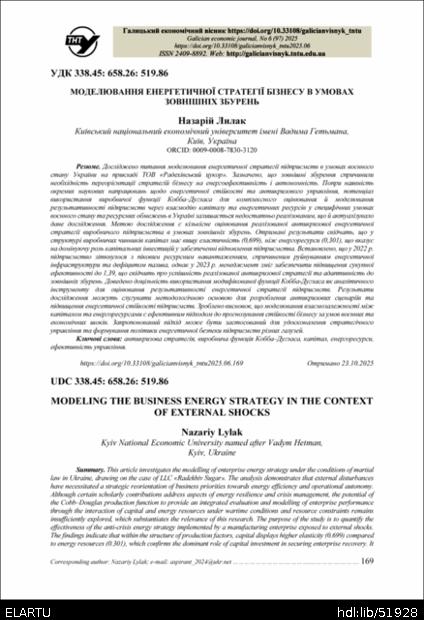
| Resumen : | Досліджено питання моделювання енергетичної стратегії підприємств в умовах воєнного
стану України на прикладі ТОВ «Радехівський цукор». Зазначено, що зовнішні збурення спричинили
необхідність переорієнтації стратегій бізнесу на енергоефективність і автономність. Попри наявність
окремих наукових напрацювань щодо енергетичної стійкості та антикризового управління, потенціал
використання виробничої функції Кобба–Дугласа для комплексного оцінювання й моделювання
результативності підприємств через взаємодію капіталу та енергетичних ресурсів у специфічних умовах
воєнного стану та ресурсних обмежень в Україні залишається недостатньо реалізованим, що й актуалізувало
дане дослідження. Метою дослідження є кількісне оцінювання реалізованої антикризової енергетичної
стратегії виробничого підприємства в умовах зовнішніх збурень. Отримані результати свідчать, що у
структурі виробничих чинників капітал має вищу еластичність (0,699), ніж енергоресурси (0,301), що вказує
на домінуючу роль капітальних інвестицій у забезпеченні відновлення підприємства. Встановлено, що у 2022 р.
підприємство зіткнулося з піковим ресурсним навантаженням, спричиненим руйнуванням енергетичної
інфраструктури та дефіцитом палива, однак у 2023 р. менеджмент зміг забезпечити підвищення сукупної
ефективності до 1,39, що свідчить про успішність реалізованої антикризової стратегії та адаптивність до
зовнішніх збурень. Доведено доцільність використання модифікованої функції Кобба-Дугласа як аналітичного
інструменту для оцінювання результативності енергетичної стратегії підприємств. Результати
дослідження можуть слугувати методологічною основою для розроблення антикризових сценаріїв та
підвищення енергетичної стійкості підприємств. Зроблено висновок, що моделювання взаємозалежності між
капіталом та енергоресурсами є ефективним підходом до прогнозування стійкості бізнесу за умов воєнних та
економічних шоків. Запропонований підхід може бути застосований для удосконалення стратегічного
управління та формування політики енергетичної безпеки підприємств різних галузей. This article investigates the modelling of enterprise energy strategy under the conditions of martial law in Ukraine, drawing on the case of LLC «Radekhiv Sugar». The analysis demonstrates that external disturbances have necessitated a strategic reorientation of business priorities towards energy efficiency and operational autonomy. Although certain scholarly contributions address aspects of energy resilience and crisis management, the potential of the Cobb–Douglas production function to provide an integrated evaluation and modelling of enterprise performance through the interaction of capital and energy resources under wartime conditions and resource constraints remains insufficiently explored, which substantiates the relevance of this research. The purpose of the study is to quantify the effectiveness of the anti-crisis energy strategy implemented by a manufacturing enterprise exposed to external shocks. The findings indicate that within the structure of production factors, capital displays higher elasticity (0.699) compared to energy resources (0.301), which confirms the dominant role of capital investment in securing enterprise recovery. It was established that in 2022 the enterprise experienced peak resource pressure caused by the destruction of energy infrastructure and fuel shortages, whereas in 2023 the management succeeded in improving overall efficiency to 1.39, which evidences the effectiveness of the adopted anti-crisis strategy and the adaptability of the enterprise to external disturbances. The study substantiates the expediency of employing a modified Cobb–Douglas function as an analytical instrument for evaluating the effectiveness of enterprise energy strategy. The results obtained may serve as a methodological basis for the development of anti-crisis scenarios and the enhancement of energy resilience in enterprises. The research concludes that modelling the interdependence between capital and energy resources constitutes an effective approach to forecasting business resilience under conditions of military and economic shocks. The proposed approach may be utilised to strengthen strategic management and inform enterprise energy security policies across various industrial sectors. |
| URI : | http://elartu.tntu.edu.ua/handle/lib/51928 |
| ISSN : | 2409-8892 |
| Copyright owner: | © Тернопільський національний технічний університет імені Івана Пулюя, 2025 |
| URL for reference material: | https://doi.org/10.1016/j.procs.2025.01.154 https://doi.org/10.1504/IJEX.2022.124175 https://doi.org/10.1016/j.ecolecon.2018.11.002 http://www.economy.nayka.com.ua/?op=1&z=5916 https://radsugar.com/reports https://commodity-board.com/ukraine-sugar-sector-2025-26-outlook-darkens-as-eu-access-shrinks https://doi.org/10.33108/galicianvisnyk_tntu2024.05.024 https://commodity-board.com/ukraine-sugar-sector-2025-26-outlook-darkens-as-eu- |
| References (Ukraine): | 1. Kirzhetska M., Kirzhetskyy Y. Financial sustainability of the digital enterprise under the conditions of uncertainty. Marketing and logistics: innovations, strategies, society: collective monograph / In Hlynskyy, N. (Ed.), Tallinn: Teadmus, 2024. Р. 246–258 2. Yemelyanov O., Petrushka T., Koleshchuk O., Petrushka K., Havras D. Modelling and assessment of obstacles to energy saving technological changes: the case of Ukrainian industrial enterprises. Procedia Computer Science. 2025. Vol. 253. Р. 922–931. DOI: https://doi.org/10.1016/j.procs.2025.01.154 3. Ayres Rt, Savin I., van den Bergh J., Hao Lu. Exergy versus Labor in Aggregate Production Functions: Estimates for Ten Large Economies. International Journal of Exergy. 2021. Vol. 38. DOI: https://doi.org/10.1504/IJEX.2022.124175 4. Keen S., Ayres R. U., Standish R. A note on the role of energy in production. Ecological Economics. 2019. Vol. 157. Р. 40–46. DOI: https://doi.org/10.1016/j.ecolecon.2018.11.002 5. Касьянова Н. В. Впровадження стратегії енергозбереження на промислових підприємствах. Електронний журнал «Ефективна економіка». 2017. № 2. URL: http://www.economy.nayka.com.ua/?op=1&z=5916 (дата звернення: 20.09.2025). 6. Фінансова звітність ТОВ «Радехівський цукор». Radsugar: веб-сайт. URL: https://radsugar.com/reports (дата звернення: 01.10.2025). 7. Commodity Board Europe GmbH. Ukraine sugar sector 2025/26. Outlook darkens as EU access shrinks : веб-сайт. URL: https://commodity-board.com/ukraine-sugar-sector-2025-26-outlook-darkens-as-eu-access-shrinks (дата звернення: 20.09.2025). 8. Костецька Н., Лотиш О. Оцінювання рівня концентрації цукрової промисловості України. Галицький економічний вісник. 2024. Том 90. № 5. С. 24–36. DOI: https://doi.org/10.33108/galicianvisnyk_tntu2024.05.024 9. Кіржецька М. С. Економічна безпека підсистем харчової промисловості України: проблеми та пріоритети зміцнення : монографія. Львів : Ліга-Прес, 2018. 214 с. |
| References (International): | 1. Kirzhetska M., Kirzhetskyy Y. (2024). Financial sustainability of the digital enterprise under the conditions of uncertainty. In: Hlynskyy, N. (Ed.), Marketing and logistics: innovations, strategies, society: collective monograph. Tallinn: Teadmus, pp. 246–258. 2. Yemelyanov O., Petrushka T., Koleshchuk O., Petrushka K., Havras D. (2025) Modelling and assessment of obstacles to energy saving technological changes: the case of Ukrainian industrial enterprises. Procedia Computer Science, vol. 253, pp. 922–931. DOI: https://doi.org/10.1016/j.procs.2025.01.154 3. Ayres R. U., Savin I., van den Bergh J., Hao L. (2021). Exergy versus Labour in Aggregate Production Functions: Estimates for Ten Large Economies. International Journal of Exergy, vol. 38. DOI: https://doi.org/10.1504/IJEX.2022.124175 4. Keen S., Ayres R. U., Standish R. (2019). A note on the role of energy in production. Ecological Economics, vol. 157, pp. 40–46. DOI: https://doi.org/10.1016/j.ecolecon.2018.11.002 5. Kasianova N. V. (2017) Vprovadzhennia stratehii enerhozberezhennia na promyslovykh pidpryiemstvakh [Implementation of the energy saving strategy at industrial enterprises]. Efektyvna ekonomika [Efficient economy], no. 2. Available at: http://www.economy.nayka.com.ua/?op=1&z=5916 (accessed: 20 September 2025). 6. Finansova zvitnist TOV “Radehivskyi tsukor” [Financial statements of LLC “Radehiv Sugar”]. Radsugar: website. Available at: https://radsugar.com/reports (accessed: 1 October 2025). 7. Commodity Board Europe GmbH. (2025). Ukraine sugar sector 2025/26. Outlook darkens as EU access shrinks. Available at: https://commodity-board.com/ukraine-sugar-sector-2025-26-outlook-darkens-as-eu- access-shrinks (accessed: 20 September 2025). 8. Kostetska N., Lotysh O. (2024) Otsiniuvannia rivnia kontsentratsii tsukrovoi promyslovosti Ukrainy [Assessment of the concentration level of Ukraine’s sugar industry]. Halytskyi ekonomichnyi visnyk [Galician Economic journal], vol. 90, no. 5, pp. 24–36. DOI: https://doi.org/10.33108/galicianvisnyk_tntu2024.05.024 9. Kirzhetska M. S. (2018). Ekonomichna bezpeka pidsystem kharchovoi promyslovosti Ukrainy: problemy ta priorytety zmitsnennia: monohrafiia [Economic security of subsystems of the food industry of Ukraine: problems and priorities for strengthening: monograph]. Lviv: Liha-Pres, 214 p. |
| Content type: | Article |
| Aparece en las colecciones: | Галицький економічний вісник, 2025, № 6 (97) |
Ficheros en este ítem:
| Fichero | Descripción | Tamaño | Formato | |
|---|---|---|---|---|
| GEJ_2025v97n6_Lylak_N-Modeling_the_business_energy_169-175.pdf | 2,52 MB | Adobe PDF | Visualizar/Abrir | |
| GEJ_2025v97n6_Lylak_N-Modeling_the_business_energy_169-175__COVER.png | 1,31 MB | image/png | Visualizar/Abrir |
Los ítems de DSpace están protegidos por copyright, con todos los derechos reservados, a menos que se indique lo contrario.