
Будь ласка, використовуйте цей ідентифікатор, щоб цитувати або посилатися на цей матеріал:
http://elartu.tntu.edu.ua/handle/lib/51531
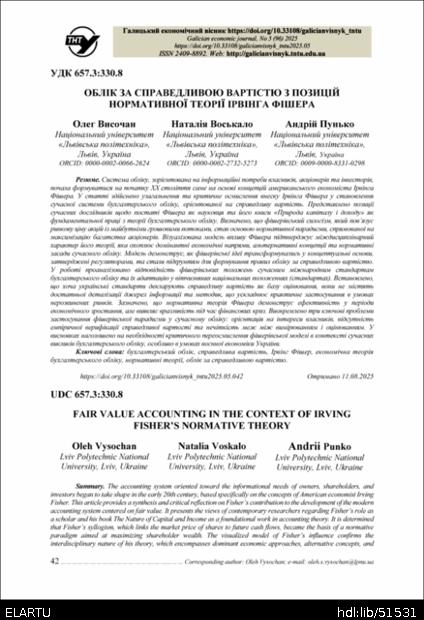
| Назва: | Облік за справедливою вартістю з позицій нормативної теорії Ірвінга Фішера |
| Інші назви: | Fair value accounting in the context of Irving Fisher’s normative theory |
| Автори: | Височан, Олег Степанович Воськало, Наталія Миколаївна Пунько, Андрій Володимирович Vysochan, Oleh Voskalo, Natalia Punko, Andrii |
| Приналежність: | Національний університет «Львівська політехніка», Львів, Україна Lviv Polytechnic National University, Lviv, Ukraine |
| Бібліографічний опис: | Височан О. С. Облік за справедливою вартістю з позицій нормативної теорії Ірвінга Фішера / Височан Олег Степанович, Воськало Наталія Миколаївна, Пунько Андрій Володимирович // ГЕВ. — Т. : ТНТУ, 2025. — Том 96. — № 5. — С. 42–49. — (Облік і оподаткування). |
| Бібліографічне посилання: | Височан О. С., Пунько А. В. Облік за справедливою вартістю з позицій нормативної теорії Ірвінга Фішера // ГЕВ, Тернопіль. 2025. Том 96. № 5. С. 42–49. |
| Bibliographic citation (APA): | Vysochan, O., Voskalo, N., & Punko, A. (2025). Oblik za spravedlyvoiu vartistiu z pozytsii normatyvnoi teorii Irvinha Fishera [Fair value accounting in the context of Irving Fisher’s normative theory]. Galician economic journal, 96(5), 42-49. TNTU. [in Ukrainian]. |
| Bibliographic citation (CHICAGO): | Vysochan O., Voskalo N., Punko A. (2025) Oblik za spravedlyvoiu vartistiu z pozytsii normatyvnoi teorii Irvinha Fishera [Fair value accounting in the context of Irving Fisher’s normative theory]. Galician economic journal (Tern.), vol. 96, no 5, pp. 42-49 [in Ukrainian]. |
| Є частиною видання: | Галицький економічний вісник, 5 (96), 2025 Galician economic journal, 5 (96), 2025 |
| Журнал/збірник: | Галицький економічний вісник |
| Випуск/№ : | 5 |
| Том: | 96 |
| Дата публікації: | 28-жов-2025 |
| Дата подання: | 11-сер-2025 |
| Дата внесення: | 16-лют-2026 |
| Видавництво: | ТНТУ TNTU |
| Місце видання, проведення: | Тернопіль Ternopil |
| DOI: | https://doi.org/10.33108/galicianvisnyk_tntu2025.05.042 |
| УДК: | 657.3 330.8 |
| Теми: | бухгалтерський облік справедлива вартість Ірвінг Фішер економічна теорія бухгалтерського обліку нормативні теорії облік за справедливою вартістю accounting fair value Irving Fisher economic theory of accounting normative theories fair value accounting |
| Кількість сторінок: | 8 |
| Діапазон сторінок: | 42-49 |
| Початкова сторінка: | 42 |
| Кінцева сторінка: | 49 |
| Короткий огляд (реферат): | Система обліку, зорієнтована на інформаційні потреби власників, акціонерів та інвесторів,
почала формуватися на початку ХХ століття саме на основі концепцій американського економіста Ірвінга
Фішера. У статті здійснено узагальнення та критичне осмислення внеску Ірвінга Фішера у становлення
сучасної системи бухгалтерського обліку, орієнтованої на справедливу вартість. Представлено позиції
сучасних дослідників щодо постаті Фішера як науковця та його книги «Природа капіталу і доходу» як
фундаментальної праці з теорії бухгалтерського обліку. Визначено, що фішерівський силогізм, який пов’язує
ринкову ціну акцій із майбутніми грошовими потоками, став основою нормативної парадигми, спрямованої на
максимізацію багатства акціонерів. Візуалізована модель впливу Фішера підтверджує міждисциплінарний
характер його теорії, яка охоплює домінантні економічні напрями, альтернативні концепції та нормативні
засади сучасного обліку. Модель демонструє, як фішерівські ідеї трансформувались у концептуальні основи,
затверджені регуляторами, та стали підґрунтям для формування правил обліку за справедливою вартістю.
У роботі проаналізовано відповідність фішерівських положень сучасним міжнародним стандартам
бухгалтерського обліку та їх адаптацію у вітчизняних національних положеннях (стандартах). Встановлено,
що хоча українські стандарти декларують справедливу вартість як базу оцінювання, вони не містять
достатньої деталізації джерел інформації та методик, що ускладнює практичне застосування в умовах
нерозвинених ринків. Зазначено, що нормативна теорія Фішера демонструє ефективність у періоди
економічного зростання, але виявляє вразливість під час фінансових криз. Виокремлено три ключові проблеми
застосування фішерівської парадигми у сучасному обліку: орієнтація на інтереси власників, відсутність
емпіричної верифікації справедливої вартості та нечіткість меж між вимірюванням і оцінюванням. У
висновках наголошено на необхідності критичного переосмислення фішерівської моделі в контексті сучасних
викликів бухгалтерського обліку, особливо в умовах воєнної економіки України. The accounting system oriented toward the informational needs of owners, shareholders, and investors began to take shape in the early 20th century, based specifically on the concepts of American economist Irving Fisher. This article provides a synthesis and critical reflection on Fisher’s contribution to the development of the modern accounting system centered on fair value. It presents the views of contemporary researchers regarding Fisher’s role as a scholar and his book The Nature of Capital and Income as a foundational work in accounting theory. It is determined that Fisher’s syllogism, which links the market price of shares to future cash flows, became the basis of a normative paradigm aimed at maximizing shareholder wealth. The visualized model of Fisher’s influence confirms the interdisciplinary nature of his theory, which encompasses dominant economic approaches, alternative concepts, and normative foundations of modern accounting. The model illustrates how Fisher’s ideas were transformed into conceptual frameworks endorsed by regulators and became the foundation for the development of fair value accounting rules. The study analyzes the alignment of Fisher’s principles with contemporary international accounting standards and their adaptation within national accounting regulations in Ukraine. It is found that although Ukrainian standards declare fair value as a measurement base, they lack sufficient detail regarding data sources and methodologies, which complicates practical implementation in underdeveloped markets. It is noted that Fisher’s normative theory proves effective during periods of economic growth but reveals vulnerabilities during financial crises. Three key problems in applying Fisher’s paradigm to modern accounting are identified: its orientation toward the interests of owners, the absence of empirical verification of fair value, and the ambiguity between measurement and valuation. The conclusion emphasizes the need for a critical reassessment of Fisher’s model in light of current challenges in accounting, particularly under the conditions of Ukraine’s wartime economy. |
| URI (Уніфікований ідентифікатор ресурсу): | http://elartu.tntu.edu.ua/handle/lib/51531 |
| ISSN: | 2409-8892 |
| Власник авторського права: | © Тернопільський національний технічний університет імені Івана Пулюя, 2025 |
| URL-посилання пов’язаного матеріалу: | https://doi.org/10.1016/j.cpa.2012.09.004 https://doi.org/10.1111/j.1536-7150.2005.00347.x https://doi.org/10.1080/10427710701335885 https://doi.org/10.1002/9781119448723 https://doi.org/10.1080/21552851.2018.1541000 https://doi.org/10.1177/10323732221144799 https://doi.org/10.5709/ce.1897-9254.250 https://doi.org/10.1080/21552851.2018.1542229 https://doi.org/10.2308/0148-4184.22.2.43 https://doi.org/10.1080/0958520032000084978 https://doi.org/10.1111/j.1468-5957.1979.tb01093.x https://doi.org/10.1515/9783112351369 https://doi.org/10.2307/2490207 https://doi.org/10.1080/21552851.2018.1542230 |
| Перелік літератури: | 1. Bryer R. Americanism and Financial Accounting Theory – Part 3: Adam Smith, the Rise and Fall of Socialism, and Irving Fisher’s Theory of Accounting. Critical Perspectives on Accounting. 2013. No. 24. P. 572–615. DOI: https://doi.org/10.1016/j.cpa.2012.09.004 2. Tobin J. Irving Fisher (1867–1947). The American Journal of Economics and Sociology. 2005. No. 64 (1). P. 19–42. DOI: https://doi.org/10.1111/j.1536-7150.2005.00347.x 3. Dimand R. W. Irving Fisher and Financial Economics: The Equity Premium Puzzle, the Predictability of Stock Prices, and Intertemporal Allocation under Risk. Journal of the History of Economic Thought. 2007. No. 29 (2). P. 153–166. DOI: https://doi.org/10.1080/10427710701335885 4. Zyla M. L. Fair Value Measurement: Practical Guidance and Implementation. 2020, 3rd edition.: John Wiley & Sons, Inc. DOI: https://doi.org/10.1002/9781119448723 5. Cardao-Pito T., Silva Ferreira J. «Fair Value» Accounting as the Normative Fisherian Phase of Accounting. Accounting History Review. 2018. No. 28 (3). P. 149–179. DOI: https://doi.org/10.1080/21552851.2018.1541000 6. Cardao-Pito T. Prevalence of Fisher’s Theory in Mainstream Accounting and Economic Research. Accounting History. 2023. No. 28 (2). P. 312–337. DOI: https://doi.org/10.1177/10323732221144799 7. Cardao-Pito T. Classes in Maximizing Shareholders’ Wealth: Irving Fisher’s Theory of the Economic Organization in Corporate Financial Economics Textbooks. Contemporary Economics. 2017. No. 11 (4). P. 369–382. Doi: https://doi.org/10.5709/ce.1897-9254.250. 8. Baker C. R. The Lack of Impact of Fair Value Accounting: A Commentary on «Fair Value» Accounting as the Normative Fisherian Phase of Accounting». Accounting History Review. 2018. No. 28 (3). P. 191–198. DOI: https://doi.org/10.1080/21552851.2018.1542229 9. Mouck T. Irving Fisher and the Mechanistic Character of Twentieth Century Accounting Thoughts. The Accounting Historians Journal. 1995. No. 22 (2). P. 43–83. DOI: https://doi.org/10.2308/0148-4184.22.2.43 10. Mattessich R. Accounting Research and Researchers of the Nineteenth Century and the Beginning of the Twentieth Century: An International Survey of Authors, Ideas and Publications. Accounting, Business & Financial History. 2003. No. 13 (2).P. 125–170. DOI: https://doi.org/10.1080/0958520032000084978 11. Lee T. A. The Contribution of Fisher to Cash Flow Accounting. Journal of Business Finance & Accounting. 1979. No. 6 (3). P. 321–330. DOI: https://doi.org/10.1111/j.1468-5957.1979.tb01093.x 12. Fisher I. The Nature of Capital and Income. 1906. London: Macmillan & Co., Ltd. DOI: https://doi.org/10.1515/9783112351369 13. Chambers R. J. Income and Capital: Fisher’s Legacy. Journal of Accounting Research. 1971. No. 9 (1). P. 137–149. DOI: https://doi.org/10.2307/2490207 14. Markarian G. The Role of Irving Fisher in the Development of Fair Value Accounting Thought. Accounting History Review. 2018. No. 28 (3). P. 181–190. DOI: https://doi.org/10.1080/21552851.2018.1542230 |
| References: | 1. Bryer R. (2013) Americanism and Financial Accounting Theory – Part 3: Adam Smith, the Rise and Fall of Socialism, and Irving Fisher’s Theory of Accounting. Critical Perspectives on Accounting, vol. 24, pp. 572-615. DOI: https://doi.org/10.1016/j.cpa.2012.09.004 2. Tobin J. (2005) Irving Fisher (1867–1947). The American Journal of Economics and Sociology, vol. 64 (1), pp. 19–42. DOI: https://doi.org/10.1111/j.1536-7150.2005.00347.x 3. Dimand R. W. (2007) Irving Fisher and Financial Economics: The Equity Premium Puzzle, the Predictability of Stock Prices, and Intertemporal Allocation under Risk. Journal of the History of Economic Thought, vol. 29 (2), pp. 153–166. DOI: https://doi.org/10.1080/10427710701335885 4. Zyla M. L. (2020). Fair Value Measurement: Practical Guidance and Implementation, 3rd edition. : John Wiley & Sons, Inc. DOI: https://doi.org/10.1002/9781119448723 5. Cardao-Pito T., & Silva Ferreira J. (2018) “Fair Value” Accounting as the Normative Fisherian Phase of Accounting. Accounting History Review, vol. 28 (3), pp. 149–179. DOI: https://doi.org/10.1080/21552851.2018.1541000 6. Cardao-Pito T. (2023) Prevalence of Fisher’s Theory in Mainstream Accounting and Economic Research. Accounting History, vol. 28 (2), pp. 312–337. DOI: https://doi.org/10.1177/10323732221144799 7. Cardao-Pito T. (2017) Classes in Maximizing Shareholders’ Wealth: Irving Fisher’s Theory of the Economic Organization in Corporate Financial Economics Textbooks. Contemporary Economics, vol. 11 (4), pp. 369–382. Doi: https://doi.org/10.5709/ce.1897-9254.250. 8. Baker C. R. (2018) The Lack of Impact of Fair Value Accounting: A Commentary on “Fair Value” Accounting as the Normative Fisherian Phase of Accounting”. Accounting History Review, vol. 28 (3), pp. 191–198. DOI: https://doi.org/10.1080/21552851.2018.1542229 9. Mouck T. (1995) Irving Fisher and the Mechanistic Character of Twentieth Century Accounting Thoughts. The Accounting Historians Journal, vol. 22 (2), pp. 43–83. DOI: https://doi.org/10.2308/0148-4184.22.2.43 10. Mattessich R. (2003) Accounting Research and Researchers of the Nineteenth Century and the Beginning of the Twentieth Century: An International Survey of Authors, Ideas and Publications. Accounting, Business & Financial History, vol. 13 (2), pp. 125–170. DOI: https://doi.org/10.1080/0958520032000084978 11. Lee T. A. (1979) The Contribution of Fisher to Cash Flow Accounting. Journal of Business Finance & Accounting, vol. 6 (3), pp. 321–330. DOI: https://doi.org/10.1111/j.1468-5957.1979.tb01093.x 12. Fisher I. (1906). The Nature of Capital and Income. London: Macmillan & Co., Ltd. DOI: https://doi.org/10.1515/9783112351369 13. Chambers R. J. (1971) Income and Capital: Fisher’s Legacy. Journal of Accounting Research, vol. 9 (1), pp. 137–149. DOI: https://doi.org/10.2307/2490207 14. Markarian G. (2018) The Role of Irving Fisher in the Development of Fair Value Accounting Thought. Accounting History Review, vol. 28 (3), рр. 181–190. DOI: https://doi.org/10.1080/21552851.2018.1542230 |
| Тип вмісту: | Article |
| Розташовується у зібраннях: | Галицький економічний вісник, 2025, № 5 (96) |
Файли цього матеріалу:
| Файл | Опис | Розмір | Формат | |
|---|---|---|---|---|
| GEJ_2025v96n5_Vysochan_O-Fair_value_accounting_in_42-49.pdf | 2,68 MB | Adobe PDF | Переглянути/відкрити | |
| GEJ_2025v96n5_Vysochan_O-Fair_value_accounting_in_42-49__COVER.png | 1,37 MB | image/png | Переглянути/відкрити |
Усі матеріали в архіві електронних ресурсів захищені авторським правом, всі права збережені.