
Ezzel az azonosítóval hivatkozhat erre a dokumentumra forrásmegjelölésben vagy hiperhivatkozás esetén:
http://elartu.tntu.edu.ua/handle/lib/51507
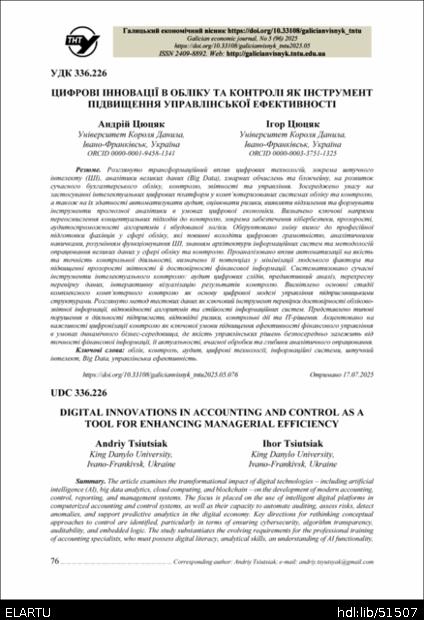
| Başlık: | Цифрові інновації в обліку та контролі як інструмент підвищення управлінської ефективності |
| Diğer Başlıklar: | Digital innovations in accounting and control as a tool for enhancing managerial efficiency |
| Yazarlar: | Цюцяк, Андрій Любомирович Цюцяк, Ігор Любомирович Tsiutsiak, Andriy Tsiutsiak, Ihor |
| Affiliation: | Університет Короля Данила, Івано-Франківськ, Україна King Danylo University, Ivano-Frankivsk, Ukraine |
| Bibliographic description (Ukraine): | Цюцяк А. Л. Цифрові інновації в обліку та контролі як інструмент підвищення управлінської ефективності / Цюцяк Андрій Любомирович, Цюцяк Ігор Любомирович // ГЕВ. — Т. : ТНТУ, 2025. — Том 96. — № 5. — С. 76–84. — (Облік і оподаткування). |
| Bibliographic reference (2015): | Цюцяк А. Л., Цюцяк І. Л. Цифрові інновації в обліку та контролі як інструмент підвищення управлінської ефективності // ГЕВ, Тернопіль. 2025. Том 96. № 5. С. 76–84. |
| Bibliographic citation (APA): | Tsiutsiak, A., & Tsiutsiak, I. (2025). Tsyfrovi innovatsii v obliku ta kontroli yak instrument pidvyshchennia upravlinskoi efektyvnosti [Digital innovations in accounting and control as a tool for enhancing managerial efficiency]. Galician economic journal, 96(5), 76-84. TNTU. [in Ukrainian]. |
| Bibliographic citation (CHICAGO): | Tsiutsiak A., Tsiutsiak I. (2025) Tsyfrovi innovatsii v obliku ta kontroli yak instrument pidvyshchennia upravlinskoi efektyvnosti [Digital innovations in accounting and control as a tool for enhancing managerial efficiency]. Galician economic journal (Tern.), vol. 96, no 5, pp. 76-84 [in Ukrainian]. |
| Is part of: | Галицький економічний вісник, 5 (96), 2025 Galician economic journal, 5 (96), 2025 |
| Journal/Collection: | Галицький економічний вісник |
| Issue: | 5 |
| Volume: | 96 |
| Yayın Tarihi: | 28-Eki-2025 |
| Submitted date: | 17-Tem-2025 |
| Date of entry: | 16-Şub-2026 |
| Yayıncı: | ТНТУ TNTU |
| Place of the edition/event: | Тернопіль Ternopil |
| DOI: | https://doi.org/10.33108/galicianvisnyk_tntu2025.05.076 |
| UDC: | 336.226 |
| Anahtar kelimeler: | облік контроль аудит цифрові технології інформаційні системи штучний інтелект Big Data управлінська ефективність accounting control audit digital technologies information systems artificial intelligence big data managerial efficiency |
| Number of pages: | 9 |
| Page range: | 76-84 |
| Start page: | 76 |
| End page: | 84 |
| Özet: | Розглянуто трансформаційний вплив цифрових технологій, зокрема штучного
інтелекту (ШІ), аналітики великих даних (Big Data), хмарних обчислень та блокчейну, на розвиток
сучасного бухгалтерського обліку, контролю, звітності та управління. Зосереджено увагу на
застосуванні інтелектуальних цифрових платформ у комп’ютеризованих системах обліку та контролю,
а також на їх здатності автоматизувати аудит, оцінювати ризики, виявляти відхилення та формувати
інструменти прогнозної аналітики в умовах цифрової економіки. Визначено ключові напрями
переосмислення концептуальних підходів до контролю, зокрема забезпечення кібербезпеки, прозорості,
аудитоспроможності алгоритмів і вбудованої логіки. Обґрунтовано зміну вимог до професійної
підготовки фахівців у сфері обліку, які повинні володіти цифровою грамотністю, аналітичними
навичками, розумінням функціонування ШІ, знанням архітектури інформаційних систем та методологій
опрацювання великих даних у сфері обліку та контролю. Проаналізовано вплив автоматизації на якість
та точність контрольної діяльності, визначено її потенціал у мінімізації людського фактора та
підвищенні прозорості звітності й достовірності фінансової інформації. Систематизовано сучасні
інструменти інтелектуального контролю: аудит цифрових слідів, предиктивний аналіз, перехресну
перевірку даних, інтерактивну візуалізацію результатів контролю. Висвітлено основні стадії
комплексного комп’ютерного контролю як основу цифрової моделі управління підприємницькими
структурами. Розглянуто метод тестових даних як ключовий інструмент перевірки достовірності обліково-
звітної інформації, відповідності алгоритмів та стійкості інформаційних систем. Представлено типові
порушення в діяльності підприємств, відповідні ризики, контрольні дії та ІТ-рішення. Акцентовано на
важливості цифровізації контролю як ключової умови підвищення ефективності фінансового управління
в умовах динамічного бізнес-середовища, де якість управлінських рішень безпосередньо залежить від
точності фінансової інформації, її актуальності, вчасної обробки та глибини аналітичного опрацювання. The article examines the transformational impact of digital technologies – including artificial intelligence (AI), big data analytics, cloud computing, and blockchain – on the development of modern accounting, control, reporting, and management systems. The focus is placed on the use of intelligent digital platforms in computerized accounting and control systems, as well as their capacity to automate auditing, assess risks, detect anomalies, and support predictive analytics in the digital economy. Key directions for rethinking conceptual approaches to control are identified, particularly in terms of ensuring cybersecurity, algorithm transparency, auditability, and embedded logic. The study substantiates the evolving requirements for the professional training of accounting specialists, who must possess digital literacy, analytical skills, an understanding of AI functionality, knowledge of information systems architecture, and methodologies for big data processing in the context of accounting and control. The influence of automation on the quality and accuracy of control activities is analyzed, and its potential to reduce human error and enhance reporting transparency and the reliability of financial information is highlighted. Modern intelligent control tools are systematized, including digital footprint auditing, predictive analytics, data cross-checking, and interactive visualization of control outcomes. The main stages of comprehensive computerized control are outlined as the foundation of a digital model for managing business entities. The test data method is considered a key instrument for verifying the reliability of accounting and reporting information, the compliance of algorithms, and the resilience of information systems. The article also presents common violations in enterprise operations, related risks, control actions, and IT solutions. The importance of digitalization is emphasized as a critical factor for improving financial management effectiveness in a dynamic business environment, where the quality of managerial decisions directly depends on the accuracy, timeliness, and analytical depth of financial information. |
| URI: | http://elartu.tntu.edu.ua/handle/lib/51507 |
| ISSN: | 2409-8892 |
| Copyright owner: | © Тернопільський національний технічний університет імені Івана Пулюя, 2025 |
| URL for reference material: | https://www.iraj.in/journal/journal_file/journal_pdf/14-213-145172620179-83.pdf https://www.scirp.org/pdf/ojbm_2022012815552296.pdf https://doi.org/10.4324/9781003198123 https://www.scirp.org/journal/paperinformation?paperid=87045 https://doi.org/10.4236/ojbm.2018.64063 https://iopscience.iop.org/article/10.1088/1742-6596/1744/4/042066/pdf https://doi.org/10.1088/1742-6596/1744/4/042066 https://doi.org/10.31558/2307-2318.2023.3.3 https://zakon.rada.gov.ua/laws/show/517-2019-%D0%BF#Text |
| References (Ukraine): | 1. Ernest O. The relevance of auditing in a computerized accounting system. International Journal of Management and Applied Science. 2015. No. 1 (11). P. 79–83. Available at: https://www.iraj.in/journal/journal_file/journal_pdf/14-213-145172620179-83.pdf (дата звернення: 14.07.2025). 2. Hasan A. Artificial Intelligence (AI) in accounting & auditing: A Literature review. Open Journal of Business and Management. 2021. No. 10 (1). P. 440–465. Available at: https://www.scirp.org/pdf/ojbm_2022012815552296.pdf (дата звернення: 15.07.2025). 3. Lehner O., Leitner-Hanetseder S., Eisl C., & Knoll C. Artificial intelligence-driven accounting (AIDA): future insights and organisational implications. In Artificial Intelligence in Accounting. 2022. P. 6–34). Routledge (дата звернення: 12.07.2025). DOI: https://doi.org/10.4324/9781003198123 4. Luo J., Meng Q., & Cai Y. Analysis of the impact of artificial intelligence application on the development of accounting industry. Open Journal of Business and Management. 2018. No. 6 (4). P. 850–856. Available at: https://www.scirp.org/journal/paperinformation?paperid=87045. (дата звернення: 15.07.2025). DOI: https://doi.org/10.4236/ojbm.2018.64063 5. Zhang Y. On the application of computer in the internal control of financial accounting system. In Journal of Physics: Conference Series. 2021. Vol. 1744. No. 4. P. 042066. IOP Publishing. Available at: https://iopscience.iop.org/article/10.1088/1742-6596/1744/4/042066/pdf (дата звернення: 14.07.2025). DOI: https://doi.org/10.1088/1742-6596/1744/4/042066 6. Гевлич Л. Диджитал аудит: світова та вітчизняна практика. Економіка і організація управління. 2023. № 3 (51) С. 24–33. DOI: https://doi.org/10.31558/2307-2318.2023.3.3 7. Про затвердження Порядку проведення Державною аудиторською службою, її міжрегіональними територіальними органами державного фінансового аудиту використання інформаційних технологій. URL: https://zakon.rada.gov.ua/laws/show/517-2019-%D0%BF#Text (дата звернення: 16.07.2025). |
| References (International): | 1. Ernest O. (2015) The relevance of auditing in a computerized accounting system. International Journal of Management and Applied Science, no. 1 (11), pp. 79–83. Available at: https://www.iraj.in/journal/journal_file/journal_pdf/14-213-145172620179-83.pdf. (accessed: 14 July 2025). 2. Hasan A. (2021) Artificial Intelligence (AI) in accounting & auditing: A Literature review. Open Journal of Business and Management, no. 10 (1), pp. 440–465. Available at: https://www.scirp.org/pdf/ojbm_2022012815552296.pdf (accessed: 15 July 2025). 3. Lehner O., Leitner-Hanetseder S., Eisl C., & Knoll C. (2022). Artificial intelligence-driven accounting (AIDA): future insights and organisational implications. In Artificial Intelligence in Accounting. pp. 6-34. Routledge (accessed: 12 July 2025). DOI: https://doi.org/10.4324/9781003198123 4. Luo J., Meng Q., & Cai Y. (2018). Analysis of the impact of artificial intelligence application on the development of accounting industry. Open Journal of Business and Management, no. 6 (4), pp. 850–856. Available at: https://www.scirp.org/journal/paperinformation?paperid=87045 (accessed: 15 July 2025). DOI: https://doi.org/10.4236/ojbm.2018.64063 5. Zhang Y. (2021) On the application of computer in the internal control of financial accounting system. In Journal of Physics: Conference Series, vol. 1744, no. 4, pp. 042066. IOP Publishing. Available at: https://iopscience.iop.org/article/10.1088/1742-6596/1744/4/042066/pdf. (accessed: 14 July 2025). DOI: https://doi.org/10.1088/1742-6596/1744/4/042066 6. Ghevlych L. (2023) Dydzhytal-audyt: svitova ta vitchyznjana praktyka [Digital audit: global and domestic practice]. Ekonomika i orghanizacija upravlinnja [Economy and management organization], vol. 3 (51), pp. 24–33. DOI: https://doi.org/10.31558/2307-2318.2023.3.3 7. Pro zatverdzhennja Porjadku provedennja Derzhavnoju audytorsjkoju sluzhboju, jiji mizhreghionaljnymy terytorialjnymy orghanamy derzhavnogho finansovogho audytu vykorystannja informacijnykh tekhnologhij [On the approval of the Procedure for conducting the use of information technologies by the State Audit Service, its interregional territorial bodies of the state financial audit]. Available at: https://zakon.rada.gov.ua/laws/show/517-2019-%D0%BF#Text (accessed: 16 July 2025). |
| Content type: | Article |
| Koleksiyonlarda Görünür: | Галицький економічний вісник, 2025, № 5 (96) |
Bu öğenin dosyaları:
| Dosya | Açıklama | Boyut | Biçim | |
|---|---|---|---|---|
| GEJ_2025v96n5_Tsiutsiak_A-Digital_innovations_in_76-84.pdf | 2,9 MB | Adobe PDF | Göster/Aç | |
| GEJ_2025v96n5_Tsiutsiak_A-Digital_innovations_in_76-84__COVER.png | 1,32 MB | image/png | Переглянути/відкрити |
Усі матеріали в архіві електронних ресурсів захищені авторським правом, всі права збережені.