
Použijte tento identifikátor k citaci nebo jako odkaz na tento záznam:
http://elartu.tntu.edu.ua/handle/lib/50458
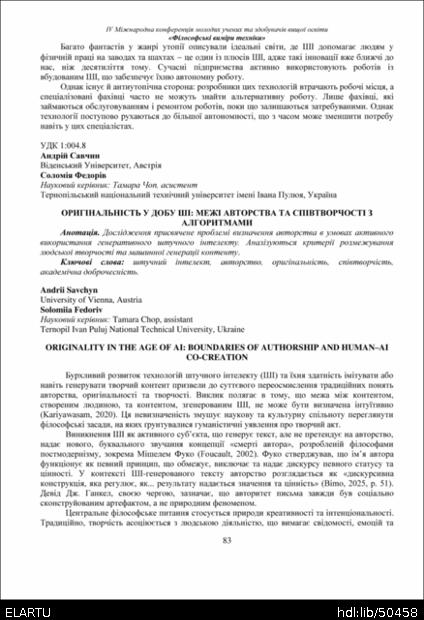
| Název: | Оригінальність у добу ШІ: межі авторства та співтворчості з алгоритмами |
| Další názvy: | Originality in the age of AI: boundaries of authorship and human–ai co-creation |
| Autoři: | Савчин, Андрій Федорів, Соломія Savchyn, Andrii Fedoriv, Solomiia |
| Affiliation: | Віденський Університет, Австрія Тернопільський національний технічний університет імені Івана Пулюя, Україна University of Vienna, Austria Ternopil Ivan Puluj National Technical University, Ukraine |
| Bibliographic description (Ukraine): | Савчин А. Оригінальність у добу ШІ: межі авторства та співтворчості з алгоритмами / Андрій Савчин, Соломія Федорів // Матеріали Ⅳ Міжнародної конференції молодих учених та здобувачів вищої освіти „Філософські виміри техніки“, 26 листопада 2025 р. — Т. : ФОП Паляниця В. А., 2025. — С. 83–85. — (Науково-технічний прогрес: проблеми та перспективи). |
| Bibliographic reference (2015): | Савчин А., Федорів С. Оригінальність у добу ШІ: межі авторства та співтворчості з алгоритмами // Матеріали Ⅳ Міжнародної конференції молодих учених та здобувачів вищої освіти „Філософські виміри техніки“, Тернопіль, 26 листопада 2025 р. 2025. С. 83–85. |
| Bibliographic citation (APA): | Savchyn, A., & Fedoriv, S. (2025). Oryhinalnist u dobu ShI: mezhi avtorstva ta spivtvorchosti z alhorytmamy [Originality in the age of AI: boundaries of authorship and human–ai co-creation]. Book of abstracts of the Ⅳ International Conference of Young Scholars and Higher Education Applicants „Philosophical dimensions of technology“, 26 November 2025, Ternopil, 83-85. PE Palianytsia V.A.. [in Ukrainian]. |
| Bibliographic citation (CHICAGO): | Savchyn A., Fedoriv S. (2025) Oryhinalnist u dobu ShI: mezhi avtorstva ta spivtvorchosti z alhorytmamy [Originality in the age of AI: boundaries of authorship and human–ai co-creation]. Book of abstracts of the Ⅳ International Conference of Young Scholars and Higher Education Applicants „Philosophical dimensions of technology“ (Tern., 26 November 2025), pp. 83-85 [in Ukrainian]. |
| Is part of: | Матеріали Ⅳ Міжнародної конференції молодих учених та здобувачів вищої освіти „Філософські виміри техніки“, 2025 Book of abstracts of the Ⅳ International Conference of Young Scholars and Higher Education Applicants „Philosophical dimensions of technology“, 2025 |
| Conference/Event: | Ⅳ Міжнародна конференція молодих учених та здобувачів вищої освіти „Філософські виміри техніки“ |
| Journal/Collection: | Матеріали Ⅳ Міжнародної конференції молодих учених та здобувачів вищої освіти „Філософські виміри техніки“ |
| Datum vydání: | 26-lis-2025 |
| Date of entry: | 19-pro-2025 |
| Nakladatel: | ФОП Паляниця В. А. PE Palianytsia V.A. |
| Place of the edition/event: | Тернопіль Ternopil |
| Temporal Coverage: | 26 листопада 2025 р. 26 November 2025 |
| Supervisor: | Чоп, Тамара Олександрівна Chop, Tamara |
| UDC: | 1 004.8 |
| Klíčová slova: | штучний інтелект авторство оригінальність співтворчість академічна доброчесність |
| Number of pages: | 3 |
| Page range: | 83-85 |
| Start page: | 83 |
| End page: | 85 |
| Abstrakt: | Дослідження присвячене проблемі визначення авторства в умовах активного використання генеративного штучного інтелекту. Аналізуються критерії розмежування людської творчості та машинної генерації контенту |
| URI: | http://elartu.tntu.edu.ua/handle/lib/50458 |
| ISBN: | 978-617-8751-05-0 |
| Copyright owner: | © Тернопільський національний технічний університет імені Івана Пулюя, 2025 |
| References (Ukraine): | 1. Barad, K. Posthumanist performativity: Toward an understanding of how matter comes to matter. Journal of Women in Culture and Society. 2003. Vol. 28, No 3. P. 801–831. 2. Bimo, S. Emerging models of AI ‘Authorship’ in popular discourse // The Routledge Handbook of AI and Literature (Routledge Literature Handbooks) / Slocombe, W., Liveley, G. (Eds). New York, NY: Routledge, 2025. P. 49–59. 3. Floridi, L. Distant writing: Literary production in the age of Artificial Intelligence. Minds and Machines. 2025. Vol. 35, No 30. P. 1–26. DOI: 10.1007/s11023-025-09732-1. 4. Foucault, M. What is an author? // Reading Architectural History / Arnold, D. (Ed.). London: Routledge, 2002. P. 71–81. DOI: 10.4324/9780203164471. 5. Gunkel, D. J. AI Signals The Death Of The Author. NOEMA. 2025. June 4. 6. Hajibayova, L., Lee, S. Authorship in the age of artificial intelligence. Journal of Documentation. 2025. DOI: 10.1108/JD-04-2025-0109. 7. Kariyawasam, K. Artificial intelligence and challenges for copyright law. International Journal of Law and Information Technology. 2020. Vol. 28, No 4. P. 279–296. DOI: 10.1093/ijlit/eaaa023. 8. Lu, B. A theory of ‘authorship transfer’ and its application to the context of Artificial Intelligence creations. Queen Mary Journal of Intellectual Property. 2021. Vol. 11, No 1. P. 2–24. DOI: 10.4337/qmjip.2021.01.01. 9. Miller, A. Artificial Intelligence, Art, and Authenticity. AI and Society. 2019. Vol. 34, No 3. P. 391–404. 10. Naaz, A., Fathima, B. Can AI Ever Be Truly Creative? A Philosophical Perspective. IRE Journals. 2025. Vol. 9, Issue 5. DOI: 10.64388/IREV9I5-1712140 |
| References (International): | 1. Barad, K. Posthumanist performativity: Toward an understanding of how matter comes to matter. Journal of Women in Culture and Society. 2003. Vol. 28, No 3. P. 801–831. 2. Bimo, S. Emerging models of AI ‘Authorship’ in popular discourse, The Routledge Handbook of AI and Literature (Routledge Literature Handbooks), Slocombe, W., Liveley, G. (Eds). New York, NY: Routledge, 2025. P. 49–59. 3. Floridi, L. Distant writing: Literary production in the age of Artificial Intelligence. Minds and Machines. 2025. Vol. 35, No 30. P. 1–26. DOI: 10.1007/s11023-025-09732-1. 4. Foucault, M. What is an author?, Reading Architectural History, Arnold, D. (Ed.). London: Routledge, 2002. P. 71–81. DOI: 10.4324/9780203164471. 5. Gunkel, D. J. AI Signals The Death Of The Author. NOEMA. 2025. June 4. 6. Hajibayova, L., Lee, S. Authorship in the age of artificial intelligence. Journal of Documentation. 2025. DOI: 10.1108/JD-04-2025-0109. 7. Kariyawasam, K. Artificial intelligence and challenges for copyright law. International Journal of Law and Information Technology. 2020. Vol. 28, No 4. P. 279–296. DOI: 10.1093/ijlit/eaaa023. 8. Lu, B. A theory of ‘authorship transfer’ and its application to the context of Artificial Intelligence creations. Queen Mary Journal of Intellectual Property. 2021. Vol. 11, No 1. P. 2–24. DOI: 10.4337/qmjip.2021.01.01. 9. Miller, A. Artificial Intelligence, Art, and Authenticity. AI and Society. 2019. Vol. 34, No 3. P. 391–404. 10. Naaz, A., Fathima, B. Can AI Ever Be Truly Creative? A Philosophical Perspective. IRE Journals. 2025. Vol. 9, Issue 5. DOI: 10.64388/IREV9I5-1712140 |
| Content type: | Conference Abstract |
| Vyskytuje se v kolekcích: | Ⅳ Міжнародна конференція молодих учених та здобувачів вищої освіти „Філософські виміри техніки“ (2025) |
Soubory připojené k záznamu:
| Soubor | Popis | Velikost | Formát | |
|---|---|---|---|---|
| ICPDT_2025_Savchyn_A-Originality_in_the_age_of_83-85.pdf | 553,64 kB | Adobe PDF | Zobrazit/otevřít | |
| ICPDT_2025_Savchyn_A-Originality_in_the_age_of_83-85__COVER.png | 429,31 kB | image/png | Zobrazit/otevřít |
Všechny záznamy v DSpace jsou chráněny autorskými právy, všechna práva vyhrazena.