
Будь ласка, використовуйте цей ідентифікатор, щоб цитувати або посилатися на цей матеріал:
http://elartu.tntu.edu.ua/handle/lib/50458
Повний запис метаданих
| Поле DC | Значення | Мова |
|---|---|---|
| dc.contributor.advisor | Чоп, Тамара Олександрівна | |
| dc.contributor.advisor | Chop, Tamara | |
| dc.contributor.author | Савчин, Андрій | |
| dc.contributor.author | Федорів, Соломія | |
| dc.contributor.author | Savchyn, Andrii | |
| dc.contributor.author | Fedoriv, Solomiia | |
| dc.coverage.temporal | 26 листопада 2025 р. | |
| dc.coverage.temporal | 26 November 2025 | |
| dc.date.accessioned | 2025-12-19T10:13:08Z | - |
| dc.date.available | 2025-12-19T10:13:08Z | - |
| dc.date.created | 2025-11-26 | |
| dc.date.issued | 2025-11-26 | |
| dc.identifier.citation | Савчин А. Оригінальність у добу ШІ: межі авторства та співтворчості з алгоритмами / Андрій Савчин, Соломія Федорів // Матеріали Ⅳ Міжнародної конференції молодих учених та здобувачів вищої освіти „Філософські виміри техніки“, 26 листопада 2025 р. — Т. : ФОП Паляниця В. А., 2025. — С. 83–85. — (Науково-технічний прогрес: проблеми та перспективи). | |
| dc.identifier.isbn | 978-617-8751-05-0 | |
| dc.identifier.uri | http://elartu.tntu.edu.ua/handle/lib/50458 | - |
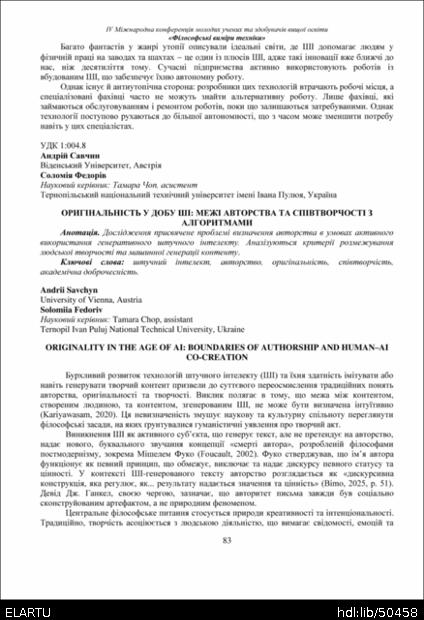
| dc.description.abstract | Дослідження присвячене проблемі визначення авторства в умовах активного використання генеративного штучного інтелекту. Аналізуються критерії розмежування людської творчості та машинної генерації контенту | |
| dc.format.extent | 83-85 | |
| dc.language.iso | uk | |
| dc.publisher | ФОП Паляниця В. А. | |
| dc.publisher | PE Palianytsia V.A. | |
| dc.relation.ispartof | Матеріали Ⅳ Міжнародної конференції молодих учених та здобувачів вищої освіти „Філософські виміри техніки“, 2025 | |
| dc.relation.ispartof | Book of abstracts of the Ⅳ International Conference of Young Scholars and Higher Education Applicants „Philosophical dimensions of technology“, 2025 | |
| dc.subject | штучний інтелект | |
| dc.subject | авторство | |
| dc.subject | оригінальність | |
| dc.subject | співтворчість | |
| dc.subject | академічна доброчесність | |
| dc.title | Оригінальність у добу ШІ: межі авторства та співтворчості з алгоритмами | |
| dc.title.alternative | Originality in the age of AI: boundaries of authorship and human–ai co-creation | |
| dc.type | Conference Abstract | |
| dc.rights.holder | © Тернопільський національний технічний університет імені Івана Пулюя, 2025 | |
| dc.coverage.placename | Тернопіль | |
| dc.coverage.placename | Ternopil | |
| dc.format.pages | 3 | |
| dc.subject.udc | 1 | |
| dc.subject.udc | 004.8 | |
| dc.relation.references | 1. Barad, K. Posthumanist performativity: Toward an understanding of how matter comes to matter. Journal of Women in Culture and Society. 2003. Vol. 28, No 3. P. 801–831. | |
| dc.relation.references | 2. Bimo, S. Emerging models of AI ‘Authorship’ in popular discourse // The Routledge Handbook of AI and Literature (Routledge Literature Handbooks) / Slocombe, W., Liveley, G. (Eds). New York, NY: Routledge, 2025. P. 49–59. | |
| dc.relation.references | 3. Floridi, L. Distant writing: Literary production in the age of Artificial Intelligence. Minds and Machines. 2025. Vol. 35, No 30. P. 1–26. DOI: 10.1007/s11023-025-09732-1. | |
| dc.relation.references | 4. Foucault, M. What is an author? // Reading Architectural History / Arnold, D. (Ed.). London: Routledge, 2002. P. 71–81. DOI: 10.4324/9780203164471. | |
| dc.relation.references | 5. Gunkel, D. J. AI Signals The Death Of The Author. NOEMA. 2025. June 4. | |
| dc.relation.references | 6. Hajibayova, L., Lee, S. Authorship in the age of artificial intelligence. Journal of Documentation. 2025. DOI: 10.1108/JD-04-2025-0109. | |
| dc.relation.references | 7. Kariyawasam, K. Artificial intelligence and challenges for copyright law. International Journal of Law and Information Technology. 2020. Vol. 28, No 4. P. 279–296. DOI: 10.1093/ijlit/eaaa023. | |
| dc.relation.references | 8. Lu, B. A theory of ‘authorship transfer’ and its application to the context of Artificial Intelligence creations. Queen Mary Journal of Intellectual Property. 2021. Vol. 11, No 1. P. 2–24. DOI: 10.4337/qmjip.2021.01.01. | |
| dc.relation.references | 9. Miller, A. Artificial Intelligence, Art, and Authenticity. AI and Society. 2019. Vol. 34, No 3. P. 391–404. | |
| dc.relation.references | 10. Naaz, A., Fathima, B. Can AI Ever Be Truly Creative? A Philosophical Perspective. IRE Journals. 2025. Vol. 9, Issue 5. DOI: 10.64388/IREV9I5-1712140 | |
| dc.relation.referencesen | 1. Barad, K. Posthumanist performativity: Toward an understanding of how matter comes to matter. Journal of Women in Culture and Society. 2003. Vol. 28, No 3. P. 801–831. | |
| dc.relation.referencesen | 2. Bimo, S. Emerging models of AI ‘Authorship’ in popular discourse, The Routledge Handbook of AI and Literature (Routledge Literature Handbooks), Slocombe, W., Liveley, G. (Eds). New York, NY: Routledge, 2025. P. 49–59. | |
| dc.relation.referencesen | 3. Floridi, L. Distant writing: Literary production in the age of Artificial Intelligence. Minds and Machines. 2025. Vol. 35, No 30. P. 1–26. DOI: 10.1007/s11023-025-09732-1. | |
| dc.relation.referencesen | 4. Foucault, M. What is an author?, Reading Architectural History, Arnold, D. (Ed.). London: Routledge, 2002. P. 71–81. DOI: 10.4324/9780203164471. | |
| dc.relation.referencesen | 5. Gunkel, D. J. AI Signals The Death Of The Author. NOEMA. 2025. June 4. | |
| dc.relation.referencesen | 6. Hajibayova, L., Lee, S. Authorship in the age of artificial intelligence. Journal of Documentation. 2025. DOI: 10.1108/JD-04-2025-0109. | |
| dc.relation.referencesen | 7. Kariyawasam, K. Artificial intelligence and challenges for copyright law. International Journal of Law and Information Technology. 2020. Vol. 28, No 4. P. 279–296. DOI: 10.1093/ijlit/eaaa023. | |
| dc.relation.referencesen | 8. Lu, B. A theory of ‘authorship transfer’ and its application to the context of Artificial Intelligence creations. Queen Mary Journal of Intellectual Property. 2021. Vol. 11, No 1. P. 2–24. DOI: 10.4337/qmjip.2021.01.01. | |
| dc.relation.referencesen | 9. Miller, A. Artificial Intelligence, Art, and Authenticity. AI and Society. 2019. Vol. 34, No 3. P. 391–404. | |
| dc.relation.referencesen | 10. Naaz, A., Fathima, B. Can AI Ever Be Truly Creative? A Philosophical Perspective. IRE Journals. 2025. Vol. 9, Issue 5. DOI: 10.64388/IREV9I5-1712140 | |
| dc.contributor.affiliation | Віденський Університет, Австрія | |
| dc.contributor.affiliation | Тернопільський національний технічний університет імені Івана Пулюя, Україна | |
| dc.contributor.affiliation | University of Vienna, Austria | |
| dc.contributor.affiliation | Ternopil Ivan Puluj National Technical University, Ukraine | |
| dc.citation.journalTitle | Матеріали Ⅳ Міжнародної конференції молодих учених та здобувачів вищої освіти „Філософські виміри техніки“ | |
| dc.citation.spage | 83 | |
| dc.citation.epage | 85 | |
| dc.citation.conference | Ⅳ Міжнародна конференція молодих учених та здобувачів вищої освіти „Філософські виміри техніки“ | |
| dc.identifier.citation2015 | Савчин А., Федорів С. Оригінальність у добу ШІ: межі авторства та співтворчості з алгоритмами // Матеріали Ⅳ Міжнародної конференції молодих учених та здобувачів вищої освіти „Філософські виміри техніки“, Тернопіль, 26 листопада 2025 р. 2025. С. 83–85. | |
| dc.identifier.citationenAPA | Savchyn, A., & Fedoriv, S. (2025). Oryhinalnist u dobu ShI: mezhi avtorstva ta spivtvorchosti z alhorytmamy [Originality in the age of AI: boundaries of authorship and human–ai co-creation]. Book of abstracts of the Ⅳ International Conference of Young Scholars and Higher Education Applicants „Philosophical dimensions of technology“, 26 November 2025, Ternopil, 83-85. PE Palianytsia V.A.. [in Ukrainian]. | |
| dc.identifier.citationenCHICAGO | Savchyn A., Fedoriv S. (2025) Oryhinalnist u dobu ShI: mezhi avtorstva ta spivtvorchosti z alhorytmamy [Originality in the age of AI: boundaries of authorship and human–ai co-creation]. Book of abstracts of the Ⅳ International Conference of Young Scholars and Higher Education Applicants „Philosophical dimensions of technology“ (Tern., 26 November 2025), pp. 83-85 [in Ukrainian]. | |
| Розташовується у зібраннях: | Ⅳ Міжнародна конференція молодих учених та здобувачів вищої освіти „Філософські виміри техніки“ (2025) | |
Файли цього матеріалу:
| Файл | Опис | Розмір | Формат | |
|---|---|---|---|---|
| ICPDT_2025_Savchyn_A-Originality_in_the_age_of_83-85.pdf | 553,64 kB | Adobe PDF | Переглянути/відкрити | |
| ICPDT_2025_Savchyn_A-Originality_in_the_age_of_83-85__COVER.png | 429,31 kB | image/png | Переглянути/відкрити |
Усі матеріали в архіві електронних ресурсів захищені авторським правом, всі права збережені.