
Будь ласка, використовуйте цей ідентифікатор, щоб цитувати або посилатися на цей матеріал:
http://elartu.tntu.edu.ua/handle/lib/54145
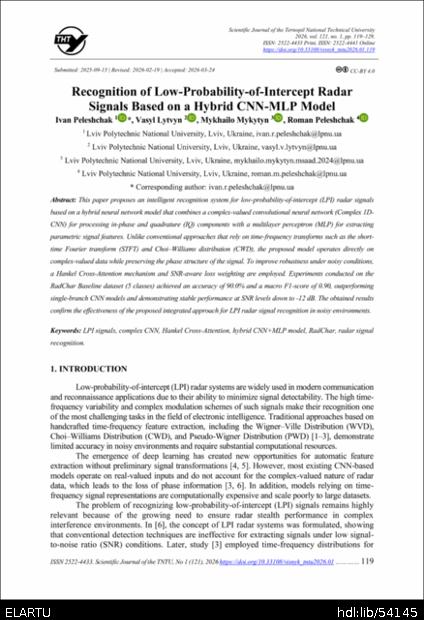
| Назва: | Recognition of Low-Probability-of-Intercept Radar Signals Based on a Hybrid CNN-MLP Model |
| Автори: | Peleshchak, Ivan Lytvyn, Vasyl Mykytyn, Mykhailo Peleshchak, Roman |
| Приналежність: | Lviv Polytechnic National University, Lviv, Ukraine |
| Бібліографічний опис: | Recognition of Low-Probability-of-Intercept Radar Signals Based on a Hybrid CNN-MLP Model / Ivan Peleshchak, Vasyl Lytvyn, Mykhailo Mykytyn, Roman Peleshchak // Scientific Journal of TNTU. — Tern. : TNTU, 2026. — Vol 121. — No 1. — P. 119–129. |
| Бібліографічне посилання: | Recognition of Low-Probability-of-Intercept Radar Signals Based on a Hybrid CNN-MLP Model / Peleshchak I. та ін. // Scientific Journal of TNTU, Ternopil. 2026. Vol 121. No 1. P. 119–129. |
| Bibliographic citation (APA): | Peleshchak, I., Lytvyn, V., Mykytyn, M., & Peleshchak, R. (2026). Recognition of Low-Probability-of-Intercept Radar Signals Based on a Hybrid CNN-MLP Model. Scientific Journal of the Ternopil National Technical University;, 121(1), 119-129. TNTU.. |
| Bibliographic citation (CHICAGO): | Peleshchak I., Lytvyn V., Mykytyn M., Peleshchak R. (2026) Recognition of Low-Probability-of-Intercept Radar Signals Based on a Hybrid CNN-MLP Model. Scientific Journal of the Ternopil National Technical University; (Tern.), vol. 121, no 1, pp. 119-129. |
| Є частиною видання: | Вісник Тернопільського національного технічного університету, 1 (121), 2026 Scientific Journal of the Ternopil National Technical University;, 1 (121), 2026 |
| Журнал/збірник: | Вісник Тернопільського національного технічного університету |
| Випуск/№ : | 1 |
| Том: | 121 |
| Дата публікації: | 24-бер-2026 |
| Дата подання: | 13-вер-2025 |
| Дата внесення: | 13-жов-2026 |
| Видавництво: | ТНТУ TNTU |
| Місце видання, проведення: | Тернопіль Ternopil |
| DOI: | https://doi.org/10.33108/visnyk_tntu2026.01.119 |
| Теми: | LPI signals complex CNN Hankel Cross-Attention hybrid CNN+MLP model RadChar radar signal recognition |
| Кількість сторінок: | 11 |
| Діапазон сторінок: | 119-129 |
| Початкова сторінка: | 119 |
| Кінцева сторінка: | 129 |
| Короткий огляд (реферат): | This paper proposes an intelligent recognition system for low-probability-of-intercept (LPI) radar signals based on a hybrid neural network model that combines a complex-valued convolutional neural network (Complex 1D- CNN) for processing in-phase and quadrature (IQ) components with a multilayer perceptron (MLP) for extracting parametric signal features. Unlike conventional approaches that rely on time-frequency transforms such as the short- time Fourier transform (STFT) and Choi–Williams distribution (CWD), the proposed model operates directly on complex-valued data while preserving the phase structure of the signal. To improve robustness under noisy conditions, a Hankel Cross-Attention mechanism and SNR-aware loss weighting are employed. Experiments conducted on the RadChar Baseline dataset (5 classes) achieved an accuracy of 90.0% and a macro F1-score of 0.90, outperforming single-branch CNN models and demonstrating stable performance at SNR levels down to -12 dB. The obtained results confirm the effectiveness of the proposed integrated approach for LPI radar signal recognition in noisy environments. |
| URI (Уніфікований ідентифікатор ресурсу): | http://elartu.tntu.edu.ua/handle/lib/54145 |
| ISSN: | 2522-4433 |
| Власник авторського права: | © Ternopil Ivan Puluj National Technical University, 2026 |
| URL-посилання пов’язаного матеріалу: | https://doi.org/10.1109/5.30749 https://doi.org/10.1109/ASSP.1989.28057 https://doi.org/10.3390/s16101682 https://doi.org/10.3390/s23208564 https://doi.org/10.1016/j.dt.2021.09.019 https://doi.org/10.1109/MAES.2006.1635166 https://doi.org/10.3390/sym9050075 https://doi.org/10.3390/sym11050725 https://doi.org/10.3390/sym11040540 https://doi.org/10.3390/sym14030570 https://doi.org/10.3390/electronics13163248 https://doi.org/10.1109/ACCESS.2019.2935247 https://doi.org/10.23919/JSEE.2020.000091 https://doi.org/10.1109/IDAACS68557.2025.11322024 https://doi.org/10.1109/ICCSP60870.2024.10543688 https://github.com/abcxyzi/RadChar https://doi.org/10.33108/visnyk_tntu2017.04.153 |
| References: | 1. L. Cohen, Time-frequency distributions – a review, Proceedings of the IEEE. 77 (1989) 941–981. https://doi.org/10.1109/5.30749. 2. H. Choi, W. Williams, Improved time-frequency representation of multicomponent signals using exponential kernels, IEEE Transactions on Acoustics, Speech, and Signal Processing. 37 (1989) 862–871. https://doi.org/10.1109/ASSP.1989.28057. 3. M. Zhang, L. Liu, M. Diao, LPI Radar Waveform Recognition Based on Time-Frequency Distribution, Sensors. 16 (2016) 1682. https://doi.org/10.3390/s16101682. 4. D.-H. Park, M.-W. Jeon, D.-M. Shin, H.-N. Kim, LPI Radar Detection Based on Deep Learning Approach with Periodic Autocorrelation Function, Sensors. 23 (2023) 8564. https://doi.org/10.3390/s23208564. 5. T. Wan, K.-L. Jiang, H. Ji, B. Tang, Deep learning-based LPI radar signals analysis and identification using a Nyquist Folding Receiver architecture, Defence Technology. 19 (2023) 196–209. https://doi.org/10.1016/j.dt.2021.09.019. 6. D.C. Schleher, LPI radar: fact or fiction, IEEE Aerospace and Electronic Systems Magazine. 21 (2006) 3–6. https://doi.org/10.1109/MAES.2006.1635166. 7. M. Zhang, M. Diao, L. Gao, L. Liu, Neural Networks for Radar Waveform Recognition, Symmetry. 9 (2017) 75. https://doi.org/10.3390/sym9050075. 8. J. Wan, X. Yu, Q. Guo, LPI Radar Waveform Recognition Based on CNN and TPOT, Symmetry. 11 (2019) 725. https://doi.org/10.3390/sym11050725. 9. Q. Guo, X. Yu, G. Ruan, LPI Radar Waveform Recognition Based on Deep Convolutional Neural Network Transfer Learning, Symmetry. 11 (2019) 540. https://doi.org/10.3390/sym11040540. 10. D. Quan, Z. Tang, X. Wang, W. Zhai, C. Qu, LPI Radar Signal Recognition Based on Dual-Channel CNN and Feature Fusion, Symmetry. 14 (2022) 570. https://doi.org/10.3390/sym14030570. 11. F. Xu, H. Hu, J. Mu, X. Wang, F. Zhou, D. Quan, Low Probability of Intercept Radar Signal Recognition Based on Semi-Supervised Support Vector Machine, Electronics. 13 (2024) 3248. https://doi.org/10.3390/electronics13163248. 12. Z. Qu, W. Wang, C. Hou, Radar Signal Intra-Pulse Modulation Recognition Based on Convolutional Denoising Autoencoder and Deep CNN, IEEE Access. 7 (2019) 112339–112347. https://doi.org/10.1109/ACCESS.2019.2935247. 13. W. Tao, K. Jiang, J. Li, T. Yan, T. Bin, Detection and recognition of LPI radar signals using visibility graphs, Journal of Systems Engineering and Electronics. 31 (2020) 1186–1192. https://doi.org/10.23919/JSEE.2020.000091. 14. O. Nazarevych, R. Peleshchak, V. Lytvyn, I. Peleshchak, V. Motyka, Recognition of Low Probability of Intercept Radar Signals in a Polar Coordinate System Based on a Hybrid CNN and MLP, in: 2025 IEEE 13th International Conference on Intelligent Data Acquisition and Advanced Computing Systems: Technology and Applications (IDAACS), Gliwice, Poland, 2025, pp. 338–345. https://doi.org/10.1109/IDAACS68557.2025.11322024. 15. R.R. Yakkati, A.B. Boddu, B. Pardhasaradhi, S.R. Yeduri, L.R. Cenkeramaddi, Low Probability of Intercept Radar Signal Classification using Multi-Channel 1D-CNN, in: Proceedings of the 10th International Conference on Communication and Signal Processing (ICCSP), IEEE, 2024, pp. 1–5. https://doi.org/10.1109/ICCSP60870.2024.10543688. 16. RadChar Dataset, GitHub Repository, (2024). https://github.com/abcxyzi/RadChar (Accessed 24 April 2026) 17. I. Lytvynenko, Method of segmentation of determined cyclic signals for the problems related to their processing and modeling, Scientific Journal of TNTU. 88 (2017) 153–169. https://doi.org/10.33108/visnyk_tntu2017.04.153. |
| Тип вмісту: | Article |
| Розташовується у зібраннях: | Вісник ТНТУ, 2026, № 1 (121) |
Файли цього матеріалу:
| Файл | Опис | Розмір | Формат | |
|---|---|---|---|---|
| TNTUSJ_2026v121n1_Peleshchak_I-Recognition_of_Low_Probability_119-129.pdf | 4,2 MB | Adobe PDF | Переглянути/відкрити | |
| TNTUSJ_2026v121n1_Peleshchak_I-Recognition_of_Low_Probability_119-129__COVER.png | 1,22 MB | image/png | Переглянути/відкрити |
Усі матеріали в архіві електронних ресурсів захищені авторським правом, всі права збережені.