
Будь ласка, використовуйте цей ідентифікатор, щоб цитувати або посилатися на цей матеріал:
http://elartu.tntu.edu.ua/handle/lib/54145
Повний запис метаданих
| Поле DC | Значення | Мова |
|---|---|---|
| dc.contributor.author | Peleshchak, Ivan | |
| dc.contributor.author | Lytvyn, Vasyl | |
| dc.contributor.author | Mykytyn, Mykhailo | |
| dc.contributor.author | Peleshchak, Roman | |
| dc.date.accessioned | 2026-10-13T08:33:23Z | - |
| dc.date.available | 2026-10-13T08:33:23Z | - |
| dc.date.created | 2026-03-24 | |
| dc.date.issued | 2026-03-24 | |
| dc.date.submitted | 2025-09-13 | |
| dc.identifier.citation | Recognition of Low-Probability-of-Intercept Radar Signals Based on a Hybrid CNN-MLP Model / Ivan Peleshchak, Vasyl Lytvyn, Mykhailo Mykytyn, Roman Peleshchak // Scientific Journal of TNTU. — Tern. : TNTU, 2026. — Vol 121. — No 1. — P. 119–129. | |
| dc.identifier.issn | 2522-4433 | |
| dc.identifier.uri | http://elartu.tntu.edu.ua/handle/lib/54145 | - |
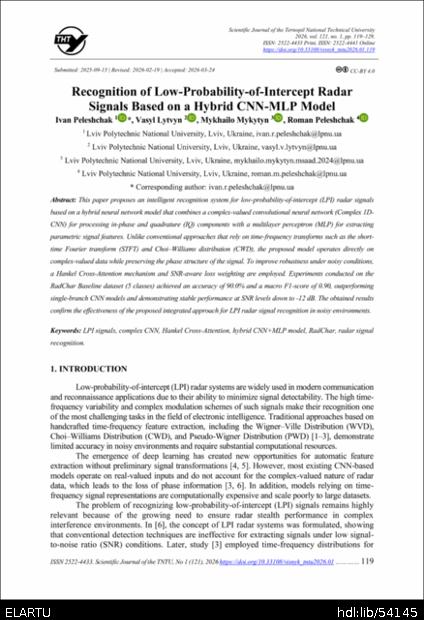
| dc.description.abstract | This paper proposes an intelligent recognition system for low-probability-of-intercept (LPI) radar signals based on a hybrid neural network model that combines a complex-valued convolutional neural network (Complex 1D- CNN) for processing in-phase and quadrature (IQ) components with a multilayer perceptron (MLP) for extracting parametric signal features. Unlike conventional approaches that rely on time-frequency transforms such as the short- time Fourier transform (STFT) and Choi–Williams distribution (CWD), the proposed model operates directly on complex-valued data while preserving the phase structure of the signal. To improve robustness under noisy conditions, a Hankel Cross-Attention mechanism and SNR-aware loss weighting are employed. Experiments conducted on the RadChar Baseline dataset (5 classes) achieved an accuracy of 90.0% and a macro F1-score of 0.90, outperforming single-branch CNN models and demonstrating stable performance at SNR levels down to -12 dB. The obtained results confirm the effectiveness of the proposed integrated approach for LPI radar signal recognition in noisy environments. | |
| dc.format.extent | 119-129 | |
| dc.language.iso | en | |
| dc.publisher | ТНТУ | |
| dc.publisher | TNTU | |
| dc.relation.ispartof | Вісник Тернопільського національного технічного університету, 1 (121), 2026 | |
| dc.relation.ispartof | Scientific Journal of the Ternopil National Technical University;, 1 (121), 2026 | |
| dc.relation.uri | https://doi.org/10.1109/5.30749 | |
| dc.relation.uri | https://doi.org/10.1109/ASSP.1989.28057 | |
| dc.relation.uri | https://doi.org/10.3390/s16101682 | |
| dc.relation.uri | https://doi.org/10.3390/s23208564 | |
| dc.relation.uri | https://doi.org/10.1016/j.dt.2021.09.019 | |
| dc.relation.uri | https://doi.org/10.1109/MAES.2006.1635166 | |
| dc.relation.uri | https://doi.org/10.3390/sym9050075 | |
| dc.relation.uri | https://doi.org/10.3390/sym11050725 | |
| dc.relation.uri | https://doi.org/10.3390/sym11040540 | |
| dc.relation.uri | https://doi.org/10.3390/sym14030570 | |
| dc.relation.uri | https://doi.org/10.3390/electronics13163248 | |
| dc.relation.uri | https://doi.org/10.1109/ACCESS.2019.2935247 | |
| dc.relation.uri | https://doi.org/10.23919/JSEE.2020.000091 | |
| dc.relation.uri | https://doi.org/10.1109/IDAACS68557.2025.11322024 | |
| dc.relation.uri | https://doi.org/10.1109/ICCSP60870.2024.10543688 | |
| dc.relation.uri | https://github.com/abcxyzi/RadChar | |
| dc.relation.uri | https://doi.org/10.33108/visnyk_tntu2017.04.153 | |
| dc.subject | LPI signals | |
| dc.subject | complex CNN | |
| dc.subject | Hankel Cross-Attention | |
| dc.subject | hybrid CNN+MLP model | |
| dc.subject | RadChar | |
| dc.subject | radar signal recognition | |
| dc.title | Recognition of Low-Probability-of-Intercept Radar Signals Based on a Hybrid CNN-MLP Model | |
| dc.type | Article | |
| dc.rights.holder | © Ternopil Ivan Puluj National Technical University, 2026 | |
| dc.coverage.placename | Тернопіль | |
| dc.coverage.placename | Ternopil | |
| dc.format.pages | 11 | |
| dc.relation.referencesen | 1. L. Cohen, Time-frequency distributions – a review, Proceedings of the IEEE. 77 (1989) 941–981. https://doi.org/10.1109/5.30749. | |
| dc.relation.referencesen | 2. H. Choi, W. Williams, Improved time-frequency representation of multicomponent signals using exponential kernels, IEEE Transactions on Acoustics, Speech, and Signal Processing. 37 (1989) 862–871. https://doi.org/10.1109/ASSP.1989.28057. | |
| dc.relation.referencesen | 3. M. Zhang, L. Liu, M. Diao, LPI Radar Waveform Recognition Based on Time-Frequency Distribution, Sensors. 16 (2016) 1682. https://doi.org/10.3390/s16101682. | |
| dc.relation.referencesen | 4. D.-H. Park, M.-W. Jeon, D.-M. Shin, H.-N. Kim, LPI Radar Detection Based on Deep Learning Approach with Periodic Autocorrelation Function, Sensors. 23 (2023) 8564. https://doi.org/10.3390/s23208564. | |
| dc.relation.referencesen | 5. T. Wan, K.-L. Jiang, H. Ji, B. Tang, Deep learning-based LPI radar signals analysis and identification using a Nyquist Folding Receiver architecture, Defence Technology. 19 (2023) 196–209. https://doi.org/10.1016/j.dt.2021.09.019. | |
| dc.relation.referencesen | 6. D.C. Schleher, LPI radar: fact or fiction, IEEE Aerospace and Electronic Systems Magazine. 21 (2006) 3–6. https://doi.org/10.1109/MAES.2006.1635166. | |
| dc.relation.referencesen | 7. M. Zhang, M. Diao, L. Gao, L. Liu, Neural Networks for Radar Waveform Recognition, Symmetry. 9 (2017) 75. https://doi.org/10.3390/sym9050075. | |
| dc.relation.referencesen | 8. J. Wan, X. Yu, Q. Guo, LPI Radar Waveform Recognition Based on CNN and TPOT, Symmetry. 11 (2019) 725. https://doi.org/10.3390/sym11050725. | |
| dc.relation.referencesen | 9. Q. Guo, X. Yu, G. Ruan, LPI Radar Waveform Recognition Based on Deep Convolutional Neural Network Transfer Learning, Symmetry. 11 (2019) 540. https://doi.org/10.3390/sym11040540. | |
| dc.relation.referencesen | 10. D. Quan, Z. Tang, X. Wang, W. Zhai, C. Qu, LPI Radar Signal Recognition Based on Dual-Channel CNN and Feature Fusion, Symmetry. 14 (2022) 570. https://doi.org/10.3390/sym14030570. | |
| dc.relation.referencesen | 11. F. Xu, H. Hu, J. Mu, X. Wang, F. Zhou, D. Quan, Low Probability of Intercept Radar Signal Recognition Based on Semi-Supervised Support Vector Machine, Electronics. 13 (2024) 3248. https://doi.org/10.3390/electronics13163248. | |
| dc.relation.referencesen | 12. Z. Qu, W. Wang, C. Hou, Radar Signal Intra-Pulse Modulation Recognition Based on Convolutional Denoising Autoencoder and Deep CNN, IEEE Access. 7 (2019) 112339–112347. https://doi.org/10.1109/ACCESS.2019.2935247. | |
| dc.relation.referencesen | 13. W. Tao, K. Jiang, J. Li, T. Yan, T. Bin, Detection and recognition of LPI radar signals using visibility graphs, Journal of Systems Engineering and Electronics. 31 (2020) 1186–1192. https://doi.org/10.23919/JSEE.2020.000091. | |
| dc.relation.referencesen | 14. O. Nazarevych, R. Peleshchak, V. Lytvyn, I. Peleshchak, V. Motyka, Recognition of Low Probability of Intercept Radar Signals in a Polar Coordinate System Based on a Hybrid CNN and MLP, in: 2025 IEEE 13th International Conference on Intelligent Data Acquisition and Advanced Computing Systems: Technology and Applications (IDAACS), Gliwice, Poland, 2025, pp. 338–345. https://doi.org/10.1109/IDAACS68557.2025.11322024. | |
| dc.relation.referencesen | 15. R.R. Yakkati, A.B. Boddu, B. Pardhasaradhi, S.R. Yeduri, L.R. Cenkeramaddi, Low Probability of Intercept Radar Signal Classification using Multi-Channel 1D-CNN, in: Proceedings of the 10th International Conference on Communication and Signal Processing (ICCSP), IEEE, 2024, pp. 1–5. https://doi.org/10.1109/ICCSP60870.2024.10543688. | |
| dc.relation.referencesen | 16. RadChar Dataset, GitHub Repository, (2024). https://github.com/abcxyzi/RadChar (Accessed 24 April 2026) | |
| dc.relation.referencesen | 17. I. Lytvynenko, Method of segmentation of determined cyclic signals for the problems related to their processing and modeling, Scientific Journal of TNTU. 88 (2017) 153–169. https://doi.org/10.33108/visnyk_tntu2017.04.153. | |
| dc.identifier.doi | https://doi.org/10.33108/visnyk_tntu2026.01.119 | |
| dc.contributor.affiliation | Lviv Polytechnic National University, Lviv, Ukraine | |
| dc.citation.journalTitle | Вісник Тернопільського національного технічного університету | |
| dc.citation.volume | 121 | |
| dc.citation.issue | 1 | |
| dc.citation.spage | 119 | |
| dc.citation.epage | 129 | |
| dc.identifier.citation2015 | Recognition of Low-Probability-of-Intercept Radar Signals Based on a Hybrid CNN-MLP Model / Peleshchak I. та ін. // Scientific Journal of TNTU, Ternopil. 2026. Vol 121. No 1. P. 119–129. | |
| dc.identifier.citationenAPA | Peleshchak, I., Lytvyn, V., Mykytyn, M., & Peleshchak, R. (2026). Recognition of Low-Probability-of-Intercept Radar Signals Based on a Hybrid CNN-MLP Model. Scientific Journal of the Ternopil National Technical University;, 121(1), 119-129. TNTU.. | |
| dc.identifier.citationenCHICAGO | Peleshchak I., Lytvyn V., Mykytyn M., Peleshchak R. (2026) Recognition of Low-Probability-of-Intercept Radar Signals Based on a Hybrid CNN-MLP Model. Scientific Journal of the Ternopil National Technical University; (Tern.), vol. 121, no 1, pp. 119-129. | |
| Розташовується у зібраннях: | Вісник ТНТУ, 2026, № 1 (121) | |
Файли цього матеріалу:
| Файл | Опис | Розмір | Формат | |
|---|---|---|---|---|
| TNTUSJ_2026v121n1_Peleshchak_I-Recognition_of_Low_Probability_119-129.pdf | 4,2 MB | Adobe PDF | Переглянути/відкрити | |
| TNTUSJ_2026v121n1_Peleshchak_I-Recognition_of_Low_Probability_119-129__COVER.png | 1,22 MB | image/png | Переглянути/відкрити |
Усі матеріали в архіві електронних ресурсів захищені авторським правом, всі права збережені.