
Будь ласка, використовуйте цей ідентифікатор, щоб цитувати або посилатися на цей матеріал:
http://elartu.tntu.edu.ua/handle/lib/53574
Повний запис метаданих
| Поле DC | Значення | Мова |
|---|---|---|
| dc.contributor.author | Васильків, Василь | |
| dc.contributor.author | Маковинський, Назарій | |
| dc.contributor.author | Корнєв, Олександр | |
| dc.contributor.author | Vasylkiv, Vasyl | |
| dc.contributor.author | Makovynskyi, Nazarii | |
| dc.contributor.author | Korniev, Oleksandr | |
| dc.coverage.temporal | 4-5 червня 2026 року | |
| dc.coverage.temporal | 4-5 June 2026 | |
| dc.date.accessioned | 2026-07-17T14:14:10Z | - |
| dc.date.available | 2026-07-17T14:14:10Z | - |
| dc.date.created | 2026-06-04 | |
| dc.date.issued | 2026-06-04 | |
| dc.identifier.citation | Васильків В. Особливості використання адитивних технологій при виготовленні гвинтових виробів, синтезованих методами генеративного дизайну / Василь Васильків, Назарій Маковинський, Олександр Корнєв // Праці Ⅱ Міжнародної науково-технічної конференці „Прикладна механіка“, 4-5 червня 2026 року. — Т. : ТНТУ, 2026. — С. 17–20. — (Сучасні технології машинобудування). | |
| dc.identifier.uri | http://elartu.tntu.edu.ua/handle/lib/53574 | - |
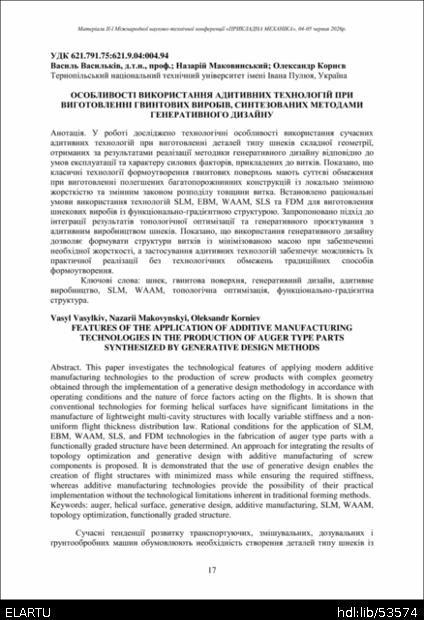
| dc.description.abstract | У роботі досліджено технологічні особливості використання сучасних адитивних технологій при виготовленні деталей типу шнеків складної геометрії, отриманих за результатами реалізації методики генеративного дизайну відповідно до умов експлуатації та характеру силових факторів, прикладених до витків. Показано, що класичні технології формоутворення гвинтових поверхонь мають суттєві обмеження при виготовленні полегшених багатопорожнинних конструкцій із локально змінною жорсткістю та змінним законом розподілу товщини витка. Встановлено раціональні умови використання технологій SLM, EBM, WAAM, SLS та FDM для виготовлення шнекових виробів із функціонально-градієнтною структурою. Запропоновано підхід до інтеграції результатів топологічної оптимізації та генеративного проєктування з адитивним виробництвом шнеків. Показано, що використання генеративного дизайну дозволяє формувати структури витків із мінімізованою масою при забезпеченні необхідної жорсткості, а застосування адитивних технологій забезпечує можливість їх практичної реалізації без технологічних обмежень традиційних способів формоутворення. | |
| dc.description.abstract | This paper investigates the technological features of applying modern additive manufacturing technologies to the production of screw products with complex geometry obtained through the implementation of a generative design methodology in accordance with operating conditions and the nature of force factors acting on the flights. It is shown that conventional technologies for forming helical surfaces have significant limitations in the manufacture of lightweight multi-cavity structures with locally variable stiffness and a non- uniform flight thickness distribution law. Rational conditions for the application of SLM, EBM, WAAM, SLS, and FDM technologies in the fabrication of auger type parts with a functionally graded structure have been determined. An approach for integrating the results of topology optimization and generative design with additive manufacturing of screw components is proposed. It is demonstrated that the use of generative design enables the creation of flight structures with minimized mass while ensuring the required stiffness, whereas additive manufacturing technologies provide the possibility of their practical implementation without the technological limitations inherent in traditional forming methods. | |
| dc.format.extent | 17-20 | |
| dc.language.iso | uk | |
| dc.publisher | ТНТУ | |
| dc.publisher | TNTU | |
| dc.relation.ispartof | Праці Ⅱ Міжнародної науково-технічної конференці „Прикладна механіка“, 2026 | |
| dc.relation.ispartof | Proceedings of the 2nd International Scientific and Technical Conference “Applied Mechanics”, 2026 | |
| dc.relation.uri | https://doi.org/10.1016/j.pmatsci.2017.10.001 | |
| dc.subject | шнек | |
| dc.subject | гвинтова поверхня | |
| dc.subject | генеративний дизайн | |
| dc.subject | адитивне виробництво | |
| dc.subject | SLM | |
| dc.subject | WAAM | |
| dc.subject | топологічна оптимізація | |
| dc.subject | функціонально-градієнтна структура | |
| dc.subject | auger | |
| dc.subject | helical surface | |
| dc.subject | generative design | |
| dc.subject | additive manufacturing | |
| dc.subject | SLM | |
| dc.subject | WAAM | |
| dc.subject | topology optimization | |
| dc.subject | functionally graded structure | |
| dc.title | Особливості використання адитивних технологій при виготовленні гвинтових виробів, синтезованих методами генеративного дизайну | |
| dc.title.alternative | Features of the application of additive manufacturing technologies in the production of auger type parts synthesized by generative design methods | |
| dc.type | Conference Abstract | |
| dc.rights.holder | © Тернопільський національний технічний університет імені Івана Пулюя, 2026 | |
| dc.coverage.placename | Тернопіль | |
| dc.coverage.placename | Ternopil | |
| dc.format.pages | 4 | |
| dc.subject.udc | 621.791.75 | |
| dc.subject.udc | 621.9.04 | |
| dc.subject.udc | 004.94 | |
| dc.relation.references | 1. Васильків В.В. Розвиток науково-прикладних основ розроблення технологій виробництва гвинтових і шнекових заготовок з використанням уніфікації. – Львів, 2015. – 48 с. | |
| dc.relation.references | 2. DebRoy T., Wei H.L., Zuback J.S., Mukherjee T., Elmer J.W., Milewski J.O., Beese A.M., Wilson-Heid A., De A., Zhang W. Additive manufacturing of metallic components – Process, structure and properties // Progress in Materials Science. – 2018. – Vol. 92. – P. 112–224. DOI: https://doi.org/10.1016/j.pmatsci.2017.10.001. | |
| dc.relation.references | 3. Herzog D., Seyda V., Wycisk E., Emmelmann C. Additive manufacturing of metals // Acta Materialia. – 2016. – Vol. 117. – P. 371–392. DOI: 10.1016/j.actamat.2016.07.019. | |
| dc.relation.references | 4. Gibson I., Rosen D., Stucker B. Additive Manufacturing Technologies. – 3rd ed. – Springer, 2021. – 670 p. ISBN: 978-3-030-56127-7. DOI: 10.1007/978-3-030-56127-7. | |
| dc.relation.references | 5. Ngo T.D., Kashani A., Imbalzano G., Nguyen K.T.Q., Hui D. Additive manufacturing (3D printing): A review of materials, methods, applications and challenges // Composites Part B: Engineering. – 2018. – Vol. 143. – P. 172–196. DOI: 10.1016/j.compositesb.2018.02.012. | |
| dc.relation.references | 6. Cunningham R., Zhao C., Parab N., Kantzos C., Pauza J., Fezzaa K., Sun T., Rollett A.D. Keyhole threshold and morphology in laser melting revealed by ultrahigh-speed x-ray imaging // Science. – 2019. – Vol. 363(6429). – P. 849–852. DOI: 10.1126/science.aav4687. | |
| dc.relation.references | 7. Vaneker T., Bernard A., Moroni G., Gibson I., Zhang Y. Design for additive manufacturing: Framework and methodology // CIRP Annals. – 2020. – Vol. 69(2). – P. 578–599. DOI: 10.1016/j.cirp.2020.05.006. | |
| dc.relation.references | 8. Gu D. Laser Additive Manufacturing of High-Performance Materials. – Springer, 2021. – 512 p. DOI:10.1007/978-3-662-46089-4 | |
| dc.relation.references | 9. ASTM International. ASTM F2792-12a: Standard Terminology for Additive Manufacturing Technologies. – West Conshohocken, PA, USA, 2023. | |
| dc.relation.references | 10. Wei H.L., Mukherjee T., Zhang W. et al. Mechanistic models for additive manufacturing of metallic components // Progress in Materials Science. – 2021. – Vol. 116. – 100703. DOI: 10.1016/j.pmatsci.2020.100703. | |
| dc.relation.references | 11. DebRoy T., Mukherjee T., Wei H.L. et al. Metallurgy, mechanistic models and machine learning in metal printing // Nature Reviews Materials. – 2021. – Vol. 6. – P. 48–68. DOI: 10.1038/s41578-020-00236-1. | |
| dc.relation.referencesen | 1. Vasylkiv V.V. Rozvytok naukovo-prykladnykh osnov rozroblennia tekhnolohii vyrobnytstva hvyntovykh i shnekovykh zahotovok z vykorystanniam unifikatsii, Lviv, 2015, 48 p. | |
| dc.relation.referencesen | 2. DebRoy T., Wei H.L., Zuback J.S., Mukherjee T., Elmer J.W., Milewski J.O., Beese A.M., Wilson-Heid A., De A., Zhang W. Additive manufacturing of metallic components – Process, structure and properties, Progress in Materials Science, 2018, Vol. 92, P. 112–224. DOI: https://doi.org/10.1016/j.pmatsci.2017.10.001. | |
| dc.relation.referencesen | 3. Herzog D., Seyda V., Wycisk E., Emmelmann C. Additive manufacturing of metals, Acta Materialia, 2016, Vol. 117, P. 371–392. DOI: 10.1016/j.actamat.2016.07.019. | |
| dc.relation.referencesen | 4. Gibson I., Rosen D., Stucker B. Additive Manufacturing Technologies, 3rd ed, Springer, 2021, 670 p. ISBN: 978-3-030-56127-7. DOI: 10.1007/978-3-030-56127-7. | |
| dc.relation.referencesen | 5. Ngo T.D., Kashani A., Imbalzano G., Nguyen K.T.Q., Hui D. Additive manufacturing (3D printing): A review of materials, methods, applications and challenges, Composites Part B: Engineering, 2018, Vol. 143, P. 172–196. DOI: 10.1016/j.compositesb.2018.02.012. | |
| dc.relation.referencesen | 6. Cunningham R., Zhao C., Parab N., Kantzos C., Pauza J., Fezzaa K., Sun T., Rollett A.D. Keyhole threshold and morphology in laser melting revealed by ultrahigh-speed x-ray imaging, Science, 2019, Vol. 363(6429), P. 849–852. DOI: 10.1126/science.aav4687. | |
| dc.relation.referencesen | 7. Vaneker T., Bernard A., Moroni G., Gibson I., Zhang Y. Design for additive manufacturing: Framework and methodology, CIRP Annals, 2020, Vol. 69(2), P. 578–599. DOI: 10.1016/j.cirp.2020.05.006. | |
| dc.relation.referencesen | 8. Gu D. Laser Additive Manufacturing of High-Performance Materials, Springer, 2021, 512 p. DOI:10.1007/978-3-662-46089-4 | |
| dc.relation.referencesen | 9. ASTM International. ASTM F2792-12a: Standard Terminology for Additive Manufacturing Technologies, West Conshohocken, PA, USA, 2023. | |
| dc.relation.referencesen | 10. Wei H.L., Mukherjee T., Zhang W. et al. Mechanistic models for additive manufacturing of metallic components, Progress in Materials Science, 2021, Vol. 116, 100703. DOI: 10.1016/j.pmatsci.2020.100703. | |
| dc.relation.referencesen | 11. DebRoy T., Mukherjee T., Wei H.L. et al. Metallurgy, mechanistic models and machine learning in metal printing, Nature Reviews Materials, 2021, Vol. 6, P. 48–68. DOI: 10.1038/s41578-020-00236-1. | |
| dc.contributor.affiliation | Тернопільський національний технічний університет імені Івана Пулюя, Україна | |
| dc.citation.journalTitle | Праці Ⅱ Міжнародної науково-технічної конференці „Прикладна механіка“ | |
| dc.citation.spage | 17 | |
| dc.citation.epage | 20 | |
| dc.citation.conference | Ⅱ Міжнародна науково-технічна конференція „Прикладна механіка“ | |
| dc.identifier.citation2015 | Васильків В., Маковинський Н., Корнєв О. Особливості використання адитивних технологій при виготовленні гвинтових виробів, синтезованих методами генеративного дизайну // Праці Ⅱ Міжнародної науково-технічної конференці „Прикладна механіка“, Тернопіль, 4-5 червня 2026 року. 2026. С. 17–20. | |
| dc.identifier.citationenAPA | Vasylkiv, V., Makovynskyi, N., & Korniev, O. (2026). Osoblyvosti vykorystannia adytyvnykh tekhnolohii pry vyhotovlenni hvyntovykh vyrobiv, syntezovanykh metodamy heneratyvnoho dyzainu [Features of the application of additive manufacturing technologies in the production of auger type parts synthesized by generative design methods]. Proceedings of the 2nd International Scientific and Technical Conference “Applied Mechanics”, 4-5 June 2026, Ternopil, 17-20. TNTU. [in Ukrainian]. | |
| dc.identifier.citationenCHICAGO | Vasylkiv V., Makovynskyi N., Korniev O. (2026) Osoblyvosti vykorystannia adytyvnykh tekhnolohii pry vyhotovlenni hvyntovykh vyrobiv, syntezovanykh metodamy heneratyvnoho dyzainu [Features of the application of additive manufacturing technologies in the production of auger type parts synthesized by generative design methods]. Proceedings of the 2nd International Scientific and Technical Conference “Applied Mechanics” (Tern., 4-5 June 2026), pp. 17-20 [in Ukrainian]. | |
| Розташовується у зібраннях: | Ⅱ Міжнародна науково-технічна конференція „Прикладна механіка“ (2026) | |
Файли цього матеріалу:
| Файл | Опис | Розмір | Формат | |
|---|---|---|---|---|
| MNTCPM_2026_Vasylkiv_V-Features_of_the_application_17-20.pdf | 702,39 kB | Adobe PDF | Переглянути/відкрити | |
| MNTCPM_2026_Vasylkiv_V-Features_of_the_application_17-20__COVER.png | 489,33 kB | image/png | Переглянути/відкрити |
Усі матеріали в архіві електронних ресурсів захищені авторським правом, всі права збережені.