
Použijte tento identifikátor k citaci nebo jako odkaz na tento záznam:
http://elartu.tntu.edu.ua/handle/lib/52494
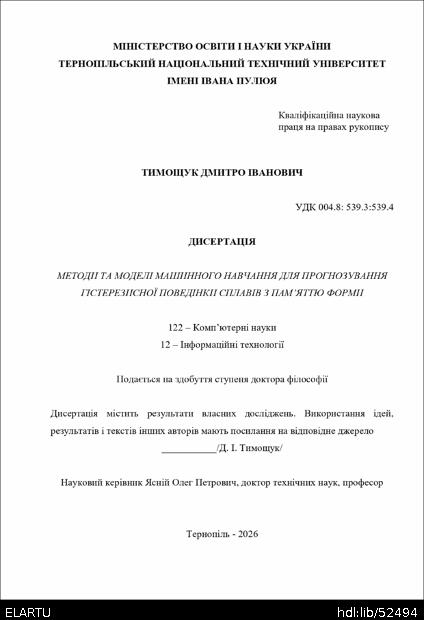
| Název: | Методи та моделі машинного навчання для прогнозування гістерезисної поведінки сплавів з пам’яттю форми |
| Další názvy: | Methods and models of machine learning for predicting the hysteresis behavior of shape memory alloys |
| Autoři: | Тимощук, Дмитро Іванович Tymoshchuk, Dmytro |
| Affiliation: | Тернопільський національний технічний університет імені Івана Пулюя |
| Bibliographic reference (2015): | Тимощук Д.І. Методи та моделі машинного навчання для прогнозування гістерезисної поведінки сплавів з пам’яттю форми : дис. ... доктора філософії : 122. Тернопіль, 2026. 205 с. |
| Datum vydání: | 2026 |
| Date of entry: | 19-čer-2026 |
| Nakladatel: | Тернопільський національний технічний університет імені Івана Пулюя |
| Country (code): | UA |
| Science degree: | доктор філософії |
| Level thesis: | докторська дисертація |
| Code and name of the specialty: | 122 - компютерні науки |
| Institution defense: | Тернопільський національний технічний університет імені Івана Пулюя |
| Supervisor: | Ясній, Олег Петрович |
| Klíčová slova: | набір даних моделювання алгоритм сплави з пам’яттю форми нітинол гістерезисна поведінка машинне навчання ансамблеві моделі рекурентні нейронні мережі темпоральна згорткова мережа прогнозування деформації регресія пояснюваний штучний інтелект метрики dataset modelling algorithm shape memory alloys nitinol hysteresis behavior machine learning ensemble models recurrent neural networks |
| Number of pages: | 205 |
| Abstrakt: | Тимощук Д.І. Методи та моделі машинного навчання для прогнозування гістерезисної поведінки сплавів з пам’яттю форми. – Кваліфікаційна наукова праця на правах рукопису. Дисертація на здобуття ступеня доктора філософії за спеціальністю 122 “Комп’ютерні науки”. – Тернопільський національний технічний університет імені Івана Пулюя, Тернопіль, 2026.
Підготовка здійснювалася на кафедрі систем штучного інтелекту та аналізу даних Тернопільського національного технічного університету імені Івана Пулюя Міністерства освіти і науки України.
Дисертація стосується розв’язання науково-практичної задачі побудови, оцінювання та порівняльного аналізу моделей машинного навчання для прогнозування гістерезисної поведінки сплавів з пам’яттю форми за умов циклічного навантаження та інтерпретації отриманих прогнозів засобами пояснюваного штучного інтелекту. Актуальність дослідження зумовлена широким застосуванням сплавів з пам’яттю форми в сучасних технічних системах, де важливими є висока точність прогнозування їхньої деформації, оцінювання впливу функціональної втоми, скорочення обсягу дорогих і тривалих експериментальних досліджень, а також забезпечення фізично обґрунтованої інтерпретації результатів моделювання. Особливу складність становить прогнозування еволюції гістерезисних петель на циклах навантаження, що виходять за межі навчального діапазону, оскільки залежність між напруженням і деформацією в таких матеріалах має нелінійний характер, залежить від історії навантаження, частоти та накопичення втомних ефектів
У вступі обґрунтовано актуальність теми дисертації, визначено її зв’язок із науковими напрямами досліджень, сформульовано мету та завдання роботи, окреслено об’єкт, предмет і методи дослідження, розкрито наукову новизну та практичне значення одержаних результатів, наведено відомості про їх апробацію, практичне використання та висвітлення в наукових публікаціях.
У першому розділі виконано аналіз предметної області. Розглянуто фізичні основи гістерезисної поведінки сплавів з пам’яттю форми, природу ефекту пам’яті форми та надпружності, а також особливості формування гістерезисних петель у координатах “напруження–деформація”. Проаналізовано вплив частоти навантаження, кількості циклів і фазових перетворень на гістерезисну поведінку сплавів з пам’яттю форми. Здійснено аналіз сучасних досліджень у галузі застосування методів машинного навчання для прогнозування властивостей SMA та використання методів пояснюваного штучного інтелекту для інтерпретації результатів. На основі аналізу літератури обґрунтовано доцільність застосування методів машинного навчання для побудови моделей, орієнтованих на екстраполяційне прогнозування гістерезисної поведінки сплавів з пам’яттю форми. У другому розділі наведено опис експериментального набору даних, отриманого під час випробувань NiTi-дроту з пам’яттю форми на малоциклову втому за різних частот циклічного навантаження. Запропоновано математичну модель прогнозування деформації SMA з урахуванням номера циклу як незалежної вхідної змінної, що дало змогу відокремити прогнозування в межах діапазону навчальних даних і екстраполяційний режим прогнозування. Вхідними змінними моделі визначено напруження, номер циклу навантаження-розвантаження та індикатор фази циклу, який відображає етап навантаження або розвантаження. Вихідною змінною є прогнозоване значення деформації матеріалу. Розглянуто ансамблеві регресійні моделі VotingRegressor і StackingRegressor, рекурентні нейронні мережі SimpleRNN, LSTM, GRU та темпоральну згорткову мережу TCN. Запропоновано стратегію групового розбиття та валідації даних за номером циклу навантаження, а також описано загальну структуру програмної системи дослідження, що охоплює модулі EDA, Dataset, ML Models, Predict, Explain і Report. У третьому розділі виконано попередню обробку експериментального набору даних, проведено статистичний аналіз вхідних ознак і цільової змінної, а також здійснено виявлення аномальних значень у даних. Наведено результати навчання та оцінювання моделей машинного навчання в межах навчального діапазону циклів 100–250. Для ансамблевих моделей здійснено налаштування гіперпараметрів методом GridSearchCV, а для нейромережевих архітектур ‒ методом Hyperband. Проведено порівняльний аналіз точності моделей за метриками MSE, MAE, MAPE та R2. Встановлено, що всі побудовані моделі забезпечують високу точність прогнозування в межах діапазону навчальних даних. Показано, що ансамблеві та нейромережеві підходи здатні з високою точністю відтворювати залежність “напруження–деформація” та форму гістерезисних петель у межах навчального інтервалу. Проведено порівняльне оцінювання точності побудованих моделей на тестових даних. У четвертому розділі представлено результати екстраполяційного прогнозування гістерезисної поведінки сплавів з пам’яттю форми на віддалених циклах навантаження. Досліджено узагальнювальну здатність моделей на циклах 251, 260, 300, 350, 400, 450 та 500. Встановлено, що найкращі результати у задачі довгострокового прогнозування забезпечує модель LSTM. Для інтерпретації прогнозів застосовано методи SHAP та Integrated Gradients. Показано, що в моделях машинного навчання домінуючий вплив на прогнозоване значення деформації має параметр напруження (ознака Stress), тоді як внесок ознаки номера циклу (Cycle) зростає зі збільшенням тривалості циклічного навантаження, що узгоджується з накопиченням ефектів функціональної втоми матеріалу. Отримані результати свідчать про фізичну узгодженість побудованих моделей і підтверджують їх практичну придатність для прогнозування гістерезисної поведінки сплавів з пам’яттю форми. Dmytro Tymoshchuk. Methods and models of machine learning for predicting the hysteresis behavior of shape memory alloys. – Qualifying scientific work as a manuscript. Dissertation for obtaining the degree of Doctor of Philosophy in specialty 122 "Computer Sciences". – Ternopil Ivan Puluj National Technical University, Ternopil, 2026. The dissertation research was carried out at the Department of Artificial Intelligence Systems and Data Analysis of Ternopil Ivan Puluj National Technical University of the Ministry of Education and Science of Ukraine. The dissertation addresses the scientific and practical problem of developing, evaluating, and comparatively analyzing machine learning models for predicting the hysteresis behavior of shape memory alloys under cyclic loading, as well as interpreting the resulting predictions using explainable artificial intelligence methods. The relevance of this study is driven by the widespread use of shape memory alloys in modern engineering systems, where high predictive accuracy of their strain behavior, assessment of the effects of functional fatigue, reduction in the scope of costly and time-consuming experimental investigations, and physically grounded interpretation of modeling results are all of major importance. A particular challenge lies in predicting the evolution of hysteresis loops for loading cycles beyond the training range, since the relationship between stress and strain in such materials is nonlinear and depends on loading history, frequency, and the accumulation of fatigue effects. The introduction substantiates the relevance of the dissertation topic, defines its connection to the broader research directions in the field, formulates the aim and objectives of the study, and outlines the object, subject, and research methods. It also presents the scientific novelty and practical significance of the results obtained, along with information on their approbation, practical application, and dissemination in scientific publications. The first chapter provides an analysis of the subject area. It examines the physical foundations of the hysteresis behavior of shape memory alloys, the nature of the shape memory effect and superelasticity, as well as the specific features of hysteresis loop formation in the “stress–strain” domain. The influence of loading frequency, number of cycles, and phase transformations on the hysteresis behavior of shape memory alloys is analyzed. In addition, current research on the application of machine learning methods for predicting SMA properties and the use of explainable artificial intelligence methods for interpreting the results is reviewed. Based on the literature analysis, the feasibility of applying machine learning methods to develop models aimed at the extrapolative prediction of the hysteresis behavior of shape memory alloys is substantiated. The second chapter describes the experimental dataset obtained during low-cycle fatigue testing of NiTi shape memory wire under different frequencies of cyclic loading. A mathematical model for predicting SMA strain is proposed, in which the cycle number is treated as an independent input variable, making it possible to distinguish between prediction within the training data range and the extrapolative prediction regime. The input variables of the model are defined as stress, the loading–unloading cycle number, and a cycle-phase indicator reflecting whether the material is in the loading or unloading stage. The output variable is the predicted value of material strain. The chapter considers the ensemble regression models VotingRegressor and StackingRegressor, the recurrent neural networks SimpleRNN, LSTM, and GRU, as well as the temporal convolutional network TCN. A strategy for group-based data splitting and validation by loading cycle number is proposed, and the overall structure of the research software system is described, covering the EDA, Dataset, ML Models, Predict, Explain, and Report modules. The third chapter presents the preprocessing of the experimental dataset, the statistical analysis of the input features and target variable, and the detection of outliers in the data. It reports the results of training and evaluating the machine learning models within the training cycle range of 100–250. For the ensemble models, hyperparameter tuning was performed using GridSearchCV, whereas the neural network architectures were optimized using the Hyperband method. A comparative analysis of model accuracy was carried out using the MSE, MAE, MAPE, and R2 metrics. It was established that all developed models provide high prediction accuracy within the training data range. The results show that both ensemble and neural network approaches are capable of reproducing the “stress–strain” relationship and the shape of hysteresis loops within the training interval with high accuracy. A comparative evaluation of the accuracy of the developed models on the test data was also performed. The fourth chapter presents the results of extrapolative prediction of the hysteresis behavior of shape memory alloys for distant loading cycles. The generalization ability of the models was investigated for cycles 251, 260, 300, 350, 400, 450, and 500. It was established that the LSTM model provides the best performance in the long-term prediction task. The SHAP and Integrated Gradients methods were applied to interpret the predictions. The results show that, within the machine learning models, the stress parameter has the dominant influence on the predicted strain value, whereas the contribution of the cycle number feature increases with the duration of cyclic loading, which is consistent with the accumulation of functional fatigue effects in the material. The obtained results indicate the physical consistency of the developed models and confirm their practical applicability for predicting the hysteresis behavior of shape memory alloys. |
| Popis: | Подається на здобуття ступеня доктора філософії. Дисертація містить результати власних досліджень. Використання ідей, результатів і текстів інших авторів мають посилання на відповідне джерело. |
| Content: | ВСТУП ...17 РОЗДІЛ 1. СУЧАСНИЙ СТАН ДОСЛІДЖЕНЬ У ГАЛУЗІ ПРОГНОЗУВАННЯ ВЛАСТИВОСТЕЙ СПЛАВІВ З ПАМ’ЯТТЮ ФОРМИ ...25 1.1. Фізичні основи формування гістерезисної поведінки сплавів з пам’яттю форми ...25 1.2. Машинне навчання в задачах прогнозування властивостей сплавів з пам’яттю форми ...30 1.3. Пояснюваний штучний інтелект у задачах прогнозування властивостей сплавів з пам’яттю форми ...36 1.4. Висновки до розділу 1 ...44 РОЗДІЛ 2. МЕТОДИКА ПОБУДОВИ ТА ІНТЕРПРЕТАЦІЇ МОДЕЛЕЙ МАШИННОГО НАВЧАННЯ ...46 2.1. Експериментальна база та формування набору даних ...47 2.2. Попередня обробка та контроль якості експериментальних даних ...50 2.2.1. Виявлення аномалій за правилом ±3sigma ...50 2.2.2. Виявлення аномалій за критерієм IQR ...51 2.2.3. Виявлення локальних аномалій за ковзним z-показником ...52 2.3. Стратегія розбиття даних і валідації моделей ...54 2.4. Математична модель прогнозування ...55 2.5. Моделі машинного навчання ...57 2.5.1. Ансамблева регресійна модель зваженого голосування (VotingRegressor) 2.5.2. Ансамблева регресійна модель стекінгу (StackingRegressor) ...59 2.5.3. Рекурентні нейронні мережі (SimpleRNN, LSTM, GRU) ...60 2.5.4. Темпоральна згорткова мережа (TCN) ...61 2.6. Оцінювання якості прогнозування ...62 2.7. Інтерпретація результатів прогнозування методами XAI ...64 2.8. Програмна система побудови, оцінювання та інтерпретації моделей ...71 2.8.1. Загальна структура програмної системи ...71 2.8.2. Використане програмне та апаратне забезпечення ...80 2.9. Висновки до розділу 2 ...83 РОЗДІЛ 3. ПОБУДОВА ТА ОЦІНЮВАННЯ ТОЧНОСТІ МОДЕЛЕЙ МАШИННОГО НАВЧАННЯ ...86 3.1. Аналіз результатів попередньої обробки даних ...86 3.2. Результати дослідження ансамблевої моделі VotingRegressor ...96 3.2.1. Налаштування гіперпараметрів базових моделей ...96 3.2.2. Аналіз вагових коефіцієнтів базових моделей ...98 3.2.3. Оцінювання точності моделі VotingRegressor ...101 3.3. Результати дослідження ансамблевої моделі StackingRegressor ...103 3.3.1. Налаштування гіперпараметрів базових моделей та мета-моделі ... 103 3.3.2. Аналіз ваг мета-моделі ElasticNet ...106 3.3.3. Оцінювання точності моделі StackingRegressor ...108 3.4. Результати дослідження рекурентних нейронних мереж ...111 3.4.1. Архітектура та налаштування гіперпараметрів моделей ...111 3.4.2. Оцінювання точності рекурентних нейронних мереж ...117 3.5. Результати дослідження темпоральної згорткової мережі ...121 3.5.1. Архітектура та налаштування гіперпараметрів ...121 3.5.2. Оцінювання точності TCN-моделі ...125 3.6. Порівняльний аналіз точності моделей ...129 3.7. Висновки до розділу 3 ...132 РОЗДІЛ 4. ПРОГНОЗУВАННЯ ТА ПОЯСНЕННЯ РОБОТИ МОДЕЛЕЙ МАШИННОГО НАВЧАННЯ ...135 4.1. Результати застосування моделі VotingRegressor ...136 4.1.1. Аналіз узагальнювальної та екстраполяційної здатності моделі ... 136 4.1.2. Прогнозування гістерезисної поведінки ...139 4.1.3. Локальна та глобальна інтерпретація результатів методом SHAP .. 142 4.2. Результати застосування моделі StackingRegressor ...146 4.2.1. Аналіз узагальнювальної та екстраполяційної здатності моделі ... 146 4.2.2. Прогнозування гістерезисної поведінки ...149 4.2.3. Локальна та глобальна інтерпретація результатів методом SHAP .. 151 4.3. Результати застосування рекурентних нейронних мереж ...155 4.3.1. Аналіз узагальнювальної та екстраполяційної здатності моделей .. 155 4.3.2. Прогнозування гістерезисної поведінки ...159 4.3.3. Локальна та глобальна інтерпретація результатів методом Integrated Gradients ...162 4.4. Результати застосування темпоральної згорткової мережі ...169 4.4.1. Аналіз узагальнювальної та екстраполяційної здатності моделі ... 169 4.4.2. Прогнозування гістерезисної поведінки ...172 4.4.3. Локальна та глобальна інтерпретація результатів методом SHAP ... 174 4.5. Порівняльний аналіз екстраполяційної здатності моделей ...180 4.6. Висновки до розділу 4 ...190 ВИСНОВКИ ...193 ПЕРЕЛІК ВИКОРИСТАНИХ ДЖЕРЕЛ ...197 ДОДАТКИ ...206 ДОДАТОК А. Список публікацій здобувача за темою дисертації та відомості про апробацію результатів дисертаційної роботи ...206 ДОДАТОК Б. Довідки та акти впровадження результатів дисертаційного дослідження ...209 ДОДАТОК В. Архітектура програмної системи дослідження ...213 ДОДАТОК Г. Метрики точності Voting-моделей ...214 ДОДАТОК Д. Метрики точності Stacking-моделей ...217 ДОДАТОК Е. Метрики точності SimpleRNN, LSTM та GRU моделей ...220 ДОДАТОК Ж. Метрики точності TCN-моделей ...225 |
| URI: | http://elartu.tntu.edu.ua/handle/lib/52494 |
| Copyright owner: | © Тимощук Дмитро Іванович, 2026 |
| References (Ukraine): | 1. Chaudhary, K., Haribhakta, V. K., & Jadhav, P. V. (2024). A review of shape memory alloys in MEMS devices and biomedical applications. Materials Today: Proceedings. https://doi.org/10.1016/j.matpr.2024.04.105 2. Abbas, A., Hung, H.-Y., Lin, P.-C., Yang, K.-C., Chen, M.-C., Lin, H.-C., & Han, Y.-Y. (2021). Atomic layer deposited TiO2 films on an equiatomic NiTi shape memory alloy for biomedical applications. Journal of Alloys and Compounds, 886, 161282. https://doi.org/10.1016/j.jallcom.2021.161282 3. Sharma, K., & Srinivas, G. (2020). Flying smart: Smart materials used in aviation industry. Materials Today: Proceedings, 27, 244–250. https://doi.org/10.1016/j.matpr.2019.10.115 4. Künnecke, S. C., Vasista, S., Riemenschneider, J., Keimer, R., & Kintscher, M. (2021). Review of Adaptive Shock Control Systems. Applied Sciences, 11(2), 817. https://doi.org/10.3390/app11020817 5. Bovesecchi, G., Corasaniti, S., Costanza, G., & Tata, M. E. (2019). A novel self-deployable solar sail system activated by shape memory alloys. Aerospace, 6(7), 78. https://doi.org/10.3390/aerospace6070078 6. Costanza, G., & Tata, M. E. (2020). Shape memory alloys for aerospace, recent developments, and new applications: A short review. Materials, 13(8), 1856. https://doi.org/10.3390/ma13081856 7. Niu, X., Yao, X., & Dong, E. (2025). Design and control of bio-inspired joints for legged robots driven by shape memory alloy wires. Biomimetics, 10(6), 378. https://doi.org/10.3390/biomimetics10060378 8. Sun, L., & Gu, H. (2025). Envelope morphology of an elephant trunk-like robot based on differential cable–sma spring actuation. Actuators, 14(2), 100. https://doi.org/10.3390/act14020100 9. Schmelter, T., Bade, L., & Kuhlenkötter, B. (2024). A two-finger gripper actuated by shape memory alloy for applications in automation technology with minimized installation space. Actuators, 13(10), 425. https://doi.org/10.3390/act13100425 10. Wang, X.-Y., Pei, Y.-C., Yao, Z.-Y., Wang, B.-H., & Wu, L. (2024). A multi-functional sensing unit of planar 3DOFs displacements and forces based on superelastic SMA wires. Sensors and Actuators A: Physical, 115766. https://doi.org/10.1016/j.sna.2024.115766 11. Riccio, A., Sellitto, A., Ameduri, S., Concilio, A., & Arena, M. (2021). Shape memory alloys (SMA) for automotive applications and challenges. In Shape Memory Alloy Engineering (pp. 785–808). Elsevier. https://doi.org/10.1016/b978-0-12-819264-1.00024-8 12. Turabimana, P., Sohn, J. W., & Choi, S.-B. (2024). Design and control of a shape memory alloy-based idle air control actuator for a mid-size passenger vehicle application. Applied Sciences, 14(11), 4784. https://doi.org/10.3390/app14114784 13. Zhang, H., Zhao, L., Li, A., & Xu, S. (2024). Design and hysteretic performance analysis of a novel multi-layer self-centering damper with shape memory alloy. Buildings, 14(2), 483. https://doi.org/10.3390/buildings14020483 14. Pereiro-Barceló, J., Bonet, J. L., Martínez-Jaén, B., & Cabañero-Escudero, B. (2023). Design recommendations for columns made of ultra-high-performance concrete and niti SMA bars. Buildings, 13(4), 991. https://doi.org/10.3390/buildings13040991 15. Rodinò, S., Rota, G., Chiodo, M., Corigliano, A., & Maletta, C. (2025). Artificial Intelligence Control Methodologies for Shape Memory Alloy Actuators: A Systematic Review and Performance Analysis. Micromachines, 16(7), 780. https://doi.org/10.3390/mi16070780 16. Tymoshchuk, D., Yasniy, O., Maruschak, P., Iasnii, V., & Didych, I. (2024). Loading Frequency Classification in Shape Memory Alloys: A Machine Learning Approach. Computers, 13(12), 339. https://doi.org/10.3390/computers13120339 17. Iasnii, V., Krechkovska, H., Budz, V., Student, O., & Lapusta, Y. (2024). Frequency effect on low‐cycle fatigue behavior of pseudoelastic NiTi alloy. Fatigue & Fracture of Engineering Materials & Structures. https://doi.org/10.1111/ffe.14331 18. Sidharth, R., Mohammed, A. S. K., & Sehitoglu, H. (2022). Functional fatigue of niti shape memory alloy: Effect of loading frequency and source of residual strains. Shape Memory and Superelasticity. https://doi.org/10.1007/s40830-022-00397-8 19. Hu, J. (2014). Investigation on the Cyclic Response of Superelastic Shape Memory Alloy (SMA) Slit Damper Devices Simulated by Quasi-Static Finite Element (FE) Analyses. Materials, 7(2), 1122–1141. https://doi.org/10.3390/ma7021122 20. Prahlad, H., & Chopra, I. (2001). Comparative evaluation of shape memory alloy constitutive models with experimental data. Journal of Intelligent Material Systems and Structures, 12(6), 383–395. https://doi.org/10.1106/104538902022599 21. Farhangi, V., Jahangir, H., Eidgahee, D. R., Karimipour, A., Javan, S. A. N., Hasani, H., Fasihihour, N., & Karakouzian, M. (2021). Behaviour investigation of sma-equipped bar hysteretic dampers using machine learning techniques. Applied Sciences, 11(21), 10057. https://doi.org/10.3390/app112110057 22. Zakerzadeh, M. R., Naseri, S., & Naseri, P. (2024). Modelling hysteresis in shape memory alloys using LSTM recurrent neural network. Journal of Applied Mathematics, 2024, 1–14. https://doi.org/10.1155/2024/1174438 23. Pei, Y.-C., Wang, B.-H., Wu, J.-T., Wang, C., Guan, J.-H., & Lu, H. (2022). A machine learning empowered shape memory alloy gripper with displacement-force-stiffness self-sensing. IEEE Transactions on Industrial Electronics, 1–10. https://doi.org/10.1109/tie.2022.3222655 24. Gu, L., Yang, K., Ding, H., Xu, Z., Mao, C., Li, P., Yu, Z., Guo, Y., & Ren, L. (2024). Machine learning in additive manufacturing - NiTi alloy’s transformation behavior. Materials & Design, 113443. https://doi.org/10.1016/j.matdes.2024.113443 25. Liu, S., Kappes, B. B., Amin-ahmadi, B., Benafan, O., Zhang, X., & Stebner, A. P. (2021). Physics-informed machine learning for composition – process – property design: Shape memory alloy demonstration. Applied Materials Today, 22, 100898. https://doi.org/10.1016/j.apmt.2020.100898 26. Catal, A. A., Bedir, E., Yilmaz, R., & Canadinc, D. (2022). Design of a NiTiHf shape memory alloy with an austenite finish temperature beyond 400 °C utilizing artificial intelligence. Journal of Alloys and Compounds, 904, 164135. https://doi.org/10.1016/j.jallcom.2022.164135 27. Thiercelin, L., Peltier, L., & Meraghni, F. (2024). Physics-informed machine learning prediction of the martensitic transformation temperature for the design of “NiTi-like” high entropy shape memory alloys. Computational Materials Science, 231, 112578. https://doi.org/10.1016/j.commatsci.2023.112578 28. Lenzen, N., & Altay, O. (2022). Machine learning enhanced dynamic response modelling of superelastic shape memory alloy wires. Materials, 15(1), 304. https://doi.org/10.3390/ma15010304 29. Swaminathan, G., Adarsh, S. H., Raju, M., Senthilkumar, K., & Muthu Kumar, T. S. (2025). Artificial neural network-based prediction of functional fatigue behaviour of an NiTi shape memory alloy. Discover Materials, 5(1). https://doi.org/10.1007/s43939-025-00396-3 30. Chen, Y., Li, R., Sun, X., Gao, X., Teng, J., Tian, Y., Meng, F., Shi, J., Wang, S., Geng, L., & Zhang, J. (2025). Investigation of thermal transformation hysteresis of NiTiHf shape memory alloys via machine learning. Solid State Communications, 397, 115830. https://doi.org/10.1016/j.ssc.2025.115830 31. Machaka, R., & Radingoana, P. M. (2023). Prediction of narrow HT-SMA thermal hysteresis behaviour using explainable machine learning. Materials Today Communications, 105806. https://doi.org/10.1016/j.mtcomm.2023.105806 32. Tian, X., Pan, Y., Li, J., Tong, X., Li, H., Zhao, W., Zhang, H., & Tan, C. (2025). Accelerated design of a novel wide thermal hysteresis NiTi-based shape memory alloy based on interpretable information machine learning. Journal of Alloys and Compounds, 179334. https://doi.org/10.1016/j.jallcom.2025.179334 33. He, S., Wang, Y., Zhang, Z., Xiao, F., Zuo, S., Zhou, Y., Cai, X., & Jin, X. (2023a). Interpretable machine learning workflow for evaluation of the transformation temperatures of TiZrHfNiCoCu high entropy shape memory alloys. Materials & Design, 225, 111513. https://doi.org/10.1016/j.matdes.2022.111513 34. Sridharan, S., Velayutham, R., Behera, S., & Murugesan, J. (2025). Ensemble-Based machine learning prediction of the temperature-induced properties of ti- based high-temperature shape memory alloy. Shape Memory and Superelasticity. https://doi.org/10.1007/s40830-025-00557-6 35. Sridharan, S., Velayutham, R., Behera, S., & Murugesan, J. (2025). Machine learning-based temperature-induced phase transformation temperature prediction of ti-based high-temperature shape memory alloy. Journal of Materials Engineering and Performance. https://doi.org/10.1007/s11665-025-11236-z 36. Zhang, X., Su, L., & Li, C. (2025). AI-Enhanced materials selection pipeline for high-performance actuators in power and aerospace systems: Predicting thermal hysteresis in high-temperature shape memory alloys. Journal of Electronic Materials. https://doi.org/10.1007/s11664-025-12554-7 37. Zadeh, S. H., Behbahanian, A., Broucek, J., Fan, M., Vazquez, G., Noroozi, M., Trehern, W., Qian, X., Karaman, I., & Arroyave, R. (2023). An interpretable boosting-based predictive model for transformation temperatures of shape memory alloys. Computational Materials Science, 226, 112225. https://doi.org/10.1016/j.commatsci.2023.112225 38. Sahoo, K., Diwase, S., Singh, M. K., Santhanam, R., & R, R. M. (2026). Materials Informatics approach to design new high-entropy shape memory alloys. Scripta Materialia, 271, 117013. https://doi.org/10.1016/j.scriptamat.2025.117013 39. Liu, C., & Su, H. (2024). Machine learning aided prediction of martensite transformation temperature of NiTi-based shape memory alloy. Materials Today Communications, 41, 110720. https://doi.org/10.1016/j.mtcomm.2024.110720 40. Tian, X., Tong, X., Li, J., Pan, Y., Li, H., Zhao, W., Zhang, H., & Tan, C. (2024). Interpretable machine learning for simultaneous designing martensitic transformation temperature and thermal hysteresis of high-entropy shape memory alloys. Materials Today Communications, 41, 110431. https://doi.org/10.1016/j.mtcomm.2024.110431 41. Iasnii, V., Bykiv, N., Yasniy, O., & Budz, V. (2022). Methodology and some results of studying the influence of frequency on functional properties of pseudoelastic SMA. Scientific journal of the Ternopil national technical university, 107(3), 45–50. https://doi.org/10.33108/visnyk_tntu2022.03.045 42. Iasnii, V. P., & Junga, R. (2018). Phase transformations and mechanical properties of the nitinol alloy with shape memory. Materials Science, 54(3), 406–411. https://doi.org/10.1007/s11003-018-0199-7 43. Standard test method for tension testing of nickel-titanium superelastic materials. (n.d.). ASTM International | ASTM. https://store.astm.org/f2516-14.html 44. Tymoshchuk, D., Yasniy, O., Didych, I., Maruschak, P., & Lutsyk, N. (2025). Recurrent neural networks with integrated gradients explanation for predicting the hysteresis behavior of shape memory alloys. Sensors, 26(1), 110. https://doi.org/10.3390/s26010110 45. Explained: Sigma. (n.d.). MIT News | Massachusetts Institute of Technology. https://news.mit.edu/2012/explained-sigma-0209 46. (IQR formula) the interquartile range method for outliers. (n.d.). ProCogia. https://procogia.com/interquartile-range-method-for-reliable-data-analysis/ 47. GeeksforGeeks. (2020, May 7). Z-Score in statistics | engineering mathematics - geeksforgeeks. https://www.geeksforgeeks.org/data-science/z-score-in-statistics/ 48. GroupShuffleSplit. (n.d.). scikit-learn. https://scikit-learn.org/stable/modules/generated/sklearn.model_selection.GroupShuffleSplit.html 49. GroupKFold. (n.d.). scikit-learn. https://scikit-learn.org/stable/modules/generated/sklearn.model_selection.GroupKFold.html 50. Out of fold predictions(oof) | kaggle. (n.d.). Kaggle: Your Machine Learning and Data Science Community. https://www.kaggle.com/discussions/getting-started/177975 51. GeeksforGeeks. (2023, September 26). What is the oof(out of fold) approach? - geeksforgeeks. https://www.geeksforgeeks.org/data-science/what-is-the-oofout-of-fold-approach/ 52. Tymoshchuk, D., & Yasniy, O. (2025). Modelling of hysteresis behaviour of nickel-titanium shape memory alloy using artificial neural network. Measuring and Computing Devices in Technological Processes, (2), 285–289. https://doi.org/10.31891/2219-9365-2025-82-40 53. Yasniy, O., Tymoshchuk, D., Didych, I., Iasnii, V., & Pasternak, I. (2025). Modelling the properties of shape memory alloys using machine learning methods. Procedia Structural Integrity, 68, 132–138. https://doi.org/10.1016/j.prostr.2025.06.033 54. Yasniy, O., Tymoshchuk, D., Didych, I., Zolotyi, R., & Tymoshchuk, V. (2025). Modeling of shape memory alloys hysteresis behavior considering the loading cycle frequency. Procedia Structural Integrity, 72, 188–194. https://doi.org/10.1016/j.prostr.2025.08.091 55. VotingRegressor. (n.d.). scikit-learn. https://scikit-learn.org/stable/modules/generated/sklearn.ensemble.VotingRegressor.html 56. Tymoshchuk, D., Yasniy, O., Lapusta, Y., Didych, I., Pasternak, I., & Iasnii, V. (2026). Modeling the hysteresis behavior of SMA by an ensemble voting machine learning model. Procedia Structural Integrity, 81, 35–40. https://doi.org/10.1016/j.prostr.2026.03.007 57. StackingRegressor. (n.d.). scikit-learn. https://scikit-learn.org/stable/modules/generated/sklearn.ensemble.StackingRegressor.html 58. Tymoshchuk, D., Yasniy, O., Didych, I., Stanko, A., & Medvid, V. (2026). Prediction of SMA hysteresis behavior by ensemble stacking machine learning model with SHAP-based explanation. Progress in Engineering Science, 100237. https://doi.org/10.1016/j.pes.2026.100237 59. Tymoshchuk, D., & Yasniy, O. (2025). Information technology for predicting the hysteresis behavior of shape memory alloys based on a stacking ensemble machine learning model. Scientific Journal of the Ternopil National Technical University, 119(3), 134–146. https://doi.org/10.33108/ visnyk_tntu2025.03.134 60. Elman, J. L. (1990). Finding structure in time. Cognitive Science, 14(2), 179–211. https://doi.org/10.1207/s15516709cog1402_1 61. Recurrent Neural Networks. (n.d.). Dive into Deep. https://d2l.ai/chapter_recurrent-neural-networks/rnn.html 62. Gers, F. A., Schmidhuber, J., & Cummins, F. (2000). Learning to forget: Continual prediction with LSTM. Neural Computation, 12(10), 2451–2471. https://doi.org/10.1162/089976600300015015 63. Hochreiter, S., & Schmidhuber, J. (1997). Long Short-Term Memory. Neural Computation, 9(8), 1735–1780. https://doi.org/10.1162/neco.1997.9.8.1735 64. Long Short-Term Memory (LSTM). (n.d.). Dive into Deep Learning. https://d2l.ai/chapter_recurrent-modern/lstm.html 65. Cho, K., Van Merriënboer, B., Bahdanau, D., & Bengio, Y. (2014). On the properties of neural machine translation: Encoder-decoder approaches. arXiv preprint arXiv:1409.1259. 66. Chung, J., Gulcehre, C., Cho, K., & Bengio, Y. (2014). Empirical evaluation of gated recurrent neural networks on sequence modeling. arXiv preprint arXiv:1412.3555. 67. Gated Recurrent Units (GRU). (n.d.). Dive into Deep Learning. https://d2l.ai/chapter_recurrent-modern/gru.html 68. Bai, S., Kolter, J. Z., & Koltun, V. (2018). An empirical evaluation of generic convolutional and recurrent networks for sequence modeling. arXiv. arXiv preprint arXiv:1803.01271, 10. 69. GitHub - baichenjia/tensorflow-tcn: Tensorflow eager implementation of temporal convolutional network (TCN). (n.d.). GitHub. https://github.com/Baichenjia/Tensorflow-TCN 70. Tymoshchuk, D., Yasniy, O., Didych, I., Maruschak, P., Lapusta, Y. (2026). Prediction of SMA Hysteresis Behavior: A Deep Learning Approach with Explainable AI. Computers, Materials & Continua, 87(3), 24. https://doi.org/10.32604/cmc.2026.077062 71. Metrics and scoring: Quantifying the quality of predictions. (n.d.). scikit-learn. https://scikit-learn.org/stable/modules/model_evaluation.html#model-evaluation 72. What is explainable AI (XAI)? (n.d.). IBM. https://www.ibm.com/think/topics/explainable-ai 73. SHAP (n.d.). SHAP latest documentation. https://shap.readthedocs.io/en/latest/ 74. GitHub - shap/shap: A game theoretic approach to explain the output of any machine learning model. (n.d.). GitHub. https://github.com/shap/shap 75. Lundberg, S. M., & Lee, S. I. (2017). A unified approach to interpreting model predictions. Advances in neural information processing systems, 30. 76. GitHub - ankurtaly/Integrated-Gradients: Attributing predictions made by the Inception network using the Integrated Gradients method. (n.d.). GitHub. https://github.com/ankurtaly/Integrated-Gradients 77. Sundararajan, M., Taly, A., & Yan, Q. (2017, July). Axiomatic attribution for deep networks. In International conference on machine learning (pp. 3319-3328). PMLR. 78. Introduction to the keras tuner | tensorflow core. (n.d.). TensorFlow. https://www.tensorflow.org/tutorials/keras/keras_tuner 79. Supervised learning. (n.d.). scikit-learn. https://scikit-learn.org/stable/supervised_learning.html 80. Keras: The High-Level API for TensorFlow | TensorFlow Core. (n.d.). TensorFlow. https://www.tensorflow.org/guide/keras 81. NumPy documentation. (n.d.). NumPy. https://numpy.org/doc/stable/ 82. Pandas documentation. (n.d.). pandas - Python Data Analysis Library. https://pandas.pydata.org/docs/ 83. Matplotlib - visualization with python. (n.d.). Matplotlib. https://matplotlib.org/ 84. Statistical data visualization - seaborn documentation. (n.d.). Seaborn. https://seaborn.pydata.org/ 85. Integrated gradients | TensorFlow Core. (n.d.). TensorFlow. https://www.tensorflow.org/tutorials/interpretability/integrated_gradients 86. Running Python functions as pipeline jobs - joblib documentation. (n.d.). Joblib. https://joblib.readthedocs.io/en/stable/ |
| Content type: | Dissertation |
| Vyskytuje se v kolekcích: | 122 Комп’ютерні науки |
Soubory připojené k záznamu:
| Soubor | Popis | Velikost | Formát | |
|---|---|---|---|---|
| Dysertatsiya_Tymoshchuk_2026.pdf | 8,86 MB | Adobe PDF | Zobrazit/otevřít | |
| cover.jpg | 341,47 kB | JPEG | Zobrazit/otevřít |
Všechny záznamy v DSpace jsou chráněny autorskými právy, všechna práva vyhrazena.