
Använd denna länk för att citera eller länka till detta dokument:
http://elartu.tntu.edu.ua/handle/lib/52480
Fullständig post
| DC fält | Värde | Språk |
|---|---|---|
| dc.contributor.advisor | Осухівська, Галина Михайлівна | - |
| dc.contributor.advisor | Сверстюк, Андрій Степанович | - |
| dc.contributor.author | Волощук, Андрій Володимирович | - |
| dc.contributor.author | Voloshchuk, A. V. | - |
| dc.date.accessioned | 2026-06-18T10:21:51Z | - |
| dc.date.available | 2026-06-18T10:21:51Z | - |
| dc.date.issued | 2026 | - |
| dc.date.submitted | 2026 | - |
| dc.identifier.uri | http://elartu.tntu.edu.ua/handle/lib/52480 | - |
| dc.description | Подається на здобуття ступеня доктора філософії. Дисертація містить результати власних досліджень. Використання ідей, результатів і текстів інших авторів мають посилання на відповідне джерело. | uk_UA |
| dc.description.abstract | Волощук А.В. Моделі та методи аналізу даних електроспоживання в розподілених електроенергетичних системах. – Кваліфікаційна наукова праця на правах рукопису. Дисертація на здобуття ступеня доктора філософії за спеціальністю 122 – Комп’ютерні науки. Тернопільський національний технічний університет імені Івана Пулюя, Тернопіль, 2026. У дисертаційній роботі розв’язано актуальне науково-прикладне завдання аналізу даних електроспоживання на основі моделі у вигляді періодично корельованих випадкових процесів (ПКВП) у поєднанні із методами машинного навчання (МН) для класифікації режимів електроспоживання в розподілених електроенергетичних системах. У вступі обґрунтовано актуальність теми дисертації, визначено зв'язок роботи з науковими темами, сформульовано мету і завдання дослідження, визначено об'єкт, предмет і методи дослідження, наведено загальну характеристику дисертації, окреслено наукову новизну отриманих результатів та їхнє практичне значення, а також розкрито питання апробації результатів дисертації та їх висвітлення в наукових працях. У першому розділі виконано аналіз сучасного стану електроенергетичних систем в умовах розвитку розподіленої генерації та інтеграції відновлюваних джерел енергії в концепції Energy 4.0, зокрема в контексті синхронізації ОЕС України з континентальною мережею ENTSO–E, що підвищує вимоги до оперативності та надійності аналізу даних електроспоживання. Розглянуто існуючі підходи до аналізу даних електроспоживання: статистичні моделі часових рядів, спектральні методи, методи машинного навчання та нейромережеві моделі, здійснено аналітичне оцінювання їх обмежень для класифікації режимів електроспоживання. Визначено, що основними прикладними завданнями є прогнозування електроспоживання, виявлення аномальних та пікових режимів, а також класифікація збалансованих і незбалансованих режимів електроспоживання вузлів розподіленої електроенергетичної системи. Обґрунтовано, що адекватна модель сигналу електроспоживання має одночасно враховувати стохастичну природу та повторювану (циклічну) структуру добового циклу. У другому розділі розглянуто клас математичних моделей, що одночасно описують стохастичну природу та повторювану структуру сигналу електроспоживання: модель циклічного випадкового процесу (ЦВП), яка дозволяє отримати інформацію про моменти вищих порядків та міжциклові кореляції, та модель періодично корельованого випадкового процесу з періодичністю математичного сподівання та автоковаріаційної функції. Обґрунтовано вибір моделі ПКВП як основної для аналізу даних електроспоживання. Детально розглянуто два методи аналізу ПКВП: компонентний метод, що базується на розкладі автоковаріаційної функції у ряд Фур'є за гармоніками періоду, та синфазний метод, що виконує когерентне усереднення реалізацій циклу у часовій області. Проведено порівняльний аналіз методів та обґрунтовано вибір компонентного методу як основного для формування інформативних ознак. У третьому розділі наведено результати експериментального дослідження реальних даних електроспоживання приватного підприємства за 365 діб (погодинна дискретизація). Підтверджено багаторівневу повторювану структуру електроспоживання з домінуванням добового періоду. На основі компонентного методу ПКВП сформовано набір із 13 інформативних ознак (9 компонентних та 4 часових), статистичний аналіз підтвердив їх дискримінантну здатність. Серед ознак визначено чотири найбільш значущі: середній рівень енергії (time_mean), інтенсивність флуктуацій після критичної точки (skew_after_45), часова локалізація точки перелому (tangent_45) та стандартне відхилення до точки перелому (std_before_45). Проведено порівняльний аналіз ефективності 14 моделей машинного навчання. Найвищий F1-score (0,9877) та Recall=1,0000 досягнуто для трьох моделей: Extra Trees, KNN (k=5) та SVM (RBF), за критерієм крос-валідаційної стабільності перевагу має Extra Trees (CV-F1=0,9826). Результати оцінювання за комплексом метрик якості (AUC, MCC, Kappa) підтверджують надійну роздільну здатність та узгодженість класифікації для всіх 14 моделей. У четвертому розділі розроблено програмний модуль, що реалізує повний цикл аналізу даних електроспоживання – від опрацювання вхідних даних методами ПКВП до класифікації режиму електроспоживання з візуалізацією результатів. Запропоновано підхід до адаптивного вибору оптимального протоколу передавання даних (MQTT, CoAP, HTTPS) на основі аналізу мережевих параметрів методами машинного навчання, що забезпечує своєчасність надходження телеметричної інформації у розподілених електроенергетичних системах. За результатами порівняльного аналізу чотирьох моделей машинного навчання найкращу точність класифікації протоколу забезпечила модель MLP Neural Network (F1=0,9020). | uk_UA |
| dc.description.abstract | Voloshchuk A.V. Models and Methods for Electricity Consumption Data Analysis in Distributed Electrical Power Systems. – Qualifying scientific work on manuscript rights. Dissertation for the degree of Doctor of Philosophy in Specialty 122 – Computer Science. Ternopil Ivan Puluj National Technical University, Ternopil, 2026. The dissertation addresses a relevant scientific and applied problem of electricity consumption data analysis based on the model of periodically correlated random processes (PCRP) combined with machine learning (ML) methods for classifying electricity consumption modes in distributed electrical power systems. The introduction substantiates the relevance of the research topic, establishes its connection with current scientific programs, formulates the aim and objectives, defines the object and subject of the study, describes the research methods, provides a general overview of the dissertation, highlights the scientific novelty and practical significance of the obtained results, and presents information on their approbation and dissemination. The first chapter analyzes the current state of electrical power systems amid the development of distributed generation and the integration of renewable energy sources within the Energy 4.0 concept, particularly in the context of synchronization of the Ukrainian Integrated Power System with the ENTSO-E continental network, which imposes higher requirements on the timeliness and reliability of electricity consumption data analysis. Existing approaches to electricity consumption data analysis are reviewed: statistical time series models, spectral methods, machine learning and neural network models; an analytical assessment of their limitations for electricity consumption mode classification is performed. The main applied tasks identified include electricity consumption forecasting, detection of anomalous and peak modes, and classification of balanced and unbalanced electricity consumption modes of nodes in a distributed electrical power system. It is substantiated that an adequate model of the electricity consumption signal must simultaneously account for both the stochastic nature and the repetitive (cyclic) structure of the daily cycle. The second chapter examines a class of mathematical models that simultaneously describe the stochastic nature and repetitive structure of the electricity consumption signal: the cyclic random process (CRP) model, which provides information about higher-order moments and inter-cycle correlations, and the periodically correlated random process model with periodicity in the mean and autocovariance function. The selection of the PCRP model as the primary model for electricity consumption data analysis is justified. Two PCRP analysis methods are examined in detail: the component method, based on Fourier series expansion of the autocovariance function over period harmonics, and the synphase method, which performs coherent averaging of cycle realizations in the time domain. A comparative analysis is performed, justifying the selection of the component method as the primary approach for generating informative features. The third chapter presents experimental results on real hourly electricity consumption data from a private enterprise over 365 days. The multi-level repetitive structure of consumption with a dominant daily cycle is confirmed. Using the PCRP component method, a set of 13 informative features (9 component and 4 temporal) is formed; statistical analysis confirms their discriminative power. Four most significant features are identified: mean energy level (time_mean), fluctuation intensity after the critical point (skew_after_45), temporal localization of the inflection point (tangent_45), and signal standard deviation before the inflection point (std_before_45). A comparative evaluation of 14 machine learning models is conducted. The highest F1-score (0.9877) and Recall=1.0000 were achieved by three models: Extra Trees, KNN (k=5), and SVM (RBF), Extra Trees demonstrates the best cross-validation stability (CV-F1=0.9826). Evaluation results across the full set of quality metrics (AUC, MCC, Kappa) confirm reliable discriminative power and classification consistency for all 14 models. The fourth chapter describes the developed software module that implements the full analysis pipeline – from PCRP-based input data processing to electricity consumption mode classification with result visualization. An adaptive approach for selecting the optimal data transmission protocol (MQTT, CoAP, HTTPS) based on network parameter analysis using machine learning is proposed, ensuring timely delivery of telemetry data in distributed electrical power systems. A comparative analysis of four machine learning models showed that the MLP Neural Network achieved the best protocol classification accuracy (F1=0.9020). | uk_UA |
| dc.description.tableofcontents | ПЕРЕЛІК УМОВНИХ ПОЗНАЧЕНЬ ТА СКОРОЧЕНЬ...13 ВСТУП...16 РОЗДІЛ 1. ОГЛЯД СУЧАСНИХ МЕТОДІВ ОПРАЦЮВАННЯ ТА АНАЛІЗУ ДАНИХ ЕЛЕКТРОСПОЖИВАННЯ В РОЗПОДІЛЕНИХ ЕЛЕКТРОЕНЕРГЕТИЧНИХ СИСТЕМАХ...25 1.1. Аналіз сучасного стану електроенергетичних систем та проблеми аналізу даних електроспоживання...25 1.2. Аналіз існуючих моделей та методів опрацювання даних електроспоживання...31 1.3. Методи машинного навчання для аналізу даних електроспоживання...37 1.4. Висновки до розділу 1...45 РОЗДІЛ 2. МОДЕЛІ ТА МЕТОДИ АНАЛІЗУ ДАНИХ ЕЛЕКТРОСПОЖИВАННЯ ...48 2.1. Аналіз процесу електроспоживання...48 2.2. Модель циклічного випадкового процесу для аналізу даних електроспоживання...53 2.3. Математична модель періодично корельованого випадкового процесу для аналізу даних електроспоживання...62 2.4. Синфазний метод аналізу сигналів електроспоживання на основі моделі ПКВП...68 2.5. Компонентний метод ПКВП для аналізу сигналів електроспоживання...82 2.6. Висновки до розділу 2...90 РОЗДІЛ 3. КЛАСИФІКАЦІЯ РЕЖИМІВ ЕЛЕКТРОСПОЖИВАННЯ В РОЗПОДІЛЕНИХ ЕЛЕКТРОЕНЕРГЕТИЧНИХ СИСТЕМАХ МЕТОДАМИ МАШИННОГО НАВЧАННЯ НА ОСНОВІ ІНФОРМАТИВНИХ ОЗНАК ОТРИМАНИХ КОМПОНЕНТНИМ МЕТОДОМ...93 3.1. Формування інформативних ознак на основі компонентного методу аналізу ПКВП...93 3.2. Статистичний аналіз виділених ознак та їх дискримінантної здатності.102 3.3. Застосування методів машинного навчання та оцінка їх ефективності для класифікації режимів електроспоживання...114 3.4. Висновки до розділу 3...132 РОЗДІЛ 4. РОЗРОБКА ТА РЕАЛІЗАЦІЯ ПРОГРАМНОГО МОДУЛЯ АНАЛІЗУ ДАНИХ ЕЛЕКТРОСПОЖИВАННЯ...134 4.1. Обґрунтування архітектури та вибору програмних засобів...134 4.2. Адаптивний вибір оптимального протоколу передавання даних на основі методів машинного навчання...139 4.3. Програмний модуль аналізу даних електроспоживання та класифікації режимів електроспоживання...150 4.4. Висновки до розділу 4...155 ВИСНОВКИ...157 СПИСОК ВИКОРИСТАНИХ ДЖЕРЕЛ...160 ДОДАТКИ...178 ДОДАТОК А Список публікацій здобувача за темою дисертації...178 ДОДАТОК Б Довідки/акти впроваджень результатів дисертаційних досліджень ...182 ДОДАТОК В Результати аналізу даних електроспоживання районів синфазним та компонентним методами ПКВП...187 ДОДАТОК Г Фрагмент програмного коду розробленого ПЗ для вибору оптимального протоколу ... 193 ДОДАТОК Д Фрагмент програмного коду розробленого ПЗ для класифікації режимів електроспоживання...198 ДОДАТОК Е Фрагмент програмного коду з середовища MATLAB....203 | uk_UA |
| dc.language.iso | uk | uk_UA |
| dc.publisher | Тернопільський національний технічний університет імені Івана Пулюя | uk_UA |
| dc.subject | електроспоживання | uk_UA |
| dc.subject | електроенергетична система | uk_UA |
| dc.subject | аналіз | uk_UA |
| dc.subject | метод | uk_UA |
| dc.subject | випадковий процес | uk_UA |
| dc.subject | статистичні оцінки | uk_UA |
| dc.subject | математична модель | uk_UA |
| dc.subject | періодично корельований випадковий процес | uk_UA |
| dc.subject | математичне сподівання | uk_UA |
| dc.subject | кореляційна функція | uk_UA |
| dc.subject | інформативні ознаки | uk_UA |
| dc.subject | машинне навчання | uk_UA |
| dc.subject | штучний інтелект | uk_UA |
| dc.subject | класифікація | uk_UA |
| dc.subject | протоколи передавання даних | uk_UA |
| dc.subject | electricity consumption | uk_UA |
| dc.subject | electrical power system | uk_UA |
| dc.subject | analysis | uk_UA |
| dc.subject | method | uk_UA |
| dc.subject | random process | uk_UA |
| dc.subject | statistical estimates | uk_UA |
| dc.subject | mathematical model | uk_UA |
| dc.subject | periodically correlated random process | uk_UA |
| dc.subject | mean value | uk_UA |
| dc.subject | correlation function | uk_UA |
| dc.subject | informative features | uk_UA |
| dc.subject | machine learning | uk_UA |
| dc.subject | artificial intelligence | uk_UA |
| dc.subject | classification | uk_UA |
| dc.subject | data transmission protocols | uk_UA |
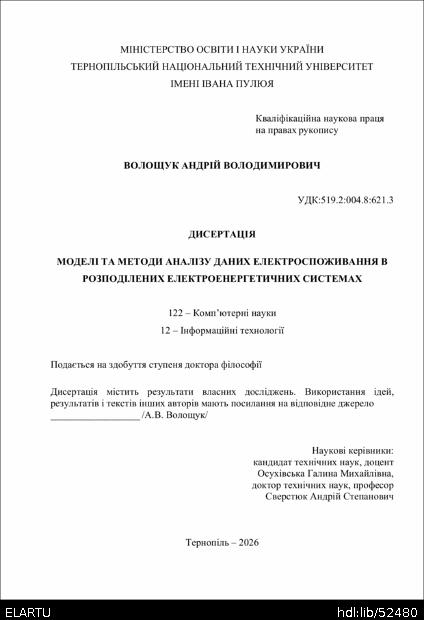
| dc.title | Моделі та методи аналізу даних електроспоживання в розподілених електроенергетичних системах | uk_UA |
| dc.title.alternative | Electricity Consumption Data Analysis in Distributed Electrical Power Systems | uk_UA |
| dc.type | Dissertation | uk_UA |
| dc.rights.holder | © Волощук Андрій Володимирович, 2026 | uk_UA |
| dc.coverage.placename | Тернопіль | uk_UA |
| dc.format.pages | 213 | - |
| dc.subject.udc | 519.2:004.8:621.3 | uk_UA |
| thesis.degree.discipline | 122 Комп’ютерні науки | - |
| thesis.degree.grantor | Тернопільський національний технічний університет імені Івана Пулюя | - |
| thesis.degree.level | докторська дисертація | - |
| thesis.degree.name | доктор філософії | - |
| dc.relation.references | 1. Khalid M. Energy 4.0: AI–enabled digital transformation for sustainable power networks. Computers & Industrial Engineering. 2024. Art. 110253. DOI: https://doi.org/10.1016/j.cie.2024.110253. | uk_UA |
| dc.relation.references | 2. Fouad M., Mali R., Lmouatassime A., Bousmah M. Machine Learning and IoT for Smart Grid. ISPRS – International Archives of the Photogrammetry, Remote Sensing and Spatial Information Sciences. 2020. Vol. XLIV–4/W3–2020. P. 233–240. DOI: https://doi.org/10.5194/isprs-archives-XLIV-4-W3-2020-233-2020. | uk_UA |
| dc.relation.references | 3. Tuballa M. L., Abundo M. L. A review of the development of Smart Grid technologies. Renewable and Sustainable Energy Reviews. 2016. Vol. 59. P. 710–725. DOI: https://doi.org/10.1016/j.rser.2016.01.011. | uk_UA |
| dc.relation.references | 4. Data Analytics for Smart Grids Applications: A Key to Smart City Development / ed. by D. Kumar Sharma et al. Cham : Springer Nature Switzerland, 2023. DOI: https://doi.org/10.1007/978-3-031-46092-0. | uk_UA |
| dc.relation.references | 5. Shi W., Cao J., Zhang Q., Li Y., Xu L. Edge Computing: Vision and Challenges. IEEE Internet of Things Journal. 2016. Vol. 3, no. 5. P. 637–646. DOI: https://doi.org/10.1109/jiot.2016.2579198. | uk_UA |
| dc.relation.references | 6. Number of connected IoT devices growing 14% to 21.1 billion. IoT Analytics Your Global IoT Market Research Partner. URL: https://iot-analytics.com/numberconnected- iot-devices/ (дата звернення: 27.02.2026). | uk_UA |
| dc.relation.references | 7. Smart Grid Technologies: Communication Technologies and Standards / V. C. Gungor et al. IEEE Transactions on Industrial Informatics. 2011. Vol. 7, no. 4. P. 529–539. DOI: https://doi.org/10.1109/tii.2011.2166794. | uk_UA |
| dc.relation.references | 8. Enhancing resilience in complex energy systems through real–time anomaly detection: a systematic literature review / A. Aghazadeh Ardebili et al. Energy Informatics. 2024. Vol. 7, no. 1. Art. 96. DOI: https://doi.org/10.1186/s42162–024–00401–8. | uk_UA |
| dc.relation.references | 9. Інтелектуальні електричні мережі: елементи та режими : монографія / за заг. ред. О. В. Кириленка. Київ : Ін-т електродинаміки НАН України, 2016. 400 с. | uk_UA |
| dc.relation.references | 10. Electric storage systems based on the use of powerful bi–directional converters / A. Zharkin et al. Bulletin of the National Technical University «KhPI» Series: New solutions in modern technologies. 2018. Vol. 1, no. 26(1302). P. 25–33. DOI: https://doi.org/10.20998/2413–4295.2018.26.04. | uk_UA |
| dc.relation.references | 11. Лежнюк П. Д., Рубаненко О. Є., Гунько І. О. Оптимізація режимів електричних мереж з відновлюваними джерелами електроенергії : монографія. Вінниця : ВНТУ, 2017. 164 с. | uk_UA |
| dc.relation.references | 61. Zhang W., Quan H., Srinivasan D. Parallel and reliable probabilistic load forecasting via quantile regression forest and quantile determination. Energy. 2018. Vol. 160. P. 810–819. DOI: https://doi.org/10.1016/j.energy.2018.07.019. | uk_UA |
| dc.relation.references | 62. Kim T.-Y., Cho S.-B. Predicting residential energy consumption using CNN-LSTM neural networks. Energy. 2019. Vol. 182. P. 72–81. DOI: https://doi.org/10.1016/j.energy.2019.05.230. | uk_UA |
| dc.relation.references | 63. Li N., Li B., Gao L. Transient Stability Assessment of Power System Based on XGBoost and Factorization Machine. IEEE Access. 2020. Vol. 8. P. 28403–28414. DOI: https://doi.org/10.1109/access.2020.2969446. | uk_UA |
| dc.relation.references | 64. A Comprehensive Survey on Graph Neural Networks / Z. Wu et al. IEEE Transactions on Neural Networks and Learning Systems. 2021. Vol. 32, no. 1. P. 4–24. DOI: https://doi.org/10.1109/tnnls.2020.2978386. | uk_UA |
| dc.relation.references | 65. Kea K., Han Y., Kim T.-K. Enhancing anomaly detection in distributed power systems using autoencoder-based federated learning. PLOS ONE. 2023. Vol. 18, no. 8. Art. e0290337. DOI: https://doi.org/10.1371/journal.pone.0290337. | uk_UA |
| dc.relation.references | 66. Imani M., Beikmohammadi A., Arabnia H. R. Comprehensive Analysis of Random Forest and XGBoost Performance with SMOTE, ADASYN, and GNUS Under Varying Imbalance Levels. Technologies. 2025. Vol. 13, no. 3. P. 88. DOI: https://doi.org/10.3390/technologies13030088. | uk_UA |
| dc.relation.references | 67. Kumar Panda D., Das S., Townley S. Hyperparameter Optimized Classification Pipeline for Handling Unbalanced Urban and Rural Energy Consumption Patterns. Expert Systems with Applications. 2023. Vol. 214. Art. 119127. DOI: https://doi.org/10.1016/j.eswa.2022.119127. | uk_UA |
| dc.relation.references | 68. Artificial Intelligence Techniques for Power System Transient Stability Assessment / P. Sarajcev et al. Energies. 2022. Vol. 15, no. 2. Art. 507. DOI: https://doi.org/10.3390/en15020507. | uk_UA |
| dc.relation.references | 69. Duan J. Deep learning anomaly detection in AI-powered intelligent power distribution systems. Frontiers in Energy Research. 2024. Vol. 12. Art. 1364456. DOI: https://doi.org/10.3389/fenrg.2024.1364456. | uk_UA |
| dc.relation.references | 70. Deep learning for intelligent demand response and smart grids: A comprehensive survey / P. Boopathy et al. Computer Science Review. 2024. Vol. 51. Art. 100617. DOI: https://doi.org/10.1016/j.cosrev.2024.100617. | uk_UA |
| dc.relation.references | 101. Khvostivskyi M., Osukhivska H., Khvostivska L., Lobur T., Velychko D. Mathematical modelling of daily computer network traffic. ITTAP'2021: 1st International Workshop on Information Technologies: Theoretical and Applied Problems. Ternopil, Ukraine, 2021. Vol. 3039. URL: https://ceur-ws.org/Vol- 3039/short24.pdf. | uk_UA |
| dc.relation.references | 71. Aguiar-Pérez J. M., Pérez-Juárez M. Á. An Insight of Deep Learning Based Demand Forecasting in Smart Grids. Sensors. 2023. Vol. 23, no. 3. Art. 1467. DOI: https://doi.org/10.3390/s23031467. | uk_UA |
| dc.relation.references | 72. A meta-learning based distribution system load forecasting model selection framework / Y. Li et al. Applied Energy. 2021. Vol. 294. Art. 116991. DOI: https://doi.org/10.1016/j.apenergy.2021.116991. | uk_UA |
| dc.relation.references | 73. Informer: Beyond Efficient Transformer for Long Sequence Time-Series Forecasting / H. Zhou et al. Proceedings of the AAAI Conference on Artificial Intelligence. 2021. Vol. 35, no. 12. P. 11106–11115. DOI: https://doi.org/10.1609/aaai.v35i12.17325. | uk_UA |
| dc.relation.references | 74. Dudek G. Pattern-based local linear regression models for short-term load forecasting. Electric Power Systems Research. 2016. Vol. 130. P. 139–147. DOI: https://doi.org/10.1016/j.epsr.2015.09.001. | uk_UA |
| dc.relation.references | 75. Dudek G. A Comprehensive Study of Random Forest for Short-Term Load Forecasting. Energies. 2022. Vol. 15, no. 20. Art. 7547. DOI: https://doi.org/10.3390/en15207547. | uk_UA |
| dc.relation.references | 76. Load Forecasting Techniques and Their Applications in Smart Grids / H. Habbak et al. Energies. 2023. Vol. 16, no. 3. Art. 1480. DOI: https://doi.org/10.3390/en16031480. | uk_UA |
| dc.relation.references | 77. A novel multi–time–scale modeling for electric power demand forecasting: From short–term to medium–term horizon / K. G. Boroojeni et al. Electric Power Systems Research. 2017. Vol. 142. P. 58–73. DOI: https://doi.org/10.1016/j.epsr.2016.08.031. | uk_UA |
| dc.relation.references | 78. Bahman S., Zareipour H. Long–Term Multi–Resolution Probabilistic Load Forecasting Using Temporal Hierarchies. Energies. 2025. Vol. 18, no. 11. Art. 2908. DOI: https://doi.org/10.3390/en18112908. | uk_UA |
| dc.relation.references | 79. Napolitano A. Cyclostationarity: New trends and applications. Signal Processing. 2016. Vol. 120. P. 385–408. DOI: https://doi.org/10.1016/j.sigpro.2015.09.011. | uk_UA |
| dc.relation.references | 80. Лупенко С. А., Литвиненко Я. В. Методи статистичного опрацювання циклічних випадкових процесів у задачах моделювання сигналів. Вісник ТНТУ. 2015. № 2 (78). С. 177–188. | uk_UA |
| dc.relation.references | 102. Хвостівський М. О., Хвостівська Л. В., Дедів І. Ю., Дедів Л. Є. Інтелектуальна система прогнозування трафіку комп'ютерних мереж на основі синфазної обробки даних. Вісник Херсонського національного технічного університету. 2025. Т. 2, № 3(94). С. 497–503. DOI: https://doi.org/10.35546/kntu2078-4481.2025.3.2.63. | uk_UA |
| dc.relation.references | 81. Periodically correlated random processes: Application in early diagnostics of mechanical systems / I. Javorskyj et al. Mechanical Systems and Signal Processing. 2017. Vol. 83. P. 406–438. DOI: https://doi.org/10.1016/j.ymssp.2016.06.022. | uk_UA |
| dc.relation.references | 82. Properties of characteristics estimators of periodically correlated random processes in preliminary determination of the period of correlation / I. N. Yavorskyj et al. Radioelectronics and Communications Systems. 2012. Vol. 55, no. 8. P. 335–348. DOI: https://doi.org/10.3103/s0735272712080018. | uk_UA |
| dc.relation.references | 83. Драган Я. П. Періодично корельовані та споріднені з ними випадкові процеси – моделі сигналів у коливних системах. Імовірнісні моделі та обробка випадкових сигналів і полів. Харків : Ін-т радіоелектр., 1992. Т. 1. С. 26–41. | uk_UA |
| dc.relation.references | 84. Lytvynenko I. V., Maruschak P. O., Lupenko S. A. Processing and modeling of ordered relief at the surface of heat–resistant steels after laser irradiation as a cyclic random process. Automatic Control and Computer Sciences. 2014. Vol. 48, no. 1. P. 1–9. DOI: https://doi.org/10.3103/s0146411614010040. | uk_UA |
| dc.relation.references | 85. Lupenko S., Butsiy R. Isomorphic Multidimensional Structures of the Cyclic Random Process in Problems of Modeling Cyclic Signals with Regular and Irregular Rhythms. Fractal and Fractional. 2024. Vol. 8, no. 4. P. 203. DOI: https://doi.org/10.3390/fractalfract8040203. | uk_UA |
| dc.relation.references | 86. Лупенко С. А., Литвиненко Я. В., Сверстюк А. С. Статистичний сумісний аналіз кардіосигналів на основі вектора циклічних ритмічно пов'язаних випадкових процесів. Електроніка та системи керування. Київ : Національний авіаційний університет, 2008. С. 22–29. | uk_UA |
| dc.relation.references | 87. Lupenko S. Abstract Cyclic Functional Relation and Taxonomies of Cyclic Signals Mathematical Models: Construction, Definitions and Properties. Mathematics. 2024. Vol. 12, no. 19. Art. 3084. DOI: https://doi.org/10.3390/math12193084. | uk_UA |
| dc.relation.references | 88. Литвиненко Я. В., Лупенко С. А., Студена Ю. Методи статистичної обробки сигналів серця на базі їх моделі у вигляді циклічного випадкового процесу із зонною часовою структурою. Вісник Тернопільського державного технічного університету. 2006. Т. 11, № 4. С. 189–200. | uk_UA |
| dc.relation.references | 89. Сверстюк А. С. Математичне моделювання та методи обробки синхронно зареєстрованих сигналів серця з використанням циклічних ритмічно пов'язаних випадкових процесів : дис. … канд. техн. наук : 01.05.02. Київ, 2010. 196 с. | uk_UA |
| dc.relation.references | 90. Mathematical model of gas consumption process in the form of cyclic random process / I. Lytvynenko et al. 2021 IEEE 16th International Conference on Computer Sciences and Information Technologies (CSIT), LVIV, Ukraine, 22–25 September 2021. 2021. DOI: https://doi.org/10.1109/csit52700.2021.9648621. | uk_UA |
| dc.relation.references | 103. Javors'kyj I., Isayev I., Zakrzewski Z., Brooks S. P. Coherent covariance analysis of periodically correlated random processes. Signal Processing. 2007. Vol. 87, no. 1. P. 13–32. DOI: https://doi.org/10.1016/j.sigpro.2006.04.002. | uk_UA |
| dc.relation.references | 91. Горкуненко А. Б., Лупенко С. А. Порівняльний аналіз математичних моделей циклічних економічних процесів в інформаційних системах підтримки прийняття економічних рішень. Науковий вісник НЛТУ України. 2012. Вип. 22.5. С. 345–351. | uk_UA |
| dc.relation.references | 92. Lupenko S. The Mathematical Model of Cyclic Signals in Dynamic Systems as a Cyclically Correlated Random Process. Mathematics. 2022. Vol. 10, no. 18. Art. 3406. DOI: https://doi.org/10.3390/math10183406. | uk_UA |
| dc.relation.references | 93. Lupenko S. Rhythm–Adaptive Statistical Estimation Methods of Probabilistic Characteristics of Cyclic Random Processes. Digital Signal Processing. 2024. Vol. 151. Art. 104563. DOI: https://doi.org/10.1016/j.dsp.2024.104563. | uk_UA |
| dc.relation.references | 94. Detection of distributed and localized faults in rotating machines using periodically non–stationary covariance analysis of vibrations / I. Yavorskyy et al. Measurement Science and Technology. 2023. DOI: https://doi.org/10.1088/1361-6501/acbc93. | uk_UA |
| dc.relation.references | 95. Methods of Hidden Periodicity Discovering for Gearbox Fault Detection / I. Javorskyj et al. Sensors. 2021. Vol. 21, no. 18. Art. 6138. DOI: https://doi.org/10.3390/s21186138. | uk_UA |
| dc.relation.references | 96. Investigation of the correlation structure of the vibration signal of the decanter bearing assembly / I. M. Javorskyj et al. Tehničeskaâ diagnostika i nerazrušaûŝij kontrolʹ. 2024. Vol. 2024, no. 2. P. 3–10. DOI: https://doi.org/10.37434/tdnk2024.02.0. | uk_UA |
| dc.relation.references | 97. Дедів Л. Є., Сверстюк А. С., Дедів І. Ю., Хвостівський М. О., Дозорський В. Г., Яворська Є. Б. Математичне та комп'ютерне моделювання електрокардіосигналів у системах голтерівського моніторингу : монографія. Львів : Магнолія 2006, 2021. 120 с. | uk_UA |
| dc.relation.references | 98. Хвостівська Л.В., Осухівська Г.М., Хвостівський М.О., Шадріна Г.М., Дедів І.Ю. Розвиток методів та алгоритмів обчислення періоду стохастичних біомедичних сигналів для медичних комп’ютерно–діагностичних систем. Вісник НТУУ КПІ. Серія Радіотехніка, Радіоапаратобудування, (79). С. 78–84. DOI: https://doi.org/10.20535/radap.2019.79.78-84. | uk_UA |
| dc.relation.references | 99. Дедів Л.Є., Хвостівський М.О., Дунець В.Л., Шадріна Г.М. Імітаційна модель електрокардіосигналу на основі періодично корельованого випадкового процесу. Вісник Тернопільського державного технічного університету. Тернопіль: ТДТУ ім. І.Пулюя. 2008. №3. С. 201–205. | uk_UA |
| dc.relation.references | 100. Дунець В.Л., Драґан Я.П. Опрацювання електрокардiосиґналу синфазним методом для виявлення патологiї. Комп’ютернi технологiї друкарства. Львiв: Українська академiя друкарства, 2007. № 18. С. 51–59. | uk_UA |
| dc.relation.references | 104. Linear filtration methods for statistical analysis of periodically correlated random processes–Part II: Harmonic series representation / I. Javorskyj et al. Signal Processing. 2011. Vol. 91, no. 11. P. 2506–2519. DOI: https://doi.org/10.1016/j.sigpro.2011.04.031. | uk_UA |
| dc.relation.references | 105. Linear filtration methods for statistical analysis of periodically correlated random processes–Part I: Coherent and component methods and their generalization / I. Javorskyj et al. Signal Processing. 2012. Vol. 92, no. 7. P. 1559–1566. DOI: https://doi.org/10.1016/j.sigpro.2011.09.030. | uk_UA |
| dc.relation.references | 106. Javorskyj I., Isayev I., Majewski J., Yuzefovych R. Component covariance analysis for periodically correlated random processes. Signal Processing. 2010. Vol. 90, no. 4. P. 1083–1102. DOI: https://doi.org/10.1016/j.sigpro.2009.07.031. | uk_UA |
| dc.relation.references | 107. Javorskyj I., Matsko I., Yuzefovych R., Zakrzewski Z. Discrete estimators of characteristics for periodically correlated time series. Digital Signal Processing. 2016. Vol. 53. P. 25–40. DOI: https://doi.org/10.1016/j.dsp.2016.03.003. | uk_UA |
| dc.relation.references | 108. Yavorskyj I. N., Yuzefovych R., Matsko I. Y., Shevchik V. Component correlation analysis of vectorial periodically non-stationary random processes. Radioelectronics and Communications Systems. 2014. Vol. 57, no. 9. P. 403–417. DOI: https://doi.org/10.3103/S0735272714090039. | uk_UA |
| dc.relation.references | 109. Javorskyj I., Yuzefovych R., Matsko I., Zakrzewski Z. The least square estimation of the basic frequency for periodically non-stationary random signals. Digital Signal Processing. 2022. Vol. 122. Art. 103333. DOI: https://doi.org/10.1016/j.dsp.2021.103333. | uk_UA |
| dc.relation.references | 110. Tymoshchuk D., Voloshchuk A., Sverstiuk A., Osukhivska H., Bahrii-Zaiats O. Machine learning-based information technology for analyzing energy peaks in power grid balancing. Proceedings of the 2nd International Workshop on Advanced Applied Information Technologies (AdvAIT 2025). Khmelnytskyi, Ukraine – Žilina, Slovakia, 2025. Vol. 4163. P. 204–220. URL: https://ceur-ws.org/Vol-4163/paper18.pdf. | uk_UA |
| dc.relation.references | 12. Лежнюк П. Д., Комар В. О., Добровольська Л. Н., Повстянко К. О. Відносне оцінювання засобів балансування режимів електроенергетичних систем з відновлюваними джерелами енергії. Вісник Вінницького політехнічного інституту. 2022. № 3. С. 24–30. DOI: https://doi.org/10.31649/1997-9266-2022- 162-3-24-30. | uk_UA |
| dc.relation.references | 111. Марченко Б. Г., Приймак М. В. Математичні основи теорії лінійних періодичних процесів : монографія. Київ : Наукова думка, 1996. 232 | uk_UA |
| dc.relation.references | 112. Tymoshchuk D., Yasniy O., Didych I., Stanko A., Medvid V. Prediction of SMA hysteresis behavior by ensemble stacking machine learning model with SHAP–based explanation. Progress in Engineering Science. 2026. Art. 100237. DOI: https://doi.org/10.1016/j.pes.2026.100237. | uk_UA |
| dc.relation.references | 113. Huang Z., Yi Y. Short–Term Load Forecasting for Regional Smart Energy Systems Based on Two–Stage Feature Extraction and Hybrid Inverted Transformer. Sustainability. 2024. Vol. 16, no. 17. Art. 7613. DOI: https://doi.org/10.3390/su16177613. | uk_UA |
| dc.relation.references | 114. Бунько В., Кондрат О., Бунько Н. Аналіз використання та впровадження системи «розумного» моніторингу електричної енергії навчального корпусу. Вісник Кременчуцького національного університету імені Михайла Остроградського. 2024. № 4. С. 169–176. DOI: https://doi.org/10.32782/1995- 0519.2024.4.22. | uk_UA |
| dc.relation.references | 115. Ahmad T., Chen H. Utility companies strategy for short–term energy demand forecasting using machine learning based models. Sustainable Cities and Society. 2018. Vol. 39. P. 401–417. DOI: https://doi.org/10.1016/j.scs.2018.03.002. | uk_UA |
| dc.relation.references | 116. Ofori-Ntow Jnr E., Ziggah Y. Y. Electricity demand forecasting based on feature extraction and optimized backpropagation neural network. e–Prime – Advances in Electrical Engineering, Electronics and Energy. 2023. Vol. 6. Art. 100293. DOI: https://doi.org/10.1016/j.prime.2023.100293. | uk_UA |
| dc.relation.references | 117. Tymoshchuk D., Didych I., Maruschak P., Yasniy O., Mykytyshyn A., Mytnyk M. Machine Learning Approaches for Classification of Composite Materials. Modelling. 2025. Vol. 6, no. 4. 118. DOI: https://doi.org/10.3390/modelling6040118. | uk_UA |
| dc.relation.references | 118. Węglarczyk S. Kernel density estimation and its application. ITM Web of Conferences. 2018. Vol. 23. Art. 00037. DOI: https://doi.org/10.1051/itmconf/20182300037. | uk_UA |
| dc.relation.references | 119. Williamson D. F., Parker R. A., Kendrick J. S. The Box Plot: A Simple Visual Method to Interpret Data. Annals of Internal Medicine. 1989. Vol. 110, no. 11. P. 916–921. DOI: https://doi.org/10.7326/0003–4819–110–11–916. | uk_UA |
| dc.relation.references | 120. Fu H., Tang S., Zhao X. Limitations of Correlation Coefficients in Research on Functional Connectomes and Psychological Processes. Human Brain Mapping. 2025. Vol. 46, no. 10. Art. e70287. DOI: https://doi.org/10.1002/hbm.70287. | uk_UA |
| dc.relation.references | 13. Komenda N., Volynets V., Hrytsiuk I., Bandura I., Romaniuk M. Estimation of the total influence of methods for increasing the line natural load. Polityka Energetyczna – Energy Policy Journal. 2024. Vol. 27, no. 1. P. 27–48. DOI: https://doi.org/10.33223/epj/175239. | uk_UA |
| dc.relation.references | 121. Hastie T., Tibshirani R., Friedman J. The Elements of Statistical Learning: Data Mining, Inference, and Prediction. 2nd ed. New York : Springer, 2009. 745 с. DOI: https://doi.org/10.1007/978-0-387-84858-7. | uk_UA |
| dc.relation.references | 122. Breiman L. Random forests. Machine Learning. 2001. Vol. 45, no. 1. P. 5–32. DOI: https://doi.org/10.1023/a:1010933404324. | uk_UA |
| dc.relation.references | 123. Geurts P., Ernst D., Wehenkel L. Extremely randomized trees. Machine Learning. 2006. Vol. 63, no. 1. P. 3–42. DOI: https://doi.org/10.1007/s10994-006- 6226-1. | uk_UA |
| dc.relation.references | 124. Cortes C., Vapnik V. Support–vector networks. Machine Learning. 1995. Vol. 20, no. 3. P. 273–297. DOI: https://doi.org/10.1007/bf00994018. | uk_UA |
| dc.relation.references | 125. Friedman J. H. Greedy function approximation: A gradient boosting machine. Annals of Statistics. 2001. Vol. 29, no. 5. P. 1189–1232. DOI: https://doi.org/10.1214/aos/1013203451. | uk_UA |
| dc.relation.references | 126. Fawcett T. An introduction to ROC analysis. Pattern Recognition Letters. 2006. Vol. 27, no. 8. P. 861–874. DOI: https://doi.org/10.1016/j.patrec.2005.10.010. | uk_UA |
| dc.relation.references | 127. Chicco D., Jurman G. The advantages of the Matthews correlation coefficient (MCC) over F1 score and accuracy in binary classification evaluation. BMC Genomics. 2020. Vol. 21, no. 1. Art. 6. DOI: https://doi.org/10.1186/s12864–019–6413–7. | uk_UA |
| dc.relation.references | 128. Mitra S., Chakraborty B., Mitra P. Smart meter data analytics applications for secure, reliable and robust grid system: Survey and future directions. Energy. 2023. Art. 129920. DOI: https://doi.org/10.1016/j.energy.2023.129920. | uk_UA |
| dc.relation.references | 129. Madran U., Qaisar S. M., Soyoglu D. Efficient Time–Series Feature Extraction and Ensemble Learning for Appliance Categorization Using Smart Meter Data. Computer Modeling in Engineering & Sciences. 2025. P. 1–10. DOI: https://doi.org/10.32604/cmes.2025.072024. | uk_UA |
| dc.relation.references | 130. Akinrogunde O. O., Adelakun A., Theophilus E. E., Thomas T. G. A systematic review of machine learning and deep learning approaches for load and energy consumption prediction in contemporary power systems. Journal of Innovation Materials, Energy, and Sustainable Engineering. 2025. Vol. 3, no. 1. P. 1–20. DOI: https://doi.org/10.61511/jimese.v3i1.2025.1949. | uk_UA |
| dc.relation.references | 14. Hrytsiuk I., Volynets V., Hrytsiuk Yu., Bandura I., Komenda N. Prospects for the integration of distributed energy sources into the Ukrainian power grid. Machinery & Energetics. 2025. Vol. 16, no. 1. P. 130–145. DOI: https://doi.org/10.31548/machinery/1.2025.130. | uk_UA |
| dc.relation.references | 131. Ali A. M., Dawoud O. K., Ghoneim O. A., Abdel-Basset M. Machine learning models for smart grid stability prediction: a comparative analysis. Scientific Reports. 2026. Vol. 16, no. 1. DOI: https://doi.org/10.1038/s41598-026-47385-x. | uk_UA |
| dc.relation.references | 132. Machine learning for power system stability and control / R. Islam et al. Results in Engineering. 2025. Vol. 26. Art. 105355. DOI: https://doi.org/10.1016/j.rineng.2025.105355. | uk_UA |
| dc.relation.references | 133. Integrating Machine Learning for Anomaly Detection and Pattern Recognition in Smart Grid Power Data / C. Xu, P. Zhang, N. Luo, F. Zheng, W. He. Distributed Generation & Alternative Energy Journal. 2025. Vol. 40, no. 3. P. 595–614. DOI: https://doi.org/10.13052/dgaej2156–3306.4037. | uk_UA |
| dc.relation.references | 134. Kashyap M., Sharma V. A comparative analysis and implementation of CoAP and MQTT protocol for IoT communication. Life Cycle Reliability and Safety Engineering. 2025. Vol. 14, no. 4. P. 715–730. DOI: https://doi.org/10.1007/s41872–025–00324–7. | uk_UA |
| dc.relation.references | 135. IoT–enabled interoperability for energy–mobility integration: A systematic review of protocols, platforms, and standards / X. Liu et al. Applied Energy. 2026. Vol. 411. Art. 127611. DOI: https://doi.org/10.1016/j.apenergy.2026.127611. | uk_UA |
| dc.relation.references | 136. Voloshchuk A., Osukhivska H. Adaptive multi–protocol communication for energy systems. Scientific journal of the Ternopil national technical university. 2025. Vol. 119, no. 3. P. 97–106. DOI: https://doi.org/10.33108/visnyk_tntu2025.03.097. | uk_UA |
| dc.relation.references | 137. Voloshchuk A., Velychko D., Osukhivska H., Palamar A. Computer system for energy distribution in conditions of electricity shortage using artificial intelligence. CEUR Workshop Proceedings: 2nd International Workshop on Computer Information Technologies in Industry 4.0 (CITI 2024). Ternopil, Ukraine, 2024. Vol. 3742. P. 66–75. URL: https://ceur-ws.org/Vol-3742/paper5.pdf. | uk_UA |
| dc.relation.references | 138. Kovtun V., Kovtun O., Grochla K., Yasniy O. The quality of service assessment of eMBB and mMTC traffic in a clustered 5G ecosystem of a smart factory. Egyptian Informatics Journal. 2025. Vol. 29. Art. 100598. DOI: https://doi.org/10.1016/j.eij.2024.100598. | uk_UA |
| dc.relation.references | 139. Żatuchin D., Azarskov M. An Adaptive Protocol Selection Framework for Energy–Efficient IoT Communication: Dynamic Optimization Through Context–Aware Decision Making. Informatics. 2025. Vol. 12, no. 4. P. 125. DOI: https://doi.org/10.3390/informatics12040125. | uk_UA |
| dc.relation.references | 140. Kasaraneni P. P., Kumar Y. V. P., Moganti G. L. K., Kannan R. Machine learning-based ensemble classifiers for anomaly handling in smart home energy 178 consumption data. Sensors. 2022. Vol. 22, no. 23. Art. 9323. DOI: https://doi.org/10.3390/s22239323. | uk_UA |
| dc.relation.references | 15. Davydenko L. V., Davydenko V. A. Aspects of integration into the electric network of decentralized generation based on renewable energy sources: an overview of issues and tasks for the sustainable development of the energy system. Journal of Electrical and Power Engineering. 2024. Vol. 30, no. 1. P. 22–29. DOI: https://doi.org/10.31474/2074-2630-2024-1-22-29. | uk_UA |
| dc.relation.references | 16. Khomiak A., Rozen V. Analysis of methods of changing volumes of electricity generation at solar power plants. Power Engineering: Economics, Technique, Ecology. 2023. no. 3. DOI: https://doi.org/10.20535/1813-5420.3.2023.289652. | uk_UA |
| dc.relation.references | 17. Про затвердження Національного плану дій з відновлюваної енергетики на період до 2030 року та плану заходів з його виконання. Офіційний вебпортал парламенту України. URL: https://zakon.rada.gov.ua/laws/show/761-2024-р#Text (дата звернення: 27.02.2026). | uk_UA |
| dc.relation.references | 18. Power system stability in the Era of energy Transition: Importance, Opportunities, Challenges, and future directions / A. M. Saleh et al. Energy Conversion and Management: X. 2024. Art. 100820. DOI: https://doi.org/10.1016/j.ecmx.2024.100820. | uk_UA |
| dc.relation.references | 19. Hahn H., Meyer–Nieberg S., Pickl S. Electric load forecasting methods: Tools for decision making. European Journal of Operational Research. 2009. Vol. 199, no. 3. P. 902–907. DOI: https://doi.org/10.1016/j.ejor.2009.01.062. | uk_UA |
| dc.relation.references | 20. Predicting peak day and peak hour of electricity demand with ensemble machine learning / T. Fu et al. Frontiers in Energy Research. 2022. Vol. 10. DOI: https://doi.org/10.3389/fenrg.2022.944804. | uk_UA |
| dc.relation.references | 21. Artificial intelligence based anomaly detection of energy consumption in buildings: A review, current trends and new perspectives / Y. Himeur et al. Applied Energy. 2021. Vol. 287. Art. 116601. DOI: https://doi.org/10.1016/j.apenergy.2021.116601. | uk_UA |
| dc.relation.references | 22. AI-Empowered Methods for Smart Energy Consumption: A Review of Load Forecasting, Anomaly Detection and Demand Response / X. Wang et al. International Journal of Precision Engineering and Manufacturing-Green Technology. 2023. DOI: https://doi.org/10.1007/s40684-023-00537-0. | uk_UA |
| dc.relation.references | 23. A data-driven methodology for deriving electricity consumption typologies from smart meters / C. Quesada et al. Energy Reports. 2025. Vol. 14. P. 2420–2434. DOI: https://doi.org/10.1016/j.egyr.2025.09.002. | uk_UA |
| dc.relation.references | 24. Comparative Analysis of ARIMA and SARIMA Models in Electrical Load Forecasting: Insights for Long and Short–Term Projections / M. A. Momani et al. International Journal of Electrical Engineering and Computer Science. 2025. Vol. 7. P. 83–89. DOI: https://doi.org/10.37394/232027.2025.7.8. | uk_UA |
| dc.relation.references | 25. Peak Electrical Energy Consumption Prediction by ARIMA, LSTM, GRU, ARIMA–LSTM and ARIMA–GRU Approaches / A. A. Pierre et al. Energies. 2023. Vol. 16, no. 12. P. 4739. DOI: https://doi.org/10.3390/en16124739. | uk_UA |
| dc.relation.references | 26. Electricity load forecasting using clustering and ARIMA model for energy management in buildings / B. Nepal et al. Japan Architectural Review. 2019. Vol. 3, no. 1. P. 62–76. DOI: https://doi.org/10.1002/2475–8876.12135. | uk_UA |
| dc.relation.references | 27. Papaioannou G. P., Dikaiakos C., Dramountanis A., Papaioannou P. G. Analysis and modeling for short- to medium-term load forecasting using a hybrid manifold learning principal component model and comparison with classical statistical models (SARIMAX, exponential smoothing) and artificial intelligence models (ANN, SVM): the case of Greek electricity market. Energies. 2016. Vol. 9, no. 8. P. 635. DOI: https://doi.org/10.3390/en9080635. | uk_UA |
| dc.relation.references | 28. Fryz M., Scherbak L. Properties of Discrete–Time Conditional Linear Cyclostationary Random Processes in the Problems Of Energy Informatics. System Research in Energy. 2023. Vol. 2023, no. 1. P. 72–79. DOI: https://doi.org/10.15407/srenergy2023.01.072. | uk_UA |
| dc.relation.references | 29. Data-driven load profiles and the dynamics of residential electricity consumption / M. Anvari et al. Nature Communications. 2022. Vol. 13, no. 1. DOI: https://doi.org/10.1038/s41467-022-31942-9. | uk_UA |
| dc.relation.references | 30. Терещенко Т. О., Ямненко Ю. С., Клепач Л. Є., Лайкова Л. Г., Палій Д. М. Огляд основних моделей прогнозування енергоспоживання в MicroGrid. Вчені записки Таврійського національного університету імені В.І. Вернадського. Серія: Технічні науки. 2018. Т. 29 (68), № 4 (1). С. 36–41. | uk_UA |
| dc.relation.references | 31. Марченко Б. Г., Приймак М. В. Побудова моделі та аналіз стохастично–періодичних навантажень енергосистем. Праці Інституту електродинаміки НАН України. Київ : ІЕД НАН України, 1999. Вип. 1. С. 129–153. | uk_UA |
| dc.relation.references | 32. Приймак М. В., Мацюк О. В., Маєвський О. В., Прошин С. Ю. Моделі та методи дослідження систем масового обслуговування марківського типу в умовах стохастичної періодичності та їхнє застосування в енергетиці. Технічна електродинаміка. 2014. № 2. С. 11–16. | uk_UA |
| dc.relation.references | 33. Марценко С. В. Математичне моделювання та статистичні методи обробки даних вимірювань в задачах моніторингу електронавантаження : автореф. дис. … канд. техн. наук : 01.05.02. Тернопіль : ТНТУ ім. І. Пулюя, 2011. 22 с. | uk_UA |
| dc.relation.references | 34. Scherbak L. M., Fryz M. Y., Hotovych V. A. Electricity consumption simulation using random coefficient periodic autoregressive model. IOP Conference Series: Earth and Environmental Science. 2023. Vol. 1254, no. 1. Art. 012027. DOI: https://doi.org/10.1088/1755-1315/1254/1/012027. | uk_UA |
| dc.relation.references | 35. Gotovych V., Nazarevych O., Shcherbak L. Mathematical modeling of the regular–mode electric power supply and electric power consumption processes of the organization. Scientific journal of the Ternopil national technical university. 2018. Vol. 91, no. 3. P. 134–142. DOI: https://doi.org/10.33108/visnyk_tntu2018.03.134. | uk_UA |
| dc.relation.references | 36. Fryz M., Scherbak L. Statistical Analysis of Random Coefficient Periodic Autoregression and Its Application for Short–Term Electricity Consumption Forecasting. Tekhnichna Elektrodynamika. 2019. Vol. 2019, no. 2. P. 38–47. DOI: https://doi.org/10.15407/techned2019.02.038. | uk_UA |
| dc.relation.references | 37. Fryz M., Mlynko B. Discrete-time conditional linear random processes and their properties. Herald of Khmelnytskyi National University. Technical Sciences. 2022. Vol. 309, no. 3. P. 7–12. DOI: https://doi.org/10.31891/2307-5732-2022-309-3-7-12. | uk_UA |
| dc.relation.references | 38. Application of hilbert transform for power quality indicators monitoring in general purpose grids / S. Kovtun et al. System Research in Energy. 2024. Vol. 2024, no. 2. P. 71–83. DOI: https://doi.org/10.15407/srenergy2024.02.071. | uk_UA |
| dc.relation.references | 39. Nowotarski J., Weron R. Recent advances in electricity price forecasting: A review of probabilistic forecasting. Renewable and Sustainable Energy Reviews. 2018. Vol. 81. P. 1548–1568. DOI: https://doi.org/10.1016/j.rser.2017.05.234. | uk_UA |
| dc.relation.references | 40. Hong T., Fan S. Probabilistic electric load forecasting: a tutorial review. International Journal of Forecasting. 2016. Vol. 32, no. 3. P. 914–938. DOI: https://doi.org/10.1016/j.ijforecast.2015.11.011. | uk_UA |
| dc.relation.references | 41. Jaworski I., Derecka M., Bielinski W. Ocena możliwości zastosowania teorii procesów losowych okresowo niestacjonarnych do badania dobowej zmienności mocy pobieranej przez odbiorców. VIII konferencja naukowo-techniczna «Rynek energii elektrycznej: liberalizacja – szanse i zagrożenia». Lublin : Politech. Lubelska, 2001. S. 45–52. (польськ.). | uk_UA |
| dc.relation.references | 42. Bielinski W., Derecka M. Komputerowo wspomagane wyznaczanie charakterystyk stochastycznych przebiegów obciążeń elektroenergetycznych. VII Konferencja naukowo-techniczna «Rynek energii elektrycznej: liberalizacja – szanse i zagrożenia» (ZKwE 2002). Poznań, Poland, 2002. S. 227–232. (польськ.). | uk_UA |
| dc.relation.references | 43. Яворський І. М. Математичні моделі та аналіз стохастичних коливань. Львів : ФМІ НАНУ, 2013. 804 с. | uk_UA |
| dc.relation.references | 44. Приймак М. В. Побудова прогнозних графіків енергонавантажень на основі періодичного лінійного випадкового процесу. Технічна електродинаміка. 2000. № 3. С. 50–52. | uk_UA |
| dc.relation.references | 45. Мацюк О. В., Приймак М. В. Періодично корельовані випадкові процеси із модульованими через період значеннями ймовірнісних характеристик. Вісник Тернопільського державного технічного університету. 2006. Т. 11, № 2. С. 142–149. | uk_UA |
| dc.relation.references | 46. Voloshchuk A., Osukhivska H., Khvostivskyi M., Sverstiuk A. Application of periodically correlated stochastic processes for forecasting electricity consumption. Measuring and Computing Devices in Technological Processes. 2025. no. 3. P. 393–403. DOI: https://doi.org/10.31891/2219-9365-2025-83-48. | uk_UA |
| dc.relation.references | 47. Voloshchuk A., Osukhivska H., Khvostivskyi M., Sverstiuk A. Analysis of electricity consumption using the component method of periodically correlated random processes. Computer Systems and Information Technologies. 2025. no. 3. P. 74–82. DOI: https://doi.org/10.31891/csit-2025-3-8. | uk_UA |
| dc.relation.references | 48. Voloshchuk A., Osukhivska H. Application of a cyclic stochastic process model for analyzing electricity consumption. Computer-Integrated Technologies: Education, Science, Production. 2025. no. 61. P. 35–42. DOI: https://doi.org/10.36910/6775- 2524-0560-2025-61-05. | uk_UA |
| dc.relation.references | 49. Драган Я. Енергетична теорія лінійних моделей стохастичних сигналів. Львів : Фіз.-мех. ін-т ім. Г. В. Карпенка НАН України, 1997. 361 с. (Теорія сигналів і систем: моделі, алгоритми, структури ; т. 1). | uk_UA |
| dc.relation.references | 50. Драган Я., Сікора Л., Яворський Б. Основи сучасної теорії стохастичних сигналів і енергетична концепція: математичний апарат, фізичне тлумачення. Львів : Центр стратегічних досліджень ЕБТЕС, 1999. 133 с. | uk_UA |
| dc.relation.references | 51. Драган Я., Євтух П., Сікора Л., Яворський Б. Періодично корельовані випадкові процеси як адекватні моделі сигналів кратної ритміки природних явищ і технологічних процесів. Комп’ютерні технології друкарства. 2000. № 4. С. 269–290. | uk_UA |
| dc.relation.references | 52. Alnuaimi A. F. A. H., Albaldawi T. H. K. An overview of machine learning classification techniques. BIO Web of Conferences. 2024. Vol. 97. P. 00133. DOI: https://doi.org/10.1051/bioconf/20249700133. | uk_UA |
| dc.relation.references | 53. A machine learning ensemble framework based on a clustering algorithm for improving electric power consumption performance / T. Sim et al. Scientific Reports. 2025. Vol. 15, no. 1. DOI: https://doi.org/10.1038/s41598–025–23978–w. | uk_UA |
| dc.relation.references | 54. Advancing ensemble learning techniques for residential building electricity consumption forecasting: Insight from explainable artificial intelligence / J. Moon et al. PLOS ONE. 2024. Vol. 19, no. 11. Art. e0307654. DOI: https://doi.org/10.1371/journal.pone.0307654. | uk_UA |
| dc.relation.references | 55. Guato Burgos M. F., Morato J., Vizcaino Imacaña F. P. A Review of Smart Grid Anomaly Detection Approaches Pertaining to Artificial Intelligence. Applied Sciences. 2024. Vol. 14, no. 3. Art. 1194. DOI: https://doi.org/10.3390/app14031194. | uk_UA |
| dc.relation.references | 56. Swarnkar V., Ralhan S., Singh M., Parashar D., Singh M. Correlation based feature importance analysis for improving machine learning stability predictions in hybrid PV systems. Scientific Reports. 2026. Vol. 16. Art. 10041. DOI: https://doi.org/10.1038/s41598–026–37270–y. | uk_UA |
| dc.relation.references | 57. Misiurek K., Olkuski T., Zyśk J. Review of Methods and Models for Forecasting Electricity Consumption. Energies. 2025. Vol. 18, no. 15. Art. 4032. DOI: https://doi.org/10.3390/en18154032. | uk_UA |
| dc.relation.references | 58. Modelling the properties of shape memory alloys using machine learning methods / O. Yasniy et al. Procedia Structural Integrity. 2025. Vol. 68. P. 132–138. DOI: https://doi.org/10.1016/j.prostr.2025.06.033. | uk_UA |
| dc.relation.references | 59. Романюк М. В., Коменда Н. В., Волинець В. І., Гадай А. В., Бандура І. О. Енергетичне моделювання Smart Grid: морфометричний підхід до аналізу розподілених енергетичних систем. Наукові праці ДонНТУ. Серія: Електротехніка і енергетика. 2025. Т. 33, вип. 2. С. 37–42. DOI: https://doi.org/10.31474/2074-2630-2025-2-37-42. | uk_UA |
| dc.relation.references | 60. Electricity Consumption Classification using Various Machine Learning Models / B. K. Paikaray et al. EAI Endorsed Transactions on Energy Web. 2024. Vol. 11. DOI: https://doi.org/10.4108/ew.6274. | uk_UA |
| dc.contributor.affiliation | Тернопільський національний технічний університет імені Івана Пулюя, Тернопіль, Україна | uk_UA |
| dc.coverage.country | UA | uk_UA |
| dc.identifier.citation2015 | Волощук А. В. Моделі та методи аналізу даних електроспоживання в розподілених електроенергетичних системах : дис. ... доктора філософії : 122. Тернопіль, 2026. 213 с. | uk_UA |
| Samling: | 122 Комп’ютерні науки | |
Fulltext och övriga filer i denna post:
| Fil | Beskrivning | Storlek | Format | |
|---|---|---|---|---|
| Disser_Voloshchuk_A_V_2026.pdf | 16,15 MB | Adobe PDF | Visa/Öppna | |
| Cover.jpg | 358,53 kB | JPEG | Visa/Öppna |
Materialet i DSpace är upphovsrättsligt skyddat och får ej användas i kommersiellt syfte!