
Por favor, use este identificador para citar o enlazar este ítem:
http://elartu.tntu.edu.ua/handle/lib/52447
Registro completo de metadatos
| Campo DC | Valor | Lengua/Idioma |
|---|---|---|
| dc.contributor.author | Кундеус, Олександр Михайлович | |
| dc.contributor.author | Зарудна, Наталія Ярославівна | |
| dc.contributor.author | Kundeus, Oleksandr | |
| dc.contributor.author | Zarudna, Nataliia | |
| dc.date.accessioned | 2026-06-15T14:49:00Z | - |
| dc.date.available | 2026-06-15T14:49:00Z | - |
| dc.date.created | 2026-01-29 | |
| dc.date.issued | 2026-01-29 | |
| dc.date.submitted | 2026-02-27 | |
| dc.identifier.citation | Кундеус О. М. Трансформація облікової політики підприємства в умовах цифровізації / Кундеус Олександр Михайлович, Зарудна Наталія Ярославівна // ГЕВ. — Т. : ТНТУ, 2026. — Том 98. — № 1. — С. 54–65. — (Облік і оподаткування). | |
| dc.identifier.issn | 2409-8892 | |
| dc.identifier.uri | http://elartu.tntu.edu.ua/handle/lib/52447 | - |
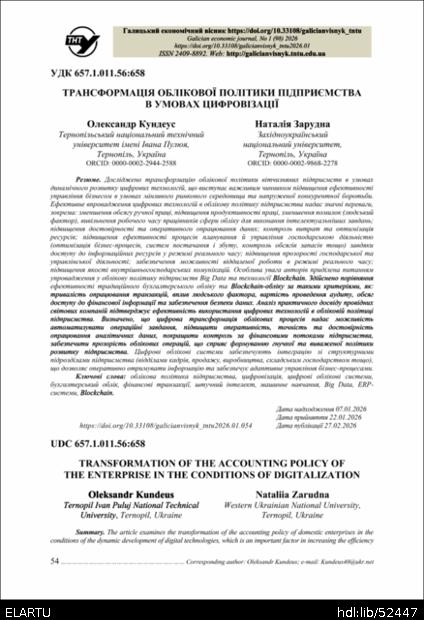
| dc.description.abstract | Досліджено трансформацію облікової політики вітчизняних підприємств в умовах динамічного розвитку цифрових технологій, що виступає важливим чинником підвищення ефективності управління бізнесом в умовах мінливого ринкового середовища та напруженої конкурентної боротьби. Ефективне впровадження цифрових технологій в облікову політику підприємства надає значні переваги, зокрема: зменшення обсягу ручної праці, підвищення продуктивності праці, зменшення помилок (людський фактор), вивільнення робочого часу працівників сфери обліку для виконання інтелектуальніших завдань; підвищення достовірності та оперативного опрацювання даних; контроль витрат та оптимізація ресурсів; підвищення ефективності процесів планування й управління господарською діяльністю (оптимізація бізнес-процесів, систем постачання і збуту, контроль обсягів запасів тощо) завдяки доступу до інформаційних ресурсів у режимі реального часу; підвищення прозорості господарської та управлінської діяльності; забезпечення можливості віддаленої роботи в режимі реального часу; підвищення якості внутрішньогосподарських комунікацій. Особлива увага авторів приділена питанням упровадження у облікову політику підприємств Big Data та технології Blockchain. Здійснено порівняння ефективності традиційного бухгалтерського обліку та Blockchain-обліку за такими критеріями, як: тривалість опрацювання транзакцій, вплив людського фактора, вартість проведення аудиту, обсяг доступу до фінансової інформації та забезпечення безпеки даних. Аналіз практичного досвіду провідних світових компаній підтверджує ефективність використання цифрових технологій в обліковій політиці підприємства. Визначено, що цифрова трансформація облікових процесів надає можливість автоматизувати операційні завдання, підвищити оперативність, точність та достовірність опрацювання аналітичних даних, покращити контроль за фінансовими потоками підприємства, забезпечити прозорість облікових операцій, що сприяє формуванню гнучкої та виваженої політики розвитку підприємства. Цифрові облікові системи забезпечують інтеграцію зі структурними підрозділами підприємства (відділами кадрів, продажу, виробництва, складським господарством тощо), що дозволяє оперативно отримувати інформацію та забезпечує адаптивне управління бізнес-процесами. | |
| dc.description.abstract | The article examines the transformation of the accounting policy of domestic enterprises in the conditions of the dynamic development of digital technologies, which is an important factor in increasing the efficiency of business management in the conditions of a changing market environment and intense competition. Effective implementation of digital technologies in the accounting policy of the enterprise provides significant advantages, in particular: reducing the volume of manual work, increasing labor productivity, reducing errors (human factor), freeing up the working hours of accounting workers to perform more intellectual tasks; increasing the reliability and efficiency of data processing; cost control and optimization of resources; increasing the efficiency of processes of planning and management of economic activity (optimization of business processes, supply and sales systems, control of inventory volumes, etc.) thanks to access to information resources in real time; increasing the transparency of economic and management activities; ensuring the possibility of remote work in real time; improving the quality of intra-economic communications. The authors paid special attention to the issues of implementation of Big Data and Blockchain technology in the accounting policy of enterprises. A comparison of the effectiveness of traditional accounting and Blockchain accounting was made based on such criteria as: the duration of transaction processing, the impact of the human factor, the cost of conducting an audit, the amount of access to financial information and ensuring data security. Analysis of the practical experience of the worldʼs leading companies confirms the effectiveness of the use of digital technologies in the accounting policy of the enterprise. It was determined that the digital transformation of accounting processes provides an opportunity to automate operational tasks, increase the efficiency, accuracy and reliability of analytical data processing, improve control over the companyʼs financial flows, and ensure the transparency of accounting operations, which contributes to the formation of a flexible and balanced policy of the companyʼs development. Digital accounting systems provide integration with the structural divisions of the enterprise (departments of personnel, sales, production, warehouse, etc.), which allows for prompt receipt of information and ensures adaptive management of business processes. | |
| dc.format.extent | 54-65 | |
| dc.language.iso | uk | |
| dc.publisher | ТНТУ | |
| dc.publisher | TNTU | |
| dc.relation.ispartof | Галицький економічний вісник, 1 (98), 2026 | |
| dc.relation.ispartof | Galician economic journal, 1 (98), 2026 | |
| dc.relation.uri | https://minfin.com.ua/ua/2025/10/15/160117962/ | |
| dc.relation.uri | https://doi.org/10.32782/2524-0072/2022-36-26 | |
| dc.relation.uri | http://doi.org/10.62405/osi.2024.01.06 | |
| dc.relation.uri | https://doi.org/10.62405/osi.2024.01.06 | |
| dc.relation.uri | https://elartu.tntu.edu.ua/handle/lib/46506 | |
| dc.relation.uri | https://doi.org/10.33108/galicianvisnyk_tntu2023.04.056 | |
| dc.relation.uri | https://doi.org/10.26642/pbo-2022-3(53)-14-20 | |
| dc.relation.uri | https://doi.org/10.37634/efp.2024.6.20 | |
| dc.relation.uri | https://zakon.rada.gov.ua/laws/show/2074-20#Text | |
| dc.relation.uri | https://doi.org/10.32782/2524-0072/2024-66-34 | |
| dc.relation.uri | https://doi.org/10.32782/2524-0072/2025-71-12 | |
| dc.relation.uri | http://sepd.tntu.edu.ua/images/stories/pdf/2023/23snmute.pdf | |
| dc.relation.uri | https://doi.org/10.33108/sepd2023.01.086 | |
| dc.relation.uri | https://doi.org/10.35774/visnyk2023.03.212 | |
| dc.relation.uri | https://www.kraken.com/uk/learn/what-are-smart-contracts | |
| dc.relation.uri | https://doi.org/10.30838/EP.198.269-274 | |
| dc.relation.uri | https://pnn.com.ua/ua/blog/detail/how-machine-learning-can-be-used-today-and-in-the-future | |
| dc.relation.uri | https://doi.org/10.35774/visnyk2024.02.177 | |
| dc.subject | облікова політика підприємства | |
| dc.subject | цифровізація | |
| dc.subject | цифрові облікові системи | |
| dc.subject | бухгалтерський облік | |
| dc.subject | фінансові транзакції | |
| dc.subject | штучний інтелект | |
| dc.subject | машинне навчання | |
| dc.subject | Big Data | |
| dc.subject | ERP-системи | |
| dc.subject | Blockchain | |
| dc.subject | enterprise accounting policy | |
| dc.subject | digitalization | |
| dc.subject | digital accounting systems | |
| dc.subject | accounting | |
| dc.subject | financial transactions | |
| dc.subject | artificial intelligence | |
| dc.subject | machine learning | |
| dc.subject | Big Data | |
| dc.subject | ERP systems | |
| dc.subject | Blockchain | |
| dc.title | Трансформація облікової політики підприємства в умовах цифровізації | |
| dc.title.alternative | Transformation of the accounting policy of the enterprise in the conditions of digitalization | |
| dc.type | Article | |
| dc.rights.holder | © Тернопільський національний технічний університет імені Івана Пулюя, 2026 | |
| dc.coverage.placename | Тернопіль | |
| dc.coverage.placename | Ternopil | |
| dc.format.pages | 12 | |
| dc.subject.udc | 657.1.011.56 | |
| dc.subject.udc | 658 | |
| dc.relation.references | 1. Антифрод-рішення з доведеною ефективністю: як IBM Safer Payments працює в європейському банку. URL: https://minfin.com.ua/ua/2025/10/15/160117962/ (дата звернення: 02.01.2026). | |
| dc.relation.references | 2. Бабінська С. Я. Технологія блокчейн в аудиті: сучасний стан та перспективи застосування. Економіка та суспільство. 2022. Вип. 36. DOI: https://doi.org/10.32782/2524-0072/2022-36-26 | |
| dc.relation.references | 3. Жорняк А. Законодавче (правове) регулювання технології блокчейн. Сучасні виклики та міжнародний досвід. Відкрита наука та інновації. 2024. № 1. С. 73–87. Doi: http://doi.org/10.62405/osi.2024.01.06. DOI: https://doi.org/10.62405/osi.2024.01.06 | |
| dc.relation.references | 4. Королюк Т., Краузе О. Первинні документи в бухгалтерському обліку підприємства в умовах цифрової економіки. Трансформація бізнесу для сталого майбутнього: дослідження, цифровізація та інновації : монографія /за ред. д.е.н., проф. О. А. Сороківської. Тернопіль : ФОП Паляниця В. А., 2024. С. 26–25. URL: https://elartu.tntu.edu.ua/handle/lib/46506 (дата звернення: 05.01.2026). | |
| dc.relation.references | 5. Краузе О., Бойко О. Роль хмарних технологій в удосконаленні обліково-аналітичних процесів. Трансформація бізнесу для сталого майбутнього: дослідження, цифровізація та інновації : монографія /за ред. д.е.н., проф. О. А. Сороківської. Тернопіль : ФОП Паляниця В. А., 2024. С. 36–45. URL: https://elartu.tntu.edu.ua/handle/lib/46506 (дата звернення: 05.01.2026). | |
| dc.relation.references | 6. Кундеус О., Білоус О. Трансформація бухгалтерського обліку в умовах цифрової економіки. Галицький економічний вісник. 2023. Том 84. № 4. С. 56–61. DOI: https://doi.org/10.33108/galicianvisnyk_tntu2023.04.056 | |
| dc.relation.references | 7. Легенчук С. Ф., Денисюк О. М. Перспективи та проблеми розвитку обліку в умовах використання Big Data. Проблеми теорії та методології бухгалтерського обліку, контролю і аналізу. 2023. № 3 (53). С. 14–20. DOI: https://doi.org/10.26642/pbo-2022-3(53)-14-20 | |
| dc.relation.references | 8. Магопець О. А., Рассоха І. В., Яцко М. В. Застосування Big Data та аналітики в бухгалтерському обліку для прийняття стратегічних рішень. Економіка. Фінанси. Право. 2024. № 6. С. 96–99. DOI: https://doi.org/10.37634/efp.2024.6.20 | |
| dc.relation.references | 9. Про віртуальні активи: Закон України. Відомості Верховної Ради України. 2023. № 15. ст. 51., редакція від 15.11.2024 р. URL: https://zakon.rada.gov.ua/laws/show/2074-20#Text (дата звернення: 07.01.2026). | |
| dc.relation.references | 10. Скрипник С., Сливка Я., Музиченко Т. Блокчейн-технології в бухгалтерії: нові підходи до забезпечення прозорості та надійності фінансової звітності. Економіка та суспільство. 2024. Вип. 66. DOI: https://doi.org/10.32782/2524-0072/2024-66-34 | |
| dc.relation.references | 11. Талах Т. А., Голячук Н. В. Цифровізація обліку для забезпечення ефективного розвитку бізнесу. Економіка та суспільство. 2025. Вип. 71. DOI: https://doi.org/10.32782/2524-0072/2025-71-12 | |
| dc.relation.references | 12. Шведа Н., Краузе О. Трансформація бізнес-моделей в умовах цифрової економіки. Соціально-економічні проблеми і держава (електронний журнал). 2023. Вип. 1 (28). С. 86–94. URL: http://sepd.tntu.edu.ua/images/stories/pdf/2023/23snmute.pdf (дата звернення: 03.01.2026). DOI: https://doi.org/10.33108/sepd2023.01.086 | |
| dc.relation.references | 13. Шевчук О., Муравський В. Блокчейн та електронні трансакції в обліку. Вісник економіки. 2023. Вип. 3. C. 212–237. DOI: https://doi.org/10.35774/visnyk2023.03.212 | |
| dc.relation.references | 14. Що таке смарт-контракти на блокчейні? 4 реальні приклади використання. URL: https://www.kraken.com/uk/learn/what-are-smart-contracts (дата звернення: 06.01.2026). | |
| dc.relation.references | 15. Юрченко О. А., Савченко Р. В. Роль і місце блокчейн-технологій для ведення бухгалтерського обліку та складання фінансової звітності. Економічний простір. 2025. № 198. С. 269–274. DOI: https://doi.org/10.30838/EP.198.269-274 | |
| dc.relation.references | 16. Як машинне навчання може бути використано сьогодні та в майбутньому. URL: https://pnn.com.ua/ua/blog/detail/how-machine-learning-can-be-used-today-and-in-the-future (дата звернення: 04.01.2026). | |
| dc.relation.references | 17. Muravskyi V., Zarudna N., Muravskyi V., Prokipchuk L. (2024). Accounting in the new generation society and Industry 5.0. Herald of Economics. No. 2. P. 177–194. DOI: https://doi.org/10.35774/visnyk2024.02.177 | |
| dc.relation.referencesen | 1. Antyfrod-rishennia z dovedenoiu efektyvnistiu: yak IBM Safer Payments pratsiuie v yevropeiskomu banku [Anti-fraud solutions with proven effectiveness: how IBM Safer Payments works in a European bank]. Available at: https://minfin.com.ua/ua/2025/10/15/160117962/ (accessed: 2 January 2026). | |
| dc.relation.referencesen | 2. Babinska S. Ya. (2022) Tekhnolohiia blokchein v audyti: suchasnyi stan ta perspektyvy zastosuvannia [Blockchain technology in auditing: current state and prospects for application]. Ekonomika ta suspilstvo [Economy and society], vol. 36. DOI: https://doi.org/10.32782/2524-0072/2022-36-26 | |
| dc.relation.referencesen | 3. Zhorniak A. (2024) Zakonodavche (pravove) rehuliuvannia tekhnolohii blokchein. Suchasni vyklyky ta mizhnarodnyi dosvid [Legislative (legal) regulation of blockchain technology. Modern challenges and international experience]. Vidkryta nauka ta innovatsii [Open Science and Innovation], no. 1, pp. 73–87. Doi: http://doi.org/10.62405/osi.2024.01.06. DOI: https://doi.org/10.62405/osi.2024.01.06 | |
| dc.relation.referencesen | 4. Koroliuk T., Krauze O. (2024). Pervynni dokumenty v bukhhalterskomu obliku pidpryiemstva v umovakh tsyfrovoi ekonomiky [Primary documents in the accounting of the enterprise in the conditions of the digital economy]/ Transformatsiia biznesu dlia staloho maibutnoho: doslidzhennia, tsyfrovizatsiia ta innovatsii: monohrafiia [Business transformation for a sustainable future: research, digitalisation and innovation: a monograph] / za red. d.e.n., prof. O. A. Sorokivskoi. Ternopil: FOP Palianytsia V. A., pp. 26–25. Available at: https://elartu.tntu.edu.ua/handle/lib/46506 (accessed: 5 January 2026). | |
| dc.relation.referencesen | 5. Krauze O., Boiko O. (2024) Rol khmarnykh tekhnolohii v udoskonalenni oblikovo-analitychnykh protsesiv [The role of cloud technologies in improving accounting and analytical processes] / Transformatsiia biznesu dlia staloho maibutnoho: doslidzhennia, tsyfrovizatsiia ta innovatsii: monohrafiia [Business transformation for a sustainable future: research, digitalisation and innovation: a monograph] / za red. d.e.n., prof. O. A. Sorokivskoi. Ternopil: FOP Palianytsia V. A., pp. 36–45. Available at: https://elartu.tntu.edu.ua/handle/lib/46506 (accessed: 5 January 2026). | |
| dc.relation.referencesen | 6. Kundeus O., Bilous O. (2023) Transformatsiia bukhhalterskoho obliku v umovakh tsyfrovoi ekonomiky [Transformation of accounting in the conditions of the digital economy]. Halytskyi ekonomichnyi visnyk [Galician economic journal], vol. 84, no. 4, pp. 56–61. DOI: https://doi.org/10.33108/galicianvisnyk_tntu2023.04.056 | |
| dc.relation.referencesen | 7. Lehenchuk S. F., Denysiuk O. M. (2023) Perspektyvy ta problemy rozvytku obliku v umovakh vykorystannia Big Data [Prospects and problems of accounting development in the conditions of using Big Data]. Problemy teorii ta metodolohii bukhhalterskoho obliku, kontroliu i analizu [Problems of theory and methodology of accounting, control and analysis], no. 3 (53), pp. 14–20. DOI: https://doi.org/10.26642/pbo-2022-3(53)-14-20 | |
| dc.relation.referencesen | 8. Mahopets O. A., Rassokha I. V., Yatsko M. V. (2024) Zastosuvannia Big Data ta analityky v bukhhalterskomu obliku dlia pryiniattia stratehichnykh rishen [Application of Big Data and analytics in accounting for strategic decision-making]. Ekonomika. Finansy. Pravo [Economics. Finance. Law], no. 6, pp. 96–99. DOI: https://doi.org/10.37634/efp.2024.6.20 | |
| dc.relation.referencesen | 9. Pro virtualni aktyvy: Zakon Ukrainy [On virtual assets: Law of Ukraine]. Vidomosti Verkhovnoi Rady Ukrainy [Information of the Verkhovna Rada of Ukraine]. 2023. No. 15, redaktsiia vid 15.11.2024 r. URL: https://zakon.rada.gov.ua/laws/show/2074-20#Text (accessed: 7 January 2026). | |
| dc.relation.referencesen | 10. Skrypnyk S., Slyvka Ya., Muzychenko T. (2024) Blokchein-tekhnolohii v bukhhalterii: novi pidkhody do zabezpechennia prozorosti ta nadiinosti finansovoi zvitnosti [Blockchain technologies in accounting: new approaches to ensuring transparency and reliability of financial reporting]. Ekonomika ta suspilstvo [Economy and society], vol. 66. DOI: https://doi.org/10.32782/2524-0072/2024-66-34 | |
| dc.relation.referencesen | 11. Talakh T. A., Holiachuk N. V. (2025) Tsyfrovizatsiia obliku dlia zabezpechennia efektyvnoho rozvytku biznesu [Digitization of accounting to ensure effective business development]. Ekonomika ta suspilstvo [Economy and society], vol. 71. DOI: https://doi.org/10.32782/2524-0072/2025-71-12 | |
| dc.relation.referencesen | 12. Shveda N., Krauze O. (2023) Transformatsiia biznes-modelei v umovakh tsyfrovoi ekonomiky [Transformation of business models in the conditions of the digital economy]. Sotsialno-ekonomichni problemy i derzhava (elektronnyi zhurnal) [Socio-economic problems and the state (electronic magazine)], vol. 1 (28), pp. 86–94. Available at: http://sepd.tntu.edu.ua/images/stories/pdf/2023/23snmute.pdf (accessed: 3 January 2026). DOI: https://doi.org/10.33108/sepd2023.01.086 | |
| dc.relation.referencesen | 13. Shevchuk O., Muravskyi V. (2023) Blokchein ta elektronni transaktsii v obliku [Blockchain and electronic transactions in accounting]. Visnyk Ekonomiky [Bulletin of Economics], vol. 3, pp. 212–237. doi: https://doi.org/10.35774/visnyk2023.03.212 | |
| dc.relation.referencesen | 14. Shcho take smart-kontrakty na blokcheini? 4 realni pryklady vykorystannia [What are blockchain smart contracts? 4 real examples of use]. Available at: https://www.kraken.com/uk/learn/what-are-smart-contracts (accessed: 6 January 2026). | |
| dc.relation.referencesen | 15. Yurchenko O. A., Savchenko R. V. (2025) Rol i mistse blokchein-tekhnolohii dlia vedennia bukhhalterskoho obliku ta skladannia finansovoi zvitnosti [The role and place of blockchain technologies for accounting and financial reporting]. Ekonomichnyi prostir [Economic space], no. 198, pp. 269–274. DOI: https://doi.org/10.30838/EP.198.269-274 | |
| dc.relation.referencesen | 16. Yak mashynne navchannia mozhe buti vykorystano sohodni ta v maibutnomu [How machine learning can be used today and in the future]. Available at: https://pnn.com.ua/ua/blog/detail/how-machine-learning-can-be-used-today-and-in-the-future (accessed: 4 January 2026). | |
| dc.relation.referencesen | 17. Muravskyi V., Zarudna N., Muravskyi V., Prokipchuk L. (2024) Oblik v suspiljstvi novoji generaciji ta Industriji 5.0. [Accounting in the new generation society and Industry 5.0]. Visnyk ekonomiky [Herald of Economics], no. 2, pp. 177–194. DOI: https://doi.org/10.35774/visnyk2024.02.177 | |
| dc.identifier.doi | https://doi.org/10.33108/galicianvisnyk_tntu2026.01.054 | |
| dc.contributor.affiliation | Тернопільський національний технічний університет імені Івана Пулюя, Тернопіль, Україна | |
| dc.contributor.affiliation | Західноукраїнський національний університет, Тернопіль, Україна | |
| dc.contributor.affiliation | Ternopil Ivan Puluj National Technical University, Ternopil, Ukraine | |
| dc.contributor.affiliation | Western Ukrainian National University, Ternopil, Ukraine | |
| dc.citation.journalTitle | Галицький економічний вісник | |
| dc.citation.volume | 98 | |
| dc.citation.issue | 1 | |
| dc.citation.spage | 54 | |
| dc.citation.epage | 65 | |
| dc.identifier.citation2015 | Кундеус О. М., Зарудна Н. Я. Трансформація облікової політики підприємства в умовах цифровізації // ГЕВ, Тернопіль. 2026. Том 98. № 1. С. 54–65. | |
| dc.identifier.citationenAPA | Kundeus, O., & Zarudna, N. (2026). Transformatsiia oblikovoi polityky pidpryiemstva v umovakh tsyfrovizatsii [Transformation of the accounting policy of the enterprise in the conditions of digitalization]. Galician economic journal, 98(1), 54-65. TNTU. [in Ukrainian]. | |
| dc.identifier.citationenCHICAGO | Kundeus O., Zarudna N. (2026) Transformatsiia oblikovoi polityky pidpryiemstva v umovakh tsyfrovizatsii [Transformation of the accounting policy of the enterprise in the conditions of digitalization]. Galician economic journal (Tern.), vol. 98, no 1, pp. 54-65 [in Ukrainian]. | |
| Aparece en las colecciones: | Галицький економічний вісник, 2026, № 1 (98) | |
Ficheros en este ítem:
| Fichero | Descripción | Tamaño | Formato | |
|---|---|---|---|---|
| GEJ_2026v98n1_Kundeus_O-Transformation_of_the_accounting_54-65.pdf | 3,53 MB | Adobe PDF | Visualizar/Abrir | |
| GEJ_2026v98n1_Kundeus_O-Transformation_of_the_accounting_54-65__COVER.png | 1,28 MB | image/png | Visualizar/Abrir |
Los ítems de DSpace están protegidos por copyright, con todos los derechos reservados, a menos que se indique lo contrario.