
Empreu aquest identificador per citar o enllaçar aquest ítem:
http://elartu.tntu.edu.ua/handle/lib/52445
Registre complet de metadades
| Camp DC | Valor | Lengua/Idioma |
|---|---|---|
| dc.contributor.author | Будник, Володимир Ігорович | |
| dc.contributor.author | Budnyk, Volodymyr | |
| dc.date.accessioned | 2026-06-15T14:49:00Z | - |
| dc.date.available | 2026-06-15T14:49:00Z | - |
| dc.date.created | 2026-01-29 | |
| dc.date.issued | 2026-01-29 | |
| dc.date.submitted | 2026-02-27 | |
| dc.identifier.citation | Будник В. І. Інтеграція технології блокчейн у процеси обліку й аудиту цифрових активів / Будник Володимир Ігорович // ГЕВ. — Т. : ТНТУ, 2026. — Том 98. — № 1. — С. 34–42. — (Облік і оподаткування). | |
| dc.identifier.issn | 2409-8892 | |
| dc.identifier.uri | http://elartu.tntu.edu.ua/handle/lib/52445 | - |
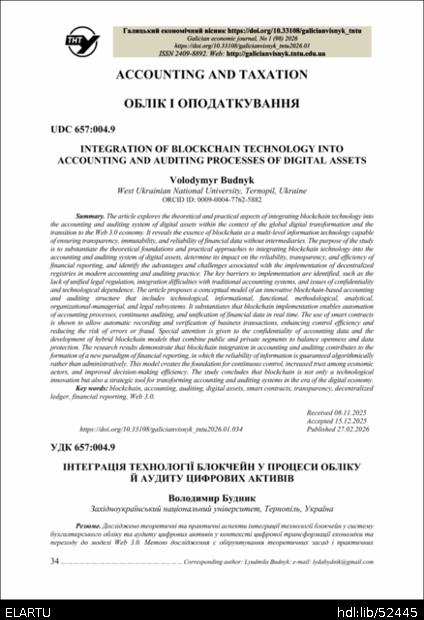
| dc.description.abstract | Досліджено теоретичні та практичні аспекти інтеграції технології блокчейн у систему бухгалтерського обліку та аудиту цифрових активів у контексті цифрової трансформації економіки та переходу до моделі Web 3.0. Метою дослідження є обґрунтування теоретичних засад і практичних підходів до інтеграції технології блокчейн у систему бухгалтерського обліку та аудиту цифрових активів, визначення її впливу на достовірність, прозорість і ефективність фінансової звітності, а також виявлення переваг і викликів, пов’язаних із упровадженням децентралізованих реєстрів у сучасну облікову та аудиторську практики. Розкрито сутність блокчейну як багаторівневої інформаційної технології, здатної забезпечити прозорість, незмінність і достовірність фінансових даних без залучення посередників. Визначено ключові проблеми, що стримують широке впровадження технології, серед яких – відсутність єдиної нормативної бази, складність інтеграції з традиційними обліковими системами, ризики конфіденційності та технологічної залежності. Запропоновано концептуальну модель інноваційної структури обліку й аудиту на основі блокчейну, що включає технологічну, інформаційну, функціональну, методологічну, аналітичну, організаційно-управлінську підсистеми. Обґрунтовано, що впровадження блокчейну забезпечує автоматизацію бухгалтерських процесів, можливість безперервного аудиту та уніфікацію фінансових даних у режимі реального часу. Окрему увагу приділено питанню конфіденційності облікових даних і розвитку гібридних моделей блокчейну, які поєднують публічні та приватні сегменти з метою забезпечення балансу між відкритістю і захистом комерційної інформації. Результати дослідження свідчать, що інтеграція блокчейну в бухгалтерський облік і аудит сприяє формуванню нової парадигми фінансової звітності, у якій достовірність інформації гарантується алгоритмічно, а не адміністративно. Така модель створює передумови для розвитку безперервного контролю, зміцнення довіри між суб’єктами економічних відносин та підвищення ефективності управлінських рішень. Зроблено висновок, що блокчейн є не лише технологічною інновацією, а й стратегічним інструментом трансформації системи обліку та аудиту в умовах цифрової економіки. | |
| dc.description.abstract | The article explores the theoretical and practical aspects of integrating blockchain technology into the accounting and auditing system of digital assets within the context of the global digital transformation and the transition to the Web 3.0 economy. It reveals the essence of blockchain as a multi-level information technology capable of ensuring transparency, immutability, and reliability of financial data without intermediaries. The purpose of the study is to substantiate the theoretical foundations and practical approaches to integrating blockchain technology into the accounting and auditing system of digital assets, determine its impact on the reliability, transparency, and efficiency of financial reporting, and identify the advantages and challenges associated with the implementation of decentralized registries in modern accounting and auditing practice. The key barriers to implementation are identified, such as the lack of unified legal regulation, integration difficulties with traditional accounting systems, and issues of confidentiality and technological dependence. The article proposes a conceptual model of an innovative blockchain-based accounting and auditing structure that includes technological, informational, functional, methodological, analytical, organizational-managerial, and legal subsystems. It substantiates that blockchain implementation enables automation of accounting processes, continuous auditing, and unification of financial data in real time. The use of smart contracts is shown to allow automatic recording and verification of business transactions, enhancing control efficiency and reducing the risk of errors or fraud. Special attention is given to the confidentiality of accounting data and the development of hybrid blockchain models that combine public and private segments to balance openness and data protection. The research results demonstrate that blockchain integration in accounting and auditing contributes to the formation of a new paradigm of financial reporting, in which the reliability of information is guaranteed algorithmically rather than administratively. This model creates the foundation for continuous control, increased trust among economic actors, and improved decision-making efficiency. The study concludes that blockchain is not only a technological innovation but also a strategic tool for transforming accounting and auditing systems in the era of the digital economy. | |
| dc.format.extent | 34-42 | |
| dc.language.iso | uk | |
| dc.publisher | ТНТУ | |
| dc.publisher | TNTU | |
| dc.relation.ispartof | Галицький економічний вісник, 1 (98), 2026 | |
| dc.relation.ispartof | Galician economic journal, 1 (98), 2026 | |
| dc.relation.uri | https://market.us/report/block-chain-technology-market/ | |
| dc.relation.uri | https://hub.kyivstar.ua/articles/web-3-0-ta-blokchejn-zminyuyut-internet-i-biznes-poyasnyuyemo-yak-same | |
| dc.relation.uri | https://www.amazon.com/Blockchain-Blueprint-Economy-Melanie-Swan/dp/1491920491 | |
| dc.relation.uri | https://doi.org/10.1007/978-3-030-27798-7 | |
| dc.relation.uri | https://doi.org/10.1108/MEDAR-11-2018-0406 | |
| dc.relation.uri | https://finukr.org.ua/docs/FU_23_03_088_uk.pdf | |
| dc.relation.uri | https://doi.org/10.33763/finukr2023.03.088 | |
| dc.relation.uri | https://doi.org/10.35774/ibo2020.03.028 | |
| dc.relation.uri | https://nzlubp.org.ua/index.php/journal/article/view/1373/1196 | |
| dc.relation.uri | https://doi.org/10.35774/visnyk2025.01.148 | |
| dc.relation.uri | https://doi.org/10.30838/EP.198.269-274 | |
| dc.relation.uri | https://doi.org/10.32782/2524-0072/2024-66-34 | |
| dc.relation.uri | https://doi.org/10.1109/ACIT52158.2021.9548557 | |
| dc.subject | блокчейн | |
| dc.subject | бухгалтерський облік | |
| dc.subject | аудит | |
| dc.subject | цифрові активи | |
| dc.subject | смартконтракти | |
| dc.subject | прозорість | |
| dc.subject | децентралізовані реєстри | |
| dc.subject | фінансова звітність | |
| dc.subject | Web 3.0 | |
| dc.subject | blockchain | |
| dc.subject | accounting | |
| dc.subject | auditing | |
| dc.subject | digital assets | |
| dc.subject | smart contracts | |
| dc.subject | transparency | |
| dc.subject | decentralized ledger | |
| dc.subject | financial reporting | |
| dc.subject | Web 3.0 | |
| dc.title | Інтеграція технології блокчейн у процеси обліку й аудиту цифрових активів | |
| dc.title.alternative | Integration of blockchain technology into accounting and auditing processes of digital assets | |
| dc.type | Article | |
| dc.rights.holder | © Тернопільський національний технічний університет імені Івана Пулюя, 2026 | |
| dc.coverage.placename | Тернопіль | |
| dc.coverage.placename | Ternopil | |
| dc.format.pages | 9 | |
| dc.subject.udc | 657 | |
| dc.subject.udc | 004.9 | |
| dc.relation.references | 1. Market.us. (2024). Global blockchain technology market. URL: https://market.us/report/block-chain-technology-market/ (дата звернення: 01.11.2025 р.) | |
| dc.relation.references | 2. Х. Федорова Web 3.0 та блокчейн змінюють інтернет і бізнес. Пояснюємо, як саме. URL: https://hub.kyivstar.ua/articles/web-3-0-ta-blokchejn-zminyuyut-internet-i-biznes-poyasnyuyemo-yak-same (дата звернення: 05.11.2025). | |
| dc.relation.references | 3. Dan Tapscott and Alex Tapscott. Blockchain Revolution: How the Technology Behind Bitcoin is Changing Money, Business, and the World. New York: Penguin Random House, 2016. 348 p. | |
| dc.relation.references | 4. Swan M. Blockchain: Blueprint for a New Economy. Massachusetts : O’Reilly Media, Inc. 2015. 149 р. URL: https://www.amazon.com/Blockchain-Blueprint-Economy-Melanie-Swan/dp/1491920491 (дата звернення: 03.11.2025 р.). | |
| dc.relation.references | 5. Attaran M., & Gunasekaran A. Blockchain principles, qualities, and business applications. Applications of blockchain technology in business. Bakersfield, California: California State University; 2019. 112 p. DOI: https://doi.org/10.1007/978-3-030-27798-7 | |
| dc.relation.references | 6. Bonson E., Bednarova M. Blockchain and its implications for accounting and auditing. Meditari Accountancy Research. 2019. (5). 725–740. DOI: https://doi.org/10.1108/MEDAR-11-2018-0406 | |
| dc.relation.references | 7. Нашкерська Г. В. Нашкерська Г. В. Технологія блокчейн у бухгалтерському обліку: переваги та обмеження. Фінанси України. 2023. № 3. C. 88–102. URL: https://finukr.org.ua/docs/FU_23_03_088_uk.pdf (дата звернення: 01.11.2025). DOI: https://doi.org/10.33763/finukr2023.03.088 | |
| dc.relation.references | 8. Ярощук О., Белова І. Технологія блокчейн в бухгалтерському обліку та аудиті. Інститут бухгалтерського обліку, контроль та аналіз в умовах глобалізації. 2020. Вип. 3–4. С. 28–44. DOI: https://doi.org/10.35774/ibo2020.03.028 | |
| dc.relation.references | 9. Шот А. П., Андрусяк В. М., Яцко М. В. Вплив блокчейн-технологій на трансформацію корпоративного бухгалтерського обліку. Scientific Notes of Lviv University of Business and Law. 2024. Вип. 42. С. 15-22. URL:https://nzlubp.org.ua/index.php/journal/article/view/1373/1196 (дата звернення: 01.11.2025 р.). | |
| dc.relation.references | 10. Будник В. Суть цифрових активів: концептуальні основи та сучасний контекст. Вісник економіки. 2025. № 1. С. 148–160. DOI: https://doi.org/10.35774/visnyk2025.01.148 | |
| dc.relation.references | 11. Юрченко О. А., Савченко Р. В. Роль і місце блокчейн-технологій для ведення бухгалтерського обліку та складання фінансової звітності. Economic space. 2025. № 198. С. 269–274. DOI: https://doi.org/10.30838/EP.198.269-274 | |
| dc.relation.references | 12. Скрипник С., Сливка Я., Музиченко Т. (2024). Блокчейн-технології в бухгалтерії: нові підходи до забезпечення прозорості та надійності фінансової звітності. Економіка та суспільство. 2024. № 66. DOI: https://doi.org/10.32782/2524-0072/2024-66-34 | |
| dc.relation.references | 13. Semaniuk V., Shpak V. and Papinko A. Estimation of the Information Efficiency of the Accounting System, 11th International Conference on Advanced Computer Information Technologies (ACIT), Deggendorf, Germany. 2021. P. 437–440. DOI: https://doi.org/10.1109/ACIT52158.2021.9548557 | |
| dc.relation.referencesen | 1. Market.us. (2024) Global blockchain technology market. Available at: https://market.us/report/block-chain-technology-market/ (accessed: 1 November 2025). | |
| dc.relation.referencesen | 2. Fedorova K. (2025). Web 3.0 ta blokchein zminiuiut internet i biznes. Poiasniuiemo, yak same [Web 3.0 and blockchain are changing the Internet and business. Explaining how exactly]. Available at: https://hub.kyivstar.ua/articles/web-3-0-ta-blokchejn-zminyuyut-internet-i-biznes-poyasnyuyemo-yak-same (accessed: 5 November 2025). | |
| dc.relation.referencesen | 3. Tapscott D., Tapscott A. (2016). Blockchain Revolution: How the Technology Behind Bitcoin is Changing Money, Business, and the World. New York: Penguin Random House, 348 p. | |
| dc.relation.referencesen | 4. Swan M. (2015). Blockchain: Blueprint for a New Economy. Massachusetts: O’Reilly Media, Inc. 149 p. Available at: https://www.amazon.com/Blockchain-Blueprint-Economy-Melanie-Swan/dp/1491920491 (accessed: 3 November 2025). | |
| dc.relation.referencesen | 5. Attaran M., Gunasekaran A. (2019). Blockchain principles, qualities, and business applications. Applications of blockchain technology in business. Bakersfield, California: California State University , 112 p. DOI: https://doi.org/10.1007/978-3-030-27798-7 | |
| dc.relation.referencesen | 6. Bonson E., Bednarova M. (2019) Blockchain and its implications for accounting and auditing. Meditari Accountancy Research, (5), pp. 725–740. DOI: https://doi.org/10.1108/MEDAR-11-2018-0406 | |
| dc.relation.referencesen | 7. Nashkerska H. V. (2023) Tekhnolohiia blokchein u bukhhalterskomu obliku: perevahy ta obmezhennia [Blockchain technology in accounting: advantages and limitations]. Finansy Ukrainy [Finance of Ukraine], no. 3, pp. 88–102. Available at: https://finukr.org.ua/docs/FU_23_03_088_uk.pdf (accessed: 1 November 2025). DOI: https://doi.org/10.33763/finukr2023.03.088 | |
| dc.relation.referencesen | 8. Yaroshchuk O., Belova I. (2020). Tekhnolohiia blokchein v bukhhalterskomu obliku ta audyti [Blockchain technology in accounting and auditing]. Instytut bukhhalterskoho obliku, kontrol ta analiz v umovakh hlobalizatsii [Institute of Accounting, Control and Analysis in the Globalization Conditions], vol. 3–4, pp. 28–44. DOI: https://doi.org/10.35774/ibo2020.03.028 | |
| dc.relation.referencesen | 9. Shot A. P., Andrusiak V. M., Yatsko M. V. (2024) Vplyv blokchein-tekhnolohii na transformatsiiu korporatyvnoho bukhhalterskoho obliku [The impact of blockchain technologies on the transformation of corporate accounting]. Scientific Notes of Lviv University of Business and Law, vol. 42, pp. 15–22. Available at: https://nzlubp.org.ua/index.php/journal/article/view/1373/1196 (accessed: 1 November 2025). | |
| dc.relation.referencesen | 10. Budnyk V. (2025) Sut tsyfrovykh aktyviv: kontseptualni osnovy ta suchasnyi kontekst [The essence of digital assets: conceptual foundations and modern context]. Visnyk ekonomiky [Bulletin of Economics], no. 1, pp. 148–160. DOI: https://doi.org/10.35774/visnyk2025.01.148 | |
| dc.relation.referencesen | 11. Yurchenko O. A., Savchenko R. V. (2025). Rol i mistse blokchein-tekhnolohii dlia vedennia bukhhalterskoho obliku ta skladannia finansovoi zvitnosti [The role and place of blockchain technologies in accounting and financial reporting]. Economic Space, no. 198, pp. 269–274. DOI: https://doi.org/10.30838/EP.198.269-274 | |
| dc.relation.referencesen | 12. Skrypnyk S., Slyvka Ya., Muzychenko T. (2024) Blokchein-tekhnolohii v bukhhalterii: novi pidkhody do zabezpechennia prozorosti ta nadiinosti finansovoi zvitnosti [Blockchain technologies in accounting: new approaches to ensuring transparency and reliability of financial reporting]. Ekonomika ta suspilstvo [Economy and Society], no. 66. DOI: https://doi.org/10.32782/2524-0072/2024-66-34 | |
| dc.relation.referencesen | 13. Semaniuk V, Shpak V. and Papinko A. (2021). Estimation of the InformationEfficiency of the Accounting System, 11th International Conference on Advanced Computer Information Technologies (ACIT), Deggendorf, Germany, pp. 437–440. DOI: https://doi.org/10.1109/ACIT52158.2021.9548557 | |
| dc.identifier.doi | https://doi.org/10.33108/galicianvisnyk_tntu2026.01.034 | |
| dc.contributor.affiliation | Західноукраїнський національний університет, Тернопіль, Україна | |
| dc.contributor.affiliation | West Ukrainian National University, Ternopil, Ukraine | |
| dc.citation.journalTitle | Галицький економічний вісник | |
| dc.citation.volume | 98 | |
| dc.citation.issue | 1 | |
| dc.citation.spage | 34 | |
| dc.citation.epage | 42 | |
| dc.identifier.citation2015 | Будник В. І. Інтеграція технології блокчейн у процеси обліку й аудиту цифрових активів // ГЕВ, Тернопіль. 2026. Том 98. № 1. С. 34–42. | |
| dc.identifier.citationenAPA | Budnyk, V. (2026). Intehratsiia tekhnolohii blokchein u protsesy obliku y audytu tsyfrovykh aktyviv [Integration of blockchain technology into accounting and auditing processes of digital assets]. Galician economic journal, 98(1), 34-42. TNTU. [in Ukrainian]. | |
| dc.identifier.citationenCHICAGO | Budnyk V. (2026) Intehratsiia tekhnolohii blokchein u protsesy obliku y audytu tsyfrovykh aktyviv [Integration of blockchain technology into accounting and auditing processes of digital assets]. Galician economic journal (Tern.), vol. 98, no 1, pp. 34-42 [in Ukrainian]. | |
| Apareix a les col·leccions: | Галицький економічний вісник, 2026, № 1 (98) | |
Arxius per aquest ítem:
| Arxiu | Descripció | Mida | Format | |
|---|---|---|---|---|
| GEJ_2026v98n1_Budnyk_V-Integration_of_blockchain_34-42.pdf | 2,83 MB | Adobe PDF | Veure/Obrir | |
| GEJ_2026v98n1_Budnyk_V-Integration_of_blockchain_34-42__COVER.png | 1,19 MB | image/png | Veure/Obrir |
Els ítems de DSpace es troben protegits per copyright, amb tots els drets reservats, sempre i quan no s’indiqui el contrari.