
Будь ласка, використовуйте цей ідентифікатор, щоб цитувати або посилатися на цей матеріал:
http://elartu.tntu.edu.ua/handle/lib/52443
Повний запис метаданих
| Поле DC | Значення | Мова |
|---|---|---|
| dc.contributor.author | Краус, Наталія Миколаївна | |
| dc.contributor.author | Краус, Катерина Миколаївна | |
| dc.contributor.author | Kraus, Nataliia | |
| dc.contributor.author | Kraus, Kateryna | |
| dc.date.accessioned | 2026-06-15T14:49:00Z | - |
| dc.date.available | 2026-06-15T14:49:00Z | - |
| dc.date.created | 2026-01-29 | |
| dc.date.issued | 2026-01-29 | |
| dc.date.submitted | 2026-02-27 | |
| dc.identifier.citation | Краус Н. М. Легалізація тіньової економіки цифровими інструментами індустрія 6.0 / Краус Наталія Миколаївна, Краус Катерина Миколаївна // ГЕВ. — Т. : ТНТУ, 2026. — Том 98. — № 1. — С. 16–24. — (Економіка та міжнародні економічні відносини). | |
| dc.identifier.issn | 2409-8892 | |
| dc.identifier.uri | http://elartu.tntu.edu.ua/handle/lib/52443 | - |
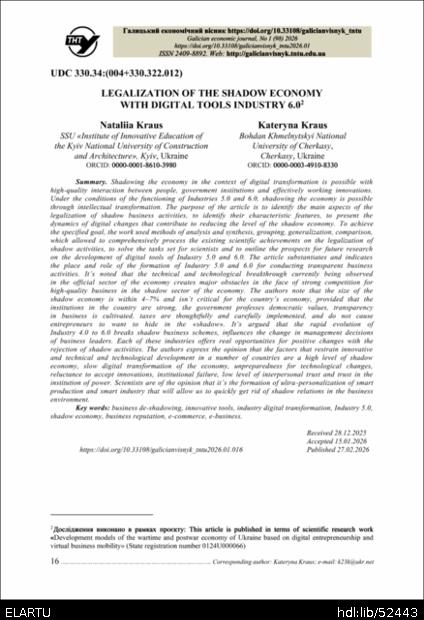
| dc.description.abstract | Тінізація економіки в умовах цифрової трансформації можлива за якісної взаємодії людини, інститутів влади й ефективно працюючих інновацій. За умов функціонування Індустрій 5.0 та 6.0, детінізація економіки можлива шляхом інтелектуальної трансформації. Мета статті полягає в тому, щоб визначити основні аспекти легалізації тіньової бізнес-діяльності, визначити їх характерні особливості, представити в динаміці цифрові зміни, що сприяють зменшенню рівня тіньової економіки. Для досягнення визначеної мети використано методи аналізу та синтезу, групування, узагальнення, порівняння, що дозволили комплексно опрацювати наявні наукові здобутки з питань легалізації тіньової діяльності, розв’язати поставлені перед науковцями завдання й окреслити перспективи майбутніх досліджень розвитку цифрових інструментів Індустрії 5.0 та 6.0. Обґрунтовано й вказано місце та роль становлення Індустрії 5.0 та 6.0 для ведення прозорої бізнес-діяльності. Зазначено, що техніко-технологічний прорив, що просте- жується наразі в офіційному секторі економіки, створює великі перешкоди в частині потужної конкуренції для якісного ведення бізнесу в тіньовому секторі економіки. Автори зазначають, що розмір тіньової економіки є в межах 4–7% і не є критичним для економіки країни за умови, що інститути в країні сильні, уряд сповідує демократичні цінності, культивується прозорість ведення бізнесу, податки продумані й зважено введенні в дію, не викликають бажання у підприємців ховатися в «тінь». Аргументовано, що швидка еволюція Індустрії від 4.0 до 6.0 ламає тіньові бізнес-схеми, впливає на зміну управлінських рішень бізнес-лідерів. Кожна з цих індустрій пропонує реальні можливості до позитивних змін з відмовою від тіньової діяльності. Висловлено думку про те, що чинниками, які стримують інноваційний і техніко-технологічний розвиток в низці країн, є високий рівень тіньової економіки, повільна цифрова трансформація економіки, неготовність до технологічних змін, небажання сприймати інновації, інституційна неспроможність, низький рівень довіри міжособистісної та до інституту влади. Науковці стоять на позиції саме становлення ультраперсоналізації розумного виробництва й смарт-промисловості, що дозволить швидкими темами позбутися тіньових відносин у бізнес-середовищі. | |
| dc.description.abstract | Shadowing the economy in the context of digital transformation is possible with high-quality interaction between people, government institutions and effectively working innovations. Under the conditions of the functioning of Industries 5.0 and 6.0, shadowing the economy is possible through intellectual transformation. The purpose of the article is to identify the main aspects of the legalization of shadow business activities, to identify their characteristic features, to present the dynamics of digital changes that contribute to reducing the level of the shadow economy. To achieve the specified goal, the work used methods of analysis and synthesis, grouping, generalization, comparison, which allowed to comprehensively process the existing scientific achievements on the legalization of shadow activities, to solve the tasks set for scientists and to outline the prospects for future research on the development of digital tools of Industry 5.0 and 6.0. The article substantiates and indicates the place and role of the formation of Industry 5.0 and 6.0 for conducting transparent business activities. Itʼs noted that the technical and technological breakthrough currently being observed in the official sector of the economy creates major obstacles in the face of strong competition for high-quality business in the shadow sector of the economy. The authors note that the size of the shadow economy is within 4–7% and isn’t critical for the country’s economy, provided that the institutions in the country are strong, the government professes democratic values, transparency in business is cultivated, taxes are thoughtfully and carefully implemented, and do not cause entrepreneurs to want to hide in the «shadow». It’s argued that the rapid evolution of Industry 4.0 to 6.0 breaks shadow business schemes, influences the change in management decisions of business leaders. Each of these industries offers real opportunities for positive changes with the rejection of shadow activities. The authors express the opinion that the factors that restrain innovative and technical and technological development in a number of countries are a high level of shadow economy, slow digital transformation of the economy, unpreparedness for technological changes, reluctance to accept innovations, institutional failure, low level of interpersonal trust and trust in the institution of power. Scientists are of the opinion that it’s the formation of ultra -personalization of smart production and smart industry that will allow us to quickly get rid of shadow relations in the business environment. | |
| dc.format.extent | 16-24 | |
| dc.language.iso | uk | |
| dc.publisher | ТНТУ | |
| dc.publisher | TNTU | |
| dc.relation.ispartof | Галицький економічний вісник, 1 (98), 2026 | |
| dc.relation.ispartof | Galician economic journal, 1 (98), 2026 | |
| dc.relation.uri | https://ukrstat.gov.ua/ | |
| dc.relation.uri | https://thedigital.gov.ua/storage/uploads/files/page/community/reports/%D0%86%D0%9D%D0%94%D0%95%D0%9A%D0%A1%202024%202%201.pdf | |
| dc.relation.uri | https://doi.org/10.15185/izawol.127 | |
| dc.relation.uri | https://doi.org/10.1007/s10842-022-00388-6 | |
| dc.relation.uri | https://doi.org/10.37394/23207.2023.20.93 | |
| dc.relation.uri | https://doi.org/10.30525/2256-0742/2024-10-3-180-192 | |
| dc.relation.uri | https://doi.org/10.3390/systems13050387 | |
| dc.relation.uri | https://www.visualcapitalist.com/size-of-the-shadow-economy-by-country/ | |
| dc.relation.uri | https://doi.org/10.1016/j.igd.2024.100173 | |
| dc.relation.uri | https://doi.org/10.3846/20294913.2016.1266530 | |
| dc.relation.uri | https://doi.org/10.1016/j.heliyon.2021.e08633 | |
| dc.subject | детінізація бізнесу | |
| dc.subject | інноваційні інструменти | |
| dc.subject | галузева цифрова трансформація | |
| dc.subject | Індустрія 5.0 | |
| dc.subject | тінізація економіки | |
| dc.subject | бізнес-репутація | |
| dc.subject | е-торгівля | |
| dc.subject | е-бізнес | |
| dc.subject | business de-shadowing | |
| dc.subject | innovative tools | |
| dc.subject | industry digital transformation | |
| dc.subject | Industry 5.0 | |
| dc.subject | shadow economy | |
| dc.subject | business reputation | |
| dc.subject | e-commerce | |
| dc.subject | e-business | |
| dc.title | Легалізація тіньової економіки цифровими інструментами індустрія 6.0 | |
| dc.title.alternative | Legalization of the shadow economy with digital tools industry 6.02 | |
| dc.type | Article | |
| dc.rights.holder | © Тернопільський національний технічний університет імені Івана Пулюя, 2026 | |
| dc.coverage.placename | Тернопіль | |
| dc.coverage.placename | Ternopil | |
| dc.format.pages | 9 | |
| dc.subject.udc | 330.34 | |
| dc.subject.udc | (004 | |
| dc.subject.udc | 330.322.012) | |
| dc.relation.references | 1. Індекс цифрової економіки та суспільства (DESI). Державна служба статистики України : вебсайт, 2025. URL: https://ukrstat.gov.ua/ (дата звернення: 11.12.2025). | |
| dc.relation.references | 2. Індекс цифрової трансформації регіонів України. Підсумки 2024 року. Міністерство цифрової трансформації України : вебсайт. URL: https://thedigital.gov.ua/storage/uploads/files/page/community/reports/%D0%86%D0%9D%D0%94%D0%95%D0%9A%D0%A1%202024%202%201.pdf (дата звернення: 12.12.2025). | |
| dc.relation.references | 3. Краус Н. М. Причини виникнення та розвитку тіньового сектора економіки в умовах трансформаційних перетворень. Економіка: проблеми теорії та практики. 2005. Вип. 204. Том ІV. С. 862–866. | |
| dc.relation.references | 4. Краус Н. М. Про структуру тіньового сектора економіки в умовах трансформаційних перетворень. Науковий вiсник Полтавського унiверситету споживчої кооперацiї України. Серiя : Економiчнi науки. 2007. № 1 (21). С. 31–34. | |
| dc.relation.references | 5. Enste D.H. The shadow economy in industrial countries. IZA World of Labor. 2015. Art. 127. DOI: https://doi.org/10.15185/izawol.127 | |
| dc.relation.references | 6. Farooq O., Aktaruzzaman K., Satt H., Bendriouch F. Z. Innovations as a response to shadow economy: Evidence from privately held firms. Journal of Industry, Competition and Trade. 2022. Vol. 22. P. 349–370. DOI: https://doi.org/10.1007/s10842-022-00388-6 | |
| dc.relation.references | 7. Kraus K., Kraus N., Manzhura O., Ishchenko I., Radzikhovska Y. Digital transformation of business processes of enterprises on the way to becoming Industry 5.0 in the gig economy. WSEAS Transactions on Business and Economics. 2023. Vol. 20. Art. 93. pp. 1008–1029. DOI: https://doi.org/10.37394/23207.2023.20.93 | |
| dc.relation.references | 8. Kraus K., Kraus N., Radzikhovska Yu. Economic growth under the influence of technical and technological changes of Industry 5.0. Baltic Journal of Economic Studies. 2025. Vol. 11 (1). P. 121–134. DOI: https://doi.org/10.30525/2256-0742/2024-10-3-180-192 | |
| dc.relation.references | 9. Madsen D. O., Slatten K., Berg T. From Industry 4.0 to Industry 6.0: Tracing the evolution of industrial paradigms through the lens of management fashion theory. Systems. 2025. Vol. 13 (5). Art. 387. DOI: https://doi.org/10.3390/systems13050387 | |
| dc.relation.references | 10. Neufeld D. Mapped: The size of each country’s shadow economy. Visual Capitalist, May 13, 2025. URL: https://www.visualcapitalist.com/size-of-the-shadow-economy-by-country/ (Last accessed: 11.12.2025). | |
| dc.relation.references | 11. Rame R., Purwanto P., Sudarno S. Industry 5.0 and sustainability: An overview of emerging trends and challenges for a green future. Innovation and Green Development. 2024. Vol. 3 (4). Art. 100173. DOI: https://doi.org/10.1016/j.igd.2024.100173 | |
| dc.relation.references | 12. Remeikiene R., Gaspareniene L., Schneider F. G. The definition of digital shadow economy. Technological and Economic Development of Economy. 2018. Vol. 24 (2). P. 696–717. DOI: https://doi.org/10.3846/20294913.2016.1266530 | |
| dc.relation.references | 13. Safuan S., Habibullah M. Sh., Sugandi E. A. Mitigating the shadow economy through financial sector development in Indonesia: some empirical results. Heliyon. 2021. Vol. 7 (12). Art. e08633. DOI: https://doi.org/10.1016/j.heliyon.2021.e08633 | |
| dc.relation.referencesen | 1. Indeks tsyfrovoi ekonomiky ta suspilstva (DESI) (2025) [Digital Economy and Society Index (DESI)]. State Statistics Service of Ukraine: website. Available at: https://ukrstat.gov.ua/ (accessed: 11 December 2025). | |
| dc.relation.referencesen | 2. Indeks tsyfrovoi transformatsii rehioniv Ukrainy. Pidsumky 2024 roku (2025) [Digital Transformation Index of Ukrainian Regions. Results for 2024]. Ministry of Digital Transformation of Ukraine: website. Available at: https://thedigital.gov.ua/storage/uploads/files/page/community/reports/%D0%86%D0%9D%D0%94%D0%95%D0%9A%D0%A1%202024%202%201.pdf (accessed: 12 December 2025). | |
| dc.relation.referencesen | 3. Kraus N. M. (2005) Prychyny vynyknennia ta rozvytku tinovoho sektora ekonomiky v umovakh transformatsiinykh peretvoren [Reasons for the emergence and development of the shadow economy in the context of transformational changes]. Ekonomika: problemy teorii ta praktyky, vol. 20, tom ІV, pp. 862–866. | |
| dc.relation.referencesen | 4. Kraus N. M. (2007) Pro strukturu tinovoho sektora ekonomiky v umovakh transformatsiinykh peretvoren [On the structure of the shadow economy sector in the context of transformational changes]. Naukovyi visnyk Poltavskoho universytetu spozhyvchoi kooperatsii Ukrainy. Seriia: Ekonomichni nauky, no. 1 (21), pp. 31–34. | |
| dc.relation.referencesen | 5. Enste D. H. (2015) The shadow economy in industrial countries. IZA World of Labor, Art. 127. DOI: https://doi.org/10.15185/izawol.127 | |
| dc.relation.referencesen | 6. Farooq O., Aktaruzzaman K., Satt H., Bendriouch F. Z. (2022) Innovations as a response to shadow economy: Evidence from privately held firms. Journal of Industry, Competition and Trade, vol. 22, pp. 349–370. DOI: https://doi.org/10.1007/s10842-022-00388-6 | |
| dc.relation.referencesen | 7. Kraus K., Kraus N., Manzhura O., Ishchenko I., Radzikhovska Y. (2023) Digital transformation of business processes of enterprises on the way to becoming Industry 5.0 in the gig economy. WSEAS Transactions on Business and Economics, vol. 20, Art. 93, pp. 1008–1029. DOI: https://doi.org/10.37394/23207.2023.20.93 | |
| dc.relation.referencesen | 8. Kraus K., Kraus N., Radzikhovska Yu. (2025) Economic growth under the influence of technical and technological changes of Industry 5.0. Baltic Journal of Economic Studies, vol. 11(1), pp. 121–134. DOI: https://doi.org/10.30525/2256-0742/2024-10-3-180-192 | |
| dc.relation.referencesen | 9. Madsen D. O., Slatten K., Berg T. (2025) From Industry 4.0 to Industry 6.0: Tracing the evolution of industrial paradigms through the lens of management fashion theory. Systems, vol. 13 (5), Art. 387. DOI: https://doi.org/10.3390/systems13050387 | |
| dc.relation.referencesen | 10. Neufeld D. (2025) Mapped: The size of each country’s shadow economy. Visual Capitalist, May 13, 2025. Available at: https://www.visualcapitalist.com/size-of-the-shadow-economy-by-country/ (accessed: 11 December 2025). | |
| dc.relation.referencesen | 11. Rame R., Purwanto P., Sudarno S. (2024) Industry 5.0 and sustainability: An overview of emerging trends and challenges for a green future. Innovation and Green Development, vol. 3 (4), Art. 100173. DOI: https://doi.org/10.1016/j.igd.2024.100173 | |
| dc.relation.referencesen | 12. Remeikiene R., Gaspareniene L., Schneider F. G. (2018) The definition of digital shadow economy. Technological and Economic Development of Economy, vol. 24 (2), pp. 696–717. DOI: https://doi.org/10.3846/20294913.2016.1266530 | |
| dc.relation.referencesen | 13. Safuan S., Habibullah M. Sh., Sugandi E. A. (2021) Mitigating the shadow economy through financial sector development in Indonesia: some empirical results. Heliyon, vol. 7 (12), Art. e08633. DOI: https://doi.org/10.1016/j.heliyon.2021.e08633 | |
| dc.identifier.doi | https://doi.org/10.33108/galicianvisnyk_tntu2026.01.016 | |
| dc.contributor.affiliation | ВСП «Інститут інноваційної освіти Київського національного університету будівництва і архітектури», Київ, Україна | |
| dc.contributor.affiliation | Черкаський національний університет імені Богдана Хмельницького, Черкаси, Україна | |
| dc.contributor.affiliation | SSU «Institute of Innovative Education of the Kyiv National University of Construction and Architecture», Kyiv, Ukraine | |
| dc.contributor.affiliation | Bohdan Khmelnytskyi National University of Cherkasy, Cherkasy, Ukraine | |
| dc.citation.journalTitle | Галицький економічний вісник | |
| dc.citation.volume | 98 | |
| dc.citation.issue | 1 | |
| dc.citation.spage | 16 | |
| dc.citation.epage | 24 | |
| dc.identifier.citation2015 | Краус Н. М., Краус К. М. Легалізація тіньової економіки цифровими інструментами індустрія 6.0 // ГЕВ, Тернопіль. 2026. Том 98. № 1. С. 16–24. | |
| dc.identifier.citationenAPA | Kraus, N., & Kraus, K. (2026). Lehalizatsiia tinovoi ekonomiky tsyfrovymy instrumentamy industriia 6.0 [Legalization of the shadow economy with digital tools industry 6.02]. Galician economic journal, 98(1), 16-24. TNTU. [in Ukrainian]. | |
| dc.identifier.citationenCHICAGO | Kraus N., Kraus K. (2026) Lehalizatsiia tinovoi ekonomiky tsyfrovymy instrumentamy industriia 6.0 [Legalization of the shadow economy with digital tools industry 6.02]. Galician economic journal (Tern.), vol. 98, no 1, pp. 16-24 [in Ukrainian]. | |
| Розташовується у зібраннях: | Галицький економічний вісник, 2026, № 1 (98) | |
Файли цього матеріалу:
| Файл | Опис | Розмір | Формат | |
|---|---|---|---|---|
| GEJ_2026v98n1_Kraus_N-Legalization_of_the_shadow_16-24.pdf | 3,1 MB | Adobe PDF | Переглянути/відкрити | |
| GEJ_2026v98n1_Kraus_N-Legalization_of_the_shadow_16-24__COVER.png | 1,16 MB | image/png | Переглянути/відкрити |
Усі матеріали в архіві електронних ресурсів захищені авторським правом, всі права збережені.