
Använd denna länk för att citera eller länka till detta dokument:
http://elartu.tntu.edu.ua/handle/lib/52438
Fullständig post
| DC fält | Värde | Språk |
|---|---|---|
| dc.contributor.author | Корчак, Олена Сергіївна | |
| dc.contributor.author | Шпилик, Світлана Василівна | |
| dc.contributor.author | Korchak, Olena | |
| dc.contributor.author | Shpylyk, Svitlana | |
| dc.date.accessioned | 2026-06-15T14:48:59Z | - |
| dc.date.available | 2026-06-15T14:48:59Z | - |
| dc.date.created | 2026-01-29 | |
| dc.date.issued | 2026-01-29 | |
| dc.date.submitted | 2026-02-27 | |
| dc.identifier.citation | Корчак О. С. Удосконалення стратегії розвитку етично орієнтованого екомаркетингу на базі філософії обʼєктивізму айн ренд для посилення сталості інноваційного бізнесу в Україні / Корчак Олена Сергіївна, Шпилик Світлана Василівна // ГЕВ. — Т. : ТНТУ, 2026. — Том 98. — № 1. — С. 242–253. — (Маркетинг). | |
| dc.identifier.issn | 2409-8892 | |
| dc.identifier.uri | http://elartu.tntu.edu.ua/handle/lib/52438 | - |
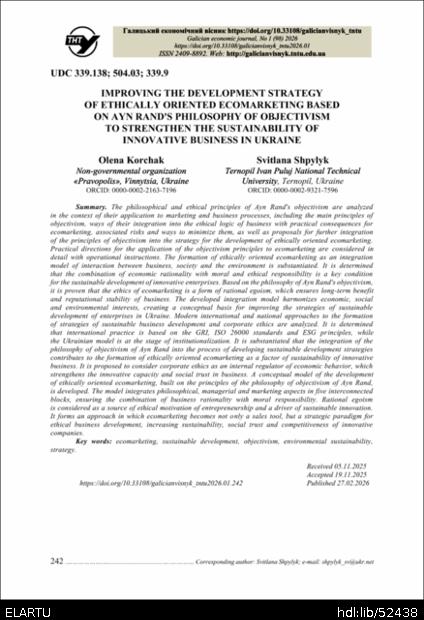
| dc.description.abstract | Проаналізовано філософсько-етичні засади об’єктивізму Айн Ренд у контексті їх застосування до маркетингових та бізнес-процесів, включаючи основні принципи об’єктивізму, шляхи їх інтеграції в етичну логіку бізнесу з практичними наслідками для екомаркетингу, супутні ризики й способи їх мінімізації, а також пропозиції для подальшої інтеграції принципів об’єктивізму в стратегію розвитку етично орієнтованого екомаркетингу. Детально розглянуто практичні напрямки застосування принципів об’єктивізму до екомаркетингу з наведенням операційних інструкцій. Обґрунтовано формування етично орієнтованого екомаркетингу як інтеграційної моделі взаємодії бізнесу, суспільства та довкілля. Визначено, що поєднання економічної раціональності з морально-етичною відповідальністю є ключовою умовою сталого розвитку інноваційних підприємств. На основі філософії об’єктивізму Айн Ренд доведено, що етичність екомаркетингу виступає формою раціонального егоїзму, який забезпечує довготривалу вигоду та репутаційну стійкість бізнесу. Розроблена інтеграційна модель гармонізує економічні, соціальні й екологічні інтереси, створюючи концептуальне підґрунтя для вдосконалення стратегій сталого розвитку підприємств в Україні. Проаналізовано сучасні міжнародні та національні підходи до формування стратегій сталого розвитку бізнесу й корпоративної етики. Визначено, що міжнародна практика базується на стандартах GRI, ISO 26000 та принципах ESG, тоді як українська модель перебуває на етапі інституціоналізації. Обґрунтовано, що інтеграція філософії об’єктивізму Айн Ренд у процес розроблення стратегій сталого розвитку сприяє формуванню етично орієнтованого екомаркетингу як чинника сталості інноваційного бізнесу. Запропоновано розглядати корпоративну етику як внутрішній регулятор економічної поведінки, який підсилює інноваційну спроможність та соціальну довіру до бізнесу. Розроблено концептуальну модель розвитку етично орієнтованого екомаркетингу, побудовану на засадах філософії об’єктивізму Айн Ренд. Модель інтегрує філософські, управлінські та маркетингові аспекти у п’яти взаємопов’язаних блоках, що забезпечують поєднання раціональності бізнесу з моральною відповідальністю. Раціональний егоїзм розглядається як джерело етичної мотивації підприємництва та рушій сталих інновацій. Вона формує підхід, за якого екомаркетинг стає не лише інструментом збуту, а стратегічною парадигмою етичного розвитку бізнесу, підвищення стійкості, соціальної довіри та конкурентоспроможності інноваційних компаній. | |
| dc.description.abstract | The philosophical and ethical principles of Ayn Randʼs objectivism are analyzed in the context of their application to marketing and business processes, including the main principles of objectivism, ways of their integration into the ethical logic of business with practical consequences for ecomarketing, associated risks and ways to minimize them, as well as proposals for further integration of the principles of objectivism into the strategy for the development of ethically oriented ecomarketing. Practical directions for the application of the objectivism principles to ecomarketing are considered in detail with operational instructions. The formation of ethically oriented ecomarketing as an integration model of interaction between business, society and the environment is substantiated. It is determined that the combination of economic rationality with moral and ethical responsibility is a key condition for the sustainable development of innovative enterprises. Based on the philosophy of Ayn Randʼs objectivism, it is proven that the ethics of ecomarketing is a form of rational egoism, which ensures long-term benefit and reputational stability of business. The developed integration model harmonizes economic, social and environmental interests, creating a conceptual basis for improving the strategies of sustainable development of enterprises in Ukraine. Modern international and national approaches to the formation of strategies of sustainable business development and corporate ethics are analyzed. It is determined that international practice is based on the GRI, ISO 26000 standards and ESG principles, while the Ukrainian model is at the stage of institutionalization. It is substantiated that the integration of the philosophy of objectivism of Ayn Rand into the process of developing sustainable development strategies contributes to the formation of ethically oriented ecomarketing as a factor of sustainability of innovative business. It is proposed to consider corporate ethics as an internal regulator of economic behavior, which strengthens the innovative capacity and social trust in business. A conceptual model of the development of ethically oriented ecomarketing, built on the principles of the philosophy of objectivism of Ayn Rand, is developed. The model integrates philosophical, managerial and marketing aspects in five interconnected blocks, ensuring the combination of business rationality with moral responsibility. Rational egoism is considered as a source of ethical motivation of entrepreneurship and a driver of sustainable innovation. It forms an approach in which ecomarketing becomes not only a sales tool, but a strategic paradigm for ethical business development, increasing sustainability, social trust and competitiveness of innovative companies. | |
| dc.format.extent | 242-253 | |
| dc.language.iso | uk | |
| dc.publisher | ТНТУ | |
| dc.publisher | TNTU | |
| dc.relation.ispartof | Галицький економічний вісник, 1 (98), 2026 | |
| dc.relation.ispartof | Galician economic journal, 1 (98), 2026 | |
| dc.relation.uri | https://doi.org/10.1109/emr.2015.7123233 | |
| dc.relation.uri | https://doi.org/10.4324/9781351278683 | |
| dc.relation.uri | https://doi.org/10.1108/13522750510619733 | |
| dc.relation.uri | https://doi.org/10.1007/978-94-024-1144-7_16 | |
| dc.relation.uri | https://doi.org/10.1257/jep.9.4.97 | |
| dc.relation.uri | https://doi.org/10.1177/1086026615599806 | |
| dc.relation.uri | https://doi.org/10.32782/mer.2023.99.03 | |
| dc.relation.uri | https://doi.org/10.36818/1562-0905-2024-2-6 | |
| dc.relation.uri | https://doi.org/10.30857/2786-5398.2024.1.9 | |
| dc.relation.uri | https://doi.org/10.33321/2708-3236.2020.70.95-99 | |
| dc.subject | екомаркетинг | |
| dc.subject | сталий розвиток | |
| dc.subject | об’єктивізм | |
| dc.subject | екологічна стійкість | |
| dc.subject | стратегія | |
| dc.subject | ecomarketing | |
| dc.subject | sustainable development | |
| dc.subject | objectivism | |
| dc.subject | environmental sustainability | |
| dc.subject | strategy | |
| dc.title | Удосконалення стратегії розвитку етично орієнтованого екомаркетингу на базі філософії обʼєктивізму айн ренд для посилення сталості інноваційного бізнесу в Україні | |
| dc.title.alternative | Improving the development strategy of ethically oriented ecomarketing based on ayn randʼs philosophy of objectivism to strengthen the sustainability of innovative business in Ukraine | |
| dc.type | Article | |
| dc.rights.holder | © Тернопільський національний технічний університет імені Івана Пулюя, 2026 | |
| dc.coverage.placename | Тернопіль | |
| dc.coverage.placename | Ternopil | |
| dc.format.pages | 12 | |
| dc.subject.udc | 339.138 | |
| dc.subject.udc | 504.03 | |
| dc.subject.udc | 339.9 | |
| dc.relation.references | 1. Kotler P., Keller K. L. Marketing Management. 16th ed. Boston: Pearson Educationю 2022. 832 p. | |
| dc.relation.references | 2. Martin D. M., Schouten J. W. Sustainable Marketing. Boston: Pearson, 2014. 320 p. | |
| dc.relation.references | 3. Nidumolu R., Prahalad C. K., Rangaswami M. R. Why Sustainability Is Now the Key Driver of Innovation. Harvard Business Review. 2009. Vol. 87. No. 9. P. 56–64. Doi: https://doi.org/10.1109/emr.2015.7123233 (дата звернення: 10.11.2025). | |
| dc.relation.references | 4. Friedman M. Capitalism and Freedom. Chicago: University of Chicago Press, 2002. 208 p. | |
| dc.relation.references | 5. Belz F. M., Peattie K. Sustainability Marketing: A Global Perspective. 2nd ed. Chichester: Wiley, 2012. 357 p. | |
| dc.relation.references | 6. Ottman J. A. The New Rules of Green Marketing: Strategies, Tools, and Inspiration for Sustainable Branding. London: Routledge, 2017. 252 p. DOI: https://doi.org/10.4324/9781351278683 | |
| dc.relation.references | 7. Crane A., Matten D. Business Ethics: Managing Corporate Citizenship and Sustainability in the Age of Globalization. 4th ed. Oxford: Oxford University Press, 2016. 634 p. | |
| dc.relation.references | 8. Peattie K., Crane A. Green Marketing: Legend, Myth, Farce or Prophesy? Qualitative Market Research: An International Journal. 2005. Vol. 8 (4). P. 357–370. DOI: https://doi.org/10.1108/13522750510619733 | |
| dc.relation.references | 9. Porter M. E., Kramer M. R. Creating Shared Value. Harvard Business Review. 2011. Vol. 89 (1–2). P. 62–77. DOI: https://doi.org/10.1007/978-94-024-1144-7_16 | |
| dc.relation.references | 10. Porter M. E., van der Linde, C. Toward a New Conception of the Environment–Competitiveness Relationship. Journal of Economic Perspectives. 1995. Vol. 9 (4). P. 97–118. DOI: https://doi.org/10.1257/jep.9.4.97 | |
| dc.relation.references | 11. Schaltegger S., Hansen E. G., Lüdeke-Freund F. Business Models for Sustainability: Origins, Present Research, and Future Avenues. Organization & Environment. 2016. Vol. 29 (1). P. 3–10. DOI: https://doi.org/10.1177/1086026615599806 | |
| dc.relation.references | 12. Rand A. Atlas Shrugged. New York: Random House, 1957. 1168 p. | |
| dc.relation.references | 13. Rand A. The Virtue of Selfishness: A New Concept of Egoism. New York: Signet, 1964. 176 p. | |
| dc.relation.references | 14. Rand A. Capitalism: The Unknown Ideal. New York: New American Library, 1967. 309 p. | |
| dc.relation.references | 15. Rand A. The Fountainhead. Indianapolis: Bobbs-Merrill, 1943. 753 p. | |
| dc.relation.references | 16. Rand A. Philosophy: Who Needs It. New York: Bobbs-Merrill, 1982. 212 p. | |
| dc.relation.references | 17. Балацький О. Ф. Економіка сталого розвитку: український вимір. Суми: СумДУ, 2020. 324 с. | |
| dc.relation.references | 18. Власюк О. С. Економічна безпека сталого розвитку: стратегічний вимір. Київ: НІСД, 2018. 368 с. | |
| dc.relation.references | 19. Князєва Т., Ороховська Л. Екологічний маркетинг у парадигмі сталого розвитку: теоретико-методологічний аспект. Mechanism of an Economic Regulation. 2023. № 1 (99). С. 17–22. DOI: https://doi.org/10.32782/mer.2023.99.03 | |
| dc.relation.references | 20. Колодійчук І. А., Куртяк М. Б. Соціально-економічні передумови переходу до зеленої економіки в регіонах України. Регіональна економіка. 2024. № 2. С. 67–75. DOI: https://doi.org/10.36818/1562-0905-2024-2-6 | |
| dc.relation.references | 21. Зозульов О. В., Зозульова Т. М. Маркетинг сталого розвитку: концепція, інструменти, практики. Київ: КНЕУ, 2019. 276 с. | |
| dc.relation.references | 22. Романенко В. Р. Розвиток концепції зеленого маркетингу як інструмент наближення до соціально- відповідального споживача. Журнал стратегічних економічних досліджень. 2024. № 1 (18). C. 85–93. DOI: https://doi.org/10.30857/2786-5398.2024.1.9 | |
| dc.relation.references | 23. Кривда О. В. Етика бізнесу та корпоративна соціальна відповідальність: сучасні тренди. Київ : КНЕУ, 2020. 212 с. | |
| dc.relation.references | 24. Майорова І. А. Корпоративна соціальна відповідальність як інструмент сталого розвитку підприємства. Вісник економіки транспорту і промисловості. 2020. № 70. С. 95–99. Doi: https://doi.org/10.33321/2708-3236.2020.70.95-99. | |
| dc.relation.references | 25. Мельник Л. Г. Філософія сталого розвитку: методологія, етика, економіка. Суми : СумДУ. 2021. 412 с. | |
| dc.relation.references | 26. Дучик С. Д., Багрій К. Л. Екологічний виклик сучасному глобальному світу в економічному вимірі: колективна монографія / за ред. С. Д. Лучик. Чернівці : ВІЦ «Місто», 2016. 296 с. | |
| dc.relation.references | 27. Садченко О. Є. Економічні механізми реалізації політики сталого розвитку. Економіка України. 2017. № 7. С. 56–67. | |
| dc.relation.referencesen | 1. Kotler P., Keller K. L. (2022). Marketing Management. 16th ed. Boston: Pearson Educationю. 832 p. | |
| dc.relation.referencesen | 2. Martin D. M., Schouten J. W. (2014) Sustainable Marketing. Boston: Pearson, 320 p. | |
| dc.relation.referencesen | 3. Nidumolu R., Prahalad C. K., Rangaswami M. R. (2009) Why Sustainability Is Now the Key Driver of Innovation. Harvard Business Review, vol. 87, no. 9, pp. 56–64. Doi: https://doi.org/10.1109/emr.2015.7123233. | |
| dc.relation.referencesen | 4. Friedman M. (2002) Capitalism and Freedom. Chicago: University of Chicago Press, 208 p. | |
| dc.relation.referencesen | 5. Belz F. M., Peattie K. (2012). Sustainability Marketing: A Global Perspective. 2nd ed. Chichester: Wiley, 357 p. | |
| dc.relation.referencesen | 6. Ottman J. A. (2017). The New Rules of Green Marketing: Strategies, Tools, and Inspiration for Sustainable Branding. London: Routledge, 252 p. DOI: https://doi.org/10.4324/9781351278683 | |
| dc.relation.referencesen | 7. Crane A., Matten D. (2016). Business Ethics: Managing Corporate Citizenship and Sustainability in the Age of Globalization. 4th ed. Oxford: Oxford University Press, 634 p. | |
| dc.relation.referencesen | 8. Peattie K., Crane A. (2005) Green Marketing: Legend, Myth, Farce or Prophesy? Qualitative Market Research: An International Journal, vol. 8 (4), pp. 357–370. DOI: https://doi.org/10.1108/13522750510619733 | |
| dc.relation.referencesen | 9. Porter M. E., Kramer M. R. (2011) Creating Shared Value. Harvard Business Review, vol. 89 (1–2), pp. 62–77. DOI: https://doi.org/10.1007/978-94-024-1144-7_16 | |
| dc.relation.referencesen | 10. Porter M. E., Linde C. (1995) Toward a New Conception of the Environment–Competitiveness Relationship. Journal of Economic Perspectives, vol. 9 (4), pp. 97–118. Doi: https://doi.org/10.1257/jep.9.4.97 | |
| dc.relation.referencesen | 11. Schaltegger S., Hansen E. G., Lüdeke-Freund F. (2016) Business Models for Sustainability: Origins, Present Research, and Future Avenues. Organization & Environment, vol. 29 (1), pp. 3–10. DOI: https://doi.org/10.1177/1086026615599806 | |
| dc.relation.referencesen | 12. Rand A. Atlas Shrugged. New York: Random House, 1957. 1168 p. | |
| dc.relation.referencesen | 13. Rand A. (1964). The Virtue of Selfishness: A New Concept of Egoism. New York: Signet, 176 p. | |
| dc.relation.referencesen | 14. Rand A. (1967). Capitalism: The Unknown Ideal. New York: New American Library, 309 p. | |
| dc.relation.referencesen | 15. Rand A. (1943). The Fountainhead. Indianapolis: Bobbs-Merrill, 753 p. | |
| dc.relation.referencesen | 16. Rand A. (1982). Philosophy: Who Needs It. New York: Bobbs-Merrill, 212 p. | |
| dc.relation.referencesen | 17. Balatskyy O. F. (2020). Ekonomika stalogo rozvytku: ukrayinskiy vymir [Economics of sustainable development: Ukrainian dimension]. Sumy: SumDU, 324 p. (In Ukrainian). | |
| dc.relation.referencesen | 18. Vlasiuk O. S. (2018). Ekonomichna bezpeka staloho rozvytku: stratehichnyi vymir [Economic security of sustainable development: strategic dimension]. Kyiv: NISD, 368 p. (In Ukrainian). | |
| dc.relation.referencesen | 19. Kniazieva T., Orochovska L. (2023) Ekolohichnyi marketynh u paradyhmi staloho rozvytku: teoretyko- metodolohichnyi aspekt [Environmental marketing in the paradigm of sustainable development: theoretical and methodological aspect]. Mechanism of an Economic Regulation, no. 1 (99), pp. 17–22. DOI: https://doi.org/10.32782/mer.2023.99.03 | |
| dc.relation.referencesen | 20. Kolodiichuk I. A., Kurtiak M. B. (2024) Sotsialno-ekonomichni peredumovy perekhodu do zelenoi ekonomiky v rehionakh Ukrainy [Socio-economic prerequisites for the transition to a green economy in the regions of Ukraine]. Rehionalna ekonomika, no. 2, pp. 67–75. Doi: https://doi.org/10.36818/1562-0905-2024-2-6 | |
| dc.relation.referencesen | 21. Zozuliov O. V., Zozuliova T. M. (2019). Marketynh staloho rozvytku: kontseptsiia, instrumenty, praktyky [Marketing for sustainable development: concept, tools, practices]. Kyiv: KNEU, 276 p. (In Ukrainian). | |
| dc.relation.referencesen | 22. Romanenko V. R. (2024) Rozvytok kontseptsii zelenoho marketynhu yak instrument nablyzhennia do sotsialno-vidpovidalnoho spozhyvacha [Development of the concept of green marketing as a tool for approaching a socially responsible consumer]. Zhurnal stratehichnykh ekonomichnykh doslidzhen, no. 1 (18), pp. 85–93. DOI: https://doi.org/10.30857/2786-5398.2024.1.9 | |
| dc.relation.referencesen | 23. Kryvda O. V. (2020). Etyka biznesu ta korporatyvna sotsialna vidpovidalnist: suchasni trendy [Business ethics and corporate social responsibility: modern trends]. Kyiv: KNEU, 212 p. (In Ukrainian). | |
| dc.relation.referencesen | 24. Maiorova I. A. (2020) Korporatyvna sotsialna vidpovidalnist yak instrument staloho rozvytku pidpryiemstva [Corporate social responsibility as a tool for sustainable development of an enterprise]. Visnyk ekonomiky transportu i promyslovosti, no. 70, pp. 95–99. Doi: https://doi.org/10.33321/2708-3236.2020.70.95-99. | |
| dc.relation.referencesen | 25. Melnyk L. H. (2021). Filosofiia staloho rozvytku: metodolohiia, etyka, ekonomika [Philosophy of sustainable development: methodology, ethics, economics]. Sumy: SumDU, 412 p. (In Ukrainian). | |
| dc.relation.referencesen | 26. Duchyk S. D., Bahrii K. L. (2016). Ekolohichnyi vyklyk suchasnomu hlobalnomu svitu v ekonomichnomu vymiri: kolektyvna monohrafiia [Environmental challenge to the modern global world in the economic dimension] / za red. S. D. Luchyk. Chernivtsi: VITs “Misto”, 296 p. (In Ukrainian). | |
| dc.relation.referencesen | 27. Sadchenko O. Ye. (2017) Ekonomichni mekhanizmy realizatsii polityky staloho rozvytku [Economic mechanisms for implementing sustainable development policy]. Ekonomika Ukrainy, no. 7, pp. 56–67. | |
| dc.identifier.doi | https://doi.org/10.33108/galicianvisnyk_tntu2026.01.242 | |
| dc.contributor.affiliation | Громадська організація «Правополіс», Вінниця, Україна | |
| dc.contributor.affiliation | Тернопільський національний технічний університет імені Івана Пулюя, Тернопіль, Україна | |
| dc.contributor.affiliation | Non-governmental organization «Pravopolis», Vinnytsia, Ukraine | |
| dc.contributor.affiliation | Ternopil Ivan Puluj National Technical University, Ternopil, Ukraine | |
| dc.citation.journalTitle | Галицький економічний вісник | |
| dc.citation.volume | 98 | |
| dc.citation.issue | 1 | |
| dc.citation.spage | 242 | |
| dc.citation.epage | 253 | |
| dc.identifier.citation2015 | Корчак О. С., Шпилик С. В. Удосконалення стратегії розвитку етично орієнтованого екомаркетингу на базі філософії обʼєктивізму айн ренд для посилення сталості інноваційного бізнесу в Україні // ГЕВ, Тернопіль. 2026. Том 98. № 1. С. 242–253. | |
| dc.identifier.citationenAPA | Korchak, O., & Shpylyk, S. (2026). Udoskonalennia stratehii rozvytku etychno oriientovanoho ekomarketynhu na bazi filosofii obʼiektyvizmu ain rend dlia posylennia stalosti innovatsiinoho biznesu v Ukraini [Improving the development strategy of ethically oriented ecomarketing based on ayn randʼs philosophy of objectivism to strengthen the sustainability of innovative business in Ukraine]. Galician economic journal, 98(1), 242-253. TNTU. [in Ukrainian]. | |
| dc.identifier.citationenCHICAGO | Korchak O., Shpylyk S. (2026) Udoskonalennia stratehii rozvytku etychno oriientovanoho ekomarketynhu na bazi filosofii obʼiektyvizmu ain rend dlia posylennia stalosti innovatsiinoho biznesu v Ukraini [Improving the development strategy of ethically oriented ecomarketing based on ayn randʼs philosophy of objectivism to strengthen the sustainability of innovative business in Ukraine]. Galician economic journal (Tern.), vol. 98, no 1, pp. 242-253 [in Ukrainian]. | |
| Samling: | Галицький економічний вісник, 2026, № 1 (98) | |
Fulltext och övriga filer i denna post:
| Fil | Beskrivning | Storlek | Format | |
|---|---|---|---|---|
| GEJ_2026v98n1_Korchak_O-Improving_the_development_242-253.pdf | 4,17 MB | Adobe PDF | Visa/Öppna | |
| GEJ_2026v98n1_Korchak_O-Improving_the_development_242-253__COVER.png | 1,19 MB | image/png | Visa/Öppna |
Materialet i DSpace är upphovsrättsligt skyddat och får ej användas i kommersiellt syfte!