
Mesedez, erabili identifikatzaile hau item hau aipatzeko edo estekatzeko:
http://elartu.tntu.edu.ua/handle/lib/51971
| Titulua: | Features of heat treatment of welded joints of railway rails |
| Beste titulu batzuk: | Особливості термічного оброблення зварних стиків залізничних рейок |
| Egilea: | Пантелеймонов, Євген Кузьменко, Георгій Прокоф’єв, Олексій Губатюк, Руслан Сенчишин, Віктор Степанович Panteleymonov, Yevhen Kuzmenko, George Prokofiev, Oleksiy Gubatiuk, Ruslan Senchyshyn, Viktor |
| Affiliation: | Інститут електрозварювання імені Є. О. Патона НАН України, Київ, Україна Тернопільський національний технічний унівесритет імені Івана Пулюя, Тернопіль, Україна E.O. Paton Electric Welding Institute of the National Academy of Sciences of Ukraine, Kyiv, Ukraine Ternopil Ivan Puluj National Technical University, Ternopil, Ukraine |
| Bibliographic description (Ukraine): | Features of heat treatment of welded joints of railway rails / Yevhen Panteleymonov, George Kuzmenko, Oleksiy Prokofiev, Ruslan Gubatiuk, Viktor Senchyshyn // Scientific Journal of TNTU. — Tern. : TNTU, 2025. — Vol 120. — No 4. — P. 58–69. |
| Bibliographic reference (2015): | Features of heat treatment of welded joints of railway rails / Panteleymonov Y. та ін. // Scientific Journal of TNTU, Ternopil. 2025. Vol 120. No 4. P. 58–69. |
| Bibliographic citation (APA): | Panteleymonov, Y., Kuzmenko, G., Prokofiev, O., Gubatiuk, R., & Senchyshyn, V. (2025). Features of heat treatment of welded joints of railway rails. Scientific Journal of the Ternopil National Technical University, 120(4), 58-69. TNTU.. |
| Bibliographic citation (CHICAGO): | Panteleymonov Y., Kuzmenko G., Prokofiev O., Gubatiuk R., Senchyshyn V. (2025) Features of heat treatment of welded joints of railway rails. Scientific Journal of the Ternopil National Technical University (Tern.), vol. 120, no 4, pp. 58-69. |
| Is part of: | Вісник Тернопільського національного технічного університету, 4 (120), 2025 Scientific Journal of the Ternopil National Technical University, 4 (120), 2025 |
| Journal/Collection: | Вісник Тернопільського національного технічного університету |
| Issue: | 4 |
| Volume: | 120 |
| Gordailuaren-data: | 23-Dec-2025 |
| Submitted date: | 1-Oct-2025 |
| Date of entry: | 23-Mar-2026 |
| Argitalpen: | ТНТУ TNTU |
| Place of the edition/event: | Тернопіль Ternopil |
| DOI: | https://doi.org/10.33108/visnyk_tntu2025.04. 058 |
| UDC: | 621.791 625.143.48 625.143.2 |
| Gako-hitzak: | рейки індуктори індукційний нагрів зварні з’єднання рейок термічне оброблення rails inductors induction heating rail welds heat treatment |
| Number of pages: | 12 |
| Page range: | 58-69 |
| Start page: | 58 |
| End page: | 69 |
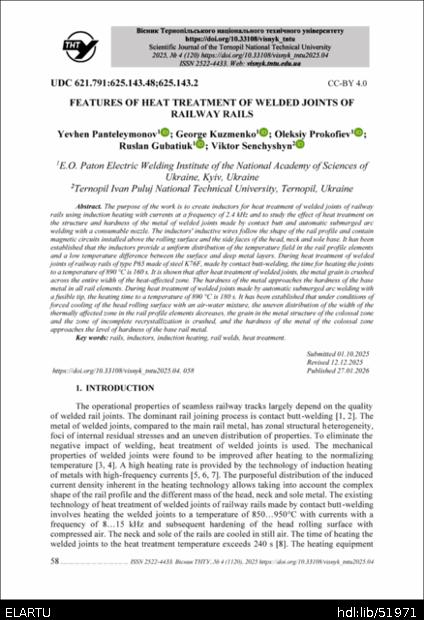
| Laburpena: | Мета роботи полягає у створенні індукторів для термічного оброблення зварних
стиків залізничних рейок із використанням індукційного нагрівання струмами частотою 2,4 кГц та
дослідженні впливу термічного оброблення на структуру та твердість металу зварних з’єднань,
виконаних контактним стиковим та автоматичним дуговим зварюванням ванним способом плавким
мундштуком. Індукуючи, дроти індукторів повторюють форму профілю рейок та містять
магнітопроводи, що встановлені над поверхнею катання та бічними гранями головки, шийкою та
основою підошви. Встановлено, що індуктори забезпечують рівномірний розподіл температурного
поля в елементах профілю рейок та низький перепад температури між поверхневими та глибинними
шарами металу. При термічному обробленні зварних стиків залізничних рейок типу Р65 зі сталі
К76Ф, виконаних контактним стиковим зварюванням, час нагрівання стиків до температури 890°С
становить 160 с. Показано, що після термічного оброблення зварних стиків, зерно металу
подрібнюється по всій ширині зони термічного впливу. Твердість металу наближається до рівня
твердості основного металу в усіх елементах рейок. При термічному обробленні зварних стиків,
виконаних автоматичним дуговим зварюванням ванним способом плавким мундштуком, час
нагрівання до температури 890°С становить 180 с. Встановлено, що в умовах примусового
охолодження поверхні катання головки повітряно-водяною сумішшю зменшується нерівномірність
розподілу ширини зони термічного впливу в елементах профілю рейок, подрібнюється зерно в
структурі металу колошовної зони та зони неповної перекристалізації, твердість металу
колошовної зони наближається до рівня твердості основного металу рейок. The purpose of the work is to create inductors for heat treatment of welded joints of railway rails using induction heating with currents at a frequency of 2.4 kHz and to study the effect of heat treatment on the structure and hardness of the metal of welded joints made by contact butt and automatic submerged arc welding with a consumable nozzle. The inductorsʼ inductive wires follow the shape of the rail profile and contain magnetic circuits installed above the rolling surface and the side faces of the head, neck and sole base. It has been established that the inductors provide a uniform distribution of the temperature field in the rail profile elements and a low temperature difference between the surface and deep metal layers. During heat treatment of welded joints of railway rails of type P65 made of steel K76F, made by contact butt-welding, the time for heating the joints to a temperature of 890 °C is 160 s. It is shown that after heat treatment of welded joints, the metal grain is crushed across the entire width of the heat-affected zone. The hardness of the metal approaches the hardness of the base metal in all rail elements. During heat treatment of welded joints made by automatic submerged arc welding with a fusible tip, the heating time to a temperature of 890 °C is 180 s. It has been established that under conditions of forced cooling of the head rolling surface with an air-water mixture, the uneven distribution of the width of the thermally affected zone in the rail profile elements decreases, the grain in the metal structure of the colossal zone and the zone of incomplete recrystallization is crushed, and the hardness of the metal of the colossal zone approaches the level of hardness of the base rail metal. |
| URI: | http://elartu.tntu.edu.ua/handle/lib/51971 |
| ISSN: | 2522-4433 |
| Copyright owner: | © Тернопільський національний технічний університет імені Івана Пулюя, 2025 |
| URL for reference material: | https://doi.org/10.37434/tpwj2020.07.01 https://doi.org/10.15407/tpwj2016.06.01 https://doi.org/10.4028/www.scientific.net/KEM.737.90 https://doi.org/10.1051/metal/2018117 https://doi.org/10.3390/app9071445 https://doi.org/10.15407/tpwj2018.03.08 https://doi.org/10.37434/tpwj2020.05.07 https://doi.org/10.37434/tpwj2021.04.07 https://doi.org/10.37434/tpwj2022.03.06 https://doi.org/10.15407/tpwj2016.10.08 |
| References (International): | 1. Kuchuk-Yatsenko S. I., Antipin E. V., Didkovskyi O. V. et al. (2020) Evaluation of quality of welded joints of high-strength railway rails of modern production taking into account the requirements of ukrainian and european standards. The Paton Welding J., 7, 3–11. https://doi.org/10.37434/tpwj2020.07.01 2. Кuchuk-Yatsenko S. I., Didkovsky A. V., Shvets V. I. et al. (2016) Flash-butt welding of high-strength rails of nowadays production, The Paton Welding J., 5–6, 7–16. https://doi.org/10.15407/tpwj2016.06.01 3. Gong L., Zhu L., Zhou H. X. (2017) Effect on hardness and microstructures of rail joint with uitra-narrow gap arc welding by post weld heat treatment. Engineering Materials, 737, 90–94. https://doi.org/10.4028/www.scientific.net/KEM.737.90 4. Kuchuk-Yatsenko S. I., Krivenko V. G., Didkovsky A. V. (2012) Technology and new generation of equipment for flash-butt welding of high strength rails of advanced production in construction and reconstruction of high-speed rail road lines. The Paton Welding J., 2, 3–8. 5. Chao Yu, Hong, Xiao, Zi-Сhen, Qi, Yun-peng, Zhao (2019) Finite element analysis and experiment on induction heating process of slab continuous casting-direct rolling. Metallurgical Research & Technology, 116 (4), 403. https://doi.org/10.1051/metal/2018117 6. Li F., Ning J., Liang S. (2019) Analytical Modeling of the Temperature Using Uniform Moving Heat Source in Planar Induction Heating Process. Applied Sciences, 9, 14–45. https://doi.org/10.3390/app9071445 7. Gong L., Zhu L., Zhou H. X. (2017) Effect on hardness and microstructures of rail joint with ultra-narrow gap arc welding by post weld heat treatment. Engineering Materials, 737, 90–94. https://doi.org/10.4028/www.scientific.net/KEM.737.90 8. Genkin I. Z. (2003) Heat treatment of welded joints in rail using induction units. The Paton Welding J., 9, 38–41. 9. Panteleymonov Е. А. (2018) To the issue of heat treatment of welded butts of rails. The Paton Welding J., 3, 36–40. https://doi.org/10.15407/tpwj2018.03.08 10. Prokofiev O. S., Gubatyuk R. S., Pismennyi O. S. et al. (2020) Development of inductors for bulk and surface heat treatment of welded butt joints of railway rails. The Paton Welding J., 5, 41–48. https://doi.org/10.37434/tpwj2020.05.07 11. Panteleimonov E. O. (2021) Portable module for heat treatment of welded joints of railway rails. The Paton Welding J., 4, 43–47. https://doi.org/10.37434/tpwj2021.04.07 12. Panteleimonov E. O. (2022) Inductors for heat treatment of welded butt joints of railway and tram grooved rails. The Paton Welding J., 3, 41–44. https://doi.org/10.37434/tpwj2022.03.06 13. Kuzmenko G. V., Kuzmenko V. G., Galinich V. I. et al. (2012) New technology of electric arc welding of rails using a bath method under conditions of tram and crane tracks. The Paton Welding J., 5, 33–37. 14. Bajic D., Kuzmenko G., Samardzic I. (2013) Welding of rails with new technology of arc. Welding metallurgical, 52, 3, 399–402. 15. Pantelejmonov E. A., Gubatuk R. S. (2016) Induction device for heat treatment to frail way rails welded butts. The Paton Welding J., 10, 41–44. https://doi.org/10.15407/tpwj2016.10.08 16. Kuchuk-Yatsenko S. I., Antipin E. V., Didkovsky O. V. (2020) Evaluation of quality of welded joints of high-strength railway rails of modern production taking into account the requirements of Ukrainian and European standards. The Paton Welding J., 7, 3–11. https://doi.org/10.37434/tpwj2020.07.01 |
| Content type: | Article |
| Bildumetan azaltzen da: | Вісник ТНТУ, 2025, № 4 (120) |
Item honetako fitxategiak:
| Fitxategia | Deskribapena | Tamaina | Formatua | |
|---|---|---|---|---|
| TNTUSJ_2025v120n4_Panteleymonov_Y-Features_of_heat_treatment_58-69.pdf | 4,67 MB | Adobe PDF | Bistaratu/Ireki | |
| TNTUSJ_2025v120n4_Panteleymonov_Y-Features_of_heat_treatment_58-69__COVER.png | 1,33 MB | image/png | Bistaratu/Ireki |
DSpaceko itemak copyright bidez babestuta daude, eskubide guztiak gordeta, baldin eta kontrakoa adierazten ez bada.