
Будь ласка, використовуйте цей ідентифікатор, щоб цитувати або посилатися на цей матеріал:
http://elartu.tntu.edu.ua/handle/lib/51968
Повний запис метаданих
| Поле DC | Значення | Мова |
|---|---|---|
| dc.contributor.author | Мамчич, Тетяна | |
| dc.contributor.author | Мамчич, Іван | |
| dc.contributor.author | Mamchych, Tetyana | |
| dc.contributor.author | Mamchych, Ivan | |
| dc.date.accessioned | 2026-03-23T16:17:39Z | - |
| dc.date.available | 2026-03-23T16:17:39Z | - |
| dc.date.created | 2025-12-23 | |
| dc.date.issued | 2025-12-23 | |
| dc.date.submitted | 2025-09-02 | |
| dc.identifier.citation | Mamchych T. Modelling residential electricity consumption / Tetyana Mamchych, Ivan Mamchych // Scientific Journal of TNTU. — Tern. : TNTU, 2025. — Vol 120. — No 4. — P. 32–38. | |
| dc.identifier.issn | 2522-4433 | |
| dc.identifier.uri | http://elartu.tntu.edu.ua/handle/lib/51968 | - |
| dc.description.abstract | Роботу присвячено проблемі моделювання споживання електроенергії приватними домогосподарствами на основі часових рядів, утворених послідовними значеннями облікових приладів, які відносяться до smart-grid технологій. Електроспоживання домогосподарств є важливою складовою загальної енергетичної системи. Дослідження цієї складової набуває особливої ваги у наш час епідемій, поширення віддалених видів робіт, посилення залежності від інтернет-технологій. Математичні моделі характеру споживання, які дозволяють виявляти шаблони, виявляти подібності таких шаблонів були б надзвичайно корисними для задач короткострокового прогнозування і передбачення попиту, та для забезпечення стабільності функціонування системи енергозабезпечення в цілому. Зауважимо, що існує особлива потреба в моделях, які використовують лише дані smart-grid приладів, не залучаючи іншого типу даних, як кількість жителів, дохід, площа помешкання та інших для віддаленого моніторингу за поточними даними. У працях [1] і [2] було запропоновано коефіцієнт подібності (the coefficient of similarity) та коефіцієнт автоподібності (the coefficient of auto-similarity) для описування характеру споживання, виявлення можливих шаблонів та вимірювання стабільності шаблонів споживання, для визначення випадків, коли такі шаблони не існують. Цитовані роботи на реальних даних демонструють ефективність цих коефіцієнтів для моніторингу споживання, а отримані результати є певним досягненням у галузі енергетики. Водночас ці роботи не містять вивчення цих обчислювальних конструкцій з точки зору прикладної математики, оскільки це роботи в галузі енергетичної науки. Заповненню цієї прогалини присвячена дана робота. Встановлено деякі властивості коефіцієнтів подібності та автоподібності, пов’язані з використанням кореляційного підходу, протестовано розпізнавальну здатність коефіцієнтів для фіксованих даних, порівняно з коефіцієнтом інтеграції Шеклі (the distance correlation) [3], [4]. Апробація даної технології виконана на даних, отриманих проектом з дослідження електроспоживання для 400 шведських домогосподарств ([5]). | |
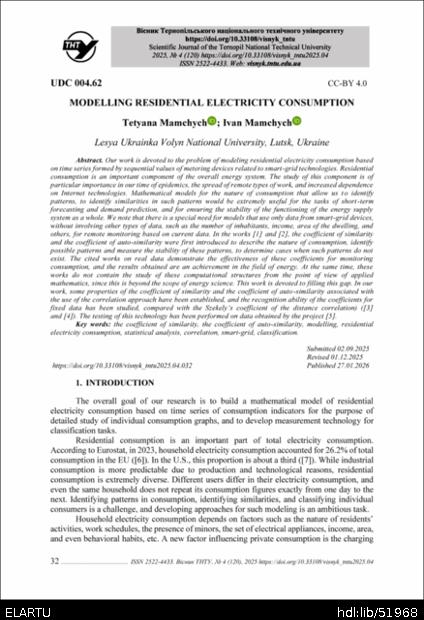
| dc.description.abstract | Our work is devoted to the problem of modeling residential electricity consumption based on time series formed by sequential values of metering devices related to smart-grid technologies. Residential consumption is an important component of the overall energy system. The study of this component is of particular importance in our time of epidemics, the spread of remote types of work, and increased dependence on Internet technologies. Mathematical models for the nature of consumption that allow us to identify patterns, to identify similarities in such patterns would be extremely useful for the tasks of short -term forecasting and demand prediction, and for ensuring the stability of the functioning of the energy supply system as a whole. We note that there is a special need for models that use only data from smart-grid devices, without involving other types of data, such as the number of inhabitants, income, area of the dwelling, and others, for remote monitoring based on current data. In the works [1] and [2], the coefficient of similarity and the coefficient of auto-similarity were first introduced to describe the nature of consumption, identify possible patterns and measure the stability of these patterns, to determine cases when such patterns do not exist. The cited works on real data demonstrate the effectiveness of these coefficients for monitoring consumption, and the results obtained are an achievement in the field of energy. At the same time, these works do not contain the study of these computational structures from the point of view of applied mathematics, since this is beyond the scope of energy science. This work is devoted to filling this gap. In our work, some properties of the coefficient of similarity and the coefficient of auto-similarity associated with the use of the correlation approach have been established, and the recognition ability of the coefficients for fixed data has been studied, compared with the Szekely’s coefficient of the distance correlation) ([3] and [4]). The testing of this technology has been performed on data obtained by the project [5]. | |
| dc.format.extent | 32-38 | |
| dc.language.iso | en | |
| dc.publisher | ТНТУ | |
| dc.publisher | TNTU | |
| dc.relation.ispartof | Вісник Тернопільського національного технічного університету, 4 (120), 2025 | |
| dc.relation.ispartof | Scientific Journal of the Ternopil National Technical University, 4 (120), 2025 | |
| dc.relation.uri | https://doi.org/10.1016/j.egypro.2015.07.494 | |
| dc.relation.uri | https://doi.org/10.1214/009053607000000505 | |
| dc.relation.uri | https://doi.org/10.1146/annurev-statistics-060116-054026 | |
| dc.relation.uri | https://ec.europa.eu/eurostat/statistics-explained/index.php?title=Energy_consumption_in_ | |
| dc.relation.uri | https://doi.org/10.1016/j.scs.2025.106623 | |
| dc.relation.uri | https://doi.org/10.3390/wevj14020036 | |
| dc.relation.uri | https://doi.org/10.1016/j.egypro.2019.01.171 | |
| dc.relation.uri | https://doi.org/10.3390/en18061314 | |
| dc.relation.uri | https://doi.org/10.1093/jcde/qwab063 | |
| dc.relation.uri | https://doi.org/10.1016/j.enbuild.2025.115432 | |
| dc.relation.uri | https://doi.org/10.20935/AcadEnergy7500 | |
| dc.relation.uri | https://doi.org/10.1016/j.egyai.2020.100009 | |
| dc.relation.uri | https://doi.org/10.33108/visnyk_tntu2021.04.087 | |
| dc.relation.uri | https://cran.r-project.org/web/packages/energy/energy.pdf | |
| dc.subject | коефіцієнт подібності | |
| dc.subject | коефіцієнт автоподібності | |
| dc.subject | моделювання | |
| dc.subject | електроспоживання домогосподарств | |
| dc.subject | статистичний аналіз | |
| dc.subject | кореляція | |
| dc.subject | smart-grid | |
| dc.subject | класифікація | |
| dc.subject | the coefficient of similarity | |
| dc.subject | the coefficient of auto-similarity | |
| dc.subject | modelling | |
| dc.subject | residential electricity consumption | |
| dc.subject | statistical analysis | |
| dc.subject | correlation | |
| dc.subject | smart-grid | |
| dc.subject | classification | |
| dc.title | Modelling residential electricity consumption | |
| dc.title.alternative | Моделювання електроспоживання домогосподарств | |
| dc.type | Article | |
| dc.rights.holder | © Тернопільський національний технічний університет імені Івана Пулюя, 2025 | |
| dc.coverage.placename | Тернопіль | |
| dc.coverage.placename | Ternopil | |
| dc.format.pages | 7 | |
| dc.subject.udc | 004.62 | |
| dc.relation.referencesen | 1. Mamchych T., Wallin F. (2014) Looking for patterns in residential electricity consumption. Energy Procedia 61, pp. 1768–1771. Doi:10.1016/j.egypro.2014.12.208. | |
| dc.relation.referencesen | 2. Mamchych T., Wallin F. (2015) Stability of patterns in residential electricity consumption. Energy Procedia 75, pp. 2738–2744. https://doi.org/10.1016/j.egypro.2015.07.494 | |
| dc.relation.referencesen | 3. Székely, Gábor J., Rizzo, Maria L., Bakirov, Nail K. (December 2007). “Measuring and testing dependence by correlation of distances”. The Annals of Statistics. 35 (6): 2769–2794. https://doi.org/10.1214/009053607000000505 | |
| dc.relation.referencesen | 4. Szekely G. J. and Rizzo M. L. (2017) The Energy of Data, The Annual Review of Statistics and Its Applications. Extended Review, 4:447-479. https://doi.org/10.1146/annurev-statistics-060116-054026 | |
| dc.relation.referencesen | 5. Zimmermann J. P. (2009). End-use metering campaign in 400 households in Sweden. Assessment of the potential electricity savings. Enertech. | |
| dc.relation.referencesen | 6. Available at: https://ec.europa.eu/eurostat/statistics-explained/index.php?title=Energy_consumption_in_ households. | |
| dc.relation.referencesen | 7. Mingyue Guo, Youngsik Choi, So-Min Cheong, Zheng O’Neill (2025) Current and future residential electricity demand using large-scale smart meter data in a changing climate. Sustainable Cities and Society, 130 (15), 106623. https://doi.org/10.1016/j.scs.2025.106623 | |
| dc.relation.referencesen | 8. Mavlonov J., Ruzimov S., Tonoli A., Amati N., Mukhitdinov A. (2023) Sensitivity Analysis of Electric Energy Consumption in Battery Electric Vehicles with Different Electric Motors. World Electr. Veh. J. 14, 36. https://doi.org/10.3390/wevj14020036 | |
| dc.relation.referencesen | 9. Matsui K., Yamagata Y., Kawakubo Sh. (2019) Real-time sensing in residential area using IoT technology for finding usage patterns to suggest action plan to conserve energy. Energy Procedia 158, pp. 6438–6445. https://doi.org/10.1016/j.egypro.2019.01.171 | |
| dc.relation.referencesen | 10. Williams B., Hooper R. J., Gnoth D. and Chase J. G. (2025) Residential Electricity Demand Modelling: Validation of a Behavioural Agent-Based Approach. Energies, 18 (6), 1314. https://doi.org/10.3390/en18061314 | |
| dc.relation.referencesen | 11. Pak W., Kim I., Choi J. (2021) Proposal of the energy consumption analysis process for the residential houses using big data analytics technique. Journal of Computational Design and Engineering, 8 (6), pp. 1591–1604. https://doi.org/10.1093/jcde/qwab063 | |
| dc.relation.referencesen | 12. Softah W., Tafakori L., Song H. (2025) Analyzing and predicting residential electricity consumption using smart meter data: A copula-based approach. Energy and Buildings, 332 (1), 115432 https://doi.org/10.1016/j.enbuild.2025.115432 | |
| dc.relation.referencesen | 13. Hosseini B. (2025) Forecasting household monthly electricity consumption using the similar pattern algorithm. Academia Green Energy, 2. https://doi.org/10.20935/AcadEnergy7500 | |
| dc.relation.referencesen | 14. Scheidt F., Medinová H., Ludwig N., Richter B., Staudt Ph., Weinhardt Ch. Data analytics in the electricity sector –A quantitative and qualitative literature review. Energy and AI 1 (2020) 100009. https://doi.org/10.1016/j.egyai.2020.100009 | |
| dc.relation.referencesen | 15. Lytvynenko Ia., Lupenko S., Nazarevych O., Shymchuk H., Hotovych V. (2021) Additive mathematical model of gas consumption process. Scientific Journal of TNTU (Tern.), vol. 104, no. 4, pp. 87–97. https://doi.org/10.33108/visnyk_tntu2021.04.087 | |
| dc.relation.referencesen | 16. Maria Rizzo, Gabor Szekely. (2025) Package ‘energy’. E-Statistics: Multivariate Inference via the Energy of Data. Available at: https://cran.r-project.org/web/packages/energy/energy.pdf. | |
| dc.identifier.doi | https://doi.org/10.33108/visnyk_tntu2025.04.032 | |
| dc.contributor.affiliation | Волинський національний університет імені Лесі Українки, Луцьк, Україна | |
| dc.contributor.affiliation | Lesya Ukrainka Volyn National University, Lutsk, Ukraine | |
| dc.citation.journalTitle | Вісник Тернопільського національного технічного університету | |
| dc.citation.volume | 120 | |
| dc.citation.issue | 4 | |
| dc.citation.spage | 32 | |
| dc.citation.epage | 38 | |
| dc.identifier.citation2015 | Mamchych T., Mamchych I. Modelling residential electricity consumption // Scientific Journal of TNTU, Ternopil. 2025. Vol 120. No 4. P. 32–38. | |
| dc.identifier.citationenAPA | Mamchych, T., & Mamchych, I. (2025). Modelling residential electricity consumption. Scientific Journal of the Ternopil National Technical University, 120(4), 32-38. TNTU.. | |
| dc.identifier.citationenCHICAGO | Mamchych T., Mamchych I. (2025) Modelling residential electricity consumption. Scientific Journal of the Ternopil National Technical University (Tern.), vol. 120, no 4, pp. 32-38. | |
| Розташовується у зібраннях: | Вісник ТНТУ, 2025, № 4 (120) | |
Файли цього матеріалу:
| Файл | Опис | Розмір | Формат | |
|---|---|---|---|---|
| TNTUSJ_2025v120n4_Mamchych_T-Modelling_residential_electricity_32-38.pdf | 2,18 MB | Adobe PDF | Переглянути/відкрити | |
| TNTUSJ_2025v120n4_Mamchych_T-Modelling_residential_electricity_32-38__COVER.png | 1,35 MB | image/png | Переглянути/відкрити |
Усі матеріали в архіві електронних ресурсів захищені авторським правом, всі права збережені.