
Παρακαλώ χρησιμοποιήστε αυτό το αναγνωριστικό για να παραπέμψετε ή να δημιουργήσετε σύνδεσμο προς αυτό το τεκμήριο:
http://elartu.tntu.edu.ua/handle/lib/51965
| Titolo: | Modeling of QSTE340TM steel fcg curve by neural network |
| Titoli alternativi: | Моделювання діаграми втомного руйнування сталі QSTE340TM нейронною мережею |
| Autori: | Ясній, Олег Петрович Цимбалюк, Любов Іванівна Блащак, Наталія Іванівна Бабій, Андрій Васильович Yasniy, Oleh Tsymbaliuk, Liubov Blashchak, Nataliia Babiy, Andriy |
| Affiliation: | Тернопільський національний технічний університет імені Івана Пулюя, Тернопіль, Україна Ternopil Ivan Puluj National Technical University, Ternopil, Ukraine |
| Bibliographic description (Ukraine): | Modeling of QSTE340TM steel fcg curve by neural network / Oleh Yasniy, Liubov Tsymbaliuk, Nataliia Blashchak, Andriy Babiy // Scientific Journal of TNTU. — Tern. : TNTU, 2025. — Vol 120. — No 4. — P. 5–9. |
| Bibliographic reference (2015): | Modeling of QSTE340TM steel fcg curve by neural network / Yasniy O. та ін. // Scientific Journal of TNTU, Ternopil. 2025. Vol 120. No 4. P. 5–9. |
| Bibliographic citation (APA): | Yasniy, O., Tsymbaliuk, L., Blashchak, N., & Babiy, A. (2025). Modeling of QSTE340TM steel fcg curve by neural network. Scientific Journal of the Ternopil National Technical University, 120(4), 5-9. TNTU.. |
| Bibliographic citation (CHICAGO): | Yasniy O., Tsymbaliuk L., Blashchak N., Babiy A. (2025) Modeling of QSTE340TM steel fcg curve by neural network. Scientific Journal of the Ternopil National Technical University (Tern.), vol. 120, no 4, pp. 5-9. |
| Is part of: | Вісник Тернопільського національного технічного університету, 4 (120), 2025 Scientific Journal of the Ternopil National Technical University, 4 (120), 2025 |
| Journal/Collection: | Вісник Тернопільського національного технічного університету |
| Issue: | 4 |
| Volume: | 120 |
| Data: | 23-dic-2025 |
| Submitted date: | 30-ago-2025 |
| Date of entry: | 23-mar-2026 |
| Editore: | ТНТУ TNTU |
| Place of the edition/event: | Тернопіль Ternopil |
| DOI: | https://doi.org/10.33108/visnyk_tntu2025.04.005 |
| UDC: | 004.8 620.1 |
| Parole chiave: | сталь QSTE340TM машинне навчання швидкість росту втомної тріщини нейронна мережа задача регресії QSTE340TM steel machine learning fatigue crack growth rate neural network regression problem |
| Number of pages: | 5 |
| Page range: | 5-9 |
| Start page: | 5 |
| End page: | 9 |
| Abstract: | Дослідження стосується моделювання росту втомних тріщин у сталі QSTE340TM за
допомогою нейронної мережі. Цей матеріал є термомеханічно прокатана високоміцна, низьколегована сталь
з границею плинності 340 МПа, яка поєднує міцність, здатність до зварювання і чудові властивості холодного
формування. Це матеріал, який успішно застосовують у автомобілебудування та елементах конструкцій,
для яких ресурс та легке проєктування є критичними. Класичні детерміновані методи оцінювання росту
втомних тріщин є часто досить дорогими і вимагають добре обладнаної лабораторії для проведення
експериментів. На противагу ним, за останні десятиліття методи машинного навчання стали широко
поширеними завдяки їх властивості виявляти неочевидні залежності на основі даних. Машинне навчання є
частиною штучного інтелекту. Воно навчається на існуючих даних і удосконалюється з часом без потреби
явного програмування. Експериментальний набір даних взято з відкритих наукових джерел. Він містив дані
швидкості росту втомної тріщини для чотирьох асиметрій циклу навантаження: 0,1; 0,3; 0,5; і 0,7. Вхідні
дані складалися з наступних ознак: розмах коефіцієнта інтенсивності напружень K (МПа√м), швидкість
росту втомної трішини da/dN та коефіцієнт асиметрії циклу навантаження R. За вихідну змінну вибрано
da/dN, а дві інші слугували в якості вхідних змінних моделі машинного навчання. Модель тренували тільки на
даних за коефіцієнтом асиметрії циклу навантаження R, який дорівнював 0,1; 0,3;та 0,7. Модель перевіряли
на даних швидкості росту втомної тріщини з коефіцієнтом асиметрії циклу навантаження R, котрий
дорівнював 0,5. Побудовано модель у вигляді багатошарового персептрона. Модель містила два прихованих
шари з кількістю нейронів 100 та 80, відповідно. Функція активації була RELU. В якості оптимізатора обрано
Adam, а параметр максимум ітерації дорівнював 500. Помилки моделі були наступними: MSE = 1.238e-10, MAE = 8.594e-06, R² = 0.95346. З отриманих результатів, можна побачити, що нейронна мережа забезпечує
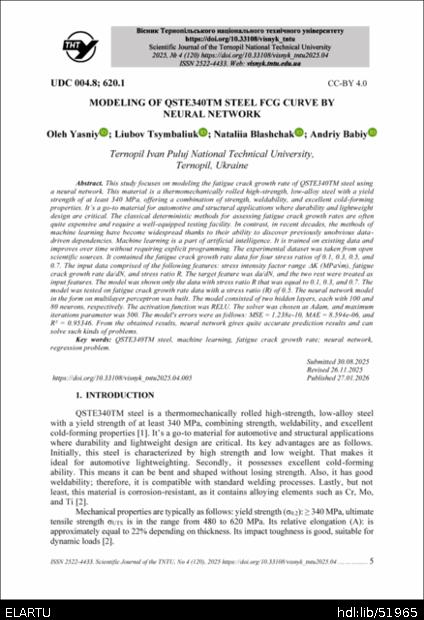
досить точні результати прогнозування і може розв’язувати задачі такого типу. This study focuses on modeling the fatigue crack growth rate of QSTE340TM steel using a neural network. This material is a thermomechanically rolled high-strength, low-alloy steel with a yield strength of at least 340 MPa, offering a combination of strength, weldability, and excellent cold-forming properties. It’s a go-to material for automotive and structural applications where durability and lightweight design are critical. The classical deterministic methods for assessing fatigue crack growth rates are often quite expensive and require a well-equipped testing facility. In contrast, in recent decades, the methods of machine learning have become widespread thanks to their ability to discover previously unobvious data - driven dependencies. Machine learning is a part of artificial intelligence. It is trained on existing data and improves over time without requiring explicit programming. The experimental dataset was taken from open scientific sources. It contained the fatigue crack growth rate data for four stress ratios of 0.1, 0.3, 0.5, and 0.7. The input data comprised of the following features: stress intensity factor range K (MPa√m), fatigue crack growth rate da/dN, and stress ratio R. The target feature was da/dN, and the two rest were treated as input features. The model was shown only the data with stress ratio R that was equal to 0.1, 0.3, and 0.7. The model was tested on fatigue crack growth rate data with a stress ratio (R) of 0.5. The neural network model in the form on multilayer perceptron was built. The model consisted of two hidden layers, each with 100 and 80 neurons, respectively. The activation function was RELU. The solver was chosen as Adam, and maximum iterations parameter was 500. The modelʼs errors were as follows: MSE = 1.238e-10, MAE = 8.594e-06, and R² = 0.95346. From the obtained results, neural network gives quite accurate prediction results and can solve such kinds of problems. |
| URI: | http://elartu.tntu.edu.ua/handle/lib/51965 |
| ISSN: | 2522-4433 |
| Copyright owner: | © Тернопільський національний технічний університет імені Івана Пулюя, 2025 |
| URL for reference material: | https://doi.org/10.5114/reum/173115 https://doi.org/10.23939/sisn2025.18.2.113 https://doi.org/10.1007/978-3-031-38747-0 https://doi.org/10.1007/s10704-011-9641-7 https://doi.org/10.1007/s11003-018-0189-9 https://doi.org/10.1016/j.engfracmech.2019.03.029 |
| References (International): | 1. QStE340TM Steel, Datasheet, Properties, Cross-Reference Table, Suppliers. 2. QStE340TM Steel – Solucky Steel. 3. SEW092 QStE340TM automotive low-carbon steel coils and sheets – BBN Steel Materials Supplier. 4. Zhang A., Lipton Z. C., Li M., Smola A. J. (2023) Dive into Deep Learning, 2023, Cambridge University Press. 5. Grus J. (2019). Data science from scratch: First principles with Python (2nd ed.), O’Reilly Media. 6. Nykytyuk S. O., Sverstiuk A. S., Klymnyuk S. I., (2023) Pyvovarchuk D. S., Palaniza Y. B. Approach to prediction and receiver operating characteristic analysis of a regression model for assessing the severity of the course Lyme borreliosis in children. Rheumatology, vol. 61, no. 5, pp. 345–352. https://doi.org/10.5114/reum/173115 7. Mosiy L., Sverstiuk A. (2025) Methods Machine Learning for Classifying ECG Based on Rhythmic and Morphological Features. Bulletin of the National University “Lviv Polytechnic”. Information Systems and Networks Series, vol. 18, no. 2, pp. 113–128. https://doi.org/10.23939/sisn2025.18.2.113 8. James G., Witten D., Hastie T., Tibshirani R., Taylor J. (2023) An Introduction to Statistical Learning: With Applications in Python, Springer. https://doi.org/10.1007/978-3-031-38747-0 9. Yasniy O., Tymoschuk D., Didych I., Zagorodna N., Malyshevska O. (2024) Modelling of automotive steel fatigue lifetime by machine learning method. ITTAP 2024: 4th International Workshop on Information Technologies: Theoretical and Applied Problems, Ternopil, Ukraine, Opole, Poland, 2024, pp. 165–172. 10. Yasniy O., Maruschak P., Lapusta Y. (2011) Probabilistic modeling of surface crack growth in a roll of continuous casting machine. International Journal of Fracture, vol. 172, pp. 113–120. https://doi.org/10.1007/s10704-011-9641-7 11. Yasnii O, Pastukh A, Pyndus Yu., Lutsyk N., Didych I. (2018) Prediction of the diagrams of fatigue fracture of D16T aluminum alloy by the methods of machine learning. Materials Science, vol. 54, no. 3, pp. 333–338. https://doi.org/10.1007/s11003-018-0189-9 12. Lu Y., Yang F., Chen Te. (2019) Effect of single overload on fatigue crack growth in QSTE340TM steel and retardation model modification. Engineering Fracture Mechanics, vol. 212, pp. 81–94. https://doi.org/10.1016/j.engfracmech.2019.03.029 13. ASTM E647-23a. Standard Test Method for Measurement of Fatigue Crack Growth Rates. Book of Standards Volume 03.01. 2023. 14. Yang F.,Chen Te., Lu Y. (2019) Data for: Effect of single overload on fatigue crack growth in QSTE340TM steel and retardation model modification, vol. 1. |
| Content type: | Article |
| Vyskytuje se v kolekcích: | Вісник ТНТУ, 2025, № 4 (120) |
Soubory připojené k záznamu:
| Soubor | Popis | Velikost | Formát | |
|---|---|---|---|---|
| TNTUSJ_2025v120n4_Yasniy_O-Modeling_of_QSTE340TM_steel_5-9.pdf | 1,64 MB | Adobe PDF | Visualizza/apri | |
| TNTUSJ_2025v120n4_Yasniy_O-Modeling_of_QSTE340TM_steel_5-9__COVER.png | 1,25 MB | image/png | Visualizza/apri |
Tutti i documenti archiviati in DSpace sono protetti da copyright. Tutti i diritti riservati.