
Будь ласка, використовуйте цей ідентифікатор, щоб цитувати або посилатися на цей матеріал:
http://elartu.tntu.edu.ua/handle/lib/51958
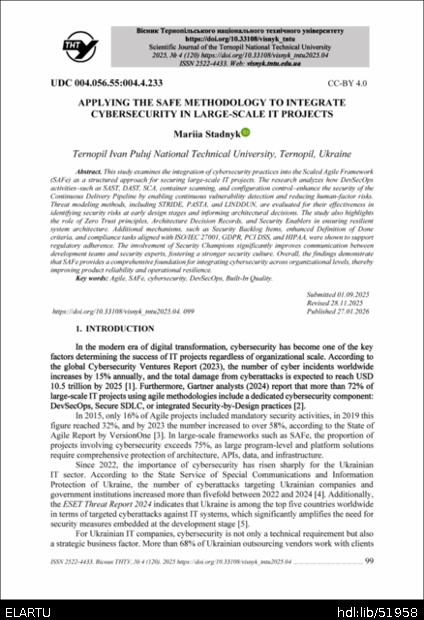
| Назва: | Applying the safe methodology to integrate cybersecurity in large-scale IT projects |
| Інші назви: | Застосування методології safe для інтеграції кібербезпеки у великомасштабних IT-проєктах |
| Автори: | Стадник, Марія Андріївна Stadnyk, Mariia |
| Приналежність: | Тернопільський національний технічний університет імені Івана Пулюя, Тернопіль, Україна Ternopil Ivan Puluj National Technical University, Ternopil, Ukraine |
| Бібліографічний опис: | Stadnyk M. Applying the safe methodology to integrate cybersecurity in large-scale IT projects / Mariia Stadnyk // Scientific Journal of TNTU. — Tern. : TNTU, 2025. — Vol 120. — No 4. — P. 99–109. |
| Бібліографічне посилання: | Stadnyk M. Applying the safe methodology to integrate cybersecurity in large-scale IT projects // Scientific Journal of TNTU, Ternopil. 2025. Vol 120. No 4. P. 99–109. |
| Bibliographic citation (APA): | Stadnyk, M. (2025). Applying the safe methodology to integrate cybersecurity in large-scale IT projects. Scientific Journal of the Ternopil National Technical University, 120(4), 99-109. TNTU.. |
| Bibliographic citation (CHICAGO): | Stadnyk M. (2025) Applying the safe methodology to integrate cybersecurity in large-scale IT projects. Scientific Journal of the Ternopil National Technical University (Tern.), vol. 120, no 4, pp. 99-109. |
| Є частиною видання: | Вісник Тернопільського національного технічного університету, 4 (120), 2025 Scientific Journal of the Ternopil National Technical University, 4 (120), 2025 |
| Журнал/збірник: | Вісник Тернопільського національного технічного університету |
| Випуск/№ : | 4 |
| Том: | 120 |
| Дата публікації: | 23-гру-2025 |
| Дата подання: | 1-вер-2025 |
| Дата внесення: | 23-бер-2026 |
| Видавництво: | ТНТУ TNTU |
| Місце видання, проведення: | Тернопіль Ternopil |
| DOI: | https://doi.org/10.33108/visnyk_tntu2025.04. 099 |
| УДК: | 004.056.55 004.4.233 |
| Теми: | Agile SAFe кібербезпека DevSecOps Built-In Quality Agile SAFe cybersecurity DevSecOps Built-In Quality |
| Кількість сторінок: | 11 |
| Діапазон сторінок: | 99-109 |
| Початкова сторінка: | 99 |
| Кінцева сторінка: | 109 |
| Короткий огляд (реферат): | Здійснено всебічний аналіз особливостей поєднання кібербезпекових практик із
методологією Scaled Agile Framework (SAFe), що розглядається як цілісний механізм захисту
великомасштабних ІТ-рішень. Показано, як упровадження компонентів DevSecOps – таких, як статичне
й динамічне тестування безпеки (SAST і DAST), аналіз програмних залежностей (SCA), сканування
контейнерних середовищ та контроль конфігурацій – забезпечує підвищення безпечності процесів
Continuous Delivery та сприяє своєчасному виявленню вразливостей. Окрема увага приділена оцінюванні
можливостей сучасних методів моделювання загроз, зокрема STRIDE, PASTA, які дозволяють
ідентифікувати критичні ризики ще під час формування архітектурних концепцій.
Проведено комплексний аналіз інструментів, за допомогою яких SAFe інтегрує кібербезпеку на всіх рівнях
організації. Розглянуто роль DevSecOps у забезпеченні безперервного сканування вразливостей у CI/CD-
конвеєрі, оцінено значення моделювання загроз та Zero Trust-архітектури для раннього виявлення ризиків
і посилення архітектурної стійкості. Детально проаналізовано застосування Security Backlogs, критеріїв
Definition of Done, ролі Security Champions та механізмів нормативної відповідності. Окремо наведено
узагальнювальну таблицю, що демонструє відповідність інструментів SAFe міжнародним стандартам
кібербезпеки та їхнє застосування на різних рівнях SAFe. Підкреслено роль Security Champions у посиленні
комунікації між технічними командами та експертами з кіберзахисту, що сприяє формуванню сталої
культури безпеки в середині організації.
Узагальнення результатів підтверджує, що SAFe створює повноцінну методологічну базу для
вбудовування кібербезпеки на всіх рівнях управління та розроблення, що, у свою чергу, підвищує надійність,
стійкість і якість ІТ-продуктів. This study examines the integration of cybersecurity practices into the Scaled Agile Framework (SAFe) as a structured approach for securing large-scale IT projects. The research analyzes how DevSecOps activities–such as SAST, DAST, SCA, container scanning, and configuration control–enhance the security of the Continuous Delivery Pipeline by enabling continuous vulnerability detection and reducing human-factor risks. Threat modeling methods, including STRIDE, PASTA, and LINDDUN, are evaluated for their effectiveness in identifying security risks at early design stages and informing architectural decisions. The study also highlights the role of Zero Trust principles, Architecture Decision Records, and Security Enablers in ensuring resilient system architecture. Additional mechanisms, such as Security Backlog Items, enhanced Definition of Done criteria, and compliance tasks aligned with ISO/IEC 27001, GDPR, PCI DSS, and HIPAA, were shown to support regulatory adherence. The involvement of Security Champions significantly improves communication between development teams and security experts, fostering a stronger security culture. Overall, the findings demonstrate that SAFe provides a comprehensive foundation for integrating cybersecurity across organizational levels, thereby improving product reliability and operational resilience. |
| URI (Уніфікований ідентифікатор ресурсу): | http://elartu.tntu.edu.ua/handle/lib/51958 |
| ISSN: | 2522-4433 |
| Власник авторського права: | © Тернопільський національний технічний університет імені Івана Пулюя, 2025 |
| URL-посилання пов’язаного матеріалу: | https://cybersecurityventures.com/cybercrime-report/ https://www.gartner.com https://digital.ai/resources/state-of-agile-report https://cip.gov.ua https://www.eset.com/int/security-report https://itukraine.org.ua https://www2.deloitte.com https://doi.org/10.1109/ACCESS.2020.2968524 https://doi.org/10.48550/arXiv.2105.13404 https://www.withsecure.com/content/dam/withsecure/global/en/white-papers/using-safe-to-align-cyber-security-and-executive-goals.pdf https://www.larksuite.com/en_us/static/docs/safe_cybersecurity.pdf https://doi.org/10.1145/3453151 https://doi.org/10.1016/j.infsof.2020.106412 https://doi.org/10.1007/978-3-030-06019-0_18 https://doi.org/10.1007/978-3-031-07245-3_10 https://doi.org/10.48550/arXiv.2106.13353 https://www.devopsinstitute.com/wp-content/uploads/Continuous-Security.pdf https://aisel.aisnet.org/cgi/viewcontent.cgi?article=1006&context=acis2019 https://doi.org/10.6028/NIST.SP.800-207 https://doi.org/10.1016/j.cose.2021.102357 https://doi.org/10.1109/ACCESS.2021.3054527 https://doi.org/10.1109/MSEC.2020.3014683 https://doi.org/10.33108/visnyk_tntu2022.02.054 |
| References: | 1. Cybersecurity Ventures (2023). 2023 Official Cybercrime Report: Cybersecurity market data, insights & statistics. https://cybersecurityventures.com/cybercrime-report/. 2. Gartner (2024). Gartner forecast: Security and risk management trends in agile and DevSecOps. Gartner Research. https://www.gartner.com. 3. VersionOne (2023). 17th Annual State of Agile Report. Digital.ai. https://digital.ai/resources/state-of-agile-report. 4. State Service of Special Communications and Information Protection of Ukraine (2024). Annual cybersecurity report of Ukraine 2022–2024. https://cip.gov.ua. 5. ESET (2024). ESET Threat Report 2024: Global trends in cyberattacks. ESET Research. https://www.eset.com/int/security-report. 6. IT Ukraine Association (2023). Ukrainian IT industry report: Outsourcing market overview and security compliance requirements. https://itukraine.org.ua. 7. Deloitte (2024). Deloitte Cyber Report 2024: Global challenges in integrating security into Agile and DevSecOps. Deloitte Insights. https://www2.deloitte.com. 8. Shahid J., Hameed M. K., Javed I. T., Qureshi K. N., Ali M., & Crespi N. (2020). Integrating security into agile software development processes. IEEE. https://doi.org/10.1109/ACCESS.2020.2968524 9. Moyon F., Mendez Fernandez D., Beckers K., Klepper S. (2021). How to integrate security compliance requirements with agile software engineering at scale? arXiv preprint arXiv:2105.13404. https://doi.org/10.48550/arXiv.2105.13404. 10. WithSecure (2022). Using SAFe to align cyber security and executive goals. https://www.withsecure.com/content/dam/withsecure/global/en/white-papers/using-safe-to-align-cyber-security-and-executive-goals.pdf. 11. LarkSuite (n.d.). Scaled Agile Framework (SAFe) for cybersecurity teams. https://www.larksuite.com/en_us/static/docs/safe_cybersecurity.pdf. 12. Aljuneidi A., et al. (2021). DevSecOps: Integrating security into DevOps. ACM Computing Surveys. https://doi.org/10.1145/3453151. 13. Kaur A., & Chatterjee I. (2020) Secure DevOps: A systematic literature review. Information and Software Technology, 130. https://doi.org/10.1016/j.infsof.2020.106412 14. Chehaba A., et al. (2019). Built-in security in agile projects: Challenges and solutions. Springer. https://doi.org/10.1007/978-3-030-06019-0_18. 15. Sabaliauskaite G., et al. (2022). Security activities in scaled agile: An empirical study. ICSOB Conference. https://doi.org/10.1007/978-3-031-07245-3_10. 16. Shostack A. (2021). Threat modeling in Agile and DevOps. Microsoft Research. https://doi.org/10.48550/arXiv.2106.13353. 17. DevOps Institute (2020). Continuous security: Automating secure software delivery. https://www.devopsinstitute.com/wp-content/uploads/Continuous-Security.pdf. 18. Bass J. M. (2019). Security challenges in large-scale agile development. ACIS 2019. https://aisel.aisnet.org/cgi/viewcontent.cgi?article=1006&context=acis2019. 19. National Institute of Standards and Technology (2020). Zero Trust Architecture (NIST SP 800-207). https://doi.org/10.6028/NIST.SP.800-207 20. Ali S., et al. (2021) Security-by-design: A comprehensive survey. Computers & Security, 111. https://doi.org/10.1016/j.cose.2021.102357. 21. Ahmad I., et al. (2021). Agile DevSecOps for cloud-native applications. IEEE. https://doi.org/10.1109/ACCESS.2021.3054527. 22. Martins R., et al. (2020). Security automation in CI/CD pipelines. Software Engineering Journal. https://doi.org/10.1109/MSEC.2020.3014683. 23 Stadnyk M., Palamar A. (2022). Project management features in the cybersecurity area. Scientific Journal of the Ternopil National Technical University, 2(106), 54–62. https://doi.org/10.33108/visnyk_tntu2022.02.054 |
| Тип вмісту: | Article |
| Розташовується у зібраннях: | Вісник ТНТУ, 2025, № 4 (120) |
Файли цього матеріалу:
| Файл | Опис | Розмір | Формат | |
|---|---|---|---|---|
| TNTUSJ_2025v120n4_Stadnyk_M-Applying_the_safe_methodology_99-109.pdf | 2,99 MB | Adobe PDF | Переглянути/відкрити | |
| TNTUSJ_2025v120n4_Stadnyk_M-Applying_the_safe_methodology_99-109__COVER.png | 1,33 MB | image/png | Переглянути/відкрити |
Усі матеріали в архіві електронних ресурсів захищені авторським правом, всі права збережені.