
Link lub cytat.
http://elartu.tntu.edu.ua/handle/lib/51612
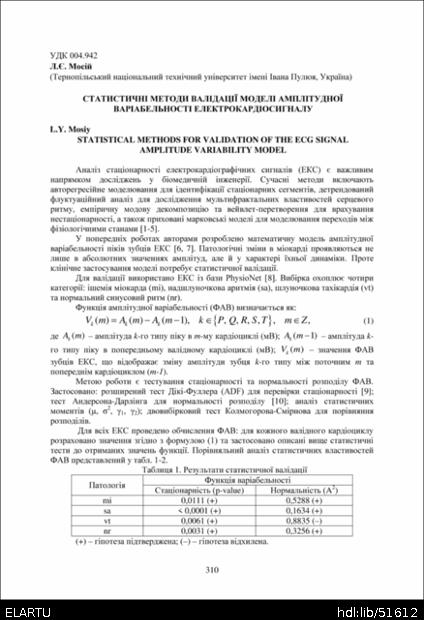
| Tytuł: | Статистичні методи валідації моделі амплітудної варіабельності електрокардіосигналу |
| Inne tytuły: | Statistical methods for validation of the ecg amplitude variability model |
| Authors: | Мосій, Л. Є. Mosiy, L. Y. |
| Affiliation: | Тернопільський національний технічний університет імені Івана Пулюя, Україна |
| Bibliographic description (Ukraine): | Мосій Л. Є. Статистичні методи валідації моделі амплітудної варіабельності електрокардіосигналу / Л. Є. Мосій // Матеріали ⅩⅣ МНТКМУС „Актуальні задачі сучасних технологій“, 11-12 грудня 2025. — Т. : ФОП Паляниця В.А., 2025. — С. 310–312. — (Комп’ютерно-інформаційні технології та системи зв’язку). |
| Bibliographic reference (2015): | Мосій Л. Є. Статистичні методи валідації моделі амплітудної варіабельності електрокардіосигналу // Матеріали ⅩⅣ МНТКМУС „Актуальні задачі сучасних технологій“, Тернопіль, 11-12 грудня 2025. 2025. С. 310–312. |
| Bibliographic citation (APA): | Mosiy, L. Y. (2025). Statystychni metody validatsii modeli amplitudnoi variabelnosti elektrokardiosyhnalu [Statistical methods for validation of the ecg amplitude variability model]. Proceedings of the ⅩⅣ International Scientific and Technical Conference of Young Scientists and Students “Current Issues of Modern Technologies”, 11-12 December 2025, Ternopil, 310-312. PE Palianytsia V.A.. [in Ukrainian]. |
| Bibliographic citation (CHICAGO): | Mosiy L. Y. (2025) Statystychni metody validatsii modeli amplitudnoi variabelnosti elektrokardiosyhnalu [Statistical methods for validation of the ecg amplitude variability model]. Proceedings of the ⅩⅣ International Scientific and Technical Conference of Young Scientists and Students “Current Issues of Modern Technologies” (Tern., 11-12 December 2025), pp. 310-312 [in Ukrainian]. |
| Część publikacji: | Матеріали ⅩⅣ Міжнародної науково-технічної конференції молодих учених та студентів „Актуальні задачі сучасних технологій“, 2025 Proceedings of the ⅩⅣ International Scientific and Technical Conference of Young Scientists and Students “Current Issues of Modern Technologies”, 2025 |
| Konferencja/wydarzenie: | ⅩⅣ Міжнародна науково-технічна конференція молодих учених та студентів „Актуальні задачі сучасних технологій“ |
| Journal/kolekcja: | Матеріали ⅩⅣ Міжнародної науково-технічної конференції молодих учених та студентів „Актуальні задачі сучасних технологій“ |
| Data wydania: | 11-gru-2025 |
| Date of entry: | 19-lut-2026 |
| Wydawca: | ФОП Паляниця В.А. PE Palianytsia V.A. |
| Place edycja: | Тернопіль Ternopil |
| Zakresu czasowego: | 11-12 грудня 2025 11-12 December 2025 |
| UDC: | 004.942 |
| Strony: | 3 |
| Zakres stron: | 310-312 |
| Główna strona: | 310 |
| Strona końcowa: | 312 |
| URI: | http://elartu.tntu.edu.ua/handle/lib/51612 |
| ISBN: | 978-614-8751-08-1 |
| Właściciel praw autorskich: | © Тернопільський національний технічний університет імені Івана Пулюя, 2025 |
| Związane URL literatura: | https://doi.org/10.1142/s0219519421500251 https://doi.org/10.32920/ryerson.14664297.v1 https://doi.org/10.1049/htl.2018.5029 https://doi.org/10.5772/13916 https://doi.org/10.1109/ehb55594.2022.9991673 https://doi.org/10.36910/6775-2524-0560-2025-59-29 https://doi.org/10.31891/csit-2025-2-4 https://doi.org/10.1161/01.cir.101.23.e215 https://doi.org/10.2307/2286348 https://doi.org/10.1214/aoms/1177729437 |
| Wykaz piśmiennictwa: | 1. Mandal, S., & Sinha, N. (2021). Arrhythmia diagnosis from ECG signal analysis using statistical features and novel classification method. Journal of Mechanics in Medicine and Biology, 21(03), 2150025. https://doi.org/10.1142/s0219519421500251 2. Rahnama, N. (2021). Empirical Mode Decomposition and Analysis of Non- Stationary Cardiac Signals. Ryerson University Library and Archives. https://doi.org/10.32920/ryerson.14664297.v1 3. Senay, S. (2018). Time‐frequency BSS of biosignals. Healthcare Technology Letters, 5(6), 242–246. https://doi.org/10.1049/htl.2018.5029 4. Samar, K., Kas, O., & Noureddine, E. (2011). Using Hidden Markov Models for ECG Characterisation. In Hidden Markov Models, Theory and Applications. InTech. https://doi.org/10.5772/13916 5. Dragu, M.-A., Frunzete, M.-C., & Zirna, B.-A. (2022). Extraction and Statistical Analysis of Fetal Electrocardiogram. In 2022 E-Health and Bioengineering Conference (EHB) (pp. 01–04). 2022 E-Health and Bioengineering Conference (EHB). IEEE. https://doi.org/10.1109/ehb55594.2022.9991673 6. Sverstiuk А., & Mosiy, L. (2025). Mathematical modeling of electrocardiogram signal amplitude variability for information technology analysis of their morphological and rhythmic characteristics. Computer-integrated technologies: education, science, production, (59), 228-240. https://doi.org/10.36910/6775-2524-0560-2025-59-29 7. Mosiy, L., & Sverstiuk, A. (2025). Information technology for electrocardiographic signal analysis based on mathematical models of temporal and amplitude variability. Computer Systems and Information Technologies, (2), 36–44. https://doi.org/10.31891/csit-2025-2-4 8. Goldberger, A. L., Amaral, L. A. N., Glass, L., Hausdorff, J. M., Ivanov, P. Ch., Mark, R. G., Mietus, J. E., Moody, G. B., Peng, C.-K., & Stanley, H. E. (2000). PhysioBank, PhysioToolkit, and PhysioNet. Circulation, 101(23). https://doi.org/10.1161/01.cir.101.23.e215 9. Dickey, D. A., & Fuller, W. A. (1979). Distribution of the Estimators for Autoregressive Time Series with a Unit Root. Journal of the American Statistical Association, 74(366), 427. https://doi.org/10.2307/2286348 10. Anderson, T. W., & Darling, D. A. (1952). Asymptotic Theory of Certain “Goodness of Fit” Criteria Based on Stochastic Processes. The Annals of Mathematical Statistics, 23(2), 193–212. https://doi.org/10.1214/aoms/1177729437 |
| References: | 1. Mandal, S., & Sinha, N. (2021). Arrhythmia diagnosis from ECG signal analysis using statistical features and novel classification method. Journal of Mechanics in Medicine and Biology, 21(03), 2150025. https://doi.org/10.1142/s0219519421500251 2. Rahnama, N. (2021). Empirical Mode Decomposition and Analysis of Non- Stationary Cardiac Signals. Ryerson University Library and Archives. https://doi.org/10.32920/ryerson.14664297.v1 3. Senay, S. (2018). Time‐frequency BSS of biosignals. Healthcare Technology Letters, 5(6), 242–246. https://doi.org/10.1049/htl.2018.5029 4. Samar, K., Kas, O., & Noureddine, E. (2011). Using Hidden Markov Models for ECG Characterisation. In Hidden Markov Models, Theory and Applications. InTech. https://doi.org/10.5772/13916 5. Dragu, M.-A., Frunzete, M.-C., & Zirna, B.-A. (2022). Extraction and Statistical Analysis of Fetal Electrocardiogram. In 2022 E-Health and Bioengineering Conference (EHB) (pp. 01–04). 2022 E-Health and Bioengineering Conference (EHB). IEEE. https://doi.org/10.1109/ehb55594.2022.9991673 6. Sverstiuk A., & Mosiy, L. (2025). Mathematical modeling of electrocardiogram signal amplitude variability for information technology analysis of their morphological and rhythmic characteristics. Computer-integrated technologies: education, science, production, (59), 228-240. https://doi.org/10.36910/6775-2524-0560-2025-59-29 7. Mosiy, L., & Sverstiuk, A. (2025). Information technology for electrocardiographic signal analysis based on mathematical models of temporal and amplitude variability. Computer Systems and Information Technologies, (2), 36–44. https://doi.org/10.31891/csit-2025-2-4 8. Goldberger, A. L., Amaral, L. A. N., Glass, L., Hausdorff, J. M., Ivanov, P. Ch., Mark, R. G., Mietus, J. E., Moody, G. B., Peng, C.-K., & Stanley, H. E. (2000). PhysioBank, PhysioToolkit, and PhysioNet. Circulation, 101(23). https://doi.org/10.1161/01.cir.101.23.e215 9. Dickey, D. A., & Fuller, W. A. (1979). Distribution of the Estimators for Autoregressive Time Series with a Unit Root. Journal of the American Statistical Association, 74(366), 427. https://doi.org/10.2307/2286348 10. Anderson, T. W., & Darling, D. A. (1952). Asymptotic Theory of Certain "Goodness of Fit" Criteria Based on Stochastic Processes. The Annals of Mathematical Statistics, 23(2), 193–212. https://doi.org/10.1214/aoms/1177729437 |
| Typ zawartości: | Conference Abstract |
| Występuje w kolekcjach: | ⅩⅣ Міжнародна науково-технічна конференція молодих учених та студентів „Актуальні задачі сучасних технологій“ (2025) |
Pliki tej pozycji:
| Plik | Opis | Wielkość | Format | |
|---|---|---|---|---|
| ISTCYSS_2025_Mosiy_L_Y-Statistical_methods_for_310-312.pdf | 933,85 kB | Adobe PDF | Przeglądanie/Otwarcie | |
| ISTCYSS_2025_Mosiy_L_Y-Statistical_methods_for_310-312__COVER.png | 375,31 kB | image/png | Przeglądanie/Otwarcie |
Pozycje DSpace są chronione prawami autorskimi