
Будь ласка, використовуйте цей ідентифікатор, щоб цитувати або посилатися на цей матеріал:
http://elartu.tntu.edu.ua/handle/lib/51529
Повний запис метаданих
| Поле DC | Значення | Мова |
|---|---|---|
| dc.contributor.author | Якубовський, Сергій Олексійович | |
| dc.contributor.author | Пічугіна, Юлія Валеріївна | |
| dc.contributor.author | Король, Іван Олександрович | |
| dc.contributor.author | Yakubovskiy, Sergiy | |
| dc.contributor.author | Pichuhina, Yuliia | |
| dc.contributor.author | Korol, Ivan | |
| dc.date.accessioned | 2026-02-16T06:51:56Z | - |
| dc.date.available | 2026-02-16T06:51:56Z | - |
| dc.date.created | 2025-10-28 | |
| dc.date.issued | 2025-10-28 | |
| dc.date.submitted | 2025-08-08 | |
| dc.identifier.citation | Якубовський С. О. Трансформації у структурі морського флоту в умовах цифровізації глобальної економіки: бенефіціарна власність, країни реєстрації та регіональні зрушення / Якубовський Сергій Олексійович, Пічугіна Юлія Валеріївна, Король Іван Олександрович // ГЕВ. — Т. : ТНТУ, 2025. — Том 96. — № 5. — С. 23–32. — (Економіка та міжнародні економічні відносини). | |
| dc.identifier.issn | 2409-8892 | |
| dc.identifier.uri | http://elartu.tntu.edu.ua/handle/lib/51529 | - |
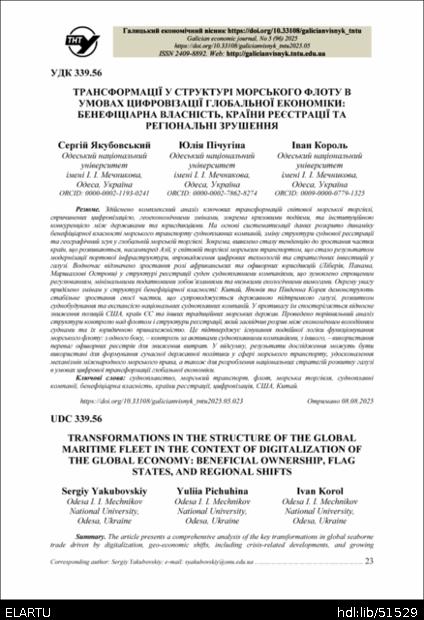
| dc.description.abstract | Здійснено комплексний аналіз ключових трансформацій світової морської торгівлі, спричинених цифровізацією, геоекономічними змінами, зокрема кризовими подіями, та інституційною конкуренцією між державами та юрисдикціями. На основі систематизації даних розкрито динаміку бенефіціарної власності морського транспорту судноплавних компаній, зміну структури суднової реєстрації та географічний зсув у глобальній морській торгівлі. Зокрема, виявлено сталу тенденцію до зростання частки країн, що розвиваються, насамперед Азії, у світовій торгівлі морським транспортом, що стало результатом модернізації портової інфраструктури, впровадження цифрових технологій та стратегічних інвестицій у галузі. Водночас відзначено зростання ролі африканських та офшорних юрисдикцій (Ліберія, Панама, Маршаллові Острови) у структурі реєстрації суден судноплавними компаніями, що зумовлено спрощеним регулюванням, мінімальними податковими зобов’язаннями та низькими екологічними вимогами. Окрему увагу приділено змінам у структурі бенефіціарної власності: Китай, Японія та Південна Корея демонструють стабільне зростання своєї частки, що супроводжується державною підтримкою галузі, розвитком суднобудування та експансією національних судноплавних компаній. У противагу їм спостерігається відносне зниження позицій США, країн ЄС та інших традиційних морських держав. Проведено порівняльний аналіз структури контролю над флотом і структури реєстрації, який засвідчив розрив між економічним володінням суднами та їх юридичною приналежністю. Це підтверджує існування подвійної логіки функціонування морського флоту: з одного боку, – контроль за активами судноплавними компаніями, з іншого, – використання переваг офшорних реєстрів для зниження витрат. У підсумку, результати дослідження можуть бути використані для формування сучасної державної політики у сфері морського транспорту, удосконалення механізмів міжнародного морського права, а також для розроблення національних стратегій розвитку галузі в умовах цифрової трансформації глобальної економіки. | |
| dc.description.abstract | The article presents a comprehensive analysis of the key transformations in global seaborne trade driven by digitalization, geo-economic shifts, including crisis-related developments, and growing institutional competition among states and jurisdictions. By systematizing empirical data, the study explores the evolving dynamics of beneficial ownership in maritime transport, changes in ship registration structures, and the geographic reconfiguration of global seaborne trade. A clear trend has been identified: developing countries, particularly those in Asia, are steadily increasing their share in global seaborne trade. This shift is largely attributed to port infrastructure modernization, the integration of digital technologies, and strategic investments in the sector. At the same time, the growing role of African and offshore jurisdictions such as Liberia, Panama, and the Marshall Islands in ship registration is noted. This development is explained by simplified regulatory regimes, minimal tax obligations, and relatively lax environmental standards, which make these jurisdictions particularly attractive to shipping companies. The study pays special attention to shifts in beneficial ownership structures. China, Japan, and South Korea show consistent growth in their fleet ownership, backed by strong government support, an advanced shipbuilding industry, and the global expansion of their national shipping companies. In contrast, the United States, EU countries, and other traditional maritime nations are experiencing a relative decline in influence. A comparative analysis of fleet control and registration structures reveals a notable disconnect between economic ownership and legal registration of vessels. This highlights a dual logic within the global maritime system: on the one hand, shipping companies seek to maintain control over their assets, while on the other, they leverage offshore registries to minimize operational costs. Ultimately, the findings of this study can inform the development of contemporary national policies in maritime transport, improve mechanisms of international maritime law, and support the formulation of national strategies for sectoral development amid the ongoing digital transformation of the global economy. | |
| dc.format.extent | 23-32 | |
| dc.language.iso | uk | |
| dc.publisher | ТНТУ | |
| dc.publisher | TNTU | |
| dc.relation.ispartof | Галицький економічний вісник, 5 (96), 2025 | |
| dc.relation.ispartof | Galician economic journal, 5 (96), 2025 | |
| dc.relation.uri | https://doi.org/10.3390/jmse13040797 | |
| dc.relation.uri | https://doi.org/10.3390/jmse13050894 | |
| dc.relation.uri | https://doi.org/10.3389/fmars.2025.1576661 | |
| dc.relation.uri | https://arxiv.org/abs/2504.01393 | |
| dc.relation.uri | https://arxiv.org/abs/2506.15842 | |
| dc.relation.uri | https://doi.org/10.1145/3719027.3744816 | |
| dc.relation.uri | https://doi.org/10.33108/galicianvisnyk_tntu2025.03.016 | |
| dc.relation.uri | https://doi.org/10.32782/business-navigator.77-34 | |
| dc.relation.uri | https://unctadstat.unctad.org/datacentre/dataviewer/US.SeaborneTrade | |
| dc.relation.uri | https://unctadstat.unctad.org/datacentre/dataviewer/US.VesselValueByOwnership | |
| dc.relation.uri | https://unctadstat.unctad | |
| dc.relation.uri | https://unctadstat.unctad.org/datacentre/dataviewer/US.VesselValueByRegistration | |
| dc.subject | судноплавство | |
| dc.subject | морський транспорт | |
| dc.subject | флот | |
| dc.subject | морська торгівля | |
| dc.subject | судноплавні компанії | |
| dc.subject | бенефіціарна власність | |
| dc.subject | країни реєстрації | |
| dc.subject | цифровізація | |
| dc.subject | США | |
| dc.subject | Китай | |
| dc.subject | shipping | |
| dc.subject | maritime transport | |
| dc.subject | fleet | |
| dc.subject | seaborne trade | |
| dc.subject | shipping companies | |
| dc.subject | beneficial ownership | |
| dc.subject | flag states | |
| dc.subject | digitalization | |
| dc.subject | United States | |
| dc.subject | China | |
| dc.title | Трансформації у структурі морського флоту в умовах цифровізації глобальної економіки: бенефіціарна власність, країни реєстрації та регіональні зрушення | |
| dc.title.alternative | Transformations in the structure of the global maritime fleet in the context of digitalization of the global economy: beneficial ownership, flag states, and regional shifts | |
| dc.type | Article | |
| dc.rights.holder | © Тернопільський національний технічний університет імені Івана Пулюя, 2025 | |
| dc.coverage.placename | Тернопіль | |
| dc.coverage.placename | Ternopil | |
| dc.format.pages | 10 | |
| dc.subject.udc | 339.56 | |
| dc.relation.references | 1. Zeng F., Li Y., Lin H., Zhang W. Digital Transformation of Maritime Logistics: Exploring Trends in the Digitalization of the Maritime Industry. Journal of Marine Science and Engineering. 2025. Vol. 13. No. 4. P. 797. DOI: https://doi.org/10.3390/jmse13040797 | |
| dc.relation.references | 2. Ferrarini L., Filippopoulos Y., Lajic Z. Digital Transformation in the Shipping Industry: A Network‑Based Bibliometric Analysis. Journal of Marine Science and Engineering. 2025. Vol. 13. No. 5. P. 894. DOI: https://doi.org/10.3390/jmse13050894 | |
| dc.relation.references | 3. Jiangtao B., Yutong Y., Xinyun B. A. Comprehensive Review of Ship Emission Reduction Technologies for Sustainable Maritime Transport. Frontiers in Marine Science. 2025. Vol. 12. P. 1576661. DOI: https://doi.org/10.3389/fmars.2025.1576661 | |
| dc.relation.references | 4. Arnaoot H. M. Navigating the Uncharted Waters: A Gradual Approach to the Certification and Integration of Maritime Autonomous Surface Ships (MASS) in Global Maritime Operations. arXiv preprint. URL: https://arxiv.org/abs/2504.01393 (дата звернення: 5.07.2025) | |
| dc.relation.references | 5. Raymaker A., Evans J., Mahoney R. A. Sea of Cyber Threats: Maritime Cybersecurity from the Perspective of Mariners. arXiv preprint. URL: https://arxiv.org/abs/2506.15842 (дата звернення: 8.07.2025). DOI: https://doi.org/10.1145/3719027.3744816 | |
| dc.relation.references | 6. Алексєєвська Г., Якубовський С., Пічугіна Ю. Зростання вартості морських перевезень як чинник глобальних інфляційних процесів. Галицький економічний вісник. 2025. Вип. 94. № 3. С. 16–28. DOI: https://doi.org/10.33108/galicianvisnyk_tntu2025.03.016 | |
| dc.relation.references | 7. Пічугіна Ю. В., Алексєєвська Г. С., Кочарян В. Г. Глобальні тенденції розвитку морського транспорту. Бізнес-навігатор. 2024. № 77. С. 34. DOI: https://doi.org/10.32782/business-navigator.77-34 | |
| dc.relation.references | 8. UNCTADstat. International Maritime Trade – Seaborne Trade. UNCTADstat Data Centre. URL: https://unctadstat.unctad.org/datacentre/dataviewer/US.SeaborneTrade (дата звернення: 15.07.2025). | |
| dc.relation.references | 9. UNCTADstat. Vessel Value by Beneficial Ownership. UNCTADstat Data Centre. URL: https://unctadstat.unctad.org/datacentre/dataviewer/US.VesselValueByOwnership (дата звернення: 15.07.2025). | |
| dc.relation.references | 10. UNCTADstat. Vessel Value by Registration. UNCTADstat Data Centre. URL: https://unctadstat.unctad. org/datacentre/dataviewer/US.VesselValueByRegistration (дата звернення: 18.07.2025). | |
| dc.relation.referencesen | 1. Zeng F., Li Y., Lin H., Zhang W. (2025) Digital Transformation of Maritime Logistics: Exploring Trends in the Digitalization of the Maritime Industry. Journal of Marine Science and Engineering, vol. 13, no. 4, pp. 797. DOI: https://doi.org/10.3390/jmse13040797 | |
| dc.relation.referencesen | 2. Ferrarini L., Filippopoulos Y., Lajic Z. (2025) Digital Transformation in the Shipping Industry: A Network‑Based Bibliometric Analysis. Journal of Marine Science and Engineering, vol. 13, No. 5, pp. 894. DOI: https://doi.org/10.3390/jmse13050894 | |
| dc.relation.referencesen | 3. Jiangtao B., Yutong Y., Xinyun B. A. (2025) Comprehensive Review of Ship Emission Reduction Technologies for Sustainable Maritime Transport. Frontiers in Marine Science, vol. 12, pp. 1576661. DOI: https://doi.org/10.3389/fmars.2025.1576661 | |
| dc.relation.referencesen | 4. Arnaoot H. M. (2025) Navigating the Uncharted Waters: A Gradual Approach to the Certification and Integration of Maritime Autonomous Surface Ships (MASS) in Global Maritime Operations. arXiv preprint. Available at: https://arxiv.org/abs/2504.01393 (accessed: 8 July 2025). | |
| dc.relation.referencesen | 5. Raymaker A., Evans J., Mahoney R. A. (2025) Sea of Cyber Threats: Maritime Cybersecurity from the Perspective of Mariners. arXiv preprint. Available at: https://arxiv.org/abs/2506.15842 (accessed: 8 July 2025). DOI: https://doi.org/10.1145/3719027.3744816 | |
| dc.relation.referencesen | 6. Alekseievska H., Yakubovskiy S., Pichuhina Yu. (2025) Zrostannia vartosti morskykh perevezenʹ yak chynnyk hlobalʹnykh infliatsiinykh protsesiv [The rising cost of maritime transport as a driver of global inflationary processes]. Halytsʹkyi ekonomichnyi visnyk, vol. 94, no., 3, pp. 16–28. DOI: https://doi.org/10.33108/galicianvisnyk_tntu2025.03.016 | |
| dc.relation.referencesen | 7. Pichuhina Yu. V., Alekseievska H. S., Kocharian V. H. (2024) Hlobalni tendentsii rozvytku morskoho transportu [Global Trends in the Development of Maritime Transport]. Biznes-navigator [Business Navigator], no. 77, pp. 34. DOI: https://doi.org/10.32782/business-navigator.77-34 | |
| dc.relation.referencesen | 8. UNCTADstat. International Maritime Trade – Seaborne Trade. UNCTADstat Data Centre. Available at: https://unctadstat.unctad.org/datacentre/dataviewer/US.SeaborneTrade (accessed: 15 July 2025). | |
| dc.relation.referencesen | 9. UNCTADstat. Vessel Value by Beneficial Ownership. UNCTADstat Data Centre. Available at: https://unctadstat.unctad.org/datacentre/dataviewer/US.VesselValueByOwnership (accessed: 15 July 2025). | |
| dc.relation.referencesen | 10. UNCTADstat. Vessel Value by Registration. UNCTADstat Data Centre. Available at: https://unctadstat.unctad.org/datacentre/dataviewer/US.VesselValueByRegistration (accessed: 15 July 2025). | |
| dc.identifier.doi | https://doi.org/10.33108/galicianvisnyk_tntu2025.05.023 | |
| dc.contributor.affiliation | Одеський національний університет імені І. І. Мечникова, Одеса, Україна | |
| dc.contributor.affiliation | Odesa I. I. Mechnikov National University, Odesa, Ukraine | |
| dc.citation.journalTitle | Галицький економічний вісник | |
| dc.citation.volume | 96 | |
| dc.citation.issue | 5 | |
| dc.citation.spage | 23 | |
| dc.citation.epage | 32 | |
| dc.identifier.citation2015 | Якубовський С. О., Король І. О. Трансформації у структурі морського флоту в умовах цифровізації глобальної економіки: бенефіціарна власність, країни реєстрації та регіональні зрушення // ГЕВ, Тернопіль. 2025. Том 96. № 5. С. 23–32. | |
| dc.identifier.citationenAPA | Yakubovskiy, S., Pichuhina, Y., & Korol, I. (2025). Transformatsii u strukturi morskoho flotu v umovakh tsyfrovizatsii hlobalnoi ekonomiky: benefitsiarna vlasnist, krainy reiestratsii ta rehionalni zrushennia [Transformations in the structure of the global maritime fleet in the context of digitalization of the global economy: beneficial ownership, flag states, and regional shifts]. Galician economic journal, 96(5), 23-32. TNTU. [in Ukrainian]. | |
| dc.identifier.citationenCHICAGO | Yakubovskiy S., Pichuhina Y., Korol I. (2025) Transformatsii u strukturi morskoho flotu v umovakh tsyfrovizatsii hlobalnoi ekonomiky: benefitsiarna vlasnist, krainy reiestratsii ta rehionalni zrushennia [Transformations in the structure of the global maritime fleet in the context of digitalization of the global economy: beneficial ownership, flag states, and regional shifts]. Galician economic journal (Tern.), vol. 96, no 5, pp. 23-32 [in Ukrainian]. | |
| Розташовується у зібраннях: | Галицький економічний вісник, 2025, № 5 (96) | |
Файли цього матеріалу:
| Файл | Опис | Розмір | Формат | |
|---|---|---|---|---|
| GEJ_2025v96n5_Yakubovskiy_S-Transformations_in_the_23-32.pdf | 3,19 MB | Adobe PDF | Переглянути/відкрити | |
| GEJ_2025v96n5_Yakubovskiy_S-Transformations_in_the_23-32__COVER.png | 1,31 MB | image/png | Переглянути/відкрити |
Усі матеріали в архіві електронних ресурсів захищені авторським правом, всі права збережені.