
Будь ласка, використовуйте цей ідентифікатор, щоб цитувати або посилатися на цей матеріал:
http://elartu.tntu.edu.ua/handle/lib/51524
Повний запис метаданих
| Поле DC | Значення | Мова |
|---|---|---|
| dc.contributor.author | Летуновська, Наталія Євгенівна | |
| dc.contributor.author | Бондаренко, Амелія Русланівна | |
| dc.contributor.author | Letunovska, Nataliia | |
| dc.contributor.author | Bondarenko, Ameliia | |
| dc.date.accessioned | 2026-02-16T06:51:55Z | - |
| dc.date.available | 2026-02-16T06:51:55Z | - |
| dc.date.created | 2025-10-28 | |
| dc.date.issued | 2025-10-28 | |
| dc.date.submitted | 2025-08-24 | |
| dc.identifier.citation | Летуновська Н. Є. Дослідження емоційних реакцій та психологічних обмежень споживачів на ринку туристичних послуг / Летуновська Наталія Євгенівна, Бондаренко Амелія Русланівна // ГЕВ. — Т. : ТНТУ, 2025. — Том 96. — № 5. — С. 234–240. — (Маркетинг). | |
| dc.identifier.issn | 2409-8892 | |
| dc.identifier.uri | http://elartu.tntu.edu.ua/handle/lib/51524 | - |
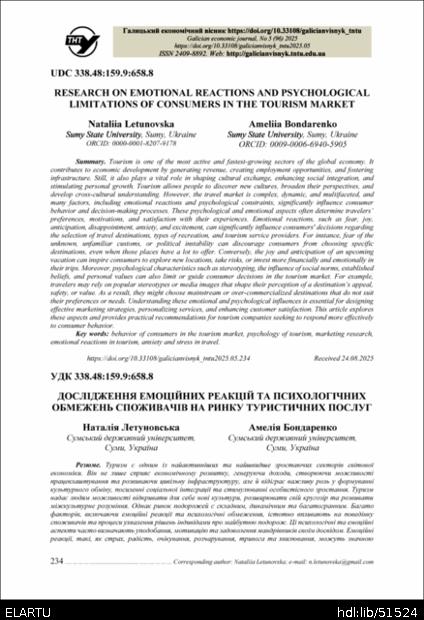
| dc.description.abstract | Туризм є одним із найактивніших та найшвидше зростаючих секторів світової економіки. Він не лише сприяє економічному розвитку, генеруючи доходи, створюючи можливості працевлаштування та розвиваючи цивільну інфраструктуру, але й відіграє важливу роль у формуванні культурного обміну, посиленні соціальної інтеграції та стимулюванні особистісного зростання. Туризм надає людям можливості відкривати для себе нові культури, розширювати свій кругозір та розвивати міжкультурне розуміння. Однак ринок подорожей є складним, динамічним та багатогранним. Багато факторів, включаючи емоційні реакції та психологічні обмеження, істотно впливають на поведінку споживачів та процеси ухвалення рішень індивідами про майбутню подорож. Ці психологічні та емоційні аспекти часто визначають уподобання, мотивацію та задоволення мандрівників своїм досвідом. Емоційні реакції, такі, як страх, радість, очікування, розчарування, тривога та хвилювання, можуть значною мірою впливати на рішення споживачів щодо вибору туристичних напрямків, видів відпочинку та постачальників туристичних послуг. Наприклад, страх перед невідомим, незнайомі звичаї або політична нестабільність можуть перешкодити споживачам вибирати певні напрямки, навіть коли ці місця мають багато чого запропонувати. І навпаки, радість та очікування майбутньої відпустки можуть надихнути споживачів досліджувати нові місця, ризикувати або інвестувати більше фінансово та емоційно у свої подорожі. Більше того, психологічні характеристики, такі, як стереотипи, вплив соціальних норм, усталені переконання та особисті цінності також можуть обмежувати або спрямовувати рішення споживачів на туристичному ринку. Наприклад, мандрівники можуть покладатися на популярні стереотипи або медіа-образи, які формують їхнє сприйняття привабливості, безпеки чи цінності місця призначення. Як результат, вони можуть обирати популярні або надмірно комерціалізовані напрямки, які насправді не відповідають їхнім уподобанням чи потребам. Розуміння цих емоційних та психологічних впливів є важливим для розроблення ефективних маркетингових стратегій, персоналізації послуг та підвищення задоволеності клієнтів. У цій статті досліджуються ці аспекти та надаються практичні рекомендації для туристичних компаній, які прагнуть ефективніше реагувати на поведінку споживачів. | |
| dc.description.abstract | Tourism is one of the most active and fastest-growing sectors of the global economy. It contributes to economic development by generating revenue, creating employment opportunities, and fostering infrastructure. Still, it also plays a vital role in shaping cultural exchange, enhancing social integration, and stimulating personal growth. Tourism allows people to discover new cultures, broaden their perspectives, and develop cross-cultural understanding. However, the travel market is complex, dynamic, and multifaceted, and many factors, including emotional reactions and psychological constraints, significantly influence consumer behavior and decision-making processes. These psychological and emotional aspects often determine travelers’ preferences, motivations, and satisfaction with their experiences. Emotional reactions, such as fear, joy, anticipation, disappointment, anxiety, and excitement, can significantly influence consumersʼ decisions regarding the selection of travel destinations, types of recreation, and tourism service providers. For instance, fear of the unknown, unfamiliar customs, or political instability can discourage consumers from choosing specific destinations, even when those places have a lot to offer. Conversely, the joy and anticipation of an upcoming vacation can inspire consumers to explore new locations, take risks, or invest more financially and emotionally in their trips. Moreover, psychological characteristics such as stereotyping, the influence of social norms, established beliefs, and personal values can also limit or guide consumer decisions in the tourism market. For example, travelers may rely on popular stereotypes or media images that shape their perception of a destination’s appeal, safety, or value. As a result, they might choose mainstream or over-commercialized destinations that do not suit their preferences or needs. Understanding these emotional and psychological influences is essential for designing effective marketing strategies, personalizing services, and enhancing customer satisfaction. This article explores these aspects and provides practical recommendations for tourism companies seeking to respond more effectively to consumer behavior. | |
| dc.format.extent | 234-240 | |
| dc.language.iso | uk | |
| dc.publisher | ТНТУ | |
| dc.publisher | TNTU | |
| dc.relation.ispartof | Галицький економічний вісник, 5 (96), 2025 | |
| dc.relation.ispartof | Galician economic journal, 5 (96), 2025 | |
| dc.relation.uri | https://news.finance.ua/ua/industriya-turyzmu-zrobyt-rekordnyy-vnesok-u-svitovyy-vvp-u-2024-roci | |
| dc.relation.uri | https://lpnu.ua/sites/default/files/2023/pages/24673/zbirnik-tez-ii-mnpk-15-16052025.pdf | |
| dc.relation.uri | https://doi.org/10.2307/2552647 | |
| dc.relation.uri | https://doi.org/10.1177/0047287504272017 | |
| dc.relation.uri | https://doi.org/10.1177/009182966000700405 | |
| dc.relation.uri | https://doi.org/10.1016/j.annals.2008.10.001 | |
| dc.relation.uri | https://link | |
| dc.relation.uri | https://doi.org/10.1007/978-3-642-39253-5_23 | |
| dc.relation.uri | https://doi.org/10.1016/j.tourman.2020.104164 | |
| dc.relation.uri | https://doi.org/10.1521/pedi.1992.6.4.343 | |
| dc.relation.uri | https://doi.org/10.35774/visnyk2021.03.098 | |
| dc.relation.uri | https://doi.org/10.3390/su13158145 | |
| dc.relation.uri | https://doi.org/10.3390/economies12100281 | |
| dc.relation.uri | https://link.springer.com/chapter/10.1007/978-3-642-39253-5_23 | |
| dc.subject | поведінка споживачів на туристичному ринку | |
| dc.subject | психологія туризму | |
| dc.subject | маркетингове дослідження | |
| dc.subject | емоційні реакції туристів | |
| dc.subject | тривога та стрес під час подорожей | |
| dc.subject | behavior of consumers in the tourism market | |
| dc.subject | psychology of tourism | |
| dc.subject | marketing research | |
| dc.subject | emotional reactions in tourism | |
| dc.subject | anxiety and stress in travel | |
| dc.title | Дослідження емоційних реакцій та психологічних обмежень споживачів на ринку туристичних послуг | |
| dc.title.alternative | Research on emotional reactions and psychological limitations of consumers in the tourism market | |
| dc.type | Article | |
| dc.rights.holder | © Тернопільський національний технічний університет імені Івана Пулюя, 2025 | |
| dc.coverage.placename | Тернопіль | |
| dc.coverage.placename | Ternopil | |
| dc.format.pages | 7 | |
| dc.subject.udc | 338.48 | |
| dc.subject.udc | 159.9 | |
| dc.subject.udc | 658.8 | |
| dc.relation.references | 1. Індустрія туризму зробить рекордний внесок у світовий ВВП у 2024 році. URL: https://news.finance.ua/ua/industriya-turyzmu-zrobyt-rekordnyy-vnesok-u-svitovyy-vvp-u-2024-roci (дата звернення: 24 серпня 2025) | |
| dc.relation.references | 2. Коваль С. Роль нейромаркетингу у відновленні довіри до туристичної галузі України. Виклики для туристичного бізнесу в Україні: європейська практика : тези доп. ІІ Міжнар. наук.-практ. конф. Львів: Растр-7, 2025. С. 161–162. URL: https://lpnu.ua/sites/default/files/2023/pages/24673/zbirnik-tez-ii-mnpk-15-16052025.pdf (дата звернення: 23 серпня 2025). | |
| dc.relation.references | 3. Cohen E. Toward a sociology of international tourism. Political Economics. 1972. No. 39 (1). P. 164–182. DOI: https://doi.org/10.2307/2552647 | |
| dc.relation.references | 4. Reisinger Y., Mavondo F. Travel anxiety and intentions to travel internationally: Implications of travel risk perception. Journal of Travel Research. 2005. Vol. 43 (3). DOI: https://doi.org/10.1177/0047287504272017 | |
| dc.relation.references | 5. Oberg K. Culture shock and the problem of adjustment to new cultural environments. Practical Anthropology. 1960. Vol. 7 (4). P. 177–182. DOI: https://doi.org/10.1177/009182966000700405 | |
| dc.relation.references | 6. Ward C., Bochner S., Furnham A. The psychology of culture shock. London: Routledge, 2001. | |
| dc.relation.references | 7. Tussyadiah I. P., Fesenmaier D. R. Mediating tourist experiences: Access to places via shared videos. Annals of Tourism Research. 2009. Vol. 36 (1). P. 24–40. DOI: https://doi.org/10.1016/j.annals.2008.10.001 | |
| dc.relation.references | 8. Kim J., Fesenmaier D. R., Johnson S. L. The effect of feedback within social media on tourism experiences. International Conference of Design, user experience, and usability. 2013. P. 212–220. URL: https://link. springer.com/chapter/10.1007/978-3-642-39253-5_23 (дата звернення: 22 серпня 2025). DOI:https://doi.org/10.1007/978-3-642-39253-5_23 | |
| dc.relation.references | 9. Zenker S., Kock F. The coronavirus pandemic – A critical discussion of a tourism research agenda. Tourism Management. 2020. Vol. 81. 104164. DOI: https://doi.org/10.1016/j.tourman.2020.104164 | |
| dc.relation.references | 10. Rahmanov F., Letunovska N., Lyulyov O. Marketing of social tourism. 55th International Scientific Conference on Economic and Social Development (Baku 18–19 June 2020). P. 147–160. | |
| dc.relation.references | 11. Costa P. T., McCrae R. R. The Five‑Factor Model of Personality and its relevance to personality disorders. Journal of Personality Disorders. 1992. No. 6( 4). P. 343–359. DOI: https://doi.org/10.1521/pedi.1992.6.4.343 | |
| dc.relation.references | 12. Росохата А., Летуновська Н., Макерська В., Кропива В. Поведінка споживачів у цифровому середовищі під впливом пандемії COVID-19: важливість фактору здоровʼя та транспарентності бізнесу. Вісник економіки. 2021. № 3. С. 98–109. DOI: https://doi.org/10.35774/visnyk2021.03.098 | |
| dc.relation.references | 13. Kuzior A., Lyulyov O., Pimonenko T., Kwilinski A., Krawczyk D. Post-industrial tourism as a driver of sustainable development. Sustainability 2021. 13. 8145. DOI: https://doi.org/10.3390/su13158145 | |
| dc.relation.references | 14. Konstantopoulou Ch., Sotirios V., Panagiotis L. Well-being and tourism: A systematic literature review. Economies. 2024. Vol. 12. 281. DOI: https://doi.org/10.3390/economies12100281 | |
| dc.relation.referencesen | 1. The tourism industry will significantly contribute to global GDP in 2024. Available at: https://news.finance.ua/ua/industriya-turyzmu-zrobyt-rekordnyy-vnesok-u-svitovyy-vvp-u-2024-roci (accessed: 24 August 2025). (In Ukrainian). | |
| dc.relation.referencesen | 2. Koval S. (2025). The role of neuromarketing in restoring trust in the tourism industry of Ukraine. Abstracts of the reports of the II International Scientific and Practical Conference “Challenges for the tourism business in Ukraine: European practice”. Lviv: Rastr-7. pp. 161–162. Available at: https://lpnu.ua/sites/default/files/2023/pages/24673/zbirnik-tez-ii-mnpk-15-16052025.pdf (in Ukrainian) (accessed: 23 August 2025). | |
| dc.relation.referencesen | 3. Cohen E. (1972) Toward a sociology of international tourism. Political Economics, vol. 39 (1), pp. 164–182. DOI: https://doi.org/10.2307/2552647 | |
| dc.relation.referencesen | 4. Reisinger Y., Mavondo F. (2005) Travel anxiety and intentions to travel internationally: Implications of travel risk perception. Journal of Travel Research, vol. 43 (3). DOI: https://doi.org/10.1177/0047287504272017 | |
| dc.relation.referencesen | 5. Oberg K. (1960) Culture shock and the problem of adjustment to new cultural environments. Practical Anthropology, vol. 7 (4), pp. 177–182. DOI: https://doi.org/10.1177/009182966000700405 | |
| dc.relation.referencesen | 6. Ward C., Bochner S., Furnham A. (2001). The psychology of culture shock. London: Routledge | |
| dc.relation.referencesen | 7. Tussyadiah I. P., Fesenmaier D. R. (2009) Mediating tourist experiences: Access to places via shared videos. Annals of Tourism Research, vol. 36 (1), pp. 24–40. DOI: https://doi.org/10.1016/j.annals.2008.10.001 | |
| dc.relation.referencesen | 8. Kim J., Fesenmaier D. R., Johnson S. L. (2013). The effect of feedback within social media on tourism experiences. International Conference of Design, user experience, and usability, pp. 212–220. Available at: https://link.springer.com/chapter/10.1007/978-3-642-39253-5_23 (accessed: 22 August 2025). DOI: https://doi.org/10.1007/978-3-642-39253-5_23 | |
| dc.relation.referencesen | 9. Zenker S., Kock F. (2020) The coronavirus pandemic – A critical discussion of a tourism research agenda. Tourism Management, vol. 81. 104164. DOI: https://doi.org/10.1016/j.tourman.2020.104164 | |
| dc.relation.referencesen | 10. Rahmanov F., Letunovska N., Lyulyov O. (2020). Marketing of social tourism. 55th International Scientific Conference on Economic and Social Development, pp. 147–160. | |
| dc.relation.referencesen | 11. Costa P. T., McCrae R. R. (1992) The five‑factor model of personality and its relevance to personality disorders. Journal of Personality Disorders, no. 6 (4), рр. 343–359. DOI: https://doi.org/10.1521/pedi.1992.6.4.343 | |
| dc.relation.referencesen | 12. Rosokhata А., Letunovska N., Makerska V., Kropyva V. (2021) Consumer behavior in the digital environment under the influence of the COVID-19 pandemic: the importance of the health factor and business transparency. Economic Bulletin, no. 3, pp. 98–109. DOI: https://doi.org/10.35774/visnyk2021.03.098 | |
| dc.relation.referencesen | 13. Kuzior A., Lyulyov O., Pimonenko T., Kwilinski A., Krawczyk D. (2021) Post-industrial tourism as a driver of sustainable development. Sustainability, no. 13. 8145. DOI: https://doi.org/10.3390/su13158145 | |
| dc.relation.referencesen | 14. Konstantopoulou Ch., Sotirios V., Panagiotis L. (2024) Well-being and tourism: A systematic literature review. Economies, no. 12. 281. DOI: https://doi.org/10.3390/economies12100281 | |
| dc.identifier.doi | https://doi.org/10.33108/galicianvisnyk_tntu2025.05.234 | |
| dc.contributor.affiliation | Сумський державний університет, Суми, Україна | |
| dc.contributor.affiliation | Sumy State University, Sumy, Ukraine | |
| dc.citation.journalTitle | Галицький економічний вісник | |
| dc.citation.volume | 96 | |
| dc.citation.issue | 5 | |
| dc.citation.spage | 234 | |
| dc.citation.epage | 240 | |
| dc.identifier.citation2015 | Летуновська Н. Є., Бондаренко А. Р. Дослідження емоційних реакцій та психологічних обмежень споживачів на ринку туристичних послуг // ГЕВ, Тернопіль. 2025. Том 96. № 5. С. 234–240. | |
| dc.identifier.citationenAPA | Letunovska, N., & Bondarenko, A. (2025). Doslidzhennia emotsiinykh reaktsii ta psykholohichnykh obmezhen spozhyvachiv na rynku turystychnykh posluh [Research on emotional reactions and psychological limitations of consumers in the tourism market]. Galician economic journal, 96(5), 234-240. TNTU. [in Ukrainian]. | |
| dc.identifier.citationenCHICAGO | Letunovska N., Bondarenko A. (2025) Doslidzhennia emotsiinykh reaktsii ta psykholohichnykh obmezhen spozhyvachiv na rynku turystychnykh posluh [Research on emotional reactions and psychological limitations of consumers in the tourism market]. Galician economic journal (Tern.), vol. 96, no 5, pp. 234-240 [in Ukrainian]. | |
| Розташовується у зібраннях: | Галицький економічний вісник, 2025, № 5 (96) | |
Файли цього матеріалу:
| Файл | Опис | Розмір | Формат | |
|---|---|---|---|---|
| GEJ_2025v96n5_Letunovska_N-Research_on_emotional_234-240.pdf | 2,31 MB | Adobe PDF | Переглянути/відкрити | |
| GEJ_2025v96n5_Letunovska_N-Research_on_emotional_234-240__COVER.png | 1,36 MB | image/png | Переглянути/відкрити |
Усі матеріали в архіві електронних ресурсів захищені авторським правом, всі права збережені.