
Будь ласка, використовуйте цей ідентифікатор, щоб цитувати або посилатися на цей матеріал:
http://elartu.tntu.edu.ua/handle/lib/51520
Повний запис метаданих
| Поле DC | Значення | Мова |
|---|---|---|
| dc.contributor.author | Юрша, Олег Михайлович | |
| dc.contributor.author | Мельник, Лілія Миколаївна | |
| dc.contributor.author | Yursha, Oleh | |
| dc.contributor.author | Melnyk, Liliya | |
| dc.date.accessioned | 2026-02-16T06:51:55Z | - |
| dc.date.available | 2026-02-16T06:51:55Z | - |
| dc.date.created | 2025-10-28 | |
| dc.date.issued | 2025-10-28 | |
| dc.date.submitted | 2025-09-16 | |
| dc.identifier.citation | Юрша О. М. Методології управління проєктами як інструменти реалізації стратегії підприємства / Юрша Олег Михайлович, Мельник Лілія Миколаївна // ГЕВ. — Т. : ТНТУ, 2025. — Том 96. — № 5. — С. 193–202. — (Менеджмент). | |
| dc.identifier.issn | 2409-8892 | |
| dc.identifier.uri | http://elartu.tntu.edu.ua/handle/lib/51520 | - |
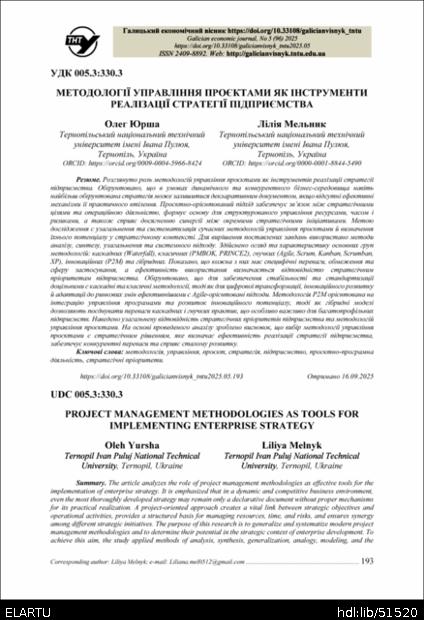
| dc.description.abstract | Розглянуто роль методологій управління проєктами як інструментів реалізації стратегії підприємства. Обґрунтовано, що в умовах динамічного та конкурентного бізнес-середовища навіть найбільш обґрунтована стратегія може залишитися декларативним документом, якщо відсутні ефективні механізми її практичного втілення. Проєктно-орієнтований підхід забезпечує зв’язок між стратегічними цілями та операційною діяльністю, формує основу для структурованого управління ресурсами, часом і ризиками, а також сприяє досягненню синергії між окремими стратегічними ініціативами. Метою дослідження є узагальнення та систематизація сучасних методологій управління проєктами й визначення їхнього потенціалу у стратегічному контексті. Для вирішення поставлених завдань використано методи аналізу, синтезу, узагальнення та системного підходу. Здійснено огляд та характеристику основних груп методологій: каскадних (Waterfall), класичних (PMBOK, PRINCE2), гнучких (Agile, Scrum, Kanban, Scrumban, XP), інноваційних (P2M) та гібридних. Показано, що кожна з них має специфічні переваги, обмеження та сферу застосування, а ефективність використання визначається відповідністю стратегічним пріоритетам підприємства. Обґрунтовано, що для забезпечення стабільності та стандартизації доцільними є каскадні та класичні методології, тоді як для цифрової трансформації, інноваційного розвитку й адаптації до ринкових змін ефективнішими є Agile-орієнтовані підходи. Методологія P2M орієнтована на інтеграцію управління програмами та розвиток інноваційного потенціалу, тоді як гібридні моделі дозволяють поєднувати переваги каскадних і гнучких практик, що особливо важливо для багатопрофільних підприємств. Наведено узагальнену відповідність стратегічних пріоритетів підприємства та методологій управління проєктами. На основі проведеного аналізу зроблено висновок, що вибір методології управління проєктами є стратегічним рішенням, яке визначає ефективність реалізації стратегії підприємства, забезпечує конкурентні переваги та сприяє сталому розвитку. | |
| dc.description.abstract | The article analyzes the role of project management methodologies as effective tools for the implementation of enterprise strategy. It is emphasized that in a dynamic and competitive business environment, even the most thoroughly developed strategy may remain only a declarative document without proper mechanisms for its practical realization. A project-oriented approach creates a vital link between strategic objectives and operational activities, provides a structured basis for managing resources, time, and risks, and ensures synergy among different strategic initiatives. The purpose of this research is to generalize and systematize modern project management methodologies and to determine their potential in the strategic context of enterprise development. To achieve this aim, the study applied methods of analysis, synthesis, generalization, analogy, modeling, and the systems approach. The paper provides a comprehensive overview and characteristics of the main groups of project management methodologies: traditional (Waterfall), classical (PMBOK, PRINCE2), agile-oriented (Agile, Scrum, Kanban, Scrumban, XP), innovative (P2M), and hybrid. It is shown that each methodology has specific advantages, limitations, and areas of application, while the effectiveness of its use depends on alignment with the strategic priorities of the enterprise. Traditional and classical methodologies are considered more appropriate for ensuring stability, standardization, and operational efficiency. Agile-oriented approaches are more effective in conditions of digital transformation, innovative growth, and rapid adaptation to market changes. The innovative P2M methodology focuses on the integration of program management and the enhancement of innovation potential at the corporate level, while hybrid models combine the benefits of traditional and agile practices, which is particularly important for diversified enterprises. The article also presents a generalized correspondence between strategic priorities and project management methodologies. The study concludes that the choice of a project management methodology should be viewed as a strategic decision that not only determines the effectiveness of enterprise strategy implementation but also ensures competitive advantages, supports innovative capacity, and contributes to long-term sustainable development. | |
| dc.format.extent | 193-202 | |
| dc.language.iso | uk | |
| dc.publisher | ТНТУ | |
| dc.publisher | TNTU | |
| dc.relation.ispartof | Галицький економічний вісник, 5 (96), 2025 | |
| dc.relation.ispartof | Galician economic journal, 5 (96), 2025 | |
| dc.relation.uri | https://doi.org/10.32347/2412-9933.2021.45.21-26 | |
| dc.relation.uri | https://doi.org/10.20998/2519-4461.2021.4.60 | |
| dc.relation.uri | https://doi.org/10.32782/2308-1988/2024-50-4 | |
| dc.relation.uri | https://doi.org/10.31558/2307-2318.2022.2.14 | |
| dc.relation.uri | https://doi.org/10.37634/efp.2022.5(2).3 | |
| dc.relation.uri | https://doi.org/10.26642/ema-2023-4(106)-26-32 | |
| dc.relation.uri | https://doi.org/10.30838/EP.196.278-283 | |
| dc.relation.uri | https://doi.org/10.1108/17538370810846414 | |
| dc.relation.uri | https://doi.org/10.21158/01208160.n0.2018.2016 | |
| dc.relation.uri | https://doi.org/10.51599/is.2016.02.02.31 | |
| dc.relation.uri | https://doi.org/10.1016/j.ijproman.2010.06.007 | |
| dc.subject | методологія | |
| dc.subject | управління | |
| dc.subject | проєкт | |
| dc.subject | стратегія | |
| dc.subject | підприємство | |
| dc.subject | проєктно-програмна діяльність | |
| dc.subject | стратегічні пріоритети | |
| dc.subject | methodology | |
| dc.subject | management | |
| dc.subject | project | |
| dc.subject | strategy | |
| dc.subject | enterprise | |
| dc.subject | project and programme activities | |
| dc.subject | strategic priorities | |
| dc.title | Методології управління проєктами як інструменти реалізації стратегії підприємства | |
| dc.title.alternative | Project management methodologies as tools for implementing enterprise strategy | |
| dc.type | Article | |
| dc.rights.holder | © Тернопільський національний технічний університет імені Івана Пулюя, 2025 | |
| dc.coverage.placename | Тернопіль | |
| dc.coverage.placename | Ternopil | |
| dc.format.pages | 10 | |
| dc.subject.udc | 005.3 | |
| dc.subject.udc | 330.3 | |
| dc.relation.references | 1. Бушуєв С. Д., Бушуєв Д. А., Бушуєва В. Б., Веренич О. В. Управління проєктами в умовах переходу до циркулярної економіки. Управління розвитком складних систем. 2021. № 45. С. 21–26. DOI: https://doi.org/10.32347/2412-9933.2021.45.21-26 | |
| dc.relation.references | 2. Лінькова О., Пікалова Ю. Проблеми управління проектами на підприємстві. Вісник Національного технічного університету «Харківський політехнічний інститут» (економічні науки). 2024. Вип. 4. С. 60–64. DOI: https://doi.org/10.20998/2519-4461.2021.4.60 | |
| dc.relation.references | 3. Мартиняк І., Бакушевич І. Гібридні моделі управління проєктами в умовах сталого розвитку та цифрової економіки. Сталий розвиток економіки. 2024. № 3 (50). С. 21–26. DOI: https://doi.org/10.32782/2308-1988/2024-50-4 | |
| dc.relation.references | 4. Овецька О. В., Кукудяк Н. В. Управління проєктами: стан та перспективи розвитку підприємства. Економіка i організація управління. 2022. № 2 (46). С. 139–147. DOI: https://doi.org/10.31558/2307-2318.2022.2.14 | |
| dc.relation.references | 5. Сорока Л. М., Степанова К. В., Уманець Т. М. Стратегічне управління проєктами. Економіка. Фінанси. Право. 2022. № 5/2. С. 14–17. DOI: https://doi.org/10.37634/efp.2022.5(2).3 | |
| dc.relation.references | 6. Тарасюк Г. М. Розвиток проєктного менеджменту: основні методології та тренди. Економіка, управління та адміністрування. 2023. № 4 (106). С. 26–32. Doi: https://doi.org/10.26642/ema-2023-4(106)-26-32. | |
| dc.relation.references | 7. Хадарцев О. Система управління проєктами на підприємстві: засади ефективного формування. Економічний простір. 2024. № 196. С. 278–283. DOI: https://doi.org/10.30838/EP.196.278-283 | |
| dc.relation.references | 8. Artto K., Martinsuo M., Dietrich P., Kujala J. Project strategy: strategy types and their contents in innovation projects. International Journal of Managing Projects in Business. 2008. Vol. 1 (1). P. 49–70. DOI: https://doi.org/10.1108/17538370810846414 | |
| dc.relation.references | 9. Edwin Ferrer. Strategic project management: a methodology for sustainable competitive advantage. Revista Escuela de Administración de Negocios, Edición Especial. 2018. P. 15–31. DOI: https://doi.org/10.21158/01208160.n0.2018.2016 | |
| dc.relation.references | 10. Michael Bible, Susan Bivins. Mastering Project Portfolio Management: A Systems Approach to Achieving Strategic Objectives. J. Ross Publishing, 2011, 360 р. | |
| dc.relation.references | 11. Nedka Nikolova. Strategic Context of Project Portfolio Management. Journal of Innovations and Sustainability, June 2016. 2 (2). P. 31–43. DOI: https://doi.org/10.51599/is.2016.02.02.31 | |
| dc.relation.references | 12. Sascha Meskendahl. The influence of business strategy on project portfolio management and its success – A conceptual framework. International Journal of Project Management. Volume 28. Issue 8. December 2010. P. 807–817. DOI: https://doi.org/10.1016/j.ijproman.2010.06.007 | |
| dc.relation.references | 13. Wyrozębski Paweł. Project portfolio management as an effective mean to strategy implementation. Journal of Management and Financial Sciences. 2015. Vol. 8. No. 22. Р. 79–95. | |
| dc.relation.referencesen | 1. Bushuev S. D., Bushuev D. A., Bushueva V. B., Verenich O. V. (2021) Upravlinnja projektamy v umovakh perekhodu do cyrkuljarnoji ekonomiky[Project management in the transition to a circular economy]. Managing the development of complex systems [Management of the development of complex systems], vol. 45, pp. 21–26. DOI: https://doi.org/10.32347/2412-9933.2021.45.21-26 | |
| dc.relation.referencesen | 2. Lynkova O., Pikalo Y. (2024) Problemy upravlinnja proektamy na pidpryjemstvi [Project management problems at the enterprise]. Bulletin of the National Technical University “Kharkiv Polytechnic Institute” (economic sciences) [Bulletin of the National Technical University “Kharkiv Polytechnic Institute” (Economic Sciences)], issue 4, pp. 60–64. DOI: https://doi.org/10.20998/2519-4461.2021.4.60 | |
| dc.relation.referencesen | 3. Martyniak I., Bakushevych I. (2024) Ghibrydni modeli upravlinnja projektamy v umovakh stalogho rozvytku ta cyfrovoji ekonomiky [Hybrid project management models in the context of sustainable development and the digital economy]. Sustainable economic development [Sustainable economic development], vol. 3 (50), pp. 21–26. DOI: https://doi.org/10.32782/2308-1988/2024-50-4 | |
| dc.relation.referencesen | 4. Ovetska O. V., Kukudyak N. V. (2022) Upravlinnja projektamy: stan ta perspektyvy rozvytku pidpryjemstva [Project management: current status and prospects for the companyʼs development]. Economics and management organisation [Economy and management organization], vol. 2 (46), pp. 139–147. DOI: https://doi.org/10.31558/2307-2318.2022.2.14 | |
| dc.relation.referencesen | 5. Soroka L. M., Stepanova K. V., Umanets T. M. (2022) Strategic project management [Strateghichne upravlinnja projektamy]. Economics. Finance. Law. [Economy. Finance. Right.], no. 5/2, pp. 14–17. DOI: https://doi.org/10.37634/efp.2022.5(2).3 | |
| dc.relation.referencesen | 6. Tarasiuk H. M. (2023) Rozvytok projektnogho menedzhmentu: osnovni metodologhiji ta trendy [Development of project management: main methodologies and trends]. Economics, Management and Administration [Economics, management and administration.], no. 4 (106), pp. 26–32. Doi: https://doi.org/10.26642/ema-2023-4(106)-26-32. | |
| dc.relation.referencesen | 7. Khadartsev O. (2024) Systema upravlinnja projektamy na pidpryjemstvi: zasady efektyvnogho formuvannja [Project management system at an enterprise: principles of effective formation]. Economic Space [Economic space], no. 196, pp. 278–283. DOI: https://doi.org/10.30838/EP.196.278-283 | |
| dc.relation.referencesen | 8. Artto K., Martinsuo M., Dietrich P., Kujala J. (2008). Project strategy: strategy types and their contents in innovation projects. International Journal of Managing Projects in Business, vol. 1 (1), pp. 49–70. DOI: https://doi.org/10.1108/17538370810846414 | |
| dc.relation.referencesen | 9. Edwin Ferrer (2018). Strategic project management: a methodology for sustainable competitive advantage. Revista Escuela de Administración de Negocios. Edición Especial, pp. 15–31. DOI: https://doi.org/10.21158/01208160.n0.2018.2016 | |
| dc.relation.referencesen | 10. Michael Bible, Susan Bivins (2011). Mastering Project Portfolio Management: A Systems Approach to Achieving Strategic Objectives. J. Ross Publishing. 360 р. | |
| dc.relation.referencesen | 11. Nedka Nikolova (2016) Strategic Context of Project Portfolio Management. Journal of Innovations and Sustainability, 2 (2), pp. 31–43. DOI: https://doi.org/10.51599/is.2016.02.02.31 | |
| dc.relation.referencesen | 12. Sascha Meskendahl (2010) The influence of business strategy on project portfolio management and its success – A conceptual framework. International Journal of Project Management, vol. 28 (8), pp. 807–817. DOI: https://doi.org/10.1016/j.ijproman.2010.06.007 | |
| dc.relation.referencesen | 13. Wyrozębski Paweł (2015) Project portfolio management as an effective mean to strategy implementation. Journal of Management and Financial Sciences, vol. 8, no. 22, pp. 79-–95. | |
| dc.identifier.doi | https://doi.org/10.33108/galicianvisnyk_tntu2025.05.193 | |
| dc.contributor.affiliation | Тернопільський національний технічний університет імені Івана Пулюя, Тернопіль, Україна | |
| dc.contributor.affiliation | Ternopil Ivan Puluj National Technical University, Ternopil, Ukraine | |
| dc.citation.journalTitle | Галицький економічний вісник | |
| dc.citation.volume | 96 | |
| dc.citation.issue | 5 | |
| dc.citation.spage | 193 | |
| dc.citation.epage | 202 | |
| dc.identifier.citation2015 | Юрша О. М., Мельник Л. М. Методології управління проєктами як інструменти реалізації стратегії підприємства // ГЕВ, Тернопіль. 2025. Том 96. № 5. С. 193–202. | |
| dc.identifier.citationenAPA | Yursha, O., & Melnyk, L. (2025). Metodolohii upravlinnia proiektamy yak instrumenty realizatsii stratehii pidpryiemstva [Project management methodologies as tools for implementing enterprise strategy]. Galician economic journal, 96(5), 193-202. TNTU. [in Ukrainian]. | |
| dc.identifier.citationenCHICAGO | Yursha O., Melnyk L. (2025) Metodolohii upravlinnia proiektamy yak instrumenty realizatsii stratehii pidpryiemstva [Project management methodologies as tools for implementing enterprise strategy]. Galician economic journal (Tern.), vol. 96, no 5, pp. 193-202 [in Ukrainian]. | |
| Розташовується у зібраннях: | Галицький економічний вісник, 2025, № 5 (96) | |
Файли цього матеріалу:
| Файл | Опис | Розмір | Формат | |
|---|---|---|---|---|
| GEJ_2025v96n5_Yursha_O-Project_management_methodologies_193-202.pdf | 3,3 MB | Adobe PDF | Переглянути/відкрити | |
| GEJ_2025v96n5_Yursha_O-Project_management_methodologies_193-202__COVER.png | 1,34 MB | image/png | Переглянути/відкрити |
Усі матеріали в архіві електронних ресурсів захищені авторським правом, всі права збережені.