
Будь ласка, використовуйте цей ідентифікатор, щоб цитувати або посилатися на цей матеріал:
http://elartu.tntu.edu.ua/handle/lib/51514
| Назва: | Сучасні моделі та інструменти ухвалення управлінських рішень у сфері послуг |
| Інші назви: | Modern models and tools for managerial decision-making in the service sector |
| Автори: | Науменко, Юлія Миколаївна Крупський, Олександр Петрович Стасюк, Юлія Михайлівна Naumenko, Yuliia Krupskyi, Oleksandr Stasiuk, Yuliia |
| Приналежність: | Дніпровський національний університет імені Олеся Гончара, Дніпро, Україна Oles Honchar Dnipro National University, Dnipro, Ukraine |
| Бібліографічний опис: | Науменко Ю. М. Сучасні моделі та інструменти ухвалення управлінських рішень у сфері послуг / Науменко Юлія Миколаївна, Крупський Олександр Петрович, Стасюк Юлія Михайлівна // ГЕВ. — Т. : ТНТУ, 2025. — Том 96. — № 5. — С. 142–152. — (Менеджмент). |
| Бібліографічне посилання: | Науменко Ю. М., Стасюк Ю. М. Сучасні моделі та інструменти ухвалення управлінських рішень у сфері послуг // ГЕВ, Тернопіль. 2025. Том 96. № 5. С. 142–152. |
| Bibliographic citation (APA): | Naumenko, Y., Krupskyi, O., & Stasiuk, Y. (2025). Suchasni modeli ta instrumenty ukhvalennia upravlinskykh rishen u sferi posluh [Modern models and tools for managerial decision-making in the service sector]. Galician economic journal, 96(5), 142-152. TNTU. [in Ukrainian]. |
| Bibliographic citation (CHICAGO): | Naumenko Y., Krupskyi O., Stasiuk Y. (2025) Suchasni modeli ta instrumenty ukhvalennia upravlinskykh rishen u sferi posluh [Modern models and tools for managerial decision-making in the service sector]. Galician economic journal (Tern.), vol. 96, no 5, pp. 142-152 [in Ukrainian]. |
| Є частиною видання: | Галицький економічний вісник, 5 (96), 2025 Galician economic journal, 5 (96), 2025 |
| Журнал/збірник: | Галицький економічний вісник |
| Випуск/№ : | 5 |
| Том: | 96 |
| Дата публікації: | 28-жов-2025 |
| Дата подання: | 15-лип-2025 |
| Дата внесення: | 16-лют-2026 |
| Видавництво: | ТНТУ TNTU |
| Місце видання, проведення: | Тернопіль Ternopil |
| DOI: | https://doi.org/10.33108/galicianvisnyk_tntu2025.05.142 |
| УДК: | 658.3005.52 005.94 004.8 |
| Теми: | управлінське рішення сфера послуг моделі прийняття рішень цифрова трансформація штучний інтелект Big Data сервіс-дизайн гнучке управління стратегічне управління managerial decision-making service sector decision-making models digital transformation artificial intelligence Big Data. service design Agile management strategic management |
| Кількість сторінок: | 11 |
| Діапазон сторінок: | 142-152 |
| Початкова сторінка: | 142 |
| Кінцева сторінка: | 152 |
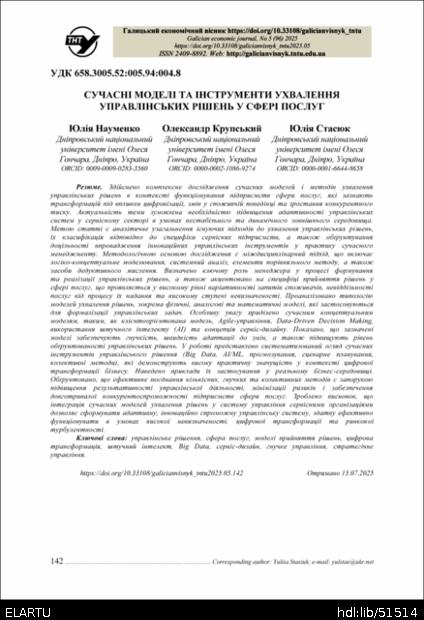
| Короткий огляд (реферат): | Здійснено комплексне дослідження сучасних моделей і методів ухвалення
управлінських рішень в контексті функціонування підприємств сфери послуг, які зазнають
трансформацій під впливом цифровізації, змін у споживчій поведінці та зростання конкурентного
тиску. Актуальність теми зумовлена необхідністю підвищення адаптивності управлінських
систем у сервісному секторі в умовах нестабільного та динамічного зовнішнього середовища.
Метою статті є аналітичне узагальнення існуючих підходів до ухвалення управлінських рішень,
їх класифікація відповідно до специфіки сервісних підприємств, а також обґрунтування
доцільності впровадження інноваційних управлінських інструментів у практику сучасного
менеджменту. Методологічною основою дослідження є міждисциплінарний підхід, що включає
логіко-концептуальне моделювання, системний аналіз, елементи порівняльного методу, а також
засоби дедуктивного мислення. Визначено ключову роль менеджера у процесі формування
та реалізації управлінських рішень, а також акцентовано на специфіці прийняття рішень у
сфері послуг, що проявляється у високому рівні варіативності запитів споживачів, невіддільності
послуг від процесу їх надання та високому ступені невизначеності. Проаналізовано типологію
моделей ухвалення рішень, зокрема фізичні, аналогові та математичні моделі, які застосовуються
для формалізації управлінських задач. Особливу увагу приділено сучасним концептуальним
моделям, таким, як клієнтоорієнтована модель, Agile-управління, Data-Driven Decision Making,
використання штучного інтелекту (AI) та концепція сервіс-дизайну. Показано, що зазначені
моделі забезпечують гнучкість, швидкість адаптації до змін, а також підвищують рівень
обґрунтованості управлінських рішень. У роботі представлено систематизований огляд сучасних
інструментів управлінського рішення (Big Data, AI/ML, прогнозування, сценарне планування,
колективні методи), які демонструють високу практичну значущість у контексті цифрової
трансформації бізнесу. Наведено приклади їх застосування у реальному бізнес-середовищі.
Обґрунтовано, що ефективне поєднання кількісних, гнучких та колективних методів є запорукою
підвищення результативності управлінської діяльності, мінімізації ризиків і забезпечення
довготривалої конкурентоспроможності підприємств сфери послуг. Зроблено висновок, що
інтеграція сучасних моделей ухвалення рішень у систему управління сервісними організаціями
дозволяє сформувати адаптивну, інноваційно спроможну управлінську систему, здатну ефективно
функціонувати в умовах високої невизначеності, цифрової трансформації та ринкової
турбулентності. The article presents a comprehensive analysis of contemporary models and methods of managerial decision-making within enterprises operating in the service sector, which are currently undergoing transformation due to digitalization, evolving consumer preferences, and increasing market competition. The relevance of the study is driven by the need to enhance the adaptability of management systems in the service sector under conditions of economic instability and environmental dynamism. The purpose of the research is to generalize and classify current approaches to decision-making, assess their applicability to the service sector, and substantiate the need for the implementation of innovative managerial tools to ensure enterprise efficiency and competitiveness. The methodological foundation of the study is based on an interdisciplinary approach incorporating logical-conceptual modeling, systems analysis, comparative analysis, and elements of deductive reasoning. The article highlights the critical role of manager s in the decision-making process and emphasizes the specific features of decision-making in the service sector, including customer orientation, variability of demand, and high levels of uncertainty. The study explores various types of decision-making models – physical, analog, and mathematical – as tools for structuring and solving managerial problems. Particular attention is paid to modern decision-making concepts such as customer-oriented models, Agile management, data-driven decision-making (DDDM), artificial intelligence (AI), and service design. These models are shown to contribute to managerial flexibility, adaptability, and the rationality of decisions made under dynamic conditions. Furthermore, the article systematizes and analyzes practical tools for managerial decision-making – Big Data, AI/ML, forecasting, scenario planning, and collective decision-making methods – and provides real-world examples of their application in business practice. It is substantiated that the integration of quantitative, adaptive, and collaborative decision -making methods increases the overall efficiency of managerial activity, reduces operational risks, and enhances the long-term competitiveness of service enterprises. The study concludes that the implementation of modern decision-making models into management practice enables the formation of adaptive, innovation- driven systems capable of functioning effectively in the face of digital transformation and market turbulence. |
| URI (Уніфікований ідентифікатор ресурсу): | http://elartu.tntu.edu.ua/handle/lib/51514 |
| ISSN: | 2409-8892 |
| Власник авторського права: | © Тернопільський національний технічний університет імені Івана Пулюя, 2025 |
| URL-посилання пов’язаного матеріалу: | https://chmnu.edu.ua/wp-content/uploads/2019/06/Ekonomika-i-suspilstvo-11-2017.pdf#page=201 https://doi.org/10.32782/2523-4803/74-2-6 https://doi.org/10.32782/2224-6282/166-9 https://doi.org/10.1109/ACIT58437.2023.10275466 https://doi.org/10.1016/j.futures.2023.103153 https://doi.org/10.1142/S0219622013400105 https://ea21journal.world/index.php/ea-v142-24/ https://doi.org/10.15276/ETR.02.2025.11 https://doi.org/10.32782/bses.81-18 https://www.ibm.com/think/topics/big-data-analytics https://www.researchgate.net/publication/322699216_Formuvanna_ekonomicnoi_kulturi_molodogo_fahivca https://www.ibm.com/think/topics/artificial-intelligence https://www.investopedia.com/terms/f/forecasting.asp https://doi.org/10.15421/192415 |
| Перелік літератури: | 1. Грубяк С. В. Сучасні аспекти розроблення і прийняття управлінських рішень. Економіка і суспільство. 2017. Т. 11. С. 201–204. URL: https://chmnu.edu.ua/wp-content/uploads/2019/06/Ekonomika-i-suspilstvo-11-2017.pdf#page=201 (дата звернення: 28.04.2025). 2. Ефективність системи управління підприємством: теоретико-методологічні аспекти та механізми реалізації : монографія / за заг. ред. Г. О. Дорошенка. Харків : Вид-во НТМТ, 2014. 424 с. 3. Кальніцька М. О. Крупський О. П. Методи прийняття управлінських рішень. Ефективність системи управління підприємством: теоретико-методологічні аспекти та механізми реалізації : монографія. Харків : НТМТ, 2014. С. 332–413. 4. Коваленко О. Л. Методи для напрацювання, аналізу та прогнозування варіантів управлінських рішень в процесі їх прийняття. Вчені записки ТНУ імені ВІ Вернадського. Серія: Менеджмент. 2024. Т. 35. № 74. С. 28–31. DOI: https://doi.org/10.32782/2523-4803/74-2-6 5. Ольшанський О. В., Ткаченко О. П., Ткачова С. С. Імплементація процесного підходу у теорію прийняття управлінських рішень. Економічний простір. 2021. № 166. С. 53–57. URL: https://doi.org/10.32782/2224-6282/166-9. 6. Buiak L., Matiukh S., Gonchar O., Yemchuk L., Dzhulii L., Bilorusets L. Methods and Models in Management Decision-Making. 2023 13th International Conference on Advanced Computer Information Technologies (ACIT). 2023. С. 284–288. DOI: https://doi.org/10.1109/ACIT58437.2023.10275466 7. Cordova-Pozo K., Rouwette E. A. J. A. Types of scenario planning and their effectiveness: A review of reviews. Futures. 2023. Vol. 149. Article ID 103153. DOI: https://doi.org/10.1016/j.futures.2023.103153 8. Drury-Grogan M. L., O’Dwyer O. An investigation of the decision-making process in agile teams. International Journal of Information Technology & Decision Making. 2013. Vol. 12. No. 6. P. 1097–1120. DOI: https://doi.org/10.1142/S0219622013400105 9. Krupskyy A. Modern Methods of Management Decision-Making and their Connection with Organizational Culture of the Tourism Enterprises in Ukraine. Economic Annals-XXI. 2014. № 7–8 (1). Р. 95–98. URL: https://ea21journal.world/index.php/ea-v142-24/ (дата звернення: 28.03.2025). 10. Krupskyi O. P., Stasiuk Y. M., Vovchok S. V. Strategies for Effective Interaction in Multicultural Teams: the Nissan Case. Economics: time realities. 2025. Vol. 2 (78). P. 99–109. DOI: https://doi.org/10.15276/ETR.02.2025.11 11. Martseniuk O., Davydiuk V., Ruzhytska K. Factors for increasing the efficiency of enterprise activities in the modern economic conditions. Black Sea Economic Studies. 2023. No. 81. DOI: https://doi.org/10.32782/bses.81-18 12. Mucci T., Stryker C. What is big data analytics? IBM Think. URL: https://www.ibm.com/think/topics/big-data-analytics (дата звернення: 28.03.2025). 13. Stasiuk Y. M. Formation of the economic culture of a young specialist. Personality in the Space of Culture: Proceedings of the All-Ukrainian Scientific and Practical Symposium. 2009, 24 September. P. 100–102. URL: https://www.researchgate.net/publication/322699216_Formuvanna_ekonomicnoi_kulturi_molodogo_fahivca (дата звернення: 28.03.2025). 14. Stryker C., Kavlakoglu E. What is AI? IBM Think. 9 August 2024. URL: https://www.ibm.com/think/topics/artificial-intelligence (дата звернення: 28.03.2025). 15. Tuovila A. Forecasting: What It Is, How It’s Used in Business and Investing. Investopedia. 26 June 2024. URL: https://www.investopedia.com/terms/f/forecasting.asp (дата звернення: 28.03.2025). 16. Vivek R., Krupskyi O. P. EI & AI In Leadership and How It Can Affect Future Leaders. European Journal of Management Issues. 2024. Vol. 32 (3). P. 174-182. DOI: https://doi.org/10.15421/192415 |
| References: | 1. Hrubiak S. V. (2017) Suchasni aspekty rozroblennia i pryiniattia upravlinskykh rishen [Modern aspects of development and adoption of managerial decisions]. Ekonomika i suspilstvo [Economy and society], vol. 11, pp. 201–204. Available at: https://chmnu.edu.ua/wp-content/uploads/2019/06/Ekonomika-i-suspilstvo-11-2017.pdf#page=201 (accessed: 28 April 2025). 2. Doroshenko H. O. (ed.) (2014) Efektyvnist systemy upravlinnia pidpryiemstvom: teoretyko-metodolohichni aspekty ta mekhanizmy realizatsii: monohrafiia [Effectiveness of the enterprise management system: theoretical and methodological aspects and implementation mechanisms: monograph]. Kharkiv: NTMT, 424 p. 3. Kalnitska M. O., Krupskyi O. P. (2014) Metody pryiniattia upravlinskykh rishen [Methods of managerial decision-making]. In: Efektyvnist systemy upravlinnia pidpryiemstvom: teoretyko-metodolohichni aspekty ta mekhanizmy realizatsii: monohrafiia [Efficiency of the enterprise management system: theoretical and methodological aspects and implementation mechanisms: monograph]. Kharkiv: NTMT, pp. 332–413. 4. Kovalenko O. L. (2024) Metody dlia napratsuvannia, analizu ta prohnozuvannia variantiv upravlinskykh rishen v protsesi yikh pryiniattia [Methods for the development, analysis and forecasting of managerial decision options in the decision-making process]. Vcheni zapysky TNU imeni V. I. Vernadskoho. Seriia: Menedzhment [Scientific notes of VI Vernadskyi TNU. Series: Management], vol. 35, no. 74, pp. 28–31. DOI: https://doi.org/10.32782/2523-4803/74-2-6 5. Olshanskyi O. V., Tkachenko O. P., Tkachova S. S. (2021) Implementatsiia protsesnoho pidkhodu u teoriiu pryiniattia upravlinskykh rishen [Implementation of the process approach in the theory of managerial decision-making]. Ekonomichnyi prostir [Economic space], no. 166, pp. 53–57. Available at: https://doi.org/10.32782/2224-6282/166-9. 6. Buiak L., Matiukh S., Gonchar O., Yemchuk L., Dzhulii L., Bilorusets L. (2023). Methods and Models in Management Decision-Making. 13th International Conference on Advanced Computer Information Technologies (ACIT). pp. 284–288. DOI: https://doi.org/10.1109/ACIT58437.2023.10275466 7. Cordova-Pozo K., Rouwette E. A. J. A. (2023) Types of scenario planning and their effectiveness: A review of reviews. Futures, vol. 149, Article ID 103153. DOI: https://doi.org/10.1016/j.futures.2023.103153 8. Drury-Grogan M. L., O’Dwyer O. (2013) An investigation of the decision-making process in agile teams. International Journal of Information Technology & Decision Making, vol. 12, no. 6, pp. 1097–1120. DOI: https://doi.org/10.1142/S0219622013400105 9. Krupskyy A. (2014) Modern Methods of Management Decision-Making and their Connection with Organizational Culture of the Tourism Enterprises in Ukraine. Economic Annals-XXI, no. 7–8 (1), pp. 95–98. Available at: https://ea21journal.world/index.php/ea-v142-24/ (accessed: 28 March 2025). 10. Krupskyi O. P., Stasiuk Y. M., Vovchok S. V. (2025) Strategies for Effective Interaction in Multicultural Teams: the Nissan Case. Economics: time realities, vol. 2 (78), pp. 99-–109. DOI: https://doi.org/10.15276/ETR.02.2025.11 11. Martseniuk O., Davydiuk V., Ruzhytska K. (2023) Factors for increasing the efficiency of enterprise activities in the modern economic conditions. Black Sea Economic Studies, no. 81. DOI: https://doi.org/10.32782/bses.81-18 12. Mucci T., Stryker C. What is big data analytics? IBM Think. Available at: https://www.ibm.com/think/topics/big-data-analytics (accessed: 28 March 2025). 13. Stasiuk Y. M. (2009). Formation of the economic culture of a young specialist. Personality in the Space of Culture: Proceedings of the All-Ukrainian Scientific and Practical Symposium. 24 September, pp. 100–102. Available at: https://www.researchgate.net/publication/322699216_Formuvanna_ekonomicnoi_kulturi_molodogo_fahivca (accessed: 28 March 2025). 14. Stryker C., Kavlakoglu E. (2024) What is AI? IBM Think. 9 August. Available at: https://www.ibm.com/think/topics/artificial-intelligence (accessed: 28 March 2025). 15. Tuovila A. (2024) Forecasting: What It Is, How It’s Used in Business and Investing. Investopedia. 26 June. Available at: https://www.investopedia.com/terms/f/forecasting.asp (accessed: 28 March 2025). 16. Vivek R., Krupskyi O. P. (2024) EI & AI In Leadership and How It Can Affect Future Leaders. European Journal of Management Issues, vol. 32 (3), pp. 174–182. DOI: https://doi.org/10.15421/192415 |
| Тип вмісту: | Article |
| Розташовується у зібраннях: | Галицький економічний вісник, 2025, № 5 (96) |
Файли цього матеріалу:
| Файл | Опис | Розмір | Формат | |
|---|---|---|---|---|
| GEJ_2025v96n5_Naumenko_Y-Modern_models_and_tools_142-152.pdf | 3,55 MB | Adobe PDF | Переглянути/відкрити | |
| GEJ_2025v96n5_Naumenko_Y-Modern_models_and_tools_142-152__COVER.png | 1,21 MB | image/png | Переглянути/відкрити |
Усі матеріали в архіві електронних ресурсів захищені авторським правом, всі права збережені.