
Будь ласка, використовуйте цей ідентифікатор, щоб цитувати або посилатися на цей матеріал:
http://elartu.tntu.edu.ua/handle/lib/51509
Повний запис метаданих
| Поле DC | Значення | Мова |
|---|---|---|
| dc.contributor.author | Кравченко, Андрій Валер’янович | |
| dc.contributor.author | Kravchenko, Andrii | |
| dc.date.accessioned | 2026-02-16T06:51:53Z | - |
| dc.date.available | 2026-02-16T06:51:53Z | - |
| dc.date.created | 2025-10-28 | |
| dc.date.issued | 2025-10-28 | |
| dc.identifier.citation | Кравченко А. В. Генеза наукових підходів до поняття «прийняття бізнес-рішення» та особливості його реалізації в малому та середньому підприємництві / Кравченко Андрій Валер’янович // ГЕВ. — Т. : ТНТУ, 2025. — Том 96. — № 5. — С. 95–102. — (Фінанси, банківська справа, страхування та фондовий ринок). | |
| dc.identifier.issn | 2409-8892 | |
| dc.identifier.uri | http://elartu.tntu.edu.ua/handle/lib/51509 | - |
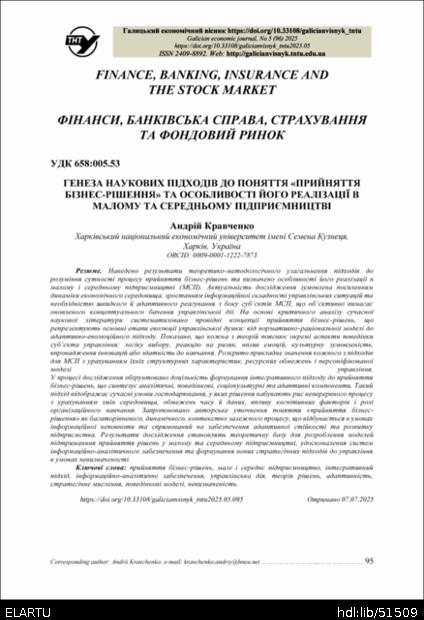
| dc.description.abstract | Наведено результати теоретико-методологічного узагальнення підходів до розуміння сутності процесу прийняття бізнес-рішень та визначено особливості його реалізації в малому і середньому підприємництві (МСП). Актуальність дослідження зумовлена посиленням динаміки економічного середовища, зростанням інформаційної складності управлінських ситуацій та необхідністю швидкого й адаптивного реагування з боку суб’єктів МСП, що об’єктивно вимагає оновленого концептуального бачення управлінської дії. На основі критичного аналізу сучасної наукової літератури систематизовано провідні концепції прийняття бізнес-рішень, що репрезентують основні етапи еволюції управлінської думки: від нормативно-раціональної моделі до адаптивно-еволюційного підходу. Показано, що кожна з теорій пояснює окремі аспекти поведінки суб’єкта управління: логіку вибору, реакцію на ризик, вплив емоцій, культурну зумовленість, впровадження інновацій або здатність до навчання. Розкрито прикладне значення кожного з підходів для МСП з урахуванням їхніх структурних характеристик, ресурсних обмежень і персоніфікованої моделі управління. У процесі дослідження обґрунтовано доцільність формування інтегративного підходу до прийняття бізнес-рішень, що синтезує аналітичні, поведінкові, соціокультурні та адаптивні компоненти. Такий підхід відображає сучасні умови господарювання, у яких рішення набувають рис неперервного процесу з урахуванням змін середовища, обмежень часу й даних, впливу когнітивних факторів і ролі організаційного навчання. Запропоновано авторське уточнення поняття «прийняття бізнес- рішення» як багаторівневого, динамічного, контекстно залежного процесу, що відбувається в умовах інформаційної неповноти та спрямований на забезпечення адаптивної стійкості та розвитку підприємства. Результати дослідження становлять теоретичну базу для розроблення моделей підтриманння прийняття рішень у малому та середньому підприємництві, удосконалення систем інформаційно-аналітичного забезпечення та формування нових стратегічних підходів до управління в умовах невизначеності. | |
| dc.description.abstract | The article presents the results of a theoretical and methodological generalisation of approaches to understanding the essence of the business decision-making process. It identifies the peculiarities of its implementation in small and medium-sized enterprises (SMEs). The studyʼs relevance is determined by the intensification of the dynamics of the economic environment, the growth of the informational complexity of management situations, and the need for a quick and adaptive response from SMEs, which objectively requires an updated conceptual vision of management action. A critical analysis of contemporary scientific literature has enabled the systematisation of the leading concepts of decision-making, which represent the main stages of the evolution of management thought. The study shows how these concepts have evolved from the normative-rational model to the adaptive-evolutionary approach. It has been demonstrated that each of the theories above elucidates discrete aspects of the behaviour of a management entity, including the logic of choice, reaction to risk, the influence of emotions, cultural conditioning, the introduction of innovations, and the ability to learn. The significance of these approaches for SMEs is revealed through an analysis of their structural characteristics, resource constraints, and personalised management model. The study substantiates the expediency of formulating an integrative approach to business decision-making, synthesizing analytical, behavioural, sociocultural, and adaptive components. This approach is indicative of contemporary economic conditions, wherein decisions are made continuously, considering environmental changes, temporal constraints, data limitations, cognitive factors, and the role of organisational learning. The author proposes to clarify the 'business decision-making' concept. This is to be understood as a multi-level, dynamic, context-dependent process that occurs in conditions of information incompleteness. This process aims to ensure the adaptive stability and development of the business. | |
| dc.format.extent | 95-102 | |
| dc.language.iso | uk | |
| dc.publisher | ТНТУ | |
| dc.publisher | TNTU | |
| dc.relation.ispartof | Галицький економічний вісник, 5 (96), 2025 | |
| dc.relation.ispartof | Galician economic journal, 5 (96), 2025 | |
| dc.relation.uri | https://www.oecd.org/en/publications/enhancing-resilience-by-boosting-digital-business-transformation-in-ukraine_4b13b0bb-en.html | |
| dc.relation.uri | https://doi.org/10.1007/978-94-017-8691-1_4 | |
| dc.relation.uri | https://core.ac.uk/download/pdf/287761281.pdf/ | |
| dc.relation.uri | https://doi.org/10.1109/ICE/ITMC49519.2020.9198545 | |
| dc.relation.uri | https://books.google.com.ua/books?id=OYdatgEACAAJ&printsec=copyright&redir_esc=y#v=onepage&q&f=false | |
| dc.relation.uri | https://doi.org/10.20414/jed.v4i1.5102 | |
| dc.relation.uri | https://msuweb.montclair.edu/~lebelp/simondectheoryaer1959.pdf | |
| dc.relation.uri | https://doi.org/10.3390/bdcc8070079 | |
| dc.subject | прийняття бізнес-рішень | |
| dc.subject | мале і середнє підприємництво | |
| dc.subject | інтегративний підхід | |
| dc.subject | інформаційно-аналітичне забезпечення | |
| dc.subject | управлінська дія | |
| dc.subject | теорія рішень | |
| dc.subject | адаптивність | |
| dc.subject | стратегічне мислення | |
| dc.subject | поведінкові моделі | |
| dc.subject | невизначеність | |
| dc.subject | business decision-making | |
| dc.subject | small and medium-sized enterprises | |
| dc.subject | integrative approach | |
| dc.subject | information and analytical support | |
| dc.subject | management action | |
| dc.subject | decision theory | |
| dc.subject | adaptability | |
| dc.subject | strategic thinking | |
| dc.subject | behavioural models | |
| dc.subject | uncertainty | |
| dc.title | Генеза наукових підходів до поняття «прийняття бізнес-рішення» та особливості його реалізації в малому та середньому підприємництві | |
| dc.title.alternative | THE GENESIS OF SCIENTIFIC APPROACHES TO THE CONCEPT OF ‘BUSINESS DECISION-MAKING’ AND THE FEATURES OF ITS IMPLEMENTATION IN SMEs | |
| dc.type | Article | |
| dc.rights.holder | © Тернопільський національний технічний університет імені Івана Пулюя, 2025 | |
| dc.coverage.placename | Тернопіль | |
| dc.coverage.placename | Ternopil | |
| dc.format.pages | 8 | |
| dc.subject.udc | 658 | |
| dc.subject.udc | 005.53 | |
| dc.relation.references | 1. Enhancing resilience by boosting digital business transformation in Ukraine. OECD Publications. 2024. URL: https://www.oecd.org/en/publications/enhancing-resilience-by-boosting-digital-business-transformation-in-ukraine_4b13b0bb-en.html (дата звернення: 01.07.2025) | |
| dc.relation.references | 2. Kitt R. Economic Decision Making: Application of the Theory of Complex Systems. In: Banerjee S., Erçetin Ş., Tekin A. (eds) Chaos Theory in Politics. Understanding Complex Systems. 2014. Springer, Dordrecht. DOI: https://doi.org/10.1007/978-94-017-8691-1_4 | |
| dc.relation.references | 3. Małecka M. The normative decision theory in economics: A philosophy of science perspective. The case of the expected utility theory. Journal of Economic Methodology. 2019. URL: https://core.ac.uk/download/pdf/287761281.pdf/ (дата звернення: 03.07.2025) | |
| dc.relation.references | 4. Mohamed Muhidin A. Trends of digitalization and adoption of big data & analytics among UK SMEs: Analysis and lessons drawn from a case study of 53 SMEs. International Conference on Engineering, Technology and Innovation. 2020. DOI: https://doi.org/10.1109/ICE/ITMC49519.2020.9198545 | |
| dc.relation.references | 5. Nutt P. C., Wilson D. C. Handbook of decision making. URL: https://books.google.com.ua/books?id=OYdatgEACAAJ&printsec=copyright&redir_esc=y#v=onepage&q&f=false (дата звернення: 02.07.2025) | |
| dc.relation.references | 6. Rosyidah U., Pratikto H. The role of behavioral bias on financial decision making: a systematic literature review and future research agenda. Journal of Enterprise and Development. 2022. 4 (1). pp. 156–179. DOI: https://doi.org/10.20414/jed.v4i1.5102 | |
| dc.relation.references | 7. Simon H. A. Theories of Decision-Making in Economics and Behavioral Science. The American Economic Review. 1959. Volume 49. No. 3. P. 253–283. URL: https://msuweb.montclair.edu/~lebelp/simondectheoryaer1959.pdf. (дата звернення: 02.07.2025) | |
| dc.relation.references | 8. Tawil A-RH., Mohamed M., Schmoor X., Vlachos K., Haidar D. Trends and Challenges towards Effective Data-Driven Decision Making in UK Small and Medium-Sized Enterprises: Case Studies and Lessons Learnt from the Analysis of 85 Small and Medium-Sized Enterprises. Big Data and Cognitive Computing. 2024. 8 (7):79. DOI: https://doi.org/10.3390/bdcc8070079 | |
| dc.relation.referencesen | 1. Enhancing resilience by boosting digital business transformation in Ukraine (2024). OECD Publications. Available at: https://www.oecd.org/en/publications/enhancing-resilience-by-boosting-digital-business-transformation-in-ukraine_4b13b0bb-en.html (accessed: 1 June 2025) | |
| dc.relation.referencesen | 2. Kitt R. (2014) Economic Decision Making: Application of the Theory of Complex Systems. In: Banerjee S., Erçetin Ş., Tekin A. (eds) Chaos Theory in Politics. Understanding Complex Systems. Springer, Dordrecht. DOI: https://doi.org/10.1007/978-94-017-8691-1_4 | |
| dc.relation.referencesen | 3. Małecka M. (2019) The normative decision theory in economics: A philosophy of science perspective. The case of the expected utility theory. Journal of Economic Methodology. Available at: https://core.ac.uk/download/pdf/287761281.pdf/ (accessed: 3 June 2025) | |
| dc.relation.referencesen | 4. Mohamed Muhidin A. (2020) Trends of digitalization and adoption of big data & analytics among UK SMEs: Analysis and lessons drawn from a case study of 53 SMEs. International Conference on Engineering, Technology and Innovation. DOI: https://doi.org/10.1109/ICE/ITMC49519.2020.9198545 | |
| dc.relation.referencesen | 5. Nutt P. C., Wilson D. C. (2010) Handbook of decision making. Available at: https://books.google.com.ua/books?id=OYdatgEACAAJ&printsec=copyright&redir_esc=y#v=onepage&q&f=false (accessed: 2 June 2025) | |
| dc.relation.referencesen | 6. Rosyidah U., Pratikto H. (2022) The role of behavioral bias on financial decision making: a systematic literature review and future research agenda. Journal of Enterprise and Development, no. 4 (1), рр. 156–179. DOI: https://doi.org/10.20414/jed.v4i1.5102 | |
| dc.relation.referencesen | 7. Simon H. A. (1959) Theories of Decision-Making in Economics and Behavioral Science. The American Economic Review. Available at: https://msuweb.montclair.edu/~lebelp/simondectheoryaer1959.pdf. (accessed: 4 June 2025) | |
| dc.relation.referencesen | 8. Tawil A-RH., Mohamed M., Schmoor X., Vlachos K., Haidar D. (2024) Trends and Challenges towards Effective Data-Driven Decision Making in UK Small and Medium-Sized Enterprises: Case Studies and Lessons Learnt from the Analysis of 85 Small and Medium-Sized Enterprises. Big Data and Cognitive Computing. 8 (7):79. DOI: https://doi.org/10.3390/bdcc8070079 | |
| dc.contributor.affiliation | Харківський національний економічний університет імені Семена Кузнеця, Харків, Україна | |
| dc.contributor.affiliation | Simon Kuznets Kharkiv National University of Economics, Kharkiv, Ukraine | |
| dc.citation.journalTitle | Галицький економічний вісник | |
| dc.citation.volume | 96 | |
| dc.citation.issue | 5 | |
| dc.citation.spage | 95 | |
| dc.citation.epage | 102 | |
| dc.identifier.citation2015 | Кравченко А. В. Генеза наукових підходів до поняття «прийняття бізнес-рішення» та особливості його реалізації в малому та середньому підприємництві // ГЕВ, Тернопіль. 2025. Том 96. № 5. С. 95–102. | |
| dc.identifier.citationenAPA | Kravchenko, A. (2025). Heneza naukovykh pidkhodiv do poniattia "pryiniattia biznes-rishennia" ta osoblyvosti yoho realizatsii v malomu ta serednomu pidpryiemnytstvi [THE GENESIS OF SCIENTIFIC APPROACHES TO THE CONCEPT OF ‘BUSINESS DECISION-MAKING’ AND THE FEATURES OF ITS IMPLEMENTATION IN SMEs]. Galician economic journal, 96(5), 95-102. TNTU. [in Ukrainian]. | |
| dc.identifier.citationenCHICAGO | Kravchenko A. (2025) Heneza naukovykh pidkhodiv do poniattia "pryiniattia biznes-rishennia" ta osoblyvosti yoho realizatsii v malomu ta serednomu pidpryiemnytstvi [THE GENESIS OF SCIENTIFIC APPROACHES TO THE CONCEPT OF ‘BUSINESS DECISION-MAKING’ AND THE FEATURES OF ITS IMPLEMENTATION IN SMEs]. Galician economic journal (Tern.), vol. 96, no 5, pp. 95-102 [in Ukrainian]. | |
| Розташовується у зібраннях: | Галицький економічний вісник, 2025, № 5 (96) | |
Файли цього матеріалу:
| Файл | Опис | Розмір | Формат | |
|---|---|---|---|---|
| GEJ_2025v96n5_Kravchenko_A-THE_GENESIS_OF_SCIENTIFIC_95-102.pdf | 2,58 MB | Adobe PDF | Переглянути/відкрити | |
| GEJ_2025v96n5_Kravchenko_A-THE_GENESIS_OF_SCIENTIFIC_95-102__COVER.png | 1,11 MB | image/png | Переглянути/відкрити |
Усі матеріали в архіві електронних ресурсів захищені авторським правом, всі права збережені.