
Будь ласка, використовуйте цей ідентифікатор, щоб цитувати або посилатися на цей матеріал:
http://elartu.tntu.edu.ua/handle/lib/51494
Повний запис метаданих
| Поле DC | Значення | Мова |
|---|---|---|
| dc.contributor.author | Біщак, Дмитро | |
| dc.contributor.author | Петрик, Михайло Романович | |
| dc.contributor.author | Bishchak, Dmytro | |
| dc.contributor.author | Petryk, Mykhaylo | |
| dc.date.accessioned | 2026-02-09T15:51:57Z | - |
| dc.date.available | 2026-02-09T15:51:57Z | - |
| dc.date.created | 2025-08-29 | |
| dc.date.issued | 2025-08-29 | |
| dc.date.submitted | 2025-07-10 | |
| dc.identifier.citation | Bishchak D. Algorithmic approach to tremor classification based on EEG and graphomotor signals / Dmytro Bishchak, Mykhaylo Petryk // Scientific Journal of TNTU. — Tern. : TNTU, 2025. — Vol 119. — No 3. — P. 35–44. | |
| dc.identifier.issn | 2522-4433 | |
| dc.identifier.uri | http://elartu.tntu.edu.ua/handle/lib/51494 | - |
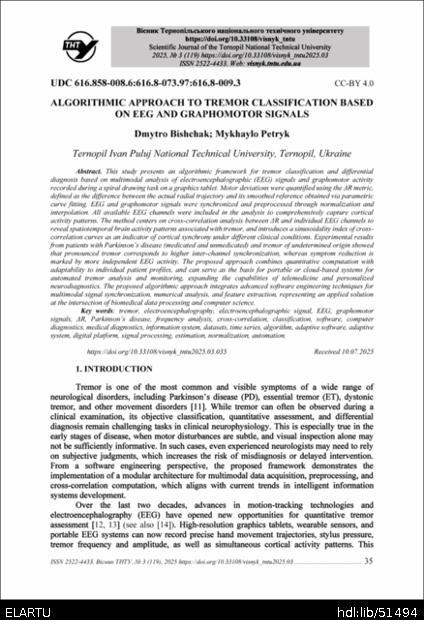
| dc.description.abstract | Представлено алгоритмічний підхід до класифікації та диференційної діагностики тремору, що ґрунтується на мультимодальному аналізі електроенцефалографічних (EEG) сигналів та графомоторної активності, зареєстрованої під час виконання пацієнтами завдання малювання спіралі на графічному планшеті зі стілусом. Для кількісного оцінювання моторних відхилень застосовано показник ΔR – різницю між реальною траєкторією руху стілуса та її згладженою (референтною) версією, отриманою шляхом параметричної криволінійної апроксимації. EEG-сигнали синхронізовано з графомоторними даними та піддано попередньому опрацюванню, включно з нормалізацією та інтерполяцією. Для подальшого аналізу використано всі наявні канали EEG з метою повного відображення просторово-часових патернів мозкової активності. Основу методу становить аналіз крос- кореляції між ΔR та кожним каналом EEG, що дозволяє виявляти просторово-часові патерни мозкової активності, асоційовані з тремором, а також досліджувати ступінь їхньої синхронності. Запропоновано індекс синусоподібності (SI), який обчислюється для крос-кореляційних кривих та виступає інтегральним показником глобальної синусоподібної тенденції кортикальної синхронізації у різних клінічних станах. Експериментальні дослідження проведено на даних, отриманих від пацієнтів з різним клінічним статусом, включаючи хворобу Паркінсона у стані медикаментозної компенсації та без неї, а також тремор невстановленого генезу. Результати показали, що виражений тремор супроводжується підвищеною синхронізацією між каналами EEG, тоді як у стані компенсації або зниження симптомів активність каналів є більш незалежною. Запропонований підхід має значну діагностичну цінність, оскільки поєднує кількісні обчислювальні методи з можливістю адаптації під індивідуальні особливості пацієнта, і може бути використаний як основа для розроблення портативних або хмарних систем автоматизованого аналізу та моніторингу тремору, що розширює можливості телемедицини та персоналізованої нейродіагностики. Запропонований алгоритмічний підхід інтегрує сучасні методи інженерії програмного забезпечення для мультимодальної синхронізації сигналів, числового аналізу та виділення ознак, що являє прикладне вирішення на перетині опрацювання біомедичних даних і комп’ютерних наук | |
| dc.description.abstract | This study presents an algorithmic framework for tremor classification and differential diagnosis based on multimodal analysis of electroencephalographic (EEG) signals and graphomotor activity recorded during a spiral drawing task on a graphics tablet. Motor deviations were quantified using the ΔR metric, defined as the difference between the actual radial trajectory and its smoothed reference obtained via parametric curve fitting. EEG and graphomotor signals were synchronized and preprocessed through normalization and interpolation. All available EEG channels were included in the analysis to comprehensively capture cortical activity patterns. The method centers on cross-correlation analysis between ΔR and individual EEG channels to reveal spatiotemporal brain activity patterns associated with tremor, and introduces a sinusoidality index of cross- correlation curves as an indicator of cortical synchrony under different clinical conditions. Experimental results from patients with Parkinson’s disease (medicated and unmedicated) and tremor of undetermined origin showed that pronounced tremor corresponds to higher inter-channel synchronization, whereas symptom reduction is marked by more independent EEG activity. The proposed approach combines quantitative computation with adaptability to individual patient profiles, and can serve as the basis for portable or cloud-based systems for automated tremor analysis and monitoring, expanding the capabilities of telemedicine and personalized neurodiagnostics. The proposed algorithmic approach integrates advanced software engineering techniques for multimodal signal synchronization, numerical analysis, and feature extraction, representing an applied solution at the intersection of biomedical data processing and computer science | |
| dc.format.extent | 35-44 | |
| dc.language.iso | en | |
| dc.publisher | ТНТУ | |
| dc.publisher | TNTU | |
| dc.relation.ispartof | Вісник Тернопільського національного технічного університету, 3 (119), 2025 | |
| dc.relation.ispartof | Scientific Journal of the Ternopil National Technical University, 3 (119), 2025 | |
| dc.relation.uri | https://doi.org/10.3390/app14093883 | |
| dc.relation.uri | https://doi.org/10.1177/09287329241291334 | |
| dc.relation.uri | https://doi.org/10.1038/s41598-024-79111-w | |
| dc.relation.uri | https://doi.org/10.1016/j.compbiomed.2022.105629 | |
| dc.relation.uri | https://doi.org/10.1016/j.future.2023.03.033 | |
| dc.relation.uri | https://doi.org/10.1109/ACCESS.2024.3416444 | |
| dc.relation.uri | https://doi.org/10.1109/ACCESS.2025.3575023 | |
| dc.relation.uri | https://doi.org/10.1109/ACCESS.2025.3585099 | |
| dc.relation.uri | https://doi.org/10.1109/TNSRE.2023.3277749 | |
| dc.relation.uri | https://doi.org/10.1109/ACCESS.2024.3487001 | |
| dc.relation.uri | https://doi.org/10.1186/s12883-023-03468-0 | |
| dc.relation.uri | https://doi.org/10.3758/s13428-016-0752-y | |
| dc.relation.uri | https://doi.org/10.3390/s21217014 | |
| dc.relation.uri | https://doi.org/10.1016/j.neulet.2022.136566 | |
| dc.relation.uri | https://doi.org/10.33108/visnyk_tntu2023.04.026 | |
| dc.relation.uri | https://doi.org/10.1073/pnas.1902276116 | |
| dc.subject | тремор | |
| dc.subject | електроенцефалографія | |
| dc.subject | електроенцефалографічний сигнал | |
| dc.subject | ЕЕГ | |
| dc.subject | графомоторні сигнали | |
| dc.subject | ΔR | |
| dc.subject | хвороба Паркінсона | |
| dc.subject | частотний аналіз | |
| dc.subject | крос-кореляція | |
| dc.subject | класифікація | |
| dc.subject | програмне забезпечення | |
| dc.subject | компʼютерна діагностика | |
| dc.subject | медична діагностика | |
| dc.subject | інформаційна система | |
| dc.subject | набори даних | |
| dc.subject | часові ряди | |
| dc.subject | алгоритм | |
| dc.subject | адаптивне програмне забезпечення | |
| dc.subject | адаптивна система | |
| dc.subject | цифрова платформа | |
| dc.subject | обробка сигналів | |
| dc.subject | оцінювання | |
| dc.subject | нормалізація | |
| dc.subject | автоматизація | |
| dc.subject | tremor | |
| dc.subject | electroencephalography | |
| dc.subject | electroencephalographic signal | |
| dc.subject | EEG | |
| dc.subject | graphomotor signals | |
| dc.subject | ΔR | |
| dc.subject | Parkinson’s disease | |
| dc.subject | frequency analysis | |
| dc.subject | cross-correlation | |
| dc.subject | classification | |
| dc.subject | software | |
| dc.subject | computer diagnostics | |
| dc.subject | medical diagnostics | |
| dc.subject | information system | |
| dc.subject | datasets | |
| dc.subject | time series | |
| dc.subject | algorithm | |
| dc.subject | adaptive software | |
| dc.subject | adaptive system | |
| dc.subject | digital platform | |
| dc.subject | signal processing | |
| dc.subject | estimation | |
| dc.subject | normalization | |
| dc.subject | automation | |
| dc.title | Algorithmic approach to tremor classification based on EEG and graphomotor signals | |
| dc.title.alternative | Алгоритмічний підхід до класифікації тремору за EEG і графомоторними сигналами | |
| dc.type | Article | |
| dc.rights.holder | © Ternopil Ivan Puluj National Technical University, 2025 | |
| dc.coverage.placename | Тернопіль | |
| dc.coverage.placename | Ternopil | |
| dc.format.pages | 10 | |
| dc.subject.udc | 616.858-008.6 | |
| dc.subject.udc | 616.8-073.97 | |
| dc.subject.udc | 616.8-009.3 | |
| dc.relation.referencesen | 1. Alrawis M., Al-Ahmadi S., Mohammad F. (2024) Bridging modalities: A multimodal machine learning approach for Parkinson’s disease diagnosis using EEG and MRI data. Appl. Sci, vol. 14, no. 9, art. 3883. https://doi.org/10.3390/app14093883 | |
| dc.relation.referencesen | 2. Jain S., Srivastava R. (2024) Multi-modality NDE fusion using encoder–decoder networks for identify multiple neurological disorders from EEG signals. Technol. Health Care, vol. 1, art. 09287329241291334. https://doi.org/10.1177/09287329241291334 | |
| dc.relation.referencesen | 3. Tang L., Hu Q., Wang X., Liu L., Zheng H., Yu W., Song C. (2024) A multimodal fusion network based on a cross-attention mechanism for the classification of Parkinsonian tremor and essential tremor. Sci. Rep, vol. 14, art. 28050. https://doi.org/10.1038/s41598-024-79111-w | |
| dc.relation.referencesen | 4. Guo Y., Huang D., Zhang W., Wang L., Li Y., Olmo G., Chan P. (2022) High-accuracy wearable detection of freezing of gait in Parkinson’s disease based on pseudo-multimodal features. Comput. Biol. Med, vol. 146, art. 105629. https://doi.org/10.1016/j.compbiomed.2022.105629 | |
| dc.relation.referencesen | 5. Ma C., Ma Y., Pan L., Li X., Yin C., Zong R., Zhang Z. (2023) Automatic diagnosis of multi-task in essential tremor: Dynamic handwriting analysis using multi-modal fusion neural network. Future Gener. Comput. Syst, vol. 145, pp. 429–441. https://doi.org/10.1016/j.future.2023.03.033 | |
| dc.relation.referencesen | 6. Raj K. D., Lal G. J., Gopalakrishnan E. A., Sowmya V., Orozco-Arroyave J. R. (2024) A visibility graph approach for multi-stage classification of Parkinson’s disease using multimodal data. IEEE Access, vol. 12, pp. 87077–87096. https://doi.org/10.1109/ACCESS.2024.3416444 | |
| dc.relation.referencesen | 7. Miah A. S. M., Suzuki T., Shin J. (2025) A methodological and structural review of Parkinson’s disease detection across diverse data modalities. IEEE Access, vol. 13, pp. 98931–98975. https://doi.org/10.1109/ACCESS.2025.3575023 | |
| dc.relation.referencesen | 8. Murtaza G., Hammoud M., Somov A. (2025) Multi-modal feature set-based detection of freezing of gait in Parkinson’s disease patients using SVM. IEEE Access, vol. 13, pp. 114798–114811. https://doi.org/10.1109/ACCESS.2025.3585099 | |
| dc.relation.referencesen | 9. Skaramagkas V., Pentari A., Kefalopoulou Z., Tsiknakis M. (2023) Multi-modal deep learning diagnosis of Parkinson’s disease – A systematic review. IEEE Trans. Neural Syst. Rehabil. Eng, vol. 31, pp. 2399–2423. https://doi.org/10.1109/TNSRE.2023.3277749 | |
| dc.relation.referencesen | 10. Dhivyaa C. R., Nithya K., Anbukkarasi S. (2024) Enhancing Parkinson’s disease detection and diagnosis: A survey of integrative approaches across diverse modalities. IEEE Access, vol. 12, pp. 158999–159024. https://doi.org/10.1109/ACCESS.2024.3487001 | |
| dc.relation.referencesen | 11. Farashi S., Sarihi A., Ramezani M., Kashani H. (2023) Parkinson’s disease tremor prediction using EEG data analysis – A preliminary and feasibility study. BMC Neurol, vol. 23, no. 1, p. 420. https://doi.org/10.1186/s12883-023-03468-0 | |
| dc.relation.referencesen | 12. Yu N. Y., Van Gemmert A. W. A., Chang S. H. (2017) Characterization of graphomotor functions in individuals with Parkinson’s disease and essential tremor. Behav. Res. Methods, vol. 49, no. 3, pp. 913–922. https://doi.org/10.3758/s13428-016-0752-y | |
| dc.relation.referencesen | 13. Brambilla C., Pirovano I., Mira R. M., Rizzo G., Scano A., Mastropietro A. (2021) Combined use of EMG and EEG techniques for neuromotor assessment in rehabilitative applications: A systematic review. Sensors, vol. 21, no. 21, Art. 7014. https://doi.org/10.3390/s21217014 | |
| dc.relation.referencesen | 14. Zhang X., Chen H., Tao L., Zhang X., Wang H., He W., Fang W. (2022) Combined multivariate pattern analysis with frequency-dependent intrinsic brain activity to identify essential tremor. Neurosci. Lett, vol. 776, Art. 136566. https://doi.org/10.1016/j.neulet.2022.136566 | |
| dc.relation.referencesen | 15. Chyniak O., Dubenko O., Potapov O., Shulha A., Kotsiuba A. (2023) Parkinsonʼs disease - an overview of modern treatment methods. EUMJ, vol. 11, no. 1, pp. 1–13. [in Ukrainian]. | |
| dc.relation.referencesen | 16. Petryk M., Bishchak D., Bachynskyi M., Brevus V., Chyzh V., Mykhalyk D. (2024) Analysis of involuntary movements of patients with tremor symptoms under the influence of cognitive influences. Applied issues of mathematical modeling, vol. 7, no. 2, pp. 150–165. [in Ukrainian]. | |
| dc.relation.referencesen | 17. Osiichuk I., Brevus V., Bishchak D., Mashtaliar Y., Mudryk I. (2024) Leveraging graphics tablet and JPen library to detect essential tremor. CEUR Workshop Proc,vol. 3742, pp. 63–69. | |
| dc.relation.referencesen | 18. Pastukh O., Yatsyshyn V. (2023) Brain-computer interaction neurointerface based on artificial intelligence and its parallel programming using high-performance calculation on cluster mobile devices. Visnyk TNTU, no. 4 (112), pp. 26–31. https://doi.org/10.33108/visnyk_tntu2023.04.026 | |
| dc.relation.referencesen | 19. Andersen R. A. (2019) From thought to action: The brain–machine interface in posterior parietal cortex. Proc. Natl. Acad. Sci, vol. 116, no. 52, pp. 26274–26279. https://doi.org/10.1073/pnas.1902276116 | |
| dc.identifier.doi | https://doi.org/10.33108/visnyk_tntu2025.03.035 | |
| dc.contributor.affiliation | Тернопільський національний технічний університет імені Івана Пулюя, Тернопіль, Україна | |
| dc.contributor.affiliation | Ternopil Ivan Puluj National Technical University, Ternopil, Ukraine | |
| dc.citation.journalTitle | Вісник Тернопільського національного технічного університету | |
| dc.citation.volume | 119 | |
| dc.citation.issue | 3 | |
| dc.citation.spage | 35 | |
| dc.citation.epage | 44 | |
| dc.identifier.citation2015 | Bishchak D., Petryk M. Algorithmic approach to tremor classification based on EEG and graphomotor signals // Scientific Journal of TNTU, Ternopil. 2025. Vol 119. No 3. P. 35–44. | |
| dc.identifier.citationenAPA | Bishchak, D., & Petryk, M. (2025). Algorithmic approach to tremor classification based on EEG and graphomotor signals. Scientific Journal of the Ternopil National Technical University, 119(3), 35-44. TNTU.. | |
| dc.identifier.citationenCHICAGO | Bishchak D., Petryk M. (2025) Algorithmic approach to tremor classification based on EEG and graphomotor signals. Scientific Journal of the Ternopil National Technical University (Tern.), vol. 119, no 3, pp. 35-44. | |
| Розташовується у зібраннях: | Вісник ТНТУ, 2025, № 3 (119) | |
Файли цього матеріалу:
| Файл | Опис | Розмір | Формат | |
|---|---|---|---|---|
| TNTUSJ_2025v119n3_Bishchak_D-Algorithmic_approach_to_35-44.pdf | 3,24 MB | Adobe PDF | Переглянути/відкрити | |
| TNTUSJ_2025v119n3_Bishchak_D-Algorithmic_approach_to_35-44__COVER.png | 1,4 MB | image/png | Переглянути/відкрити |
Усі матеріали в архіві електронних ресурсів захищені авторським правом, всі права збережені.