
Будь ласка, використовуйте цей ідентифікатор, щоб цитувати або посилатися на цей матеріал:
http://elartu.tntu.edu.ua/handle/lib/51483
Повний запис метаданих
| Поле DC | Значення | Мова |
|---|---|---|
| dc.contributor.author | Волощук, Андрій | |
| dc.contributor.author | Осухівська, Галина Михайлівна | |
| dc.contributor.author | Voloshchuk, Andrii | |
| dc.contributor.author | Osukhivska, Halyna | |
| dc.date.accessioned | 2026-02-09T15:51:56Z | - |
| dc.date.available | 2026-02-09T15:51:56Z | - |
| dc.date.created | 2025-08-29 | |
| dc.date.issued | 2025-08-29 | |
| dc.date.submitted | 2025-07-25 | |
| dc.identifier.citation | Voloshchuk A. Adaptive multi-protocol communication for energy systems / Andrii Voloshchuk, Halyna Osukhivska // Scientific Journal of TNTU. — Tern. : TNTU, 2025. — Vol 119. — No 3. — P. 97–106. | |
| dc.identifier.issn | 2522-4433 | |
| dc.identifier.uri | http://elartu.tntu.edu.ua/handle/lib/51483 | - |
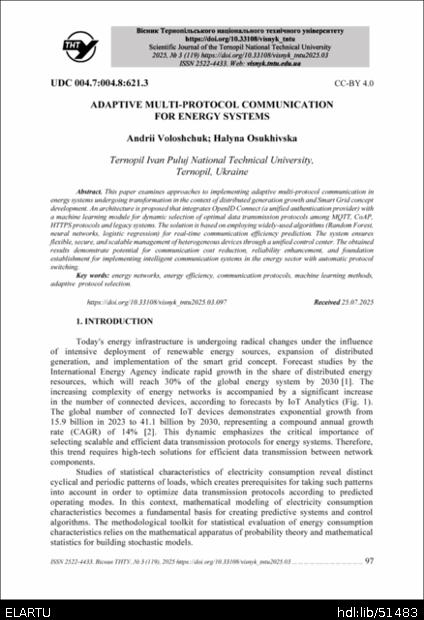
| dc.description.abstract | Розглянуто підходи до впровадження адаптивної багатопротокольної комунікації в енергетичних системах, що трансформуються в умовах зростання розподіленої генерації та розвитку концепції Smart Grid. Зростаюча гетерогенність сучасних енергетичних інфраструктур, зумовлена масовим упровадженням IoT-пристроїв, інтелектуальних лічильників та розподілених енергетичних ресурсів, створює суттєві виклики для забезпечення надійного та ефективного передавання даних. За таких умов традиційні статичні комунікаційні архітектури виявляються малоефективними та неспроможними адаптуватися до динамічних змін стану мережі. Запропоновано архітектурний підхід, що поєднує провайдер ідентифікації OpenID Connect як уніфікований механізм автентифікації та авторизації з інтелектуальним модулем машинного навчання для адаптивного управління протоколами зв’язку. Динамічний вибір протоколів передавання даних здійснюється між MQTT, CoAP, HTTPS та іншими промисловими системами з урахуванням показників продуктивності мережі в реальному часі, вимог безпеки та характеристик експлуатаційного навантаження. Для прогнозування ефективності комунікації використано багатомодельний підхід машинного навчання, що включає алгоритми Random Forest, нейронні мережі та логістичну регресію, які забезпечують взаємодоповнювальний аналіз мережевих параметрів. Остаточне рішення щодо вибору оптимального протоколу формується на основі зваженого консенсусного механізму з урахуванням показників якості кожної моделі. Запропонована система реалізує протокол – незалежну модель безпеки, централізоване управління гетерогенними пристроями та масштабовану архітектуру, придатну для сучасних і перспективних енергетичних мереж. Результати експериментальних досліджень, отримані на основі реальних експлуатаційних даних, підтверджують можливість зменшення комунікаційних витрат, підвищення надійності передавання даних і забезпечення стабільної роботи системи за змінних мережевих умов. Отримані результати доводять, що поєднання централізованої ідентифікації з адаптивним, заснованим на машинному навчанні вибором протоколів створює надійну основу для інтелектуальних комунікаційних систем з автоматичним перемиканням протоколів у енергетичних інфраструктурах нового покоління та експлуатаційної стійкості | |
| dc.description.abstract | This paper examines approaches to implementing adaptive multi-protocol communication in energy systems undergoing transformation in the context of distributed generation growth and Smart Grid concept development. An architecture is proposed that integrates OpenID Connect (a unified authentication provider) with a machine learning module for dynamic selection of optimal data transmission protocols among MQTT, CoAP, HTTPS protocols and legacy systems. The solution is based on employing widely-used algorithms (Random Forest, neural networks, logistic regression) for real-time communication efficiency prediction. The system ensures flexible, secure, and scalable management of heterogeneous devices through a unified control center. The obtained results demonstrate potential for communication cost reduction, reliability enhancement, and foundation establishment for implementing intelligent communication systems in the energy sector with automatic protocol switching | |
| dc.format.extent | 97-106 | |
| dc.language.iso | en | |
| dc.publisher | ТНТУ | |
| dc.publisher | TNTU | |
| dc.relation.ispartof | Вісник Тернопільського національного технічного університету, 3 (119), 2025 | |
| dc.relation.ispartof | Scientific Journal of the Ternopil National Technical University, 3 (119), 2025 | |
| dc.relation.uri | https://doi.org/10.1787/827374a6-en | |
| dc.relation.uri | https://iot-analytics.com/number-connected | |
| dc.relation.uri | https://doi.org/10.1016/j.enbuild.2018.01.017 | |
| dc.relation.uri | https://doi.org/10.1016/ | |
| dc.relation.uri | https://doi.org/10.1016/j.renene.2019.08.092 | |
| dc.relation.uri | https://doi.org/10.1016/j.rser.2015.12.114 | |
| dc.relation.uri | https://doi.org/10.1007/s40565-018-0438-9 | |
| dc.relation.uri | https://doi.org/10.33108/visnyk_tntu2021.04.131 | |
| dc.relation.uri | https://doi.org/10.1109/SysEng.2017.8088251 | |
| dc.relation.uri | https://doi.org/10.1109/ACCESS.2020.2993363 | |
| dc.relation.uri | https://doi.org/10.1109/ISSNIP.2014.6827678 | |
| dc.relation.uri | https://doi.org/10.17487/RFC8446 | |
| dc.relation.uri | https://doi.org/10.5120/15764-4454 | |
| dc.relation.uri | https://doi.org/10.17487/RFC6749 | |
| dc.relation.uri | https://openid.net/specs/openid-connect-core-1_0.html | |
| dc.relation.uri | https://doi.org/10.33108/visnyk_tntu2024.02.039 | |
| dc.relation.uri | https://www.wireshark.org/docs/wsug_html/ | |
| dc.relation.uri | https://doi.org/10.48550/ARXIV.1811.12808 | |
| dc.relation.uri | https://ceur-ws.org/Vol-3742/paper5.pdf | |
| dc.subject | енергетичні мережі | |
| dc.subject | енергоефективність | |
| dc.subject | комунікаційні протоколи | |
| dc.subject | методи машинного навчання | |
| dc.subject | адаптивний вибір протоколу | |
| dc.subject | energy networks | |
| dc.subject | energy efficiency | |
| dc.subject | communication protocols | |
| dc.subject | machine learning methods | |
| dc.subject | adaptive protocol selection | |
| dc.title | Adaptive multi-protocol communication for energy systems | |
| dc.title.alternative | Адаптивна багатопротокольна комунікація для енергетичних систем | |
| dc.type | Article | |
| dc.rights.holder | © Ternopil Ivan Puluj National Technical University, 2025 | |
| dc.coverage.placename | Тернопіль | |
| dc.coverage.placename | Ternopil | |
| dc.format.pages | 10 | |
| dc.subject.udc | 004.7 | |
| dc.subject.udc | 004.8 | |
| dc.subject.udc | 621.3 | |
| dc.relation.referencesen | 1. International Energy Agency. (2023). World Energy Outlook 2023. IEA Publications. Available at: https: //www.iea.org/reports/world-energy-outlook-2023. https://doi.org/10.1787/827374a6-en | |
| dc.relation.referencesen | 2. IoT Analytics. (2024). State of IoT Summer 2024. Available at: https://iot-analytics.com/number-connected -iot- devices/. | |
| dc.relation.referencesen | 3. Ahmad T., Chen H., Guo Y., & Wang J. (2018). A comprehensive overview on the data driven and large scale based approaches for forecasting of building energy demand. Energy and Buildings, 165, 301–320. https://doi.org/10.1016/j.enbuild.2018.01.017 | |
| dc.relation.referencesen | 4. Zhang Y., Wang J., & Wang X. (2020). Review on probabilistic forecasting of wind power generation with machine learning. Renewable and Sustainable Energy Reviews, 125, 109827. https://doi.org/10.1016/ j.rser.2020.109827. | |
| dc.relation.referencesen | 5. Dileep G. (2020). A survey on smart grid technologies and applications. Renewable Energy, 146, 2589–2625. https://doi.org/10.1016/j.renene.2019.08.092 | |
| dc.relation.referencesen | 6. Kabalci Y. (2016). A survey on smart metering and smart grid communication. Renewable and Sustainable Energy Reviews, 57, 302–318. https://doi.org/10.1016/j.rser.2015.12.114 | |
| dc.relation.referencesen | 7. Chen X., McElroy M. B., Wu Q., Shu Y., & Xue Y. (2019). Transition towards higher penetration of renewables: an overview of interlinked technical, environmental and socio-economic challenges. Journal of Modern Power Systems and Clean Energy, 7(1), 1–18. https://doi.org/10.1007/s40565-018-0438-9 | |
| dc.relation.referencesen | 8. Starchenko V. (2021) Traffic optimization in wifi networks for the internet of things. Scientific Journal of the Ternopil National Technical University, 104 (4), 131–142. https://doi.org/10.33108/visnyk_tntu2021.04.131 | |
| dc.relation.referencesen | 9. Naik N. (2017). Choice of effective messaging protocols for IoT systems: MQTT, CoAP, AMQP and HTTP. In 2017 IEEE International Systems Engineering Symposium (ISSE) (pp. 1–7). IEEE. https://doi.org/10.1109/SysEng.2017.8088251 | |
| dc.relation.referencesen | 10. Al-Masri, E., et al. (2020). Investigating messaging protocols for the Internet of Things (IoT). IEEE Access, 8, 94880-94911. https://doi.org/10.1109/ACCESS.2020.2993363 | |
| dc.relation.referencesen | 11. Thangavel D., Ma X., Valera A., Tan H.-X., & Tan C. K.-Y. (2014). Performance evaluation of MQTT and CoAP via a common middleware. In 2014 IEEE Ninth International Conference on Intelligent Sensors, Sensor Networks and Information Processing (ISSNIP). IEEE. https://doi.org/10.1109/ISSNIP.2014.6827678 | |
| dc.relation.referencesen | 12. Rescorla E. (2018). The Transport Layer Security (TLS) Protocol Version 1.3. RFC 8446. Internet Engineering Task Force. https://doi.org/10.17487/RFC8446 | |
| dc.relation.referencesen | 13. Kumar S., & Patel D. R. (2019) A survey on Internet of Things: Security and privacy issues. International Journal of Computer Applications, 90 (11), 20–26. https://doi.org/10.5120/15764-4454 | |
| dc.relation.referencesen | 14. Hardt D. (2020). The OAuth 2.0 Authorization Framework. RFC 6749 (Updated). Internet Engineering Task Force. https://doi.org/10.17487/RFC6749. | |
| dc.relation.referencesen | 15. Jones M., et al. (2019). OpenID Connect Core 1.0 incorporating errata set 1. OpenID Foundation. https://openid.net/specs/openid-connect-core-1_0.html. | |
| dc.relation.referencesen | 16. Martsenyuk V., & Kit N. (2024) A multivariate method of forecasting the nonlinear dynamics of production network based on multilayer neural models. Scientific Journal of the Ternopil National Technical University, 114 (2), 39–50. https://doi.org/10.33108/visnyk_tntu2024.02.039 | |
| dc.relation.referencesen | 17. Combs G., et al. (2023). Wireshark Userʼs Guide for Wireshark 4.0. Wireshark Foundation. https://www.wireshark.org/docs/wsug_html/. | |
| dc.relation.referencesen | 18. Raschka S. (2018). Model Evaluation, Model Selection, and Algorithm Selection in Machine Learning (Version 3). arXiv. https://doi.org/10.48550/ARXIV.1811.12808. | |
| dc.relation.referencesen | 19. International Electrotechnical Commission. (2018). IEC 61850-5-2018: Communication requirements for functions and device models. IEC Publications. | |
| dc.relation.referencesen | 20. IEEE Standards Association. (2018). IEEE Standard 1613-2018: Environmental and Testing Requirements for Communications Networking Devices in Electric Power Substations. IEEE. | |
| dc.relation.referencesen | 21. A. Voloshchuk, D. Velychko, H. Osukhivska, A. Palamar, (2024). Computer system for energy distribution in conditions of electricity shortage using artificial intelligence, in: Proceedings of the 2nd International Workshop on Computer Information Technologies in Industry 4.0 (CITI 2024), Volume 3742, Ternopil, Ukraine, June 12–14, pp. 66–75. Available at: https://ceur-ws.org/Vol-3742/paper5.pdf. | |
| dc.identifier.doi | https://doi.org/10.33108/visnyk_tntu2025.03.097 | |
| dc.contributor.affiliation | Тернопільський національний технічний університет імені Івана Пулюя, Тернопіль, Україна | |
| dc.contributor.affiliation | Ternopil Ivan Puluj National Technical University, Ternopil, Ukraine | |
| dc.citation.journalTitle | Вісник Тернопільського національного технічного університету | |
| dc.citation.volume | 119 | |
| dc.citation.issue | 3 | |
| dc.citation.spage | 97 | |
| dc.citation.epage | 106 | |
| dc.identifier.citation2015 | Voloshchuk A., Osukhivska H. Adaptive multi-protocol communication for energy systems // Scientific Journal of TNTU, Ternopil. 2025. Vol 119. No 3. P. 97–106. | |
| dc.identifier.citationenAPA | Voloshchuk, A., & Osukhivska, H. (2025). Adaptive multi-protocol communication for energy systems. Scientific Journal of the Ternopil National Technical University, 119(3), 97-106. TNTU.. | |
| dc.identifier.citationenCHICAGO | Voloshchuk A., Osukhivska H. (2025) Adaptive multi-protocol communication for energy systems. Scientific Journal of the Ternopil National Technical University (Tern.), vol. 119, no 3, pp. 97-106. | |
| Розташовується у зібраннях: | Вісник ТНТУ, 2025, № 3 (119) | |
Файли цього матеріалу:
| Файл | Опис | Розмір | Формат | |
|---|---|---|---|---|
| TNTUSJ_2025v119n3_Voloshchuk_A-Adaptive_multi_protocol_97-106.pdf | 2,89 MB | Adobe PDF | Переглянути/відкрити | |
| TNTUSJ_2025v119n3_Voloshchuk_A-Adaptive_multi_protocol_97-106__COVER.png | 1,17 MB | image/png | Переглянути/відкрити |
Усі матеріали в архіві електронних ресурсів захищені авторським правом, всі права збережені.