
Link lub cytat.
http://elartu.tntu.edu.ua/handle/lib/54159
Pełny rekord metadanych
| Pole DC | Wartość | Język |
|---|---|---|
| dc.contributor.author | Lypak, Taras | |
| dc.contributor.author | Lypak, Halyna | |
| dc.contributor.author | Kramar, Taras | |
| dc.contributor.author | Duda, Oleksij | |
| dc.date.accessioned | 2026-10-13T08:48:18Z | - |
| dc.date.available | 2026-10-13T08:48:18Z | - |
| dc.date.created | 2026-05-26 | |
| dc.date.issued | 2026-05-26 | |
| dc.date.submitted | 2026-03-01 | |
| dc.identifier.citation | Strategies for LLM-Driven User Interface Generation in Smart Systems: A Comparative Analysis with Decision Guidance / Taras Lypak, Halyna Lypak, Taras Kramar, Oleksij Duda // Scientific Journal of TNTU. — Tern. : TNTU, 2026. — Vol 122. — No 2. — P. 70–83. | |
| dc.identifier.issn | 2522-4433 | |
| dc.identifier.uri | http://elartu.tntu.edu.ua/handle/lib/54159 | - |
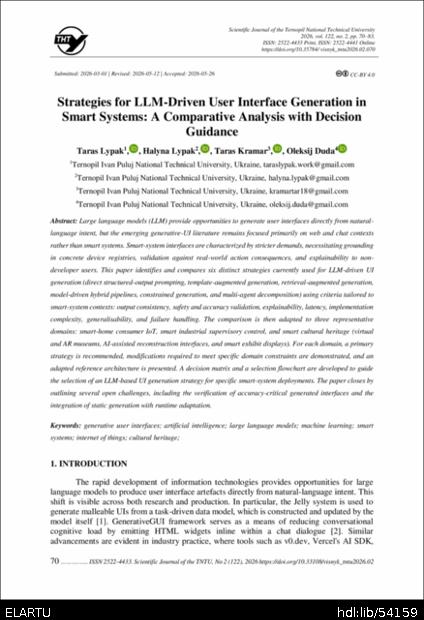
| dc.description.abstract | Large language models (LLM) provide opportunities to generate user interfaces directly from natural- language intent, but the emerging generative-UI literature remains focused primarily on web and chat contexts rather than smart systems. Smart-system interfaces are characterized by stricter demands, necessitating grounding in concrete device registries, validation against real-world action consequences, and explainability to non- developer users. This paper identifies and compares six distinct strategies currently used for LLM-driven UI generation (direct structured-output prompting, template-augmented generation, retrieval-augmented generation, model-driven hybrid pipelines, constrained generation, and multi-agent decomposition) using criteria tailored to smart-system contexts: output consistency, safety and accuracy validation, explainability, latency, implementation complexity, generalisability, and failure handling. The comparison is then adapted to three representative domains: smart-home consumer IoT, smart industrial supervisory control, and smart cultural heritage (virtual and AR museums, AI-assisted reconstruction interfaces, and smart exhibit displays). For each domain, a primary strategy is recommended, modifications required to meet specific domain constraints are demonstrated, and an adapted reference architecture is presented. A decision matrix and a selection flowchart are developed to guide the selection of an LLM-based UI generation strategy for specific smart-system deployments. The paper closes by outlining several open challenges, including the verification of accuracy-critical generated interfaces and the integration of static generation with runtime adaptation. | |
| dc.format.extent | 70-83 | |
| dc.language.iso | en | |
| dc.publisher | ТНТУ | |
| dc.publisher | TNTU | |
| dc.relation.ispartof | Вісник Тернопільського національного технічного університету, 2 (122), 2026 | |
| dc.relation.ispartof | Scientific Journal of the Ternopil National Technical University, 2 (122), 2026 | |
| dc.relation.uri | https://doi.org/10.48550/arXiv.2411.15100 | |
| dc.relation.uri | https://doi.org/10.18653/v1/2025.wnut-1.7 | |
| dc.subject | generative user interfaces | |
| dc.subject | artificial intelligence | |
| dc.subject | large language models | |
| dc.subject | machine learning | |
| dc.subject | smart systems | |
| dc.subject | internet of things | |
| dc.subject | cultural heritage | |
| dc.title | Strategies for LLM-Driven User Interface Generation in Smart Systems: A Comparative Analysis with Decision Guidance | |
| dc.type | Article | |
| dc.rights.holder | © Тернопільський національний технічний університет імені Івана Пулюя, 2026 | |
| dc.coverage.placename | Тернопіль | |
| dc.coverage.placename | Ternopil | |
| dc.format.pages | 14 | |
| dc.relation.referencesen | 1. Cao Y., Jiang P., Xia H. (2025). Generative and malleable user interfaces with generative and evolving task-driven data model, in: Proc. of the 2025 CHI Conference on Human Factors in Computing Systems, ACM, New York, 2025. DOI: 10.1145/3706598.3713285 | |
| dc.relation.referencesen | 2. Hojo N., Shinoda K., Yamazaki Y., Suzuki K., Sugiyama H., Nishida K. (2025). Saito K., GenerativeGUI: dynamic GUI generation leveraging LLMs for enhanced user interaction on chat interfaces, in: Extended Abstracts of the 2025 CHI Conference on Human Factors in Computing Systems (CHI EA '25), ACM, New York, 2025. DOI: 10.1145/3706599.3719743 | |
| dc.relation.referencesen | 3. Carrera-Rivera A., Larrinaga F., Lasa G., Martinez-Arellano G., Unamuno G. (2024) AdaptUI: a framework for the development of adaptive user interfaces in smart product-service systems. User Modeling and User-Adapted Interaction, 34, pp. 1929–1980. DOI: 10.1007/s11257-024-09414-0. | |
| dc.relation.referencesen | 4. King E., Yu H., Lee S., Julien C. (2024) Sasha: creative goal-oriented reasoning in smart homes with large language models, Proceedings of the ACM on Interactive, Mobile. Wearable and Ubiquitous Technologies, 8. DOI: 10.1145/3643505 | |
| dc.relation.referencesen | 5. Amershi S., Weld D., Vorvoreanu M., Fourney A., Nushi B., Collisson P., Suh J., Iqbal S., Bennett P. N., Inkpen K., Teevan J., Kikin-Gil R., Horvitz E. (2019). Guidelines for human-AI interaction, in: Proc. of the 2019 CHI Conference on Human Factors in Computing Systems, ACM, New York, pp. 1–13. DOI: 10.1145/3290605.3300233 | |
| dc.relation.referencesen | 6. Brdnik S., Heričko T., Šumak B. (2022) Intelligent user interfaces and their evaluation: a systematic mapping study. Sensors, 22, 5830. DOI: 10.3390/s22155830 | |
| dc.relation.referencesen | 7. Laitaruk I., Mamchych I. (2025) Some methodological conclusions about the generative АI model data analyst. Scientific Journal of TNTU, vol. 120, no. 4, pp. 130–140. DOI: doi.org/10.33108/visnyk_tntu2025.04.130. | |
| dc.relation.referencesen | 8. Calvary G., Coutaz J., Thevenin D., Limbourg Q., Bouillon L., Vanderdonckt J. (2003) A unifying reference framework for multi-target user interfaces. Interacting with Computers, 15, pp. 289–308. DOI: 10.1016/S0953-5438(03)00010-9. | |
| dc.relation.referencesen | 9. Todi K., Bailly G., Leiva L. A., Oulasvirta A. (2021). Adapting user interfaces with model-based reinforcement learning, in: Proc. of the 2021 CHI Conference on Human Factors in Computing Systems, ACM, New York, 2021. DOI: 10.1145/3411764.3445497. | |
| dc.relation.referencesen | 10. Liu M. X., Yang J., Li T. J.-J., Reza K. K., Terry M. (2024). We need structured output: towards user-centered constraints on large language model output, in: Extended Abstracts of the 2024 CHI Conference on Human Factors in Computing Systems (CHI EA '24), ACM, New York, 2024. DOI: 10.1145/3613905.3650756. | |
| dc.relation.referencesen | 11. Dong Y., Ruan C. F., Cai Y., Lai R., Xu Z., Zhao Y., Chen T. (2025). XGrammar: flexible and efficient structured generation engine for large language models, in: Proc. of Machine Learning and Systems (MLSys 2025), 2025. https://doi.org/10.48550/arXiv.2411.15100 | |
| dc.relation.referencesen | 12. Vasic I., Fill H.-G., Quattrini R., Pierdicca R. (2025). Knowledge graphs vs. large language models: competitors or partners in supporting virtual museums, ACM Journal on Computing and Cultural Heritage. DOI: 10.1145/3756016. | |
| dc.relation.referencesen | 13. Fakih M., Dharmaji R., Moghaddas Y., Quiros Araya G., Ogundare O., Faruque M. A. Al (2024). LLM4PLC: harnessing large language models for verifiable programming of PLCs in industrial control systems, in: Proc. of the 46th International Conference on Software Engineering: Software Engineering in Practice (ICSE-SEIP '24), ACM, New York, pp. 192–203. DOI: 10.1145/3639477.3639743. | |
| dc.relation.referencesen | 14. Xia Y., Jazdi N., Zhang J., Shah C., Weyrich M., Control Industrial Automation System with Large Language Model Agents, in 2025 IEEE 30th International Conference on Emerging Technologies and Factory Automation (ETFA) (pp. 1–8). IEEE. DOI: 10.48550/arXiv.2409.18009. | |
| dc.relation.referencesen | 15. Birkmose R., Reece N. M., Norvin E. H., Bjerva J., Zhang M. (2025). On-device LLMs for home assistant: dual role in intent detection and response generation, in: Proc. of the Tenth Workshop on Noisy and User-generated Text (W-NUT 2025), ACL, 2025, pp. 57–67. https://doi.org/10.18653/v1/2025.wnut-1.7. | |
| dc.relation.referencesen | 16. Gallo S., Paternò F., Malizia A. (2024). A conversational agent for creating automations exploiting large language models, Personal and Ubiquitous Computing, 2024. DOI: 10.1007/s00779-024-01825-5. | |
| dc.relation.referencesen | 17. Mountantonakis M., Tzitzikas Y. (2025) Generating SPARQL queries over CIDOC-CRM using a two-stage ontology path patterns method in LLM prompts. ACM Journal on Computing and Cultural Heritage, 18 (1), pp. 1–20. DOI: 10.1145/3708326. | |
| dc.relation.referencesen | 18. Lypak H., Kunanets N., Veretennikova N., Matsiuk H., Kramar T., Duda O. (2023). An Information System Project Using Augmented Reality for a Small Local History Museum, in: 2023 IEEE 18th International Conference on Computer Science and Information Technologies (CSIT), Lviv 2023, pp. 1–4. ISSN 27663655. DOI: 10.1109/CSIT61576.2023.10324194 | |
| dc.relation.referencesen | 19. Lypak H., Lypak T., Kunanets N. (2024) Designing a Machine Learning-Based Information System for Preserving and Classifying Documentary Heritage Artifacts, Herald of Khmelnytskyi National University. Technical Sciences, vol. 339, no. 4, pp. 176–182. ISSN 2307-5732. DOI: 10.31891/2307-5732-2024-339-4-29. | |
| dc.identifier.doi | https://doi.org/10.35784/ visnyk_tntu2026.02.070 | |
| dc.contributor.affiliation | Ternopil Ivan Puluj National Technical University, Ukraine | |
| dc.citation.journalTitle | Вісник Тернопільського національного технічного університету | |
| dc.citation.volume | 122 | |
| dc.citation.issue | 2 | |
| dc.citation.spage | 70 | |
| dc.citation.epage | 83 | |
| dc.identifier.citation2015 | Strategies for LLM-Driven User Interface Generation in Smart Systems: A Comparative Analysis with Decision Guidance / Lypak T. та ін. // Scientific Journal of TNTU, Ternopil. 2026. Vol 122. No 2. P. 70–83. | |
| dc.identifier.citationenAPA | Lypak, T., Lypak, H., Kramar, T., & Duda, O. (2026). Strategies for LLM-Driven User Interface Generation in Smart Systems: A Comparative Analysis with Decision Guidance. Scientific Journal of the Ternopil National Technical University, 122(2), 70-83. TNTU.. | |
| dc.identifier.citationenCHICAGO | Lypak T., Lypak H., Kramar T., Duda O. (2026) Strategies for LLM-Driven User Interface Generation in Smart Systems: A Comparative Analysis with Decision Guidance. Scientific Journal of the Ternopil National Technical University (Tern.), vol. 122, no 2, pp. 70-83. | |
| Występuje w kolekcjach: | Вісник ТНТУ, 2026, № 2 (122) | |
Pliki tej pozycji:
| Plik | Opis | Wielkość | Format | |
|---|---|---|---|---|
| TNTUSJ_2026v122n2_Lypak_T-Strategies_for_LLM_Driven_User_70-83.pdf | 4,99 MB | Adobe PDF | Przeglądanie/Otwarcie | |
| TNTUSJ_2026v122n2_Lypak_T-Strategies_for_LLM_Driven_User_70-83__COVER.png | 1,05 MB | image/png | Przeglądanie/Otwarcie |
Pozycje DSpace są chronione prawami autorskimi