
Будь ласка, використовуйте цей ідентифікатор, щоб цитувати або посилатися на цей матеріал:
http://elartu.tntu.edu.ua/handle/lib/51973
Повний запис метаданих
| Поле DC | Значення | Мова |
|---|---|---|
| dc.contributor.advisor | Ясній, Олег Петрович | - |
| dc.contributor.author | Демчик, Владислав Іванович | - |
| dc.contributor.author | Demchyk, V.I. | - |
| dc.date.accessioned | 2026-03-26T13:20:41Z | - |
| dc.date.available | 2026-03-26T13:20:41Z | - |
| dc.date.issued | 2026 | - |
| dc.date.submitted | 2026 | - |
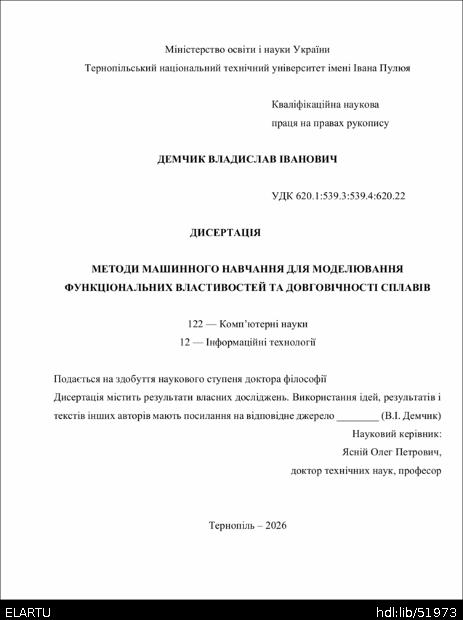
| dc.identifier.citation | Демчик В. І. Методи машинного навчання для моделювання функціональних властивостей та довговічності сплавів : дис. ... доктора філософії : 122. Тернопіль, 2026. 142 с. | uk_UA |
| dc.identifier.uri | http://elartu.tntu.edu.ua/handle/lib/51973 | - |
| dc.description | Подається на здобуття наукового ступеня доктора філософії. Дисертація містить результати власних досліджень. Використання ідей, результатів і текстів інших авторів мають посилання на відповідне джерело. | uk_UA |
| dc.description.abstract | Демчик В.І. Методи машинного навчання для моделювання функціональних властивостей та довговічності сплавів. — Кваліфікаційна наукова праця на правах рукопису. Дисертація на здобуття наукового ступеня доктора філософії за спеціальністю 122 “Комп'ютерні науки” (галузь знань 12 “Інформаційні технології”). — Тернопільський національний технічний університет імені Івана Пулюя, Тернопіль, 2026. Стрімкий розвиток інформаційних технологій зумовив експоненційне зростання обсягів даних, що потребують сучасних методів їхнього аналізу та обробки. Проведення експериментальних досліджень у галузях механіки деформівного твердого тіла, фізики твердого тіла та матеріалознавства часто є фінансово затратним, тривалим і науковоємним процесом. Тому застосовування методів машинного навчання на основі достатнього масиву експериментальних даних постає як ефективна альтернатива прямим експериментам. Особливий інтерес у матеріалознавстві та механіці становлять сплави з пам’яттю форми, які поєднують унікальні функціональні властивості ‒ ефект пам’яті форми та псевдопружність, що виникають унаслідок аустенітно-мартенситного перетворення. Дослідження та моделювання цих властивостей є актуальним завданням, яке доцільно розв’язувати методами машинного навчання з учителем. Аналіз сучасного стану наукових робіт показав, що, хоча існує низка підходів до застосування машинного навчання у механіці та матеріалознавстві, питання прогнозування функціональних характеристик сплавів з пам’яттю форми та їхньої втомної довговічності залишаються недостатньо висвітленими. Це визначає актуальність розроблення нових методів, що базуються на алгоритмах машинного навчання з учителем, для моделювання та прогнозування властивостей і довговічності таких матеріалів. У першому розділі дисертаційної роботи детально розглянуто сплави з пам’яттю форми та їх функціональні властивості: відновлення, псевдопружність та висока демпфуюча здатність, котрі успішно застосовують у різного роду промисловій діяльності: кріплення, з’єднання, реагуючі на температуру системи безпеки, домашні прилади, одяг, актуатори у роботах і більшість медичних та біомедичних приладів. Також згадано такі функціональні властивості: - Поведінка фазових перетворень: перехід СПФ між мартенситною та аустенітною фазами залежить від температури та рівня напружень. Таке перетворення є бездифузійним і зворотним, забезпечуючи їхню унікальну механічну поведінку. - Термічний гістерезис: температури фазових переходів під час нагрівання та охолодження відрізняються, створюючи петлі гістерезису. Це впливає на поведінку СПФ під дією термічної втоми. - Механічні та фізичні особливості: висока міцність та в’язкість. Приміром, СПФ на основі нітинолу можуть досягати межі міцності понад 1200 МПа і видовжуватися більше 10 %, не зазнаючи при цьому руйнування. - Стійкість до корозії та біосумісність: СПФ, а особливо NiTi сплави добре підходять для медичних імплантатів внаслідок своєї стійкості до корозії та сумісності із тканинами тіла. - Втомна поведінка: їхня поведінка за дії циклічного навантаження залежить від фази, температур переходу та мікроструктурної морфології. Проаналізовано різноманітні методи машинного навчання та їх застосування у різних галузях науки і техніки. Зокрема, наведено їхні можливості для прогнозування властивостей сплавів з пам’яттю форми та для моделювання довговічності. У другому розділі дисертаційної роботи описано методику прогнозування функціональних властивостей СПФ методами машинного навчання, котра потрібна для побудови відповідних регресійних залежностей на основі відповідних алгоритмів. Основними аспектами дослідження були система аналізу даних Orange, попередня обробка даних та аугментація відповідного набору даних. Як основний інструмент аналізу даних використовували програмне середовище Orange, котре дозволило здійснити повний цикл інтелектуального аналізу даних та побудувати відповідні регресійні залежності методами машинного навчання з учителем. Наведено методику попередньої обробки даних на основі перетворення ознаки у діапазон [0, 1], що дозволило побудувати ефективні моделі машинного навчання, зокрема, нейронні мережі. Також представлено методики аугментації набору даних на основі кубічних сплайнів, методу інтерполяції Акіма та модифікованого методу makima. Подано загальну методику прогнозування функціональних властивостей СПФ у вигляді блок- схеми, яка відображає основні кроки побудови відповідних регресійних залежностей. Описані методики забезпечують високу точність прогнозування, що є фундаментом для науково обґрунтованих висновків та рекомендацій. Описано метод k найближчих сусідів, метод опорних векторів, метод випадкових лісів, метод градієнтного спуску, методи бустінгу та метод нейронних мереж. У третьому розділі дисертаційної роботи змодельовано та отримано регресійні залежності розмаху залишкових деформацій та розмаху розсіяної енергії для чотирьох досліджуваних зразків методом k найближчих сусідів, а також методом опорних векторів, методом стохастичного градієнтного спуску, випадковими лісами, нейронними мережами, градієнтним бустінгом та AdaBoost. Серед усіх досліджених методів, метод k найближчих сусідів, AdaBoost, градієнтний бустінг і випадковий ліс показали найкращі результати у термінах похибки прогнозування. Змодельовано функціональні властивості NiTi СПФ методами машинного навчання з учителем. Моделювання здійснено у програмному комплексі аналізу даних Orange. Функціональні властивості СПФ, а саме, розмах розсіяної енергії, деформацій та напружень змодельовано методами kNN, AdaBoost, Random Forest, Gradient Boosting, Neural Network. Отримано відповідні регресійні залежності і здійснено крос-валідацію результатів. Отримано помилки результатів і коефіцієнт детермінації моделюванням методами МН з учителем для розмаху енергії, напружень та деформацій залежно від кількості циклів навантаження, відповідно. Для кожної фізичної величини найкращі результати у термінах помилок одержано методом k найближчих сусідів. Застосовано НМ для прогнозування втомної довговічності елементів конструкцій, виконаних із титанових сплавів за дії циклічного навантаження. Зокрема, запропонована модель, котра ґрунтується на багатошаровому персептроні, прогнозує довжину втомної тріщини з високою точністю. Помилка прогнозування не перевищує 0,4 % для тестового набору даних, що вказує на можливість моделі відтворювати фізичні закони. НМ показала здатність адаптуватися до різних коефіцієнтів асиметрії циклу навантаження R = 0,03; 0,1; 0,3 та умов навантаження. Відсутність значних відхилень між навчальними та тестовими наборами даних підтверджує той факт, що модель не схильна до перенавчання і добре узагальнює на нових даних. Запропонована модель дозволяє точно оцінювати залишковий ресурс матеріалу елемента конструкції і дозволяє приймати рішення щодо ремонту та подальшої експлуатації елемента конструкції. Таким чином, побудована НМ дозволяє поєднувати традиційні моделі механіки руйнування з методами машинного навчання, збільшуючи точність прогнозування та зменшуючи залежність від розкиду експериментальних даних. Результати моделювання свідчать про ефективність запропонованої моделі для оцінки втомної поведінки елементів конструкцій за циклічного навантаження, зменшуючи ризик катастрофічних руйнувань в умовах експлуатації реального світу Побудовано математичну модель опису петель гістерезису сплаву із пам’яттю форми, яка ґрунтується на методі найменших квадратів. Запропонований підхід дозволяє отримати залежності гістерезисної поведінки матеріалу на основі експериментальних даних. Встановлено, що модель досить добре описує діаграми деформування сплавів із пам’яттю форми. Змодельовано розсіяну енергію нікельтитанового сплаву СПФ методами машинного навчання з учителем, врахувавши частоту циклу навантаження. Набір даних складався з петель гістерезису для шести частот циклу навантаження 0,1; 0,5; 1; 5; 7 та 10 Гц. Вхідні дані складалися з наступних ознак: напруження (МПа), номер циклу навантаження N та частота циклу навантаження f (Гц). Ґрунтуючись на цих даних, для кожного циклу навантаження і для кожної частоти навантаження, обчислено розсіяну енергію. Для того, аби додатково збільшити набір даних, його інтерпольовано модифікованим методом інтерполяції makima. Загалом, побудовано чотири моделі машинного навчання методами Random Forest, AdaBoost, Gradient Boosting та Neural Network. Для досліджуваного набору даних методи Gradient Boosting та Neural Network демонструють більші значення похибки прогнозування порівняно з ансамблевими методами. Тому згадані вище методи не підходять для розв’язування конкретної задачі. Найкращі результати показали ансамблеві методи, такі як AdaBoost та Random Forest. Приміром, MAPE методу AdaBoost становила тільки 0,074, тоді як MAPE методу Random Forest складала 0,144. | uk_UA |
| dc.description.abstract | The rapid development of information technology has led to exponential growth in data volume, requiring modern methods of analysis and processing. Conducting experimental research in the fields of deformable solid mechanics, solid physics, and materials science is often financially costly, long-term, and science-intensive. Therefore, the application of machine learning methods based on a sufficient dataset of experimental data appears to be an effective alternative to direct experiments. Of particular interest in materials science and mechanics are shape memory alloys (SMAs), which combine unique functional properties - the shape memory effect and superelasticity, which arise because of the austenitic-martensitic transformation. Research and modelling of these properties is a relevant task best addressed with supervised machine learning methods. The analysis of current scientific studies showed that although several approaches to applying machine learning in mechanics and materials science exist, the prediction of the functional characteristics of shape memory alloys and their fatigue durability remains insufficiently covered. This determines the relevance of developing new methods based on supervised machine learning algorithms to model and predict the properties and durability of such materials. The first chapter of the dissertation discusses in detail shape memory alloys and their functional properties: recovery, superelasticity, and high damping capacity, which are successfully used in various types of industrial activities: fasteners, connections, The rapid development of information technology has led to exponential growth in data volume, requiring modern methods of analysis and processing. Conducting experimental research in the fields of deformable solid mechanics, solid physics, and materials science is often financially costly, long-term, and science-intensive. Therefore, the application of machine learning methods based on a sufficient dataset of experimental data appears to be an effective alternative to direct experiments. Of particular interest in materials science and mechanics are shape memory alloys (SMAs), which combine unique functional properties - the shape memory effect and superelasticity, which arise because of the austenitic-martensitic transformation. Research and modelling of these properties is a relevant task best addressed with supervised machine learning methods. The analysis of current scientific studies showed that although several approaches to applying machine learning in mechanics and materials science exist, the prediction of the functional characteristics of shape memory alloys and their fatigue durability remains insufficiently covered. This determines the relevance of developing new methods based on supervised machine learning algorithms to model and predict the properties and durability of such materials. The first chapter of the dissertation discusses in detail shape memory alloys and their functional properties: recovery, superelasticity, and high damping capacity, which are successfully used in various types of industrial activities: fasteners, connections, The rapid development of information technology has led to exponential growth in data volume, requiring modern methods of analysis and processing. Conducting experimental research in the fields of deformable solid mechanics, solid physics, and materials science is often financially costly, long-term, and science-intensive. Therefore, the application of machine learning methods based on a sufficient dataset of experimental data appears to be an effective alternative to direct experiments. Of particular interest in materials science and mechanics are shape memory alloys (SMAs), which combine unique functional properties - the shape memory effect and superelasticity, which arise because of the austenitic-martensitic transformation. Research and modelling of these properties is a relevant task best addressed with supervised machine learning methods. The analysis of current scientific studies showed that although several approaches to applying machine learning in mechanics and materials science exist, the prediction of the functional characteristics of shape memory alloys and their fatigue durability remains insufficiently covered. This determines the relevance of developing new methods based on supervised machine learning algorithms to model and predict the properties and durability of such materials. The first chapter of the dissertation discusses in detail shape memory alloys and their functional properties: recovery, superelasticity, and high damping capacity, which are successfully used in various types of industrial activities: fasteners, connections, temperature-responsive security systems, household appliances, clothing, actuators in robots, and most medical and biomedical devices. The following functional properties are also mentioned: - Behaviour of phase transformations: the transition of shape memory alloys between the martensitic and austenitic phases depends on temperature and stress. This transformation is diffusionless and reversible, providing their unique mechanical behavior. - Thermal hysteresis: the phase transition temperatures differ between heating and cooling, creating hysteresis loops. This affects the SMA's behaviour under thermal fatigue. - Mechanical and physical properties: high strength and toughness. For example, Nitinol-based SMA can reach a tensile strength of more than 1200 MPa and elongate by more than 10% without failure. - Corrosion resistance and biocompatibility: SMA and, especially, NiTi alloys are well-suited for medical implants due to their corrosion resistance and compatibility with body tissues. - Fatigue behaviour: their behaviour under cyclic loading depends on the phase, transition temperatures, and microstructural morphology. Various machine learning methods and their applications in different fields of science and technology are analysed. Their capabilities for predicting the properties of shape memory alloys and for modelling durability are presented. The second chapter of the dissertation describes the methodology for predicting the functional properties of SMAs using machine learning methods, which is necessary for constructing the corresponding regression dependencies based on the corresponding algorithms. The main aspects of the study were the Orange data analysis system, data preprocessing, and data set augmentation. The Orange software environment served as the primary tool for data analysis, enabling a full cycle of intelligent analysis and the construction of corresponding regression models using supervised machine learning methods. A data preprocessing methodology that transforms features to the range [0, 1] is presented, enabling the construction of effective machine learning models, in particular neural networks. Also presented are methods for augmenting the dataset based on cubic splines, the Akima interpolation method, and the modified makima method. A general method for predicting the functional properties of SMAs is presented as a flowchart outlining the main steps for constructing the corresponding regression models. The described methods provide high prediction accuracy, which is the foundation for scientifically sound conclusions and recommendations. The k-nearest neighbours method, support vector method, random forest method, gradient descent method, boosting methods, and neural network method are described. In the third chapter of the dissertation, the regression dependences of the residual strain amplitude and the dissipated energy amplitude for the four studied samples were modelled and obtained by the k-nearest neighbours method, as well as by the support vector method, the stochastic gradient method, random forests, neural networks, gradient boosting, and AdaBoost. Among the studied methods, k-nearest neighbours, AdaBoost, gradient boosting, and random forest yielded the best results in terms of prediction error. The functional properties of NiTi SMA are modelled using supervised machine learning. The modelling was carried out in the Orange data analysis software package. The functional properties of the SMA, namely the ranges of dissipated energy, strains, and stresses, were modelled using kNN, AdaBoost, Random Forest, Gradient Boosting, and Neural Networks. The corresponding regression dependencies were obtained, and the results were cross-validated. The errors in the results and the coefficient of determination from modelling using supervised ML methods, across ranges of energy, stresses, and strains, were obtained for different numbers of load cycles. For each physical quantity, the k-nearest neighbours method yielded the lowest errors. The functional properties of NiTi SMA are modelled using supervised machine learning. The modelling was carried out in the Orange data analysis software package. The functional properties of the SMA, namely the ranges of dissipated energy, strains, and stresses, were modelled using kNN, AdaBoost, Random Forest, Gradient Boosting, and Neural Networks. The corresponding regression dependencies were obtained, and the results were cross-validated. The errors in the results and the coefficient of determination from modelling using supervised ML methods, across ranges of energy, stresses, and strains, were obtained for different numbers of load cycles. For each physical quantity, the k-nearest neighbours method yielded the lowest errors. NM was applied to predict the fatigue life of structural elements made of titanium alloys under cyclic loading. In particular, the proposed multilayer perceptron-based model predicts fatigue crack length with high accuracy. The prediction error does not exceed 0.4% on the test data set, indicating the model's ability to reproduce physical laws. The NM showed the ability to adapt to different load cycle asymmetry coefficients, R = 0.03, 0.1, and 0.3, and loading conditions. The absence of significant deviations between the training and test data sets confirms the fact that the model is not prone to overtraining and generalizes well to new data. The proposed model enables an accurate assessment of the residual resource of the structural element material and allows conclusions to be drawn about its repair and functionality. Thus, the constructed neural network allows combining traditional fracture mechanics models with machine learning methods, thereby increasing prediction accuracy and reducing dependence on experimental data scatter. The proposed model is a reliable tool for assessing the fatigue behaviour of structural elements under cyclic loading, reducing the risk of catastrophic failures in real-world operating conditions. A mathematical model for describing the hysteresis loops of an alloy with shape memory, based on the least squares method, has been constructed. The proposed approach allows determining the material's hysteretic behavior dependencies from experimental data. It was established that the model describes the deformation diagrams of shape memory alloys quite well. The dissipated energy of the nickel-titanium alloy SMAs was modelled using supervised machine learning methods, accounting for the loading cycle frequency. The data set consisted of hysteresis loops for six loading cycle frequencies: 0.1, 0.5, 1, 5, 7, and 10 Hz. The input data consisted of the following features: stress (MPa), loading cycle number N, and loading cycle frequency f (Hz). Based on these data, the dissipated energy was calculated for each loading cycle and for each loading frequency. To further increase the data set, it was interpolated using the modified makima interpolation method. In total, four machine learning models were built using the Random Forest, AdaBoost, Gradient Boosting and Neural Network methods. It was found that Gradient Boosting and Neural Network methods are not suitable for this dataset, since the prediction errors are quite large. Therefore, the above-mentioned methods are not suitable for solving a specific problem. The best results were shown by ensemble methods such as AdaBoost and Random Forest. For example, the MAPE of the AdaBoost method was only 0.074, while the MAPE of the Random Forest method was 0.144. | uk_UA |
| dc.description.tableofcontents | ВСТУП ...16 РОЗДІЛ 1 ЛІТЕРАТУРНИЙ ОГЛЯД...21 1.1. Сплави з пам'яттю форми ...21 1.2. Функціональні властивості сплавів з пам'яттю форми ...25 1.3. Сплави з пам’яттю форми та машинне навчання ...26 1.4. Прогнозування властивостей СПФ методами машинного навчання ...32 1.5. Моделювання довговічності методами машинного навчання ...34 1.6. Висновки до розділу 1 ...36 РОЗДІЛ 2 МЕТОДИКА ПРОГНОЗУВАННЯ ФУНКЦІОНАЛЬНИХ ВЛАСТИВОСТЕЙ СПФ МАШИННИМ НАВЧАННЯМ ...37 2.1. Система аналізу даних Orange ...37 2.3. Аугментація набору даних... 40 2.4. Методика моделювання функціональних властивостей СПФ ...41 2.5. Основні метрики методів машинного навчання ...46 2.6. Методи машинного навчання ...48 2.6.1. Метод k найближчих сусідів ...51 2.6.2. Метод опорних векторів ...57 2.6.3. Метод випадкових лісів ...65 2.6.4. Метод градієнтного спуску ...67 2.6.5. Методи бустінгу ...68 2.6.6. Метод нейронних мереж ...70 2.6.7. Архітектура нейронних мереж та методи їх навчання ...76 2.7. Висновки до розділу 2 ...83 РОЗДІЛ 3 МОДЕЛЮВАННЯ ФУНКЦІОНАЛЬНИХ ВЛАСТИВОСТЕЙ СПФ ТА ДОВГОВІЧНОСТІ ТИТАНОВОГО СПЛАВУ ...85 3.1. Моделювання розмаху розсіяної енергії, напружень та деформацій СПФ 85 3.2. Моделювання розмаху залишкових деформацій та розмаху розсіяної енергії СПФ ...89 3.3. Моделювання втомної довговічності титанового сплаву ...102 3.4. Моделювання гістерезисної поведінки СПФ ...111 3.5. Моделювання функціональних властивостей СПФ з урахуванням частоти навантаження ...116 3.6. Висновки до розділу 3 ...119 ВИСНОВКИ ...122 СПИСОК ВИКОРИСТАНИХ ДЖЕРЕЛ ...124 Додатки ...139 Додаток А ...139 Додаток Б ...141 Додаток В ...142 | uk_UA |
| dc.language.iso | uk | uk_UA |
| dc.publisher | Тернопільський національний технічний університет ім. І. Пулюя | uk_UA |
| dc.subject | набір даних | uk_UA |
| dc.subject | dataset | uk_UA |
| dc.subject | наука про дані | uk_UA |
| dc.subject | data science | uk_UA |
| dc.subject | нейронні мережі | uk_UA |
| dc.subject | neural networks | uk_UA |
| dc.subject | MLP | uk_UA |
| dc.subject | MLP | uk_UA |
| dc.subject | штучний інтелект | uk_UA |
| dc.subject | artificial intelligence | uk_UA |
| dc.subject | машинне навчання | uk_UA |
| dc.subject | machine learning | uk_UA |
| dc.subject | функціональні властивості | uk_UA |
| dc.subject | functional properties | uk_UA |
| dc.subject | регресія | uk_UA |
| dc.subject | regression | uk_UA |
| dc.subject | випадковий ліс | uk_UA |
| dc.subject | random forest | uk_UA |
| dc.subject | нейронна мережа | uk_UA |
| dc.subject | neural network | uk_UA |
| dc.subject | метали | uk_UA |
| dc.subject | metals | uk_UA |
| dc.subject | моделювання | uk_UA |
| dc.subject | modelling | uk_UA |
| dc.subject | апроксимація | uk_UA |
| dc.subject | approximation | uk_UA |
| dc.subject | алгоритм | uk_UA |
| dc.subject | algorithm | uk_UA |
| dc.subject | сплави | uk_UA |
| dc.subject | alloys | uk_UA |
| dc.title | Методи машинного навчання для моделювання функціональних властивостей та довговічності сплавів | uk_UA |
| dc.title.alternative | Machine learning methods for modeling of functional properties and lifetime of alloys | uk_UA |
| dc.type | Dissertation | uk_UA |
| dc.rights.holder | © Демчик Владислав Іванович, 2026 | uk_UA |
| dc.coverage.placename | Тернопіль | uk_UA |
| dc.format.pages | 142 | - |
| dc.subject.udc | 620.1:539.3:539.4:620.22 | uk_UA |
| thesis.degree.discipline | 122 | - |
| thesis.degree.level | докторська дисертація | - |
| thesis.degree.name | доктор філософії | - |
| dc.relation.references | [1] L. G. Machado and D. C. Lagoudas, Shape Memory Alloys. Modeling of SMAs. Springer, 2008. doi: 10.1007/978-0-387-47685-8. | - |
| dc.relation.references | [2] P. Ghosh, A. Rao, and A. R. Srinivasa, “Design of multi-state and smart-bias components using shape memory alloy and shape memory polymer composites,” Mater. Des., vol. 44, pp. 164–171, 2013, doi: 10.1016/j.matdes.2012.05.063. | - |
| dc.relation.references | [3] L. A. Momoda, Frontiers of Engineering. National Academies Press, 2005. doi: 10.17226/11220. | - |
| dc.relation.references | [4] J. N. Rao, Ashwin and Srinivasa, Arun Ramaswamy and Reddy, “Design of shape memory alloy (SMA) actuators,” 2015, doi: 10.1007/978-3-319-03188-0. | - |
| dc.relation.references | [5] S. H. Mohammed and S. H. Shahatha, “Shape memory alloys, properties and applications: A review,” AIP Conf. Proc., vol. 2593, May 2023, doi: 10.1063/5.0112999/17764437/020008_1_5.0112999.PDF. | - |
| dc.relation.references | [6] K. Otsuka and X. Ren, “Recent developments in the research of shape memory alloys,” Intermetallics, vol. 7, no. 5, pp. 511–528, May 1999, doi: 10.1016/S0966- 9795(98)00070-3. | - |
| dc.relation.references | [7] R. Hmede, F. Chapelle, and Y. Lapusta, “Review of Neural Network Modeling of Shape Memory Alloys,” Sensors, vol. 22, no. 15, Aug. 2022, doi: 10.3390/S22155610. | - |
| dc.relation.references | [8] J. Mohd Jani, M. Leary, A. Subic, and M. A. Gibson, “A review of shape memory alloy research, applications and opportunities,” Mater. Des., vol. 56, pp. 1078–1113, Apr. 2014, doi: 10.1016/J.MATDES.2013.11.084. | - |
| dc.relation.references | [9] W. Huang, “On the selection of shape memory alloys for actuators,” Mater. Des., vol. 23, no. 1, pp. 11–19, Feb. 2002, doi: 10.1016/S0261-3069(01)00039-5. | - |
| dc.relation.references | [10] A. Fink, Z. Fu, and C. Körner, “Functional properties and shape memory effect of Nitinol manufactured via electron beam powder bed fusion,” Materialia, vol. 30, p. 101823, Aug. 2023, doi: 10.1016/J.MTLA.2023.101823. | - |
| dc.relation.references | [11] M. Elahinia, N. Shayesteh Moghaddam, M. Taheri Andani, A. Amerinatanzi, B. A. Bimber, and R. F. Hamilton, “Fabrication of NiTi through additive manufacturing: A review,” Prog. Mater. Sci., vol. 83, pp. 630–663, Oct. 2016, doi: 10.1016/J.PMATSCI.2016.08.001. | - |
| dc.relation.references | [67] P. Yasnii, O. Pastukh, Y. Pyndus, N. S. Lutsyk, and I. S. Didych, “Prediction of the Diagrams of Fatigue Fracture of D16T Aluminum Alloy by the Methods of Machine Learning,” Mater. Sci., vol. 54, no. 3, pp. 333–338, Nov. 2018, doi: 10.1007/S11003- 018-0189-9. | - |
| dc.relation.references | [68] J. R. Mohanty, B. B. Verma, D. R. K. Parhi, and P. K. Ray, “Application of Artificial Neural Network for Predicting Fatigue Crack Propagation Life of Aluminum Alloys,” 2009, Accessed: Mar. 03, 2026. [Online]. Available: http://dspace.nitrkl.ac.in:8080/dspace/handle/2080/1024 | - |
| dc.relation.references | [69] R. M. V. Pidaparti and M. J. Palakal, “Neural network approach to fatigue-crack- growth predictions under aircraft spectrum loadings,” https://doi.org/10.2514/3.46797, vol. 32, no. 4, pp. 825–831, May 1995, doi: 10.2514/3.46797. | - |
| dc.relation.references | [70] K. Zarrabi, W. W. Lu, and A. K. Hellier, “An artificial neural network approach to fatigue crack growth,” Adv. Mater. Res., vol. 275, pp. 3–6, 2011, doi: 10.4028/WWW.SCIENTIFIC.NET/AMR.275.3. | - |
| dc.relation.references | [71] S. Liu, Y., Mahadevan, “An Artificial Neural Network-Based Algorithm for Evaluation of Fatigue Crack Growth,” Int. J. Fatigue, vol. 27, pp. 790–795, 2005. | - |
| dc.relation.references | [73] Y. Zhang, S., Chen, X., Liu, “Prediction of Fatigue–Crack Growth with Neural Network-Based Increment Learning Scheme,” Eng. Fract. Mech., vol. 250, no. 107744, 2021. | - |
| dc.relation.references | [72] Y. Murakami, H., Okazaki, “Bayesian Neural Network Analysis of Fatigue Crack Growth Rate in Nickel-Base Superalloys,” ISIJ Int., vol. 36, pp. 1373–1378, 1996. | - |
| dc.relation.references | [78] I. Konovalenko, P. Maruschak, J. Brezinová, J. Viňáš, and J. Brezina, “Steel surface defect classification using deep residual neural network,” Metals (Basel)., vol. 10, no. 6, pp. 1–15, Jun. 2020, doi: 10.3390/MET10060846. | - |
| dc.relation.references | [106] J. H. Friedman, “Greedy function approximation: A gradient boosting machine,” Ann. Stat., vol. 29, no. 5, pp. 1189–1232, 2001, doi: 10.1214/AOS/1013203451. | - |
| dc.relation.references | [123] O. Yasniy, I. Didych, D. Tymoshchuk, P. Maruschak, and V. Demchyk, “Prediction of structural elements lifetime of titanium alloy using neural network,” Procedia Struct. Integr., vol. 72, pp. 181–187, Jan. 2025, doi: 10.1016/J.PROSTR.2025.08.090. | - |
| dc.relation.references | [89] “Applications of Machine Learning - GeeksforGeeks.” Accessed: Mar. 01, 2026. [Online]. Available: https://www.geeksforgeeks.org/machine-learning/machine- learning-introduction/ | - |
| dc.relation.references | [74] R. Pratoori, “Comparison of Random Forest and Neural Network Framework for Prediction of Fatigue Crack Growth Rate in Nickel Superalloys,” 2023. | - |
| dc.relation.references | [75] A. MOUSSOUNI, N. BENACHOUR, and M. BENACHOUR, “Modeling of fatigue crack growth by neural networks,” Int. Conf. Sci. Acad. Res., vol. 1, pp. 215–219, Mar. 2023, Accessed: Mar. 03, 2026. [Online]. Available: https://as- proceeding.com/index.php/icsar/article/view/298 | - |
| dc.relation.references | [76] F. M. Monticeli, R. M. Neves, H. L. Ornaghi, and J. H. S. Almeida, “Prediction of Bending Properties for 3D-Printed Carbon Fibre/Epoxy Composites with Several Processing Parameters Using ANN and Statistical Methods,” Polymers (Basel)., vol. 14, no. 17, Sep. 2022, doi: 10.3390/POLYM14173668. | - |
| dc.relation.references | [77] O. Yasniy, M. Mytnyk, P. Maruschak, A. Mykytyshyn, and I. Didych, “MACHINE LEARNING METHODS AS APPLIED TO MODELLING THERMAL CONDUCTIVITY OF EPOXY-BASED COMPOSITES WITH DIFFERENT FILLERS FOR AIRCRAFT,” Aviation, vol. 28, no. 2, pp. 64–71, May 2024, doi: 10.3846/AVIATION.2024.21472. | - |
| dc.relation.references | [117] Y. chen Wu and J. wen Feng, “Development and Application of Artificial Neural Network,” Wirel. Pers. Commun., vol. 102, no. 2, pp. 1645–1656, Sep. 2018, doi: 10.1007/S11277-017-5224-X/METRICS. | - |
| dc.relation.references | [79] D. Tymoshchuk, O. Yasniy, P. Maruschak, V. Iasnii, and I. Didych, “Loading Frequency Classification in Shape Memory Alloys: A Machine Learning Approach,” Comput. 2024, Vol. 13, vol. 13, no. 12, Dec. 2024, doi: 10.3390/COMPUTERS13120339. | - |
| dc.relation.references | [108] A. Natekin and A. Knoll, “Gradient boosting machines, a tutorial,” Front Neurorobot., vol. 7, no. DEC, 2013, doi: 10.3389/FNBOT.2013.00021. | - |
| dc.relation.references | [80] O. Yasniy, I. Pasternak, I. Didych, S. Fedak, and D. Tymoshchuk, “Methods of jump-like creep modeling of AMg6 aluminum alloy,” Procedia Struct. Integr., vol. 48, pp. 149–154, 2023, doi: 10.1016/J.PROSTR.2023.07.141. | - |
| dc.relation.references | [90] P. Srisuradetchai and K. Suksrikran, “Random kernel k-nearest neighbors regression,” Front. Big Data, vol. 7, 2024, doi: 10.3389/FDATA.2024.1402384. | - |
| dc.relation.references | [86] C. C. C. Moler, “Makima Piecewise Cubic Interpolation,” Mathematics and Computing - MATLAB & Simulink. Accessed: Mar. 03, 2026. [Online]. Available: https://blogs.mathworks.com/cleve/2019/04/29/makima-piecewise-cubic- interpolation/ | - |
| dc.relation.references | [122] O. Yasniy, N. Lutsyk, V. Demchyk, H. Osukhivska, and O. Malyshevska, “The prediction of structural properties of Ni-Ti shape memory alloy by the supervised machine learning methods”. | - |
| dc.relation.references | [81] “Orange Data Mining.” Accessed: Mar. 09, 2026. [Online]. Available: https://orangedatamining.com/ | - |
| dc.relation.references | [82] С. В. Пронін and А. Д. Сотников, “ВИКОРИСТАННЯ ПЛАТФОРМИ ORANGE ДЛЯ АНАЛІЗУ ДАНИХ,” Вісник Харківського національного автомобільно- дорожнього університету, no. 99, pp. 131–131, Dec. 2022, doi: 10.30977/BUL.2219-5548.2022.99.0.131. | - |
| dc.relation.references | [83] M. Yu.A., S. T.V., and G. A.I., “Using orange technology for data mining in the education sector,” Системні технології, vol. 3, no. 152, pp. 115–127, Apr. 2024, doi: 10.34185/1562-9945-3-152-2024-12. | - |
| dc.relation.references | [84] G. Birkhoff and C. de Boor, “Piecewise Polynomial Interpolation and Approximation,” Approx. Funct. Elsevier Publ. Company, Amsterdam, pp. 164–190, 1964, Accessed: Mar. 03, 2026. [Online]. Available: https://www.scirp.org/reference/referencespapers?referenceid=171297 | - |
| dc.relation.references | [85] H. Akima, “A New Method of Interpolation and Smooth Curve Fitting Based on Local Procedures,” J. ACM, vol. 17, no. 4, pp. 589–602, Oct. 1970, doi: 10.1145/321607.321609. | - |
| dc.relation.references | [107] J. H. Friedman, “Stochastic gradient boosting,” Comput. Stat. Data Anal., vol. 38, no. 4, pp. 367–378, Feb. 2002, doi: 10.1016/S0167-9473(01)00065-2. | - |
| dc.relation.references | [127] D. Goldfarb, “A Family of Variable-Metric Methods Derived by Variational Means,” Math. Comput., vol. 24, no. 109, p. 23, Jan. 1970, doi: 10.2307/2004873. | - |
| dc.relation.references | [87] J. Liu, J. Chen, Z. Sun, H. Zhang, and Q. Yuan, “A Study on Fatigue Crack Closure Associated with the Growth of Long Crack in a New Titanium Alloy,” Metals (Basel)., vol. 13, no. 8, Aug. 2023, doi: 10.3390/MET13081377. | - |
| dc.relation.references | [88] G. James, D. Witten, T. Hastie, R. Tibshirani, and J. Taylor, “An Introduction to Statistical Learning,” 2023, doi: 10.1007/978-3-031-38747-0. | - |
| dc.relation.references | [116] R. Dastres and M. Soori, “Artificial Neural Network Systems,” Int. J. Imaging Robot., vol. 2021, no. 2, pp. 13–25, 2021, Accessed: Mar. 09, 2026. [Online]. Available: www.ceserp.com/cp-jour | - |
| dc.relation.references | [91] E. Fix and J. L. Hodges, “Discriminatory Analysis. Nonparametric Discrimination: Consistency Properties,” Int. Stat. Rev. / Rev. Int. Stat., vol. 57, no. 3, p. 238, Dec. 1989, doi: 10.2307/1403797. | - |
| dc.relation.references | [131] W. S. Cleveland, “Robust Locally Weighted Regression and Smoothing Scatterplots,” J. Am. Stat. Assoc., vol. 74, pp. 829–836, 1979. | - |
| dc.relation.references | [92] A. Smola and S. V. N. Vishwanathan, Introduction to Machine Learning. Cambridge University Press, 2010. | - |
| dc.relation.references | [93] R. Basak, D., Pal, S., Ch, D., & Patranabis, “Support Vector Regression.,” Neural Inf. Process. Rev., vol. 11, pp. 203–224, 2007, Accessed: Mar. 03, 2026. [Online]. Available: https://www.scirp.org/reference/referencespapers?referenceid=2911991 | - |
| dc.relation.references | [13] K. Otsuka, C. M. Wayman, K. Nakai, H. Sakamoto, and K. Shimizu, “Superelasticity effects and stress-induced martensitic transformations in Cu-Al-Ni alloys,” Acta Metall., vol. 24, no. 3, pp. 207–226, Mar. 1976, doi: 10.1016/0001-6160(76)90071-7. | - |
| dc.relation.references | [94] E. García-Gonzalo, Z. Fernández-Muñiz, P. J. G. Nieto, A. B. Sánchez, and M. M. Fernández, “Hard-Rock Stability Analysis for Span Design in Entry-Type Excavations with Learning Classifiers,” Mater. 2016, Vol. 9, vol. 9, no. 7, Jun. 2016, doi: 10.3390/MA9070531. | - |
| dc.relation.references | [105] W. Cao et al., “A Learning Framework for Intelligent Selection of Software Verification Algorithms,” J. Artif. Intell., vol. 2, no. 4, pp. 177–187, 2020, doi: 10.32604/JAI.2020.014829. | - |
| dc.relation.references | [95] T. M. Mitchell, Machine learning. London: McGraw-Hill Science/Engineering/Math, 1997. | - |
| dc.relation.references | [96] “www.statsoft.com Electronic Manual.” | - |
| dc.relation.references | [21] M. S. Kim et al., “Shape Memory Alloy (SMA) Actuators: The Role of Material, Form, and Scaling Effects,” Adv. Mater., vol. 35, no. 33, p. 2208517, Aug. 2023, doi: 10.1002/ADMA.202208517. | - |
| dc.relation.references | [97] T. K. Ho, “Random decision forests,” Proc. Int. Conf. Doc. Anal. Recognition, ICDAR, vol. 1, pp. 278–282, 1995, doi: 10.1109/ICDAR.1995.598994. | - |
| dc.relation.references | [14] J. H. Yang and C. M. Wayman, “Self-accomodation and shape memory mechanism of ϵ-martensite — II. Theoretical considerations,” Mater. Charact., vol. 28, no. 1, pp. 37–47, Jan. 1992, doi: 10.1016/1044-5803(92)90027-F. | - |
| dc.relation.references | [104] C. Aldrich, “Process Variable Importance Analysis by Use ofRandom Forests in a Shapley Regression Framework,” Minerals, vol. 10, pp. 2–17, 2020, doi: doi:10.3390/min10050420. | - |
| dc.relation.references | [102] M. Y. Khan, A. Qayoom, M. S. Nizami, M. S. Siddiqui, S. Wasi, and S. M. K. U. R. Raazi, “Automated Prediction of Good Dictionary EXamples (GDEX): A Comprehensive Experiment with Distant Supervision, Machine Learning, and Word Embedding-Based Deep Learning Techniques,” Complexity, vol. 2021, no. 1, p. 2553199, Jan. 2021, doi: 10.1155/2021/2553199. | - |
| dc.relation.references | [98] E. M. Kleinberg, “Stochastic discrimination,” Ann. Math. Artif. Intell., vol. 1, no. 1– 4, pp. 207–239, Sep. 1990, doi: 10.1007/BF01531079/METRICS. | - |
| dc.relation.references | [99] L. Breiman, “Random forests,” Mach. Learn., vol. 45, no. 1, pp. 5–32, Oct. 2001, doi: 10.1023/A:1010933404324/METRICS. | - |
| dc.relation.references | [15] L. Sun and W. M. Huang, “Nature of the multistage transformation in shape memory alloys upon heating,” Met. Sci. Heat Treat., vol. 51, no. 11–12, pp. 573–578, Nov. 2009, doi: 10.1007/S11041-010-9213-X. | - |
| dc.relation.references | [103] N. B. Shakhovska, R. M. Kaminsky, and O. B. Vovk, Artificial intelligence systems: textbook. manual. Lviv: Lviv Polytechnic Publishing House, 2018. | - |
| dc.relation.references | [100] Y. Amit and D. Geman, “Communicated by Shimon Ullman Shape Quantization and Recognition with Randomized Trees,” Neural Comput., vol. 9, pp. 1545–1588, 1997. | - |
| dc.relation.references | [115] J. Schmidhuber, “Deep learning in neural networks: An overview,” Neural Networks, vol. 61, pp. 85–117, Jan. 2015, doi: 10.1016/J.NEUNET.2014.09.003. | - |
| dc.relation.references | [22] X. P. Zhang, H. Y. Liu, B. Yuan, and Y. P. Zhang, “Superelasticity decay of porous NiTi shape memory alloys under cyclic strain-controlled fatigue conditions,” Mater. Sci. Eng. A, vol. 481–482, no. 1-2 C, pp. 170–173, May 2008, doi: 10.1016/J.MSEA.2007.02.147. | - |
| dc.relation.references | [101] G. Biau and G. B. Fr, “Analysis of a Random Forests Model,” J. Mach. Learn. Res., vol. 13, pp. 1063–1095, 2012. | - |
| dc.relation.references | [12] G. Song, N. Ma, and H. N. Li, “Applications of shape memory alloys in civil structures,” Eng. Struct., vol. 28, no. 9, pp. 1266–1274, Jul. 2006, doi: 10.1016/J.ENGSTRUCT.2005.12.010. | - |
| dc.relation.references | [126] FLETCHER R, “A new approach to variable metric algorithms,” Comput. J., vol. 13, no. 3, pp. 317–322, Jan. 1970, doi: 10.1093/COMJNL/13.3.317. | - |
| dc.relation.references | [121] V. Demchyk and O. Yasniy, “Modelling of functional properties of shape memory alloy by machine learning methods,” Sci. J. Ternopil Natl. Tech. Univ., vol. 119, no. 3, pp. 56–62, 2025, doi: 10.33108/VISNYK_TNTU2025.03.056. | - |
| dc.relation.references | [16] J. P. Oliveira, R. M. Miranda, and F. M. Braz Fernandes, “Welding and Joining of NiTi Shape Memory Alloys: A Review,” Prog. Mater. Sci., vol. 88, pp. 412–466, Jul. 2017, doi: 10.1016/J.PMATSCI.2017.04.008. | - |
| dc.relation.references | [17] T. W. Duerig and K. Bhattacharya, “The Influence of the R-Phase on the Superelastic Behavior of NiTi,” Shape Mem. Superelasticity, vol. 1, no. 2, pp. 153–161, Jun. 2015, doi: 10.1007/S40830-015-0013-4/FIGURES/13. | - |
| dc.relation.references | [18] Mihálcz I., “FUNDAMENTAL CHARACTERISTICS AND DESIGN METHOD FOR NICKEL-TITANIUM SHAPE MEMORY ALLOY,” Period. Polytech. Mech. Eng., vol. 45, no. 1, pp. 75–86, Feb. 2001, doi: n/a. | - |
| dc.relation.references | [20] Ľ. Miková, S. Medvecká-Beňová, M. Kelemen, F. Trebuňa, and I. Virgala, “APPLICATION OF SHAPE MEMORY ALLOY (SMA) AS ACTUATOR,” METALURGIJA, vol. 54, pp. 169–172, 2015. | - |
| dc.relation.references | [24] D. J. Hartl and D. C. Lagoudas, “Aerospace applications of shape memory alloys,” Proc. Inst. Mech. Eng. Part G J. Aerosp. Eng., vol. 221, no. 4, pp. 535–552, 2007, doi: 10.1243/09544100JAERO211. | - |
| dc.relation.references | [130] V. Hutsaylyuk, V. Demchyk, O. Yasniy, N. Lutsyk, and A. Fiialka, “The modelling of NiTi shape memory alloy functional properties by machine learning methods,” Appl. Comput. Sci., vol. 21, no. 4, pp. 127–135, Dec. 2025, doi: 10.35784/ACS_7986. | - |
| dc.relation.references | [35] G. M. Seed and G. S. Murphy, “The applicability of neural networks in modelling the growth of short fatigue cracks,” Fatigue Fract. Eng. Mater. Struct., vol. 21, no. 2, pp. 183–190, 1998, doi: 10.1046/J.1460-2695.1998.00329.X. | - |
| dc.relation.references | [23] L. Petrini and F. Migliavacca, “Biomedical Applications of Shape Memory Alloys,” J. Metall., vol. 2011, pp. 1–15, May 2011, doi: 10.1155/2011/501483. | - |
| dc.relation.references | [33] R. Ramprasad, R. Batra, G. Pilania, A. Mannodi-Kanakkithodi, and C. Kim, “Machine learning in materials informatics: recent applications and prospects,” npj Comput. Mater. 2017 31, vol. 3, no. 1, pp. 54-, Dec. 2017, doi: 10.1038/s41524-017- 0056-5. | - |
| dc.relation.references | [114] H. N. Balakrishnan, A. Kathpalia, S. Saha, and N. Nagaraj, “ChaosNet: A chaos based artificial neural network architecture for classification,” Chaos, vol. 29, no. 11, Nov. 2019, doi: 10.1063/1.5120831. | - |
| dc.relation.references | [25] R. A. Abubakar, F. Wang, and L. Wang, “A review on Nitinol shape memory alloy heat engines,” Smart Mater. Struct., vol. 30, no. 1, p. 013001, Nov. 2020, doi: 10.1088/1361-665X/ABC6B8. | - |
| dc.relation.references | [26] S. Zareie, A. S. Issa, R. J. Seethaler, and A. Zabihollah, “Recent advances in the applications of shape memory alloys in civil infrastructures: A review,” Structures, vol. 27, pp. 1535–1550, Oct. 2020, doi: 10.1016/J.ISTRUC.2020.05.058. | - |
| dc.relation.references | [27] T. W. Duerig, “Applications of Shape Memory,” Mater. Sci. Forum, vol. 56–58, pp. 679–691, Jan. 1990, doi: 10.4028/WWW.SCIENTIFIC.NET/MSF.56-58.679. | - |
| dc.relation.references | [28] H. Ma and C. Cho, “Feasibility study on a superelastic SMA damper with re-centring capability,” Mater. Sci. Eng. A, vol. 473, no. 1–2, pp. 290–296, Jan. 2008, doi: 10.1016/J.MSEA.2007.04.073. | - |
| dc.relation.references | [43] J. F. Durodola, N. Li, S. Ramachandra, and A. N. Thite, “A pattern recognition artificial neural network method for random fatigue loading life prediction,” Int. J. Fatigue, vol. 99, pp. 55–67, Jun. 2017, doi: 10.1016/J.IJFATIGUE.2017.02.003. | - |
| dc.relation.references | [29] O. E. Onyshko, “Modeling of the Physicomechanical Behavior of Bodies Made of Alloys with Shape Memory in the Presence of Electric Fields,” Mater. Sci., vol. 53, no. 4, pp. 541–547, Jan. 2018, doi: 10.1007/S11003-018-0107-1/METRICS. | - |
| dc.relation.references | [30] P. Yasniy, M. Kolisnyk, O. Kononchuk, and V. Iasnii, “Calculation of constructive parameters of SMA damper,” Sci. J. Ternopil Natl. Tech. Univ., vol. 88, no. 4, pp. 7– 15, Jan. 2018, doi: 10.33108/VISNYK_TNTU2017.04.007. | - |
| dc.relation.references | [31] J. Cederström and J. Van Humbeeck, “Relationship Between Shape Memory Material Properties and Applications,” Le J. Phys. IV, vol. 05, no. C2, pp. C2-335- C2-341, Feb. 1995, doi: 10.1051/JP4:1995251 | - |
| dc.relation.references | [113] F. Bre, J. M. Gimenez, and V. D. Fachinotti, “Prediction of wind pressure coefficients on building surfaces using artificial neural networks,” Energy Build., vol. 158, pp. 1429–1441, Jan. 2018, doi: 10.1016/J.ENBUILD.2017.11.045. | - |
| dc.relation.references | [32] V. A. Chernenko, V. V. Kokorin, and I. N. Vitenko, “Properties of ribbon made from shape memory alloy Ni2MnGa by quenching from the liquid state,” Smart Mater. Struct., vol. 3, no. 1, p. 80, Mar. 1994, doi: 10.1088/0964-1726/3/1/010. | - |
| dc.relation.references | [120] O. Yasniy, V. Demchyk, and N. Lutsyk, “Modelling of functional properties of shape-memory alloys by machine learning methods,” Sci. J. Ternopil Natl. Tech. Univ., vol. 108, no. 4, pp. 74–78, 2022, doi: 10.33108/VISNYK_TNTU2022.04.074. | - |
| dc.relation.references | [19] K. A. Tsoi, R. Stalmans, and J. Schrooten, “Transformational behaviour of constrained shape memory alloys,” Acta Mater., vol. 50, no. 14, pp. 3535–3544, Aug. 2002, doi: 10.1016/S1359-6454(02)00145-3. | - |
| dc.relation.references | [34] F. E. Bock, R. C. Aydin, C. J. Cyron, N. Huber, S. R. Kalidindi, and B. Klusemann, “A review of the application of machine learning and data mining approaches in continuum materials mechanics,” Front. Mater., vol. 6, p. Article No. 110, May 2019, doi: 10.15480/882.2309. | - |
| dc.relation.references | [125] C. G. Broyden, “The Convergence of a Class of Double-rank Minimization Algorithms 1. General Considerations,” IMA J. Appl. Math., vol. 6, no. 1, pp. 76–90, Mar. 1970, doi: 10.1093/IMAMAT/6.1.76. | - |
| dc.relation.references | [36] P. Artymiak, L. Bukowski, J. Feliks, S. Narberhaus, and H. Zenner, “Determination of S–N curves with the application of artificial neural networks,” Fatigue Fract. Eng. Mater. Struct., vol. 22, no. 8, pp. 723–728, Aug. 1999, doi: 10.1046/J.1460- 2695.1999.T01-1-00198.X. | - |
| dc.relation.references | [44] D. Xue et al., “An informatics approach to transformation temperatures of NiTi- based shape memory alloys,” Acta Mater., vol. 125, pp. 532–541, Feb. 2017, doi: 10.1016/J.ACTAMAT.2016.12.009. | - |
| dc.relation.references | [37] J. Y. Kang and J. H. Song, “Neural network applications in determining the fatigue crack opening load,” Int. J. Fatigue, vol. 20, no. 1, pp. 57–69, Jan. 1998, doi: 10.1016/S0142-1123(97)00119-9. | - |
| dc.relation.references | [38] J. C. Figueira Pujol and J. M. Andrade Pinto, “A neural network approach to fatigue life prediction,” Int. J. Fatigue, vol. 33, no. 3, pp. 313–322, Mar. 2011, doi: 10.1016/J.IJFATIGUE.2010.09.003. | - |
| dc.relation.references | [39] Y. Kim, H. Kim, and I. G. Ahn, “A study on the fatigue damage model for Gaussian wideband process of two peaks by an artificial neural network,” Ocean Eng., vol. 111, pp. 310–322, Jan. 2016, doi: 10.1016/J.OCEANENG.2015.11.008. | - |
| dc.relation.references | [40] A. Rovinelli, M. D. Sangid, H. Proudhon, and W. Ludwig, “Using machine learning and a data-driven approach to identify the small fatigue crack driving force in polycrystalline materials,” npj Comput. Mater. 2018 41, vol. 4, no. 1, pp. 35-, Jul. 2018, doi: 10.1038/s41524-018-0094-7. | - |
| dc.relation.references | [48] Z. Song et al., “Machine learning in materials design: Algorithm and application*,” Chinese Phys. B, vol. 29, no. 11, p. 116103, Nov. 2020, doi: 10.1088/1674- 1056/ABC0E3. | - |
| dc.relation.references | [41] H. Wang, W. Zhang, F. Sun, and W. Zhang, “A Comparison Study of Machine Learning Based Algorithms for Fatigue Crack Growth Calculation,” Mater. 2017, Vol. 10, vol. 10, no. 5, May 2017, doi: 10.3390/MA10050543. | - |
| dc.relation.references | [42] M. Jimenez-Martinez and M. Alfaro-Ponce, “Fatigue damage effect approach by artificial neural network,” Int. J. Fatigue, vol. 124, pp. 42–47, Jul. 2019, doi: 10.1016/J.IJFATIGUE.2019.02.043. | - |
| dc.relation.references | [55] N. Lenzen and O. Altay, “Machine Learning Enhanced Dynamic Response Modelling of Superelastic Shape Memory Alloy Wires,” Mater. 2022, Vol. 15, vol. 15, no. 1, Jan. 2022, doi: 10.3390/MA15010304. | - |
| dc.relation.references | [129] О. П. Ясній et al., “Моделі гістерезисної поведінки матеріалів із пам’яттю форми,” Праці конференції Міжнародної науково-технічної конференції присвяченої 70-річчю від дня народженнячлен-кореспондента НАН України, проф. Яснія Петра Володимировича „Міцність і довговічність сучасних матеріалів та конструкцій“, pp. 148–150, Nov. 2022, Accessed: Mar. 10, 2026. [Online]. Available: http://elartu.tntu.edu.ua/handle/lib/39133 | - |
| dc.relation.references | [46] O. YASNIY and V. DEMCHYK, “СПЛАВИ З ПАМ’ЯТТЮ ФОРМИ І МАШИННЕ НАВЧАННЯ: ОГЛЯД,” Meas. Comput. DEVICES Technol. Process., no. 2, pp. 13–17, May 2025, doi: 10.31891/2219-9365-2025-82-2. | - |
| dc.relation.references | [45] S. Wu, S. Zhao, D. Wu, and Y. Wang, “Constitutive modelling for restrained recovery of shape memory alloys based on artificial neural network,” NeuroQuantology, vol. 16, no. 5, pp. 806–813, 2018, doi: 10.14704/NQ.2018.16.5.1387. | - |
| dc.relation.references | [112] M. van Gerven and S. Bohte, “Editorial: Artificial neural networks as models of neural information processing,” Front. Comput. Neurosci., vol. 11, p. 333898, Dec. 2017, doi: 10.3389/FNCOM.2017.00114/TEXT. | - |
| dc.relation.references | [47] X. Liu, P. Xu, J. Zhao, W. Lu, M. Li, and G. Wang, “Material machine learning for alloys: Applications, challenges and perspectives,” J. Alloys Compd., vol. 921, p. 165984, Nov. 2022, doi: 10.1016/J.JALLCOM.2022.165984. | - |
| dc.relation.references | [119] V. Iasnii, P. Yasniy, Y. Lapusta, and T. Shnitsar, “Experimental study of pseudoelastic NiTi alloy under cyclic loading,” Sci. J. Ternopil Natl. Tech. Univ., vol. 92, no. 4, pp. 7–12, 2019, doi: 10.33108/VISNYK_TNTU2018.04.007. | - |
| dc.relation.references | [49] T. M. . Mitchell, Machine learning, Indian Edtion. McGraw Hill, 2017. | - |
| dc.relation.references | [50] Q. Hu, K. Chen, F. Liu, M. Zhao, F. Liang, and D. Xue, “Smart Materials Prediction: Applying Machine Learning to Lithium Solid-State Electrolyte,” Materials (Basel)., vol. 15, no. 3, p. 1157, Feb. 2022, doi: 10.3390/MA15031157. | - |
| dc.relation.references | [51] G. M. Coli, E. Boattini, L. Filion, and M. Dijkstra, “Inverse design of soft materials via a deep learning-based evolutionary strategy,” Sci. Adv., vol. 8, no. 3, Jan. 2022, doi: 10.1126/SCIADV.ABJ6731/SUPPL_FILE/SCIADV.ABJ6731_SM.PDF. | - |
| dc.relation.references | [65] Volodymyr Iasnii; Nazarii Bykiv; Oleh Yasniy; Volodymyr Budz, “Methodology and some results of studying the influence of frequency on functional properties of pseudoelastic SMA | Enhanced Reader,” Sci. J. Ternopil Natl. Tech. Univ., vol. No 3, no. 107, pp. 45–50, 2022. | - |
| dc.relation.references | [56] R. Dutta, C. Chen, D. Renshaw, and D. Liang, “Vision Based Supervised Restricted Boltzmann Machine Helps to Actuate Novel Shape Memory Alloy Accurately,” Jun. 2021, doi: 10.21203/RS.3.RS-577116/V1. | - |
| dc.relation.references | [52] J. Li et al., “AI Applications through the Whole Life Cycle of Material Discovery,” Matter, vol. 3, no. 2, pp. 393–432, Aug. 2020, doi: 10.1016/J.MATT.2020.06.011. | - |
| dc.relation.references | [53] W. Trehern, R. Ortiz-Ayala, K. C. Atli, R. Arroyave, and I. Karaman, “Data-driven shape memory alloy discovery using Artificial Intelligence Materials Selection (AIMS) framework,” Acta Mater., vol. 228, p. 117751, Apr. 2022, doi: 10.1016/J.ACTAMAT.2022.117751. | - |
| dc.relation.references | [54] U. M. H. U. Kankanamge, J. Reiner, X. Ma, S. C. Gallo, and W. Xu, “Machine learning guided alloy design of high-temperature NiTiHf shape memory alloys,” J. Mater. Sci., vol. 57, no. 41, pp. 19447–19465, Nov. 2022, doi: 10.1007/S10853-022- 07793-6. | - |
| dc.relation.references | [124] J. Chen and Y. Liu, “Fatigue modeling using neural networks: A comprehensive review,” Fatigue Fract. Eng. Mater. Struct., vol. 45, no. 4, pp. 945–979, Apr. 2022, doi: 10.1111/FFE.13640. | - |
| dc.relation.references | [111] M. Chen, U. Challita, W. Saad, C. Yin, and M. Debbah, “Artificial Neural Networks- Based Machine Learning for Wireless Networks: A Tutorial,” IEEE Commun. Surv. Tutorials, vol. 21, no. 4, pp. 3039–3071, Oct. 2019, doi: 10.1109/COMST.2019.2926625. | - |
| dc.relation.references | [64] D. W. Marquardt, “An Algorithm for Least-Squares Estimation of Nonlinear Parameters,” J. Soc. Ind. Appl. Math., vol. 11, no. 2, pp. 431–441, Jun. 1963, doi: 10.1137/0111030. | - |
| dc.relation.references | [57] W. J. Song, S. G. Choi, and E. S. Lee, “Prediction and comparison of electrochemical machining on shape memory alloy(SMA) using deep neural network(DNN),” J. Electrochem. Sci. Technol., vol. 10, no. 3, pp. 276–283, Sep. 2019, doi: 10.33961/JECST.2019.03174. | - |
| dc.relation.references | [58] M. Liu, L. Hao, W. Zhang, Y. Chen, and J. Chen, “Reinforcement Learning Control of a Shape Memory Alloy-based Bionic Robotic Hand,” 9th IEEE Int. Conf. Cyber Technol. Autom. Control Intell. Syst. CYBER 2019, pp. 969–973, Jul. 2019, doi: 10.1109/CYBER46603.2019.9066775. | - |
| dc.relation.references | [59] A. K. Sheshadri et al., “AI models for prediction of displacement and temperature in shape memory alloy (SMA) wire,” AIP Conf. Proc., vol. 2335, Mar. 2021, doi: 10.1063/5.0043926. | - |
| dc.relation.references | [66] O. Yasniy, I. Didych, and Y. Lapusta, “Prediction of fatigue crack growth diagrams by methods of machine learning under constant amplitude loading,” Acta Metall. Slovaca, vol. 26, no. 1, pp. 31–33, 2020, doi: 10.36547/AMS.26.1.346. | - |
| dc.relation.references | [60] R. Dutta, L. Chen, D. Renshaw, and D. Liang, “Artificial intelligence automates the characterization of reversibly actuating planar-flow-casted NiTi shape memory alloy foil,” PLoS One, vol. 17, no. 10 October, Oct. 2022, doi: 10.1371/JOURNAL.PONE.0275485. | - |
| dc.relation.references | [61] A. Mendizabal, P. Márquez-Neila, and S. Cotin, “Simulation of hyperelastic materials in real-time using deep learning,” Med. Image Anal., vol. 59, p. 101569, Jan. 2020, doi: 10.1016/J.MEDIA.2019.101569. | - |
| dc.relation.references | [62] M. R. Prajna, P. J. Antony, and N. A. Jnanesh, “Machine learning approach for flexural characterization of smart material,” J. Phys. Conf. Ser., vol. 1142, no. 1, Nov. 2018, doi: 10.1088/1742-6596/1142/1/012007. | - |
| dc.relation.references | [109] Z. He, D. Lin, T. Lau, and M. Wu, “Gradient boosting machine: a survey point zero one technology,” arXiv, vol. 1908.06951, pp. 1–9, 2019. | - |
| dc.relation.references | [63] K. Levenberg, “A method for the solution of certain non-linear problems in least squares,” Q. Appl. Math., vol. 2, no. 2, pp. 164–168, Jul. 1944, doi: 10.1090/QAM/10666. | - |
| dc.relation.references | [118] S. Haykin, Neural Networks and Learning Machines. Third Edition, Pearson Education, Inc. McMaster University, Hamilton, Ontario, Canada, 2009. | - |
| dc.relation.references | [110] Y. Freund and R. E. Schapire, “A Decision-Theoretic Generalization of On-Line Learning and an Application to Boosting,” J. Comput. Syst. Sci., vol. 55, no. 1, pp. 119–139, Aug. 1997, doi: 10.1006/JCSS.1997.1504. | - |
| dc.relation.references | [128] D. F. Shanno, “Conditioning of Quasi-Newton Methods for Function Minimization Math. Comput., vol. 24, no. 111, p. 647, Jul. 1970, doi: 10.2307/2004840. | - |
| dc.contributor.affiliation | Тернопільський національний технічний університет імені Івана Пулюя | uk_UA |
| dc.coverage.country | UA | uk_UA |
| Розташовується у зібраннях: | 122 Комп’ютерні науки | |
Файли цього матеріалу:
| Файл | Опис | Розмір | Формат | |
|---|---|---|---|---|
| Dissertation_Demchyk V.I._2026.pdf | 2,82 MB | Adobe PDF | Переглянути/відкрити | |
| Cover.jpg | 310,31 kB | JPEG | Переглянути/відкрити |
Усі матеріали в архіві електронних ресурсів захищені авторським правом, всі права збережені.