
Будь ласка, використовуйте цей ідентифікатор, щоб цитувати або посилатися на цей матеріал:
http://elartu.tntu.edu.ua/handle/lib/51967
Повний запис метаданих
| Поле DC | Значення | Мова |
|---|---|---|
| dc.contributor.author | Коваленко, Антон | |
| dc.contributor.author | Северин, Валерій | |
| dc.contributor.author | Kovalenko, Anton | |
| dc.contributor.author | Severyn, Valerii | |
| dc.date.accessioned | 2026-03-23T16:17:39Z | - |
| dc.date.available | 2026-03-23T16:17:39Z | - |
| dc.date.created | 2025-12-23 | |
| dc.date.issued | 2025-12-23 | |
| dc.date.submitted | 2025-09-07 | |
| dc.identifier.citation | Kovalenko A. Optimization of the architecture and hyperparameters of the U-NET model to improve the quality of biological objects segmentation / Anton Kovalenko, Valerii Severyn // Scientific Journal of TNTU. — Tern. : TNTU, 2025. — Vol 120. — No 4. — P. 21–31. | |
| dc.identifier.issn | 2522-4433 | |
| dc.identifier.uri | http://elartu.tntu.edu.ua/handle/lib/51967 | - |
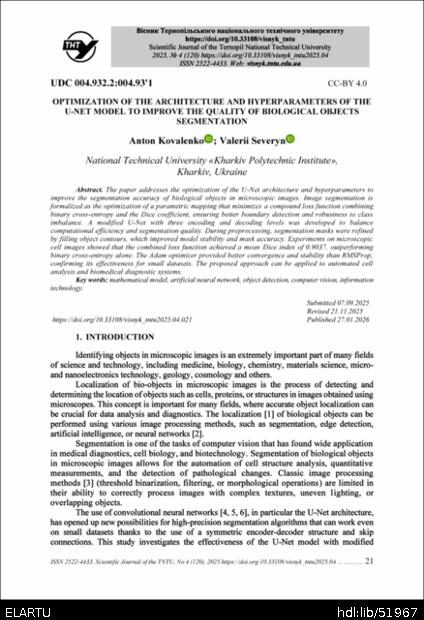
| dc.description.abstract | Розглянуто задачу оптимізації архітектури та гіперпараметрів моделі U-Net для підвищення точності сегментації біологічних об’єктів на мікроскопічних зображеннях. Процес сегментації зображень розглядається як задача оптимізації параметричного відображення f : I → M , що мінімізує складену функцію втрат, яка поєднує бінарну крос-ентропію та коефіцієнт Дайса. Такий підхід забезпечує підвищену точність визначення меж обʼєктів та стійкість до дисбалансу класів. Розроблено модифіковану архітектуру U-Net з трьома рівнями кодування та декодування, що дозволяє зменшити глибину мережі без втрати точності. Такий підхід забезпечує оптимальне співвідношення між обчислювальною ефективністю, швидкістю навчання та якістю сегментації. Експериментальні дослідження проводилися на наборі мікроскопічних зображень клітин, що містять контури біологічних структур. У процесі попереднього опрацювання даних виконано налаштування масок сегментації шляхом заповнення контурів обʼєктів, що дало змогу сформувати повні цільові області замість лише контурних меж. Це суттєво підвищило стабільність навчання моделі та точність прогнозування піксельних масок. Отримані результати показали, що використання комбінованої функції втрат дозволяє отримати кращі метрики якості при навчанні моделі й середнього індексу Дайса 0,9037 на валідаційному наборі, що перевищує результати, отримані при використанні лише бінарної перехресної ентропії. Оптимізатор Adam забезпечив кращу збіжність та стабільність результатів порівняно з RMSProp, підтверджуючи його ефективність для сегментації на обмежених наборах даних. Запропонований підхід дозволяє зменшити глибину моделі без втрати точності сегментації й може бути використаний для автоматизованого аналізу клітинних структур, оцінювання морфологічних змін і розроблення систем компʼютерної діагностики у біомедичних дослідженнях. | |
| dc.description.abstract | The paper addresses the optimization of the U-Net architecture and hyperparameters to improve the segmentation accuracy of biological objects in microscopic images. Image segmentation is formalized as the optimization of a parametric mapping that minimizes a compound loss function combining binary cross-entropy and the Dice coefficient, ensuring better boundary detection and robustness to class imbalance. A modified U-Net with three encoding and decoding levels was developed to balance computational efficiency and segmentation quality. During preprocessing, segmentation masks were refined by filling object contours, which improved model stability and mask accuracy. Experiments on microscopic cell images showed that the combined loss function achieved a mean Dice index of 0.9037, outperforming binary cross-entropy alone. The Adam optimizer provided better convergence and stability than RMSProp, confirming its effectiveness for small datasets. The proposed approach can be applied to automated cell analysis and biomedical diagnostic systems. | |
| dc.format.extent | 21-31 | |
| dc.language.iso | en | |
| dc.publisher | ТНТУ | |
| dc.publisher | TNTU | |
| dc.relation.ispartof | Вісник Тернопільського національного технічного університету, 4 (120), 2025 | |
| dc.relation.ispartof | Scientific Journal of the Ternopil National Technical University, 4 (120), 2025 | |
| dc.relation.uri | https://doi.org/10.15588/1607-3274-2024-1-12 | |
| dc.relation.uri | https://doi.org/10.1109/KhPIWeek61434.2024.10878016 | |
| dc.relation.uri | https://doi.org/10.1109/KhPIWeek61412.2023.10312903 | |
| dc.relation.uri | https://doi.org/10.1038/s41598-023-33357-y | |
| dc.relation.uri | https://doi.org/10.33108/visnyk_tntu2025.02.042 | |
| dc.relation.uri | https://doi.org/10.33108/visnyk_tntu2024.03.082 | |
| dc.relation.uri | https://doi.org/10.1016/j.measurement.2018.11.006 | |
| dc.relation.uri | https://doi.org/10.1186/s13104-022-06096-y | |
| dc.relation.uri | https://doi.org/10.1007/978-3-319-24574-4_28 | |
| dc.relation.uri | https://doi.org/10.1155/2022/1603273 | |
| dc.relation.uri | https://doi.org/10.1007/s11042-022-13730-1 | |
| dc.relation.uri | https://doi.org/10.3390/a18090588 | |
| dc.relation.uri | https://bbbc.broadinstitute.org/BBBC030 | |
| dc.relation.uri | https://doi.org/10.3390/jimaging7020016 | |
| dc.relation.uri | https://doi.org/10.18280/ria.370424 | |
| dc.subject | математична модель | |
| dc.subject | штучна нейронна мережа | |
| dc.subject | виявлення обʼєктів | |
| dc.subject | компʼютерний зір | |
| dc.subject | інформаційна технологія | |
| dc.subject | mathematical model | |
| dc.subject | artificial neural network | |
| dc.subject | object detection | |
| dc.subject | computer vision | |
| dc.subject | information technology | |
| dc.title | Optimization of the architecture and hyperparameters of the U-NET model to improve the quality of biological objects segmentation | |
| dc.title.alternative | Оптимізація архітектури та гіперпараметрів моделі U-NET для покращення якості сегментації біологічних обʼєктів | |
| dc.type | Article | |
| dc.rights.holder | © Тернопільський національний технічний університет імені Івана Пулюя, 2025 | |
| dc.coverage.placename | Тернопіль | |
| dc.coverage.placename | Ternopil | |
| dc.format.pages | 11 | |
| dc.subject.udc | 004.932.2 | |
| dc.subject.udc | 004.93ʼ1 | |
| dc.relation.referencesen | 1. Kovalenko S. M., Kutsenko O. S., Kovalenko S. V., Kovalenko A. S. (2024) Approach to the Automatic Creation of an Annotated Dataset for the Detection, Localization and Classification of Blood Cells in an Image. Radio Electronics, Computer Science, Control, (1), 128. https://doi.org/10.15588/1607-3274-2024-1-12 | |
| dc.relation.referencesen | 2. Kovalenko S., Kovalenko S., Kutsenko A., Godlevskyi M., Severin V. (2024). Kovalenko A. Methodology for Creating Annotated Datasets of Biological Objects in Microscopic Images. 2024 IEEE 5th KhPI Week on Advanced Technology (KhPIWeek), Kharkiv, Ukraine, pp. 1–6. https://doi.org/10.1109/KhPIWeek61434.2024.10878016 | |
| dc.relation.referencesen | 3. Kovalenko S., Kovalenko S., Mikhnova O., Kovalenko A., Pelikh D., Severin V. (2023). An Approach to Blood Cell Classification Based on Object Segmentation and Machine Learning . 2023 IEEE 4th KhPI Week on Advanced Technology (KhPIWeek), Kharkiv, Ukraine, pp. 1–6. https://doi.org/10.1109/KhPIWeek61412.2023.10312903 | |
| dc.relation.referencesen | 4. Jin S., Yu S., Peng J. et al. A novel medical image segmentation approach by using multi-branch segmentation network based on local and global information synchronous learning. Sci Rep 13, 6762. 2023. https://doi.org/10.1038/s41598-023-33357-y | |
| dc.relation.referencesen | 5. Totosko O., Stukhliak D., Stukhliak P. (2025) Usage of neural networks for analysis and processing of experimental research of composite materials. Scientific Journal of TNTU (Tern.), vol. 118, no. 2, pp. 42–55. https://doi.org/10.33108/visnyk_tntu2025.02.042 | |
| dc.relation.referencesen | 6. Stefanyshyn V., Stefanyshyn I., Pastukh O., Kulikov S. (2024) Comparison of the accuracy of machine learning algorithms for brain-computer interaction based on high-performance computing technologies. Scientific Journal of TNTU (Tern.), vol. 115, no. 3, pp. 82–90. https://doi.org/10.33108/visnyk_tntu2024.03.082 | |
| dc.relation.referencesen | 7 Jha S., Son L. H., Kumar R., Priyadarshini I., Smarandache F., Long H. V., (2019) Neutrosophic image segmentation with Dice Coefficients. Measurement, vol. 134, pp. 762–772, ISSN 0263-2241. https://doi.org/10.1016/j.measurement.2018.11.006 | |
| dc.relation.referencesen | 8. Müller D., Soto-Rey I., Kramer F. (2022) Towards a guideline for evaluation metrics in medical image segmentation. BMC Res Notes. 15. 210. https://doi.org/10.1186/s13104-022-06096-y | |
| dc.relation.referencesen | 9. Ronneberger O., Fischer P., Brox T. U-Net: Convolutional Networks for Biomedical Image Segmentation. In: Navab, N., Hornegger, J., Wells, W., Frangi, A. (eds) Medical Image Computing and Computer- Assisted Intervention – MICCAI 2015. MICCAI 2015. Lecture Notes in Computer Science, vol. 9351. 2015. Springer, Cham. https://doi.org/10.1007/978-3-319-24574-4_28 | |
| dc.relation.referencesen | 10. Wang Y., Kong J., Zhang H. U‑Net: A Smart Application with Multidimensional Attention Network for Remote Sensing Images. Scientific Programming 2022.1 2022. 1603273. https://doi.org/10.1155/2022/1603273 | |
| dc.relation.referencesen | 11 Jena B., Jain S., Nayak G. K., Saxena S. (2023) Analysis of depth variation of U-NET architecture for brain tumor segmentation. Multimedia Tools Appl. 82, 7, pp. 10723–10743. https://doi.org/10.1007/s11042-022-13730-1 | |
| dc.relation.referencesen | 12 Gkologkinas G. D., Ntouros K., Protopapadakis E., Rallis I. (2025) A Comparative Analysis of U-Net Architectures with Dimensionality Reduction for Agricultural Crop Classification Using Hyperspectral Data. Algorithms, 18, 588. https://doi.org/10.3390/a18090588 | |
| dc.relation.referencesen | 13 Chinese Hamster Ovary Cells dataset. https://bbbc.broadinstitute.org/BBBC030. | |
| dc.relation.referencesen | 14. Furtado P. (2021) Testing Segmentation Popular Loss and Variations in Three Multiclass Medical Imaging Problems. J Imaging, 27;7(2):16. PMID: 34460615; PMCID: PMC8321275. https://doi.org/10.3390/jimaging7020016 | |
| dc.relation.referencesen | 15 Kartowisastro I. H., Latupapua J. (2023) A comparison of Adaptive Moment Estimation (Adam) and RMSProp optimisation techniques for wildlife animal classification using convolutional neural networks // Revue dʼIntelligence Artificielle, vol. 37, no. 4, pp. 1023–1030. https://doi.org/10.18280/ria.370424 | |
| dc.identifier.doi | https://doi.org/10.33108/visnyk_tntu2025.04.021 | |
| dc.contributor.affiliation | Національний технічний університет «Харківський політехнічний інститут», Харків, Україна | |
| dc.contributor.affiliation | National Technical University «Kharkiv Polytechnic Institute», Kharkiv, Ukraine | |
| dc.citation.journalTitle | Вісник Тернопільського національного технічного університету | |
| dc.citation.volume | 120 | |
| dc.citation.issue | 4 | |
| dc.citation.spage | 21 | |
| dc.citation.epage | 31 | |
| dc.identifier.citation2015 | Kovalenko A., Severyn V. Optimization of the architecture and hyperparameters of the U-NET model to improve the quality of biological objects segmentation // Scientific Journal of TNTU, Ternopil. 2025. Vol 120. No 4. P. 21–31. | |
| dc.identifier.citationenAPA | Kovalenko, A., & Severyn, V. (2025). Optimization of the architecture and hyperparameters of the U-NET model to improve the quality of biological objects segmentation. Scientific Journal of the Ternopil National Technical University, 120(4), 21-31. TNTU.. | |
| dc.identifier.citationenCHICAGO | Kovalenko A., Severyn V. (2025) Optimization of the architecture and hyperparameters of the U-NET model to improve the quality of biological objects segmentation. Scientific Journal of the Ternopil National Technical University (Tern.), vol. 120, no 4, pp. 21-31. | |
| Розташовується у зібраннях: | Вісник ТНТУ, 2025, № 4 (120) | |
Файли цього матеріалу:
| Файл | Опис | Розмір | Формат | |
|---|---|---|---|---|
| TNTUSJ_2025v120n4_Kovalenko_A-Optimization_of_the_architecture_21-31.pdf | 4,32 MB | Adobe PDF | Переглянути/відкрити | |
| TNTUSJ_2025v120n4_Kovalenko_A-Optimization_of_the_architecture_21-31__COVER.png | 1,23 MB | image/png | Переглянути/відкрити |
Усі матеріали в архіві електронних ресурсів захищені авторським правом, всі права збережені.