
Будь ласка, використовуйте цей ідентифікатор, щоб цитувати або посилатися на цей матеріал:
http://elartu.tntu.edu.ua/handle/lib/51960
Повний запис метаданих
| Поле DC | Значення | Мова |
|---|---|---|
| dc.contributor.author | Венгринюк, Олег | |
| dc.contributor.author | Звірко, Ольга | |
| dc.contributor.author | Venhryniuk, Oleh | |
| dc.contributor.author | Zvirko, Olha | |
| dc.date.accessioned | 2026-03-23T16:17:37Z | - |
| dc.date.available | 2026-03-23T16:17:37Z | - |
| dc.date.created | 2025-12-23 | |
| dc.date.issued | 2025-12-23 | |
| dc.date.submitted | 2025-10-06 | |
| dc.identifier.citation | Venhryniuk O. Modeling of hydrogen-induced fracture toughness degradation of pipe steel / Oleh Venhryniuk, Olha Zvirko // Scientific Journal of TNTU. — Tern. : TNTU, 2025. — Vol 120. — No 4. — P. 120–129. | |
| dc.identifier.issn | 2522-4433 | |
| dc.identifier.uri | http://elartu.tntu.edu.ua/handle/lib/51960 | - |
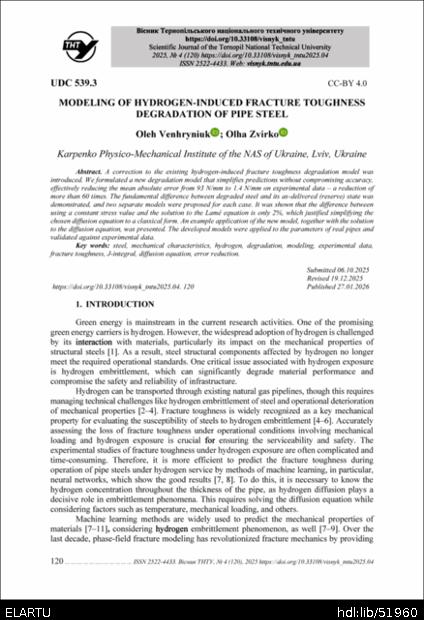
| dc.description.abstract | У роботі запропоновано уточнення до існуючої моделі деградації тріщиностійкості трубної сталі під впливом водню шляхом введення додаткового коефіцієнта матеріалу. Сформульовано нову модель деградації, яка дозволяє значно спростити процес прогнозування без втрати точності. Запропонована модель оперує відносними концентраціями водню та тріщиностійкістю, що дало змогу знизити середню абсолютну похибку більш ніж у 60 разів. Показано фундаментальну різницю між деградованою сталлю після експлуатації та її вихідним станом, для кожного з яких розроблено окремі моделі. Для обох моделей використано метод найменших квадратів для визначення коефіцієнтів на основі експериментальних даних. Виведено рівняння дифузії водню з урахуванням механічного навантаження, що діє на стінку труби. Доведено, що різниця між використанням сталого значення напруження та розв’язком рівняння Ламе становить лише 2%, що дозволяє спростити рівняння дифузії до класичної форми. Наведено приклад застосування нової моделі разом із розв’язком рівняння дифузії для реальних параметрів труб. Розроблені моделі апробовано на експериментальних даних і показано високу точність прогнозування деградації тріщиностійкості сталі. Моделі враховують вплив концентрації водню по товщині стінки труби. Встановлено, що деградація тріщиностійкості у сталі після тривалої експлуатації відбувається значно інтенсивніше, ніж у сталі у вихідному стані. Для резервної сталі деградація добре описується лінійною моделлю, а для деградованої – оберненою функцією. Моделі можуть бути використані для оцінювання технічного стану трубопроводів, що транспортують водень чи водневмісні середовища. Обґрунтовано можливість подальшої інтеграції розроблених моделей у фізично-інформовані нейронні мережі для підвищення точності прогнозування. Отримані результати можна використати для оцінювання залишкового ресурсу водневих трубопроводів та оптимізації планування їхнього обслуговування, що сприятиме підвищенню безпеки їхньої експлуатації. | |
| dc.description.abstract | A correction to the existing hydrogen-induced fracture toughness degradation model was introduced. We formulated a new degradation model that simplifies predictions without compromising accuracy, effectively reducing the mean absolute error from 93 N/mm to 1.4 N/mm on experimental data – a reduction of more than 60 times. The fundamental difference between degraded steel and its as-delivered (reserve) state was demonstrated, and two separate models were proposed for each case. It was shown that the difference between using a constant stress value and the solution to the Lamé equation is only 2%, which justified simplifying the chosen diffusion equation to a classical form. An example application of the new model, together with the solution to the diffusion equation, was presented. The developed models were applied to the parameters of real pipes and validated against experimental data. | |
| dc.format.extent | 120-129 | |
| dc.language.iso | en | |
| dc.publisher | ТНТУ | |
| dc.publisher | TNTU | |
| dc.relation.ispartof | Вісник Тернопільського національного технічного університету, 4 (120), 2025 | |
| dc.relation.ispartof | Scientific Journal of the Ternopil National Technical University, 4 (120), 2025 | |
| dc.relation.uri | https://doi.org/10.1016/j.ijhydene.2023.05.293 | |
| dc.relation.uri | https://doi.org/10.1007/978-3-031-85390-6_21 | |
| dc.relation.uri | https://doi.org/10.33108/visnyk_tntu2025 | |
| dc.relation.uri | https://doi.org/10.1007/s11223-024-00704-x | |
| dc.relation.uri | https://doi.org/10.3390/ma12111843 | |
| dc.relation.uri | https://doi.org/10.3390/mi11040430 | |
| dc.relation.uri | https://doi.org/10.1016/j.ijhydene.2020.05.015 | |
| dc.relation.uri | https://doi.org/10.1016/j.cma.2024.117104 | |
| dc.relation.uri | https://doi.org/10.3390/ma13235500 | |
| dc.relation.uri | https://doi.org/10.1016/j.prostr.2025.06.033 | |
| dc.relation.uri | https://doi.org/10.33108/visnyk_tntu2022.04.074 | |
| dc.relation.uri | https://doi.org/10.1016/j.ijhydene.2022.12.102 | |
| dc.relation.uri | https://doi.org/10.1016/j.rser.2024.114898 | |
| dc.relation.uri | https://doi.org/10.1016/0001-6160(82)90023-2 | |
| dc.relation.uri | https://doi.org/10.1016/j.corsci.2009.07.013 | |
| dc.subject | сталь | |
| dc.subject | механічні властивості | |
| dc.subject | водень | |
| dc.subject | деградація | |
| dc.subject | моделювання | |
| dc.subject | експериментальні дані | |
| dc.subject | вʼязкість руйнування | |
| dc.subject | J-інтеграл | |
| dc.subject | рівняння дифузії | |
| dc.subject | зменшення похибки | |
| dc.subject | steel | |
| dc.subject | mechanical characteristics | |
| dc.subject | hydrogen | |
| dc.subject | degradation | |
| dc.subject | modeling | |
| dc.subject | experimental data | |
| dc.subject | fracture toughness | |
| dc.subject | J-integral | |
| dc.subject | diffusion equation | |
| dc.subject | error reduction | |
| dc.title | Modeling of hydrogen-induced fracture toughness degradation of pipe steel | |
| dc.title.alternative | Моделювання деградації тріщиностійкості у трубній сталі під впливом водню | |
| dc.type | Article | |
| dc.rights.holder | © Тернопільський національний технічний університет імені Івана Пулюя, 2025 | |
| dc.coverage.placename | Тернопіль | |
| dc.coverage.placename | Ternopil | |
| dc.format.pages | 10 | |
| dc.subject.udc | 539.3 | |
| dc.relation.referencesen | 1. Campari A., Ustolin F., Alvaro A., Paltrinieri N. (2023) A review on hydrogen embrittlement based inspection of hydrogen technologies. Int. J. Hydrogen Energy, vol. 48, no. https://doi.org/10.1016/j.ijhydene.2023.05.293 | |
| dc.relation.referencesen | 2. Zvirko O., Tsyrulnyk O., Venhryniuk O., Nykyforchyn H. (2025). Hydrogen Related Transport via Existing Gas Pipelines. In: Prentkovskis O., Yatskiv (Jackiva) I., Skačkauskas Stosiak M. (eds). Lecture Notes in Intelligent Transportation and Infrastructure. Springer 219. https://doi.org/10.1007/978-3-031-85390-6_21 | |
| dc.relation.referencesen | 3. Poberezhnyi L. (2025) The deformation behavior of the long-term exploited pipelines in soil Scientific Journal of TNTU, vol. 118, no. 2, pp. 5–19. https://doi.org/10.33108/visnyk_tntu2025 | |
| dc.relation.referencesen | 4. Zvirko O. I., Tsyrulnyk O. T., Venhrynyuk O. I., Nykyforchyn H. M. (2024) Sensitivity method for estimating the hydrogen embrittlement of ferritic-pearlitic pipe steel. Strength no. 5, art. no. 104534, pp. 928–935. https://doi.org/10.1007/s11223-024-00704-x | |
| dc.relation.referencesen | 5. Сabrini M. et al. (2019) Hydrogen embrittlement evaluation of micro alloyed steels by curve. Materials, vol. 12. Art. No. 1843, pp. 1–17. https://doi.org/10.3390/ma12111843 | |
| dc.relation.referencesen | 6. Kyriakopoulou H. P. et al. (2020) Investigation of hydrogen embrittlement susceptibility toughness drop after in situ hydrogen cathodic charging for an X65 pipeline steel. Micromachines art. no. 20, pp. 1–20. https://doi.org/10.3390/mi11040430 | |
| dc.relation.referencesen | 7. Huang C., Gao X. (2020) Phase field modeling of hydrogen embrittlement. Int. vol. 45, no. 38, pp. 20053–20068. https://doi.org/10.1016/j.ijhydene.2020.05.015 | |
| dc.relation.referencesen | 8. Manav M., Molinaro R., Mishra S., De Lorenzis L. (2024) Phase-field modeling of fracture with physics- informed deep learning. Comput. Methods in Appl. Mech. Eng, vol. 429, art. no. 117104, pp. 1–21. https://doi.org/10.1016/j.cma.2024.117104 | |
| dc.relation.referencesen | 9. Malitckii E., Fangnon E., Vilaça P. (2020) Evaluation of steels susceptibility to hydrogen embrittlement: A thermal desorption spectroscopy-based approach coupled with artificial neural network. Materials, vol. 13, no. 23, art. no. 5500, pp. 1–14. https://doi.org/10.3390/ma13235500 | |
| dc.relation.referencesen | 10. Yasniy O., Tymoshchuk D., Didych I., Iasnii V., Pasternak I. (2025) Modelling the properties of shape memory alloys using machine learning methods. Procedia Struct. Integr, vol. 68, pp. 132–138. https://doi.org/10.1016/j.prostr.2025.06.033 | |
| dc.relation.referencesen | 11. Yasniy O., Demchyk V., Lutsyk N. (2022) Modelling of functional properties of shape-memory alloys by machine learning methods. Scientific Journal of TNTU, vol. 108, no. 4, pp. 74–78. https://doi.org/10.33108/visnyk_tntu2022.04.074 | |
| dc.relation.referencesen | 12. He X. et al. (2024) Prediction model for the evolution of hydrogen concentration under leakage in hydrogen refueling station using deep neural networks. Int. J. Hydrogen Energy, vol. 51D, pp. 702–712. https://doi.org/10.1016/j.ijhydene.2022.12.102 | |
| dc.relation.referencesen | 13. Zhang X. et al. (2025) Hydrogen jet and diffusion modeling by physics-informed graph neural network. Renew. Sustain. Energy Rev, vol. 207, art. no. 114898. https://doi.org/10.1016/j.rser.2024.114898 | |
| dc.relation.referencesen | 14. Larche F. C., Cahn J. W. (1982) The effect of self-stress on diffusion in solids. Acta Metall, vol. 30. pp. 1835–1845. https://doi.org/10.1016/0001-6160(82)90023-2 | |
| dc.relation.referencesen | 15. Beer F. P. et al. (2012). Mechanics of Materials, 6th ed. McGraw-Hill, New York. | |
| dc.relation.referencesen | 16. Raichenko A. I. (1981). Mathematical Theory of Diffusion in Applications. Naukova Dumka. Kyiv, 396 p. | |
| dc.relation.referencesen | 17. Wang R. (2009) Effects of hydrogen on the fracture toughness of a X70 pipeline steel. Cor. Sci, vol. 51, pp. 2803–2810. https://doi.org/10.1016/j.corsci.2009.07.013 | |
| dc.identifier.doi | https://doi.org/10.33108/visnyk_tntu2025.04. 120 | |
| dc.contributor.affiliation | Фізико-механічний інститут імені Г. В. Карпенка Національної академії наук України, Львів, Україна | |
| dc.contributor.affiliation | Karpenko Physico-Mechanical Institute of the NAS of Ukraine, Lviv, Ukraine | |
| dc.citation.journalTitle | Вісник Тернопільського національного технічного університету | |
| dc.citation.volume | 120 | |
| dc.citation.issue | 4 | |
| dc.citation.spage | 120 | |
| dc.citation.epage | 129 | |
| dc.identifier.citation2015 | Venhryniuk O., Zvirko O. Modeling of hydrogen-induced fracture toughness degradation of pipe steel // Scientific Journal of TNTU, Ternopil. 2025. Vol 120. No 4. P. 120–129. | |
| dc.identifier.citationenAPA | Venhryniuk, O., & Zvirko, O. (2025). Modeling of hydrogen-induced fracture toughness degradation of pipe steel. Scientific Journal of the Ternopil National Technical University, 120(4), 120-129. TNTU.. | |
| dc.identifier.citationenCHICAGO | Venhryniuk O., Zvirko O. (2025) Modeling of hydrogen-induced fracture toughness degradation of pipe steel. Scientific Journal of the Ternopil National Technical University (Tern.), vol. 120, no 4, pp. 120-129. | |
| Розташовується у зібраннях: | Вісник ТНТУ, 2025, № 4 (120) | |
Файли цього матеріалу:
| Файл | Опис | Розмір | Формат | |
|---|---|---|---|---|
| TNTUSJ_2025v120n4_Venhryniuk_O-Modeling_of_hydrogen_120-129.pdf | 3,67 MB | Adobe PDF | Переглянути/відкрити | |
| TNTUSJ_2025v120n4_Venhryniuk_O-Modeling_of_hydrogen_120-129__COVER.png | 1,29 MB | image/png | Переглянути/відкрити |
Усі матеріали в архіві електронних ресурсів захищені авторським правом, всі права збережені.