
Použijte tento identifikátor k citaci nebo jako odkaz na tento záznam:
http://elartu.tntu.edu.ua/handle/lib/51956
Full metadata record
| DC pole | Hodnota | Jazyk |
|---|---|---|
| dc.contributor.author | Шафар, Андрій | |
| dc.contributor.author | Shafar, Andriy | |
| dc.date.accessioned | 2026-03-23T16:17:35Z | - |
| dc.date.available | 2026-03-23T16:17:35Z | - |
| dc.date.created | 2025-12-23 | |
| dc.date.issued | 2025-12-23 | |
| dc.date.submitted | 2025-09-28 | |
| dc.identifier.citation | Shafar A. Intellectual-analytical platform for assessing the security risk of tourist travel / Andriy Shafar // Scientific Journal of TNTU. — Tern. : TNTU, 2025. — Vol 120. — No 4. — P. 78–89. | |
| dc.identifier.issn | 2522-4433 | |
| dc.identifier.uri | http://elartu.tntu.edu.ua/handle/lib/51956 | - |
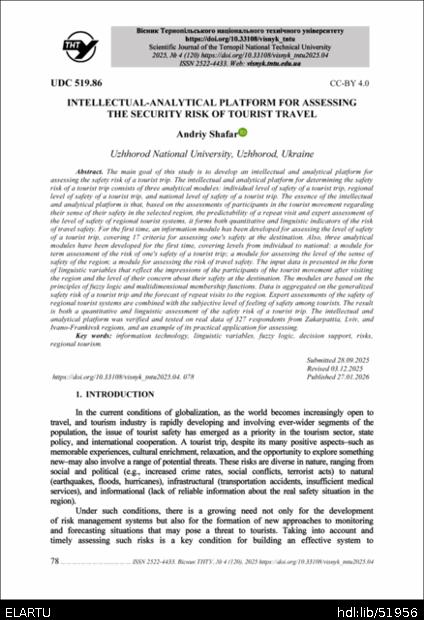
| dc.description.abstract | Основною метою дослідження є розроблення інтелектуально-аналітичної платформи оцінювання ризику безпеки туристичної подорожі. Інтелектуально-аналітична платформа оцінювання ризику безпеки туристичної подорожі складається з трьох аналітичних модулів: індивідуальний рівень безпеки туристичної подорожі; регіональний рівень безпеки туристичної подорожі; національний рівень безпеки туристичної подорожі. Суть інтелектуально-аналітичної платформи полягає в тому, що вона, спираючись на оцінювання учасників туристичного руху щодо відчуття власної безпеки у вибраному регіоні, передбачуваність повторного візиту та експертне оцінювання рівня безпеки регіональних туристичних систем, формує як кількісні, так і лінгвістичні індикатори ризику безпечності подорожі. Вперше розроблено інформаційний модуль для оцінювання рівня безпеки туристичної подорожі, що охоплює 17 критеріїв оцінювання власної безпеки у місці призначення. Також вперше розроблено три аналітичні модулі, що охоплюють рівні від індивідуального до національного: модуль терм-оцінювання ризику власної безпеки туристичної подорожі; модуль оцінювання рівня почуття безпеки регіону; модуль оцінювання ризику безпеки туристичної подорожі. Вхідні дані представлені у вигляді лінгвістичних змінних, що відображають враження учасників туристичного руху після відвідування регіону та рівень їхньої стурбованості щодо власної безпеки у місці призначення. Модулі базуються на принципах нечіткої логіки та багатовимірних функцій належності. Здійснюється агрегування даних щодо узагальненого ризику безпеки туристичної подорожі та прогнозу повторного відвідування регіону. Поєднуються оцінювання безпеки регіональних туристичних систем від експертів із суб’єктивним рівнем почуття безпеки серед туристів. Результатом є як кількісна, так і лінгвістична оцінка ризику безпеки туристичної подорожі. Інтелектуально-аналітичну платформу верифіковано та апробовано на реальних даних 327 респондентів із Закарпатської, Львівської та Івано-Франківської областей, а також проілюстровано приклад її практичного застосування для оцінювання. | |
| dc.description.abstract | The main goal of this study is to develop an intellectual and analytical platform for assessing the safety risk of a tourist trip. The intellectual and analytical platform for determining the safety risk of a tourist trip consists of three analytical modules: individual level of safety of a tourist trip, regional level of safety of a tourist trip, and national level of safety of a tourist trip. The essence of the intellectual and analytical platform is that, based on the assessments of participants in the tourist movement regarding their sense of their safety in the selected region, the predictability of a repeat visit and expert assessment of the level of safety of regional tourist systems, it forms both quantitative and linguistic indicators of the risk of travel safety. For the first time, an information module has been developed for assessing the level of safety of a tourist trip, covering 17 criteria for assessing oneʼs safety at the destination. Also, three analytical modules have been developed for the first time, covering levels from individual to national: a module for term assessment of the risk of oneʼs safety of a tourist trip; a module for assessing the level of the sense of safety of the region; a module for assessing the risk of travel safety. The input data is presented in the form of linguistic variables that reflect the impressions of the participants of the tourist movement after visiting the region and the level of their concern about their safety at the destination. The modules are based on the principles of fuzzy logic and multidimensional membership functions. Data is aggregated on the generalized safety risk of a tourist trip and the forecast of repeat visits to the region. Expert assessments of the safety of regional tourist systems are combined with the subjective level of feeling of safety among tourists. The result is both a quantitative and linguistic assessment of the safety risk of a tourist trip. The intellectual and analytical platform was verified and tested on real data of 327 respondents from Zakarpattia, Lviv, and Ivano-Frankivsk regions, and an example of its practical application for assessing. | |
| dc.format.extent | 78-89 | |
| dc.language.iso | en | |
| dc.publisher | ТНТУ | |
| dc.publisher | TNTU | |
| dc.relation.ispartof | Вісник Тернопільського національного технічного університету, 4 (120), 2025 | |
| dc.relation.ispartof | Scientific Journal of the Ternopil National Technical University, 4 (120), 2025 | |
| dc.relation.uri | https://doi.org/10.1080/1528008X.2014.921779 | |
| dc.relation.uri | https://doi.org/10.1155/2021/1980037 | |
| dc.relation.uri | https://doi.org/10.1080/10941665.2016.1175487 | |
| dc.relation.uri | https://doi.org/10.3846/20294913.2016.1198840 | |
| dc.relation.uri | https://doi.org/10.1007/s12144-021-02282-6 | |
| dc.relation.uri | https://doi.org/10.1080/13683500.2021.1944995 | |
| dc.relation.uri | https://doi.org/10.32347/2412-9933.2024.57.164-173 | |
| dc.relation.uri | https://doi.org/10.32782/2708-4949.1(5).2022.9 | |
| dc.relation.uri | https://doi.org/10.1080/02642069.2018.1508458 | |
| dc.relation.uri | https://doi.org/10.1007/978-3-319-44263-1_17 | |
| dc.relation.uri | https://doi.org/10.1016/j.technovation.2022.102623 | |
| dc.relation.uri | https://doi.org/10.1016/j.jbusres.2022.113415 | |
| dc.relation.uri | https://doi.org/10.26661/2786-6254-2024-2-02 | |
| dc.relation.uri | https://docs.google.com/spreadsheets/d/1PfgXZNhypVLwZkASmAZWw-hcyed_9ZdP/edit?usp=sharing&ouid=102166509137650076958&rtpof=true&sd=true | |
| dc.subject | інформаційні технології | |
| dc.subject | лінгвістичні змінні | |
| dc.subject | нечітка логіка | |
| dc.subject | підтримання прийняття рішень | |
| dc.subject | ризики | |
| dc.subject | регіональний туризм | |
| dc.subject | information technology | |
| dc.subject | linguistic variables | |
| dc.subject | fuzzy logic | |
| dc.subject | decision support | |
| dc.subject | risks | |
| dc.subject | regional tourism | |
| dc.title | Intellectual-analytical platform for assessing the security risk of tourist travel | |
| dc.title.alternative | Інтелектуально-аналітична платформа оцінювання ризику безпеки туристичної подорожі | |
| dc.type | Article | |
| dc.rights.holder | © Тернопільський національний технічний університет імені Івана Пулюя, 2025 | |
| dc.coverage.placename | Тернопіль | |
| dc.coverage.placename | Ternopil | |
| dc.format.pages | 12 | |
| dc.subject.udc | 519.86 | |
| dc.relation.referencesen | 1. Vyklyuk Ya. I., Artemenko O. I. (2008) Using fuzzy logic to determine the recreational potential of the territory. Bulletin of the National University of Lviv Polytechnic. Information Systems and Networks, no. 631. pp. 45–54. | |
| dc.relation.referencesen | 2. Luštický M., Bína V. (2014) Application of fuzzy benchmarking approach for strategic planning of tourism destination. J. Quality Assurance in Hospitality & Tourism, vol. 15, no. 4, pp. 327–355. https://doi.org/10.1080/1528008X.2014.921779 | |
| dc.relation.referencesen | 3. Guo W. (2021). Safety risk assessment of tourism management system based on PSO-BP neural network. Comput. Intell. Neurosci, pp. 1–11. https://doi.org/10.1155/2021/1980037 | |
| dc.relation.referencesen | 4. Fu H. H., Tzeng S. Y. (2016) Applying Fuzzy Multiple Criteria Decision Making approach to establish safety-management system for hot spring hotels. Asia Pac. J. Tour. Res, vol. 21, no. 12, pp. 1343–1356. https://doi.org/10.1080/10941665.2016.1175487 | |
| dc.relation.referencesen | 5. Faraji Sabokbar H., Ayashi A., Hosseini A., Banaitis A., Banaitienė N., Ayashi R. (2016) Risk assessment in tourism system using a fuzzy set and dominance-based rough set. Technol. Econ. Dev. Econ, vol. 22, no. 4, pp. 554–573. https://doi.org/10.3846/20294913.2016.1198840 | |
| dc.relation.referencesen | 6. Karl M., Schmude J. (2017) Understanding the role of risk (perception) in destination choice: A literature review and synthesis. Tourism, vol. 65, no. 2, pp. 138–155. | |
| dc.relation.referencesen | 7. Golets A., Farias J., Pilati R., Costa H. (2023) COVID-19 pandemic and tourism: The impact of health risk perception and intolerance of uncertainty on travel intentions. Curr. Psychol, vol. 42, pp. 2500–2513. https://doi.org/10.1007/s12144-021-02282-6 | |
| dc.relation.referencesen | 8. Vena-Oya J., Castañeda-García J. A., Rodríguez-Molina M. Á. (2022) Forecasting a post-COVID-19 economic crisis using fuzzy cognitive maps: a Spanish tourism-sector perspective. Curr. Issues Tour, vol. 25, no. 13, pp. 2048–2062. https://doi.org/10.1080/13683500.2021.1944995 | |
| dc.relation.referencesen | 9. Bilak Yu. Yu., Shafar A. A. (2024) Information and analytical model for assessing the level of satisfaction of tourists with regard to accommodation establishments. Management of development of storage systems. Upravl. rozvytkom sklad. System, no. 57, pp. 164–173. https://doi.org/10.32347/2412-9933.2024.57.164-173 | |
| dc.relation.referencesen | 10. Ladyk S., Bazylyuk K. (2022) Using the apparatus of the theory of imprecise sets for evaluating the quality of the tourist product. Іnnovation and technology in the sphere of consumer goods and consumption, vol. 1, no. 5, pp. 47–51. https://doi.org/10.32782/2708-4949.1(5).2022.9 | |
| dc.relation.referencesen | 11. Femenia-Serra F., Neuhofer B., Ivars-Baidal J. A. (2019) Towards a conceptualisation of smart tourists and their role within the smart destination scenario. Serv. Ind. J., vol. 39, no. 2, pp. 109–133. https://doi.org/10.1080/02642069.2018.1508458 | |
| dc.relation.referencesen | 12. Xiang Z., Fesenmaier D. R. (2017) Big data analytics, tourism design and smart tourism. In: Analytics in Smart Tourism Design, pp. 299–307. https://doi.org/10.1007/978-3-319-44263-1_17 | |
| dc.relation.referencesen | 13. Mariani M. M., Machado I., Magrelli V., Dwivedi Y. K. (2022) Artificial intelligence in innovation research: A systematic review, conceptual framework, and future research directions. Technovation. Art. 102623. https://doi.org/10.1016/j.technovation.2022.102623 | |
| dc.relation.referencesen | 14. Christou P., Hadjielias E., Simillidou A., Kvasova O. (2023) The use of intelligent automation as a form of digital transformation in tourism: Towards a hybrid experiential offering. J. Bus. Res., vol. 155, art. 113415. https://doi.org/10.1016/j.jbusres.2022.113415 | |
| dc.relation.referencesen | 15. Shafar A. A. (2024) Neuro-fuzzy model of destination evaluation and selection taking into account the touristʼs target needs. Comput. Sci. Appl, no. 2, pp. 13–22. https://doi.org/10.26661/2786-6254-2024-2-02 | |
| dc.relation.referencesen | 16. Data from 327 respondents for assessing the safety risk of a tourist trip. Available at: https://docs.google.com/spreadsheets/d/1PfgXZNhypVLwZkASmAZWw-hcyed_9ZdP/edit?usp=sharing&ouid=102166509137650076958&rtpof=true&sd=true (accessed: 07.05.2025). | |
| dc.identifier.doi | https://doi.org/10.33108/visnyk_tntu2025.04. 078 | |
| dc.contributor.affiliation | ДВНЗ «Ужгородський національний університет», Ужгород, Україна | |
| dc.contributor.affiliation | Uzhhorod National University, Uzhhorod, Ukraine | |
| dc.citation.journalTitle | Вісник Тернопільського національного технічного університету | |
| dc.citation.volume | 120 | |
| dc.citation.issue | 4 | |
| dc.citation.spage | 78 | |
| dc.citation.epage | 89 | |
| dc.identifier.citation2015 | Shafar A. Intellectual-analytical platform for assessing the security risk of tourist travel // Scientific Journal of TNTU, Ternopil. 2025. Vol 120. No 4. P. 78–89. | |
| dc.identifier.citationenAPA | Shafar, A. (2025). Intellectual-analytical platform for assessing the security risk of tourist travel. Scientific Journal of the Ternopil National Technical University, 120(4), 78-89. TNTU.. | |
| dc.identifier.citationenCHICAGO | Shafar A. (2025) Intellectual-analytical platform for assessing the security risk of tourist travel. Scientific Journal of the Ternopil National Technical University (Tern.), vol. 120, no 4, pp. 78-89. | |
| Vyskytuje se v kolekcích: | Вісник ТНТУ, 2025, № 4 (120) | |
Soubory připojené k záznamu:
| Soubor | Popis | Velikost | Formát | |
|---|---|---|---|---|
| TNTUSJ_2025v120n4_Shafar_A-Intellectual_analytical_platform_78-89.pdf | 4,03 MB | Adobe PDF | Zobrazit/otevřít | |
| TNTUSJ_2025v120n4_Shafar_A-Intellectual_analytical_platform_78-89__COVER.png | 1,28 MB | image/png | Zobrazit/otevřít |
Všechny záznamy v DSpace jsou chráněny autorskými právy, všechna práva vyhrazena.