
Будь ласка, використовуйте цей ідентифікатор, щоб цитувати або посилатися на цей матеріал:
http://elartu.tntu.edu.ua/handle/lib/51495
Повний запис метаданих
| Поле DC | Значення | Мова |
|---|---|---|
| dc.contributor.author | Дедів, Леонід Євгенович | |
| dc.contributor.author | Ковалик, Сергій | |
| dc.contributor.author | Dediv, Leonid | |
| dc.contributor.author | Kovalyk, Serhii | |
| dc.date.accessioned | 2026-02-09T15:51:57Z | - |
| dc.date.available | 2026-02-09T15:51:57Z | - |
| dc.date.created | 2025-08-29 | |
| dc.date.issued | 2025-08-29 | |
| dc.date.submitted | 2025-07-16 | |
| dc.identifier.citation | Dediv L. Structure of the bionic hand prosthesis control system with sensor feedback / Leonid Dediv, Serhii Kovalyk // Scientific Journal of TNTU. — Tern. : TNTU, 2025. — Vol 119. — No 3. — P. 45–55. | |
| dc.identifier.issn | 2522-4433 | |
| dc.identifier.uri | http://elartu.tntu.edu.ua/handle/lib/51495 | - |
| dc.description.abstract | Проведено аналіз стану проблеми створення високофункціональних біонічних протезів та показано актуальність створення адаптивної системи керування такими протезами за результатами опрацювання біосигналів. Розглянуто переваги та недоліки методу прямої реєстрації сигналів з моторних відділів кори головного мозку людини, застосування спеціалізованих так званих нервових манжет для отримання сигналів безпосередньо від периферійних нервових волокон, а також імплантованих електродів та реєстрації поверхневих електроміографічних сигналів (пЕМГ). Враховуючи неінвазивність, безпечність та простоту технічної реалізації в основі роботи проєктованої системи використано метод реєстрації саме пЕМГ. Однак для підвищення інформативності вихідного матеріалу та можливості виділення більшої кількості інформативних ознак окремих фантомних рухів запропоновано використати мультиелектродну систему, а також для забезпечення адаптивності роботи протеза запропоновано в розробленій структурі системи керування реалізувати сенсорний зворотний зв’язок. Для цього запропоновано використати сигнали з тактильних сенсорів, які розміщуватимуться на кінцях пальців протеза. Запропоновано структуру системи керування, яка включає в себе два пов’язані канали обміну даними та чотири основні елементи: мультиелектродну систему із пЕМГ сенсорами; куксоприймаючу гільзу із актуаторами; смартфон чи ПК із відповідним програмним забезпеченням; біонічний протез із процесорним модулем, драйверами двигунів та модулем реєстрації сигналів з тактильних сенсорів. Запропоновано основні структурні елементи, такі, як мультиелектродна система, куксоприймаюча гільза та власне біонічний протез виконати як окремі незалежні елементи, які з’єднуються між собою по окремих безпровідних каналах обміну даними. Розроблено елементи мультиелектродної системи записування пЕМГ та записування сигналів сенсорного зворотного зв’язку | |
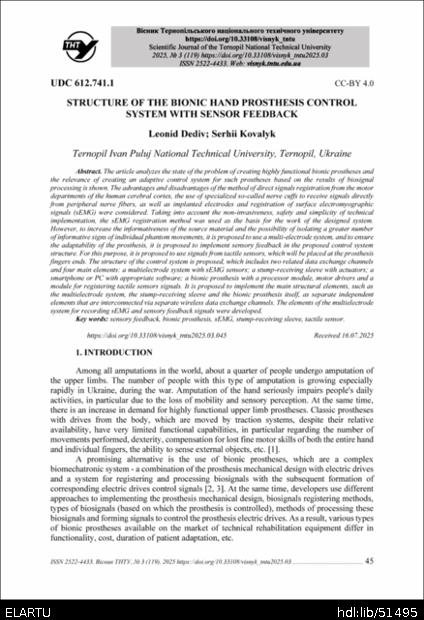
| dc.description.abstract | The article analyzes the state of the problem of creating highly functional bionic prostheses and the relevance of creating an adaptive control system for such prostheses based on the results of biosignal processing is shown. The advantages and disadvantages of the method of direct signals registration from the motor departments of the human cerebral cortex, the use of specialized so-called nerve cuffs to receive signals directly from peripheral nerve fibers, as well as implanted electrodes and registration of surface electromyographic signals (sEMG) were considered. Taking into account the non-invasiveness, safety and simplicity of technical implementation, the sEMG registration method was used as the basis for the work of the designed system. However, to increase the informativeness of the source material and the possibility of isolating a greater number of informative signs of individual phantom movements, it is proposed to use a multi-electrode system, and to ensure the adaptability of the prosthesis, it is proposed to implement sensory feedback in the proposed control system structure. For this purpose, it is proposed to use signals from tactile sensors, which will be placed at the prosthesis fingers ends. The structure of the control system is proposed, which includes two related data exchange channels and four main elements: a multielectrode system with sEMG sensors; a stump-receiving sleeve with actuators; a smartphone or PC with appropriate software; a bionic prosthesis with a processor module, motor drivers and a module for registering tactile sensors signals. It is proposed to implement the main structural elements, such as the multielectrode system, the stump-receiving sleeve and the bionic prosthesis itself, as separate independent elements that are interconnected via separate wireless data exchange channels. The elements of the multielectrode system for recording sEMG and sensory feedback signals were developed | |
| dc.format.extent | 45-55 | |
| dc.language.iso | en | |
| dc.publisher | ТНТУ | |
| dc.publisher | TNTU | |
| dc.relation.ispartof | Вісник Тернопільського національного технічного університету, 3 (119), 2025 | |
| dc.relation.ispartof | Scientific Journal of the Ternopil National Technical University, 3 (119), 2025 | |
| dc.relation.uri | https://doi.org/10.1016/j.apmr.2007.11.005 | |
| dc.relation.uri | https://doi.org/10.1016/S0140-6736(12)61816-9 | |
| dc.relation.uri | https://doi.org/10.1088/1741-2560/11/6/066013 | |
| dc.relation.uri | https://doi.org/10.23919/DATE.2017.7927217 | |
| dc.relation.uri | https://doi.org/10.1186/1743-0003-12-1 | |
| dc.relation.uri | https://doi.org/10.1016/j.eswa.2014.03.014 | |
| dc.relation.uri | https://doi.org/10.1016/j.bspc.2014.12.001 | |
| dc.relation.uri | https://doi.org/10.21307/ijssis-2018-005 | |
| dc.relation.uri | https://www.ottobock.com/en-au/Prosthetics/UpperLimb_MyoPlus | |
| dc.relation.uri | https://doi.org/10.1109/JMEMS.2007.896716 | |
| dc.relation.uri | https://doi.org/10.1109/ICInfA.2014.6932786 | |
| dc.relation.uri | https://doi.org/10.1109/IROS.2011.6095181 | |
| dc.relation.uri | https://doi.org/10.1109/CSIT49958.2020.9321935 | |
| dc.relation.uri | https://doi.org/10.3389/fbioe.2024.1385459 | |
| dc.relation.uri | https://doi.org/10.3390/s22030980 | |
| dc.subject | сенсорний зворотний зв’язок | |
| dc.subject | біонічний протез | |
| dc.subject | пЕМГ | |
| dc.subject | куксоприймаюча гільза | |
| dc.subject | тактильний сенсор | |
| dc.subject | sensory feedback | |
| dc.subject | bionic prosthesis | |
| dc.subject | sEMG | |
| dc.subject | stump-receiving sleeve | |
| dc.subject | tactile sensor | |
| dc.title | Structure of the bionic hand prosthesis control system with sensor feedback | |
| dc.title.alternative | Структура системи керування біонічним протезом кисті руки з сенсорним зворотним зв’язком | |
| dc.type | Article | |
| dc.rights.holder | © Ternopil Ivan Puluj National Technical University, 2025 | |
| dc.coverage.placename | Тернопіль | |
| dc.coverage.placename | Ternopil | |
| dc.format.pages | 11 | |
| dc.subject.udc | 612.741.1 | |
| dc.relation.referencesen | 1. Ziegler-Graham K., MacKenzie E. J., Ephraim P. L., Travison T. G., Brookmeyer R. Estimating the Prevalence of Limb Loss in the United States: 2005 to 2050. Arch. Phys. Med. Rehabil. 2008, 89, pp. 422–429. https://doi.org/10.1016/j.apmr.2007.11.005 | |
| dc.relation.referencesen | 2. HANDBOOK OF BIOMECHATRONICS. JACOB SEGIL. Academic Press is an imprint of Elsevier. 2019, Elsevier Inc., 603 p. | |
| dc.relation.referencesen | 3. THE MECHATRONICS HANDBOOK / Editor-in-Chief Robert H. Bishop. The University of Texas at Austin. Austin, Texas, 2002, 1229 p. | |
| dc.relation.referencesen | 4. Collinger J. L., Wodlinger B., Downey J. E., Wang W., Tyler-Kabara E. C., Weber D. J., McMorland A. J. C., Velliste M., Boninger M. L., Schwartz A. B. (2013) High-performance neuroprosthetic control by an individual with tetraplegia. Lancet, 381, pp. 557–564. https://doi.org/10.1016/S0140-6736(12)61816-9 | |
| dc.relation.referencesen | 5. Smith L. H.; Kuiken T. A.; Hargrove L. J. (2014) Real-time simultaneous and proportional myoelectric control using intramuscular EMG. J. Neural. Eng, 11, 66013. https://doi.org/10.1088/1741-2560/11/6/066013 | |
| dc.relation.referencesen | 6. Milosevic B., Benatti S., Farella E. (2017) Design challenges for wearable EMG applications. In Proceedings of the Design, Automation & Test in Europe Conference & Exhibition (DATE), Lausanne, Switzerland, 27–31, pp. 1432–1437. https://doi.org/10.23919/DATE.2017.7927217 | |
| dc.relation.referencesen | 7. Tucker M. R., Olivier J., Pagel A., Bleuler H., Bouri M., Lambercy O., del R Millбn J., Riener R., Vallery H., Gassert R. (2015) Control strategies for active lower extremity prosthetics and orthotics: A review. J. Neuroeng. Rehabil, 12, 1. https://doi.org/10.1186/1743-0003-12-1 | |
| dc.relation.referencesen | 8. Mesa I., Rubio A., Tubia I., De No J., Diaz J. (2014) Channel and feature selection for a surface electromyographic pattern recognition task. Expert Syst. Appl, 41, pp. 5190–5200. https://doi.org/10.1016/j.eswa.2014.03.014 | |
| dc.relation.referencesen | 9. McCool P., Petropoulakis L., Soraghan J. J., Chatlani N. (2015) Improved pattern recognition classification accuracy for surface myoelectric signals using spectral enhancement. Biomed. Signal Process. Control, 18, pp. 61–68. https://doi.org/10.1016/j.bspc.2014.12.001 | |
| dc.relation.referencesen | 10. Paolo Visconti, Federico Gaetani, Giovanni Antonio Zappatore, Patrizio Primiceri, 2018. Technical Features and Functionalities of Myo Armband: An Overview on Related Literature and Advanced Applications of Myoelectric Armbands Mainly Focused on Arm Prostheses. International journal on smart sensing and intelligent systems. P. 1–25. https://doi.org/10.21307/ijssis-2018-005 | |
| dc.relation.referencesen | 11. Available at: https://www.ottobock.com/en-au/Prosthetics/UpperLimb_MyoPlus. | |
| dc.relation.referencesen | 12. E.-S. Hwang, J.-h. Seo and Y.-J. Kim (2007) “A polymer-based flexible tactile sensor for both normal and shear load detections and its application for robotics”, J. microelectromechanical systems, vol. 16, no. 3, pp. 556–563. https://doi.org/10.1109/JMEMS.2007.896716 | |
| dc.relation.referencesen | 13. Y. Wang, K. Xi, G. Liang, M. Mei and Z. Chen (2014). “A flexible capacitive tactile sensor array for prosthetic hand real-time contact force measurement,” in Information and Automation (ICIA), IEEE International Conference on, pp. 937–942, IEEE, 2014. https://doi.org/10.1109/ICInfA.2014.6932786 | |
| dc.relation.referencesen | 14. H. N. Sani and S. G. Meek (2011) “Characterizing the performance of an optical slip sensor for grip control in a prosthesis,” in 2011 IEEE/RSJ International Conference on Intelligent Robots and Systems, pp. 1927–1932, IEEE, 2011. https://doi.org/10.1109/IROS.2011.6095181 | |
| dc.relation.referencesen | 15. Vasil Dozorskyi, Vasyl Martsenyuk, Oksana Dozorska, Leonid Dediv, Nataliya Klymuk. The concept of developing the structure of a highly functional bionic hand prosthesis based on IoT technologies. Proceedings of the 1st international workshop on “Bioinformatics and Applied Information Technologies”(BAIT-2024). P. 268–280. | |
| dc.relation.referencesen | 16. Oksana Dozorska, Evhenia Yavorska, Vasil Dozorskyi, Vyacheslav Nykytyuk, Leonid Dediv (2020). The Method of Selection and Pre-processing of Electromyographic Signals for Bio-controlled Prosthetic of Hand. Proc. of the 2020 IEEE 15th International Conference on Computer Sciences and Information Technologies (CSIT), 23–26 September 2020, pp. 188–192. Lviv-Zbarazh, Ukraine. https://doi.org/10.1109/CSIT49958.2020.9321935 | |
| dc.relation.referencesen | 17. Martsenyuk V., Soldatkin O., Klos-Witkowska A., Sverstiuk A., & Berketa K. (2024) Operational stability study of lactate biosensors: modeling, parameter identification, and stability analysis. In Frontiers in Bioengineering and Biotechnology, vol. 12. Frontiers Media SA. https://doi.org/10.3389/fbioe.2024.1385459 | |
| dc.relation.referencesen | 18. Martsenyuk V., Klos-Witkowska A., Dzyadevych S., Sverstiuk A. (2022) Nonlinear Analytics for Electrochemical Biosensor Design Using Enzyme Aggregates and Delayed Mass Action. Sensors, 22 (3), 980. https://doi.org/10.3390/s22030980 | |
| dc.identifier.doi | https://doi.org/10.33108/visnyk_tntu2025.03.045 | |
| dc.contributor.affiliation | Тернопільський національний технічний університет імені Івана Пулюя, Тернопіль, Україна | |
| dc.contributor.affiliation | Ternopil Ivan Puluj National Technical University, Ternopil, Ukraine | |
| dc.citation.journalTitle | Вісник Тернопільського національного технічного університету | |
| dc.citation.volume | 119 | |
| dc.citation.issue | 3 | |
| dc.citation.spage | 45 | |
| dc.citation.epage | 55 | |
| dc.identifier.citation2015 | Dediv L., Kovalyk S. Structure of the bionic hand prosthesis control system with sensor feedback // Scientific Journal of TNTU, Ternopil. 2025. Vol 119. No 3. P. 45–55. | |
| dc.identifier.citationenAPA | Dediv, L., & Kovalyk, S. (2025). Structure of the bionic hand prosthesis control system with sensor feedback. Scientific Journal of the Ternopil National Technical University, 119(3), 45-55. TNTU.. | |
| dc.identifier.citationenCHICAGO | Dediv L., Kovalyk S. (2025) Structure of the bionic hand prosthesis control system with sensor feedback. Scientific Journal of the Ternopil National Technical University (Tern.), vol. 119, no 3, pp. 45-55. | |
| Розташовується у зібраннях: | Вісник ТНТУ, 2025, № 3 (119) | |
Файли цього матеріалу:
| Файл | Опис | Розмір | Формат | |
|---|---|---|---|---|
| TNTUSJ_2025v119n3_Dediv_L-Structure_of_the_bionic_hand_45-55.pdf | 3,43 MB | Adobe PDF | Переглянути/відкрити | |
| TNTUSJ_2025v119n3_Dediv_L-Structure_of_the_bionic_hand_45-55__COVER.png | 1,38 MB | image/png | Переглянути/відкрити |
Усі матеріали в архіві електронних ресурсів захищені авторським правом, всі права збережені.