
Будь ласка, використовуйте цей ідентифікатор, щоб цитувати або посилатися на цей матеріал:
http://elartu.tntu.edu.ua/handle/lib/51481
Повний запис метаданих
| Поле DC | Значення | Мова |
|---|---|---|
| dc.contributor.author | Гнатюк, Олександр | |
| dc.contributor.author | Крет, Володимир | |
| dc.contributor.author | Hnatiuk, Oleksandr | |
| dc.contributor.author | Kret, Volodymyr | |
| dc.date.accessioned | 2026-02-09T15:51:55Z | - |
| dc.date.available | 2026-02-09T15:51:55Z | - |
| dc.date.created | 2025-08-29 | |
| dc.date.issued | 2025-08-29 | |
| dc.date.submitted | 2025-07-08 | |
| dc.identifier.citation | Hnatiuk O. Load testing of bored concrete micropile with enlarged base in dispersive soil conditions / Oleksandr Hnatiuk, Volodymyr Kret // Scientific Journal of TNTU. — Tern. : TNTU, 2025. — Vol 119. — No 3. — P. 75–82. | |
| dc.identifier.issn | 2522-4433 | |
| dc.identifier.uri | http://elartu.tntu.edu.ua/handle/lib/51481 | - |
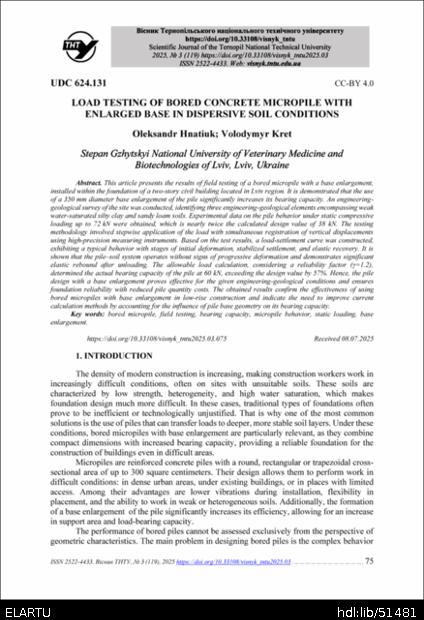
| dc.description.abstract | Наведено результати натурних випробувань бурової мікропалі з нижнім розширенням, влаштованої в межах фундаменту двоповерхової цивільної будівлі на території Львівської області. Показано, що застосування розширення діаметром 350 мм у нижній частині палі дає змогу суттєво підвищити її несучу здатність. Проведено інженерно-геологічне обстеження ділянки, в межах якої виділено три інженерно-геологічні елементи, що охоплюють слабкі водонасичені суглинки та супіски. Отримано експериментальні дані про поведінку палі під дією статичного втискувального навантаження до 72 кН, що майже вдвічі перевищує розрахункове нормативне значення 38 кН. Випробування виконано безпосередньо в межах реального фундаменту споруди, що забезпечило достовірність і практичну цінність отриманих результатів. Методика випробування передбачала поетапне прикладання навантаження з одночасною реєстрацією вертикальних переміщень за допомогою високоточних вимірювальних приладів. За результатами випробування побудовано криву «навантаження–розвантаження», що має типовий характер зі стадіями початкової деформації, стабілізованого осідання та пружного відновлення. Показано, що система «паля–основа» працює без ознак прогресуючих деформацій і демонструє значне пружне відновлення після розвантаження. Розрахунок допустимого навантаження з урахуванням коефіцієнта надійності (γ=1.2) дозволив визначити фактичну несучу здатність палі на рівні 60 кН, що на 57 % перевищує проектне значення. Звідси випливає, що конструкція палі з нижнім розширенням є ефективною для заданих інженерно-геологічних умов та забезпечує надійність фундаменту за менших витрат. Отримані результати підтверджують ефективність застосування бурових мікропаль із нижнім розширенням у малоповерховому будівництві та вказують на необхідність удосконалення чинних методик розрахунку з урахуванням впливу геометрії основи палі на її несучу здатність | |
| dc.description.abstract | This article presents the results of field testing of a bored micropile with a base enlargement, installed within the foundation of a two-story civil building located in Lviv region. It is demonstrated that the use of a 350 mm diameter base enlargement of the pile significantly increases its bearing capacity. An engineering-geological survey of the site was conducted, identifying three engineering-geological elements encompassing weak water-saturated silty clay and sandy loam soils. Experimental data on the pile behavior under static compressive loading up to 72 kN were obtained, which is nearly twice the calculated design value of 38 kN. The testing methodology involved stepwise application of the load with simultaneous registration of vertical displacements using high-precision measuring instruments. Based on the test results, a load-settlement curve was constructed, exhibiting a typical behavior with stages of initial deformation, stabilized settlement, and elastic recovery. It is shown that the pile–soil system operates without signs of progressive deformation and demonstrates significant elastic rebound after unloading. The allowable load calculation, considering a reliability factor (γ=1.2), determined the actual bearing capacity of the pile at 60 kN, exceeding the design value by 57%. Hence, the pile design with a base enlargement proves effective for the given engineering-geological conditions and ensures foundation reliability with reduced pile quantity costs. The obtained results confirm the effectiveness of using bored micropiles with base enlargement in low-rise construction and indicate the need to improve current calculation methods by accounting for the influence of pile base geometry on its bearing capacity | |
| dc.format.extent | 75-82 | |
| dc.language.iso | en | |
| dc.publisher | ТНТУ | |
| dc.publisher | TNTU | |
| dc.relation.ispartof | Вісник Тернопільського національного технічного університету, 3 (119), 2025 | |
| dc.relation.ispartof | Scientific Journal of the Ternopil National Technical University, 3 (119), 2025 | |
| dc.relation.uri | https://doi.org/10.30564/agger.v5i1.5276 | |
| dc.relation.uri | https://doi.org/10.1016/j.proeng.2015.07.101 | |
| dc.subject | бурова мікропаля | |
| dc.subject | натурне випробування | |
| dc.subject | несуча здатність | |
| dc.subject | робота мікропалі | |
| dc.subject | статичне навантаження | |
| dc.subject | нижнє розширення | |
| dc.subject | bored micropile | |
| dc.subject | field testing | |
| dc.subject | bearing capacity | |
| dc.subject | micropile behavior | |
| dc.subject | static loading | |
| dc.subject | base enlargement | |
| dc.title | Load testing of bored concrete micropile with enlarged base in dispersive soil conditions | |
| dc.title.alternative | Натурне випробування бурової бетонної мікропалі з розширенням у дисперсних грунтах | |
| dc.type | Article | |
| dc.rights.holder | © Ternopil Ivan Puluj National Technical University, 2025 | |
| dc.coverage.placename | Тернопіль | |
| dc.coverage.placename | Ternopil | |
| dc.format.pages | 8 | |
| dc.subject.udc | 624.131 | |
| dc.relation.referencesen | 1. Korniyenko M. V., Karpenko D. A. (2008) Bearing capacity of bored piles with enlargement in loess soils based on static test results. Foundations and Substructures: Interdepartmental Scientific and Technical Collection, no. 31, pp. 54–63. | |
| dc.relation.referencesen | 2. Demchyna B., Kunanets Yu., Volosetskyi N. (2014) Measurement of forces under the pile base using a special measuring plate. Visnyk of Lviv National Agrarian University. Architecture and Agricultural Construction, no. 15, pp. 40–45. | |
| dc.relation.referencesen | 3. Boiko I. P., Pidlutskyi I. P. (2012) Investigation of pile installation in a foundation of different lengths. Collection of Scientific Works of Poltava National Technical University named after Yuri Kondratyuk. Series: Industrial Engineering, Construction, issue 4 (2), pp. 42–48. | |
| dc.relation.referencesen | 4. Nasr A. M., Azzam W. R., Harran I. S. (2023) Geometrical influence of an under-reamed pile in clay under compressive load: a numerical study. Advances in Geological and Geotechnical Engineering Research, 5 (1), pp. 1–9. https://doi.org/10.30564/agger.v5i1.5276 | |
| dc.relation.referencesen | 5. Kazimierz Józefiak, Artur Zbiciak, Maciej Maślakowski, Tomasz Piotrowski (2015) Numerical modeling and analysis of the bearing capacity of a pile foundation. Procedia Engineering, vol. 111, pp. 356–363. https://doi.org/10.1016/j.proeng.2015.07.101 | |
| dc.relation.referencesen | 6. DSTU B V.2.6-156:2010. Buildings and structures. Concrete and reinforced concrete structures made of heavy concrete. Design rules. | |
| dc.relation.referencesen | 7. DSTU-N B V.2.1-28:2013. Guidelines for performing earthworks, construction of foundations and substructures (SNiP 3.02.01-87, MOD). | |
| dc.relation.referencesen | 8. DBN A.2.1-1-2008. Surveying, design, and territorial activity. Engineering surveys for construction. | |
| dc.relation.referencesen | 9. DSTU B V.2.1-17:2009. Foundations and substructures of buildings and structures. Soils. Methods for laboratory determination of physical properties. | |
| dc.relation.referencesen | 10. DBN V.2.1-10:2018. Foundations and substructures of buildings and structures. General provisions. | |
| dc.relation.referencesen | 11. DSTU B V.2.1-5-96. Foundations and substructures of buildings and structures. Soils. Methods of statistical processing of test results. | |
| dc.relation.referencesen | 12. DSTU B V.2.1-27:2010. Foundations and substructures of buildings and structures. Piles. Determination of bearing capacity based on field test results. | |
| dc.relation.referencesen | 13. DSTU B V.2.1-1-95. Foundations and substructures of buildings and structures. Soils. Method of field pile testing. | |
| dc.relation.referencesen | 14. Eurocode 7: EN 1997-1:2004 /AC/. Geotechnical design – Part 1: General rules (together with United Kingdom National Application Document). 88 p. | |
| dc.relation.referencesen | 15. DSTU ISO 22477-1:2015. Geotechnical investigation and testing. Testing of piles. Part 1: Static load testing of piles. | |
| dc.relation.referencesen | 16. DBN V.2.1-10:2018. Foundations and substructures of buildings and structures. General provisions. | |
| dc.relation.referencesen | 17. DBN V.2.1-10:2009. Construction facilities and industrial construction products. Foundations and substructures of buildings and structures. Foundations and substructures. General design provisions. | |
| dc.identifier.doi | https://doi.org/10.33108/visnyk_tntu2025.03.075 | |
| dc.contributor.affiliation | Львівський національний університет ветеринарної медицини та біотехнологій імені С. З. Ґжицького, Львів, Україна | |
| dc.contributor.affiliation | Stepan Gzhytskyi National University of Veterinary Medicine and Biotechnologies of Lviv, Lviv, Ukraine | |
| dc.citation.journalTitle | Вісник Тернопільського національного технічного університету | |
| dc.citation.volume | 119 | |
| dc.citation.issue | 3 | |
| dc.citation.spage | 75 | |
| dc.citation.epage | 82 | |
| dc.identifier.citation2015 | Hnatiuk O., Kret V. Load testing of bored concrete micropile with enlarged base in dispersive soil conditions // Scientific Journal of TNTU, Ternopil. 2025. Vol 119. No 3. P. 75–82. | |
| dc.identifier.citationenAPA | Hnatiuk, O., & Kret, V. (2025). Load testing of bored concrete micropile with enlarged base in dispersive soil conditions. Scientific Journal of the Ternopil National Technical University, 119(3), 75-82. TNTU.. | |
| dc.identifier.citationenCHICAGO | Hnatiuk O., Kret V. (2025) Load testing of bored concrete micropile with enlarged base in dispersive soil conditions. Scientific Journal of the Ternopil National Technical University (Tern.), vol. 119, no 3, pp. 75-82. | |
| Розташовується у зібраннях: | Вісник ТНТУ, 2025, № 3 (119) | |
Файли цього матеріалу:
| Файл | Опис | Розмір | Формат | |
|---|---|---|---|---|
| TNTUSJ_2025v119n3_Hnatiuk_O-Load_testing_of_bored_concrete_75-82.pdf | 2,32 MB | Adobe PDF | Переглянути/відкрити | |
| TNTUSJ_2025v119n3_Hnatiuk_O-Load_testing_of_bored_concrete_75-82__COVER.png | 1,34 MB | image/png | Переглянути/відкрити |
Усі матеріали в архіві електронних ресурсів захищені авторським правом, всі права збережені.