
Будь ласка, використовуйте цей ідентифікатор, щоб цитувати або посилатися на цей матеріал:
http://elartu.tntu.edu.ua/handle/lib/44686
Повний запис метаданих
| Поле DC | Значення | Мова |
|---|---|---|
| dc.contributor.author | Черещук, Любомир-Олексій | - |
| dc.contributor.author | Мельникова, Наталія | - |
| dc.contributor.author | Chereshchuk, Liubomyr-Oleksii | - |
| dc.contributor.author | Melnykova, Nataliia | - |
| dc.date.accessioned | 2024-04-17T10:57:27Z | - |
| dc.date.available | 2024-04-17T10:57:27Z | - |
| dc.date.created | 2024-03-19 | - |
| dc.date.issued | 2024-03-19 | - |
| dc.date.submitted | 2023-12-14 | - |
| dc.identifier.citation | Chereshchuk L. Application of machine learning methods for predicting the risk of stroke occurrence / Liubomyr-Oleksii Chereshchuk, Nataliia Melnykova // Scientific Journal of TNTU. — Tern. : TNTU, 2024. — Vol 113. — No 1. — P. 27–35. | - |
| dc.identifier.issn | 2522-4433 | - |
| dc.identifier.uri | http://elartu.tntu.edu.ua/handle/lib/44686 | - |
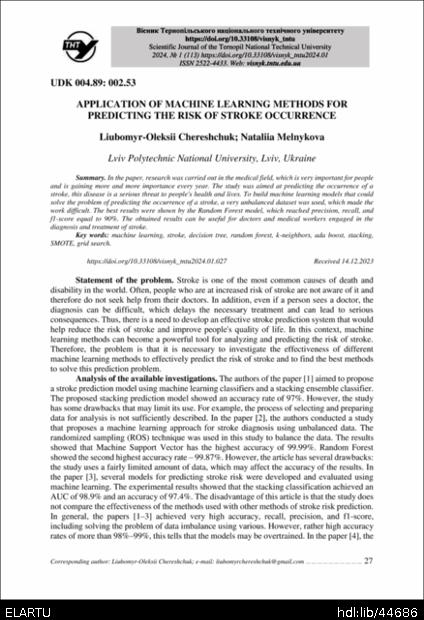
| dc.description.abstract | Проведено дослідження в медичній сфері, яка є дуже важливою для людей і з кожним роком набуває все більшого значення. Дослідження спрямоване на прогнозування виникнення інсульту. Це захворювання є серйозною загрозою для здоров'я та життя людей. Для побудови моделей машинного навчання, які б могли вирішити проблему прогнозування виникнення інсульту, використовувався дуже незбалансований набір даних, що ускладнювало роботу. Використовуючи опрацьовані дані, отримані в результаті застосуванняметодів попереднього опрацювання даних, побудовано та порівняно різні моделі машинного навчання для вирішення поставленої задачі класифікації. Найкращі результати показала модель random forest, яка досягла precision, recall та f1-score на рівні 90%. Також використовувався показник accuracy, який дорівнював 90%. Однак для того, щоб показати недоцільність даного показника в задачах класифікації, було натреновано модель random forest classifier з найоптимальнішими гіперпараметрами, отриманими за допомогою методу grid search на даних, які опрацьовані без етапу вирішення проблеми незбалансованості даних. У результаті модель показала показник accuracy, що дорівнював 96%. Проте показники precision, recall та f1-score для 1 (буде інсульт) класу дорівнювали 0%. Такі результати показали, що модель погано навчилася та взагалі не змогла класифікувати даний клас. Отже. в результаті виконання даної роботи побудовано модель random forest classifier для вирішення проблеми прогнозування виникнення інсульту, яка показала добрі результати оцінювання показників precision, recall та f1-score – 90%. Отримані результати дослідження є досить важливими, оскільки можуть допомогти лікарям ефективніше впроваджувати профілактичні заходи і збільшити шанси на порятунок життя та здоров'я пацієнтів від інсульту | - |
| dc.description.abstract | In the paper, research was carried out in the medical field, which is very important for people and is gaining more and more importance every year. The study was aimed at predicting the occurrence of a stroke, this disease is a serious threat to people's health and lives. To build machine learning models that could solve the problem of predicting the occurrence of a stroke, a very unbalanced dataset was used, which made the work difficult. The best results were shown by the Random Forest model, which reached precision, recall, andf1-score equal to 90%. The obtained results can be useful for doctors and medical workers engaged in the diagnosis and treatment of stroke | - |
| dc.format.extent | 27-35 | - |
| dc.language.iso | en | - |
| dc.publisher | ТНТУ | - |
| dc.publisher | TNTU | - |
| dc.relation.ispartof | Вісник Тернопільського національного технічного університету, 1 (113), 2024 | - |
| dc.relation.ispartof | Scientific Journal of the Ternopil National Technical University, 1 (113), 2024 | - |
| dc.relation.uri | https://doi.org/10.14569/IJACSA.2022.0131232 | - |
| dc.relation.uri | https://doi.org/10.1016/j.health.2022.100116 | - |
| dc.relation.uri | https://doi.org/10.3390/s22134670 | - |
| dc.relation.uri | https://doi.org/10.14569/IJACSA.2021.0120662 | - |
| dc.relation.uri | https://datahack.analyticsvidhya.com | - |
| dc.subject | машинне навчання | - |
| dc.subject | інсульт | - |
| dc.subject | дерево рішень | - |
| dc.subject | випадковий ліс | - |
| dc.subject | k-сусідів | - |
| dc.subject | адаптивне прискорення | - |
| dc.subject | стекування | - |
| dc.subject | техніка надмірної вибірки синтетичної меншості | - |
| dc.subject | сітковий пошук | - |
| dc.subject | machine learning | - |
| dc.subject | stroke | - |
| dc.subject | decision tree | - |
| dc.subject | random forest | - |
| dc.subject | k-neighbors | - |
| dc.subject | ada boost | - |
| dc.subject | stacking | - |
| dc.subject | SMOTE | - |
| dc.subject | grid search | - |
| dc.title | Application of machine learning methods for predicting the risk of stroke occurrence | - |
| dc.title.alternative | Застосування методів машинного навчання для прогнозування загрози виникнення інсульту | - |
| dc.rights.holder | © Тернопільський національний технічний університет імені Івана Пулюя, 2024 | - |
| dc.coverage.placename | Тернопіль | - |
| dc.coverage.placename | Ternopil | - |
| dc.format.pages | 9 | - |
| dc.subject.udc | 004.89 | - |
| dc.subject.udc | 002.53 | - |
| dc.relation.references | 1. Mostafa S. A., Elzanfaly D. S., Yakoub A. E. A Machine Learning Ensemble Classifier for Prediction of Brain Strokes. International Journal of Advanced Computer Science and Applications (IJACSA). 2022. Issue 13. No. 12. [In English]. https://doi.org/10.14569/IJACSA.2022.0131232 | - |
| dc.relation.references | 2. Biswas N., Uddin K. M. M., Rikta S. T., Dey S. K. A comparative analysis of machine learning classifiers for stroke prediction: A predictive analytics approach. Healthcare Analytics. 2022. Issue 2. P. 100116. [In English]. https://doi.org/10.1016/j.health.2022.100116 | - |
| dc.relation.references | 3. Dritsas E., Trigka M. Stroke Risk Prediction with Machine Learning Techniques. Sensors. 2022. Issue 22. No. 13. P. 4670. [In English]. https://doi.org/10.3390/s22134670 | - |
| dc.relation.references | 4. Khan M. K. Computer Science and Engineering. 2022. [In English]. | - |
| dc.relation.references | 5. Sailasya G., Kumari G. L. A. Analyzing the Performance of Stroke Prediction using ML Classification Algorithms. International Journal of Advanced Computer Science and Applications (IJACSA). 2021. Issue 12. No. 6. [In English]. https://doi.org/10.14569/IJACSA.2021.0120662 | - |
| dc.relation.references | 6. DataHack : Biggest Data hackathon platform for Data Scientists. Web Resource. [In English]. URL: https://datahack.analyticsvidhya.com. | - |
| dc.relation.referencesen | 1. Mostafa S. A., Elzanfaly D. S., Yakoub A. E. A Machine Learning Ensemble Classifier for Prediction of Brain Strokes. International Journal of Advanced Computer Science and Applications (IJACSA). 2022. Issue 13. No. 12. [In English]. https://doi.org/10.14569/IJACSA.2022.0131232 | - |
| dc.relation.referencesen | 2. Biswas N., Uddin K. M. M., Rikta S. T., Dey S. K. A comparative analysis of machine learning classifiers for stroke prediction: A predictive analytics approach. Healthcare Analytics. 2022. Issue 2. P. 100116. [In English]. https://doi.org/10.1016/j.health.2022.100116 | - |
| dc.relation.referencesen | 3. Dritsas E., Trigka M. Stroke Risk Prediction with Machine Learning Techniques. Sensors. 2022. Issue 22. No. 13. P. 4670. [In English]. https://doi.org/10.3390/s22134670 | - |
| dc.relation.referencesen | 4. Khan M. K. Computer Science and Engineering. 2022. [In English]. | - |
| dc.relation.referencesen | 5. Sailasya G., Kumari G. L. A. Analyzing the Performance of Stroke Prediction using ML Classification Algorithms. International Journal of Advanced Computer Science and Applications (IJACSA). 2021. Issue 12. No. 6. [In English]. https://doi.org/10.14569/IJACSA.2021.0120662 | - |
| dc.relation.referencesen | 6. DataHack : Biggest Data hackathon platform for Data Scientists. Web Resource. [In English]. URL: https://datahack.analyticsvidhya.com. | - |
| dc.identifier.citationen | Chereshchuk L., Melnykova N. (2024) Application of machine learning methods for predicting the risk of stroke occurrence. Scientific Journal of TNTU (Tern.), vol. 113, no 1, pp. 27-35. | - |
| dc.identifier.doi | https://doi.org/10.33108/visnyk_tntu2024.01.027 | - |
| dc.contributor.affiliation | Національний університет «Львівська Політехніка», Львів, Україна | - |
| dc.contributor.affiliation | Lviv Polytechnic National University, Lviv, Ukraine | - |
| dc.citation.journalTitle | Вісник Тернопільського національного технічного університету | - |
| dc.citation.volume | 113 | - |
| dc.citation.issue | 1 | - |
| dc.citation.spage | 27 | - |
| dc.citation.epage | 35 | - |
| Розташовується у зібраннях: | Вісник ТНТУ, 2024, № 1 (113) | |
Файли цього матеріалу:
| Файл | Опис | Розмір | Формат | |
|---|---|---|---|---|
| TNTUSJ_2024v113n1_Chereshchuk_L-Application_of_machine_27-35.pdf | 3,67 MB | Adobe PDF | Переглянути/відкрити | |
| TNTUSJ_2024v113n1_Chereshchuk_L-Application_of_machine_27-35.djvu | 246,9 kB | DjVu | Переглянути/відкрити | |
| TNTUSJ_2024v113n1_Chereshchuk_L-Application_of_machine_27-35__COVER.png | 1,33 MB | image/png | Переглянути/відкрити |
Усі матеріали в архіві електронних ресурсів захищені авторським правом, всі права збережені.